What Is DSPM? Data Security Posture Management for Cloud Explained
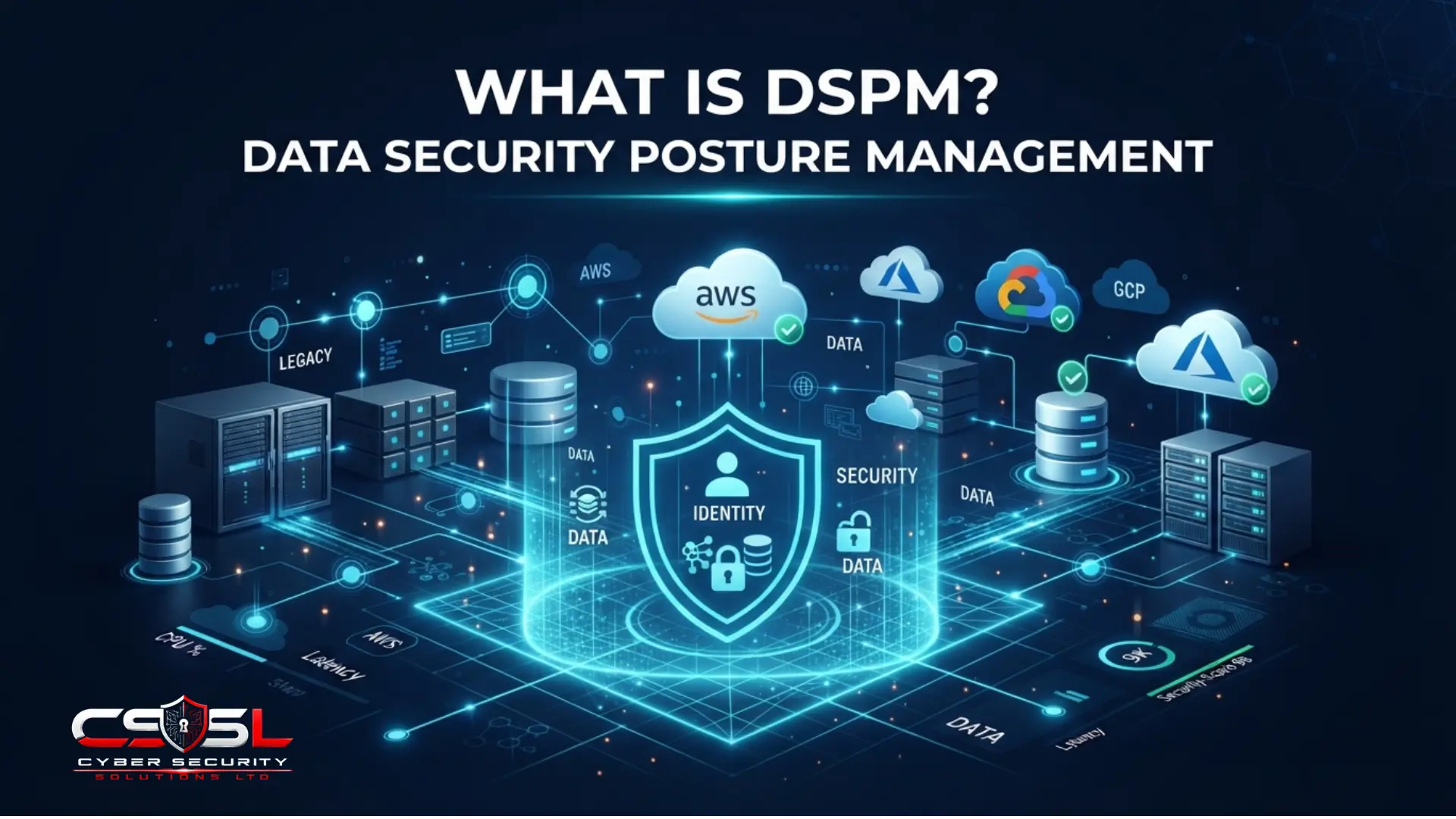
DSPM, Data Security Posture Management, is a category of security tooling that automatically discovers and classifies sensitive data across cloud environments, then continuously monitors how that data is exposed. It goes beyond infrastructure configuration to answer what sensitive data actually sits inside a resource.
If your CSPM tool says a storage bucket is misconfigured but does not tell you what is actually inside it, or a developer copied production customer data into a test environment months ago and you only just found out, this guide explains exactly what DSPM does and why it matters alongside your existing security tools.
What Is DSPM?
Data Security Posture Management is a category of security tooling that automatically discovers, classifies, and continuously monitors sensitive data across cloud environments, providing visibility into where sensitive data actually resides, who can access it, how well it is protected, and whether its current exposure represents genuine risk.
Gartner and industry analysts formalized DSPM as a distinct market category more recently than CSPM, reflecting a maturing recognition that configuration correctness alone does not answer the more fundamental question of what data an organization actually holds and where. Most organizations, even those with mature CSPM deployments, genuinely do not know where all their sensitive data lives across sprawling, fast-changing cloud environments. A forgotten database snapshot or an abandoned data lake export can sit unclassified and unmonitored for years.
DSPM is not a DLP tool blocking data in transit, not an encryption product, and not a compliance framework on its own. Its core function is discovery, classification, and exposure analysis, feeding the information that other controls need to act on effectively. See What Is CSPM? Cloud Security Posture Management Explained and SSPM vs CSPM for the foundational posture management context this builds on.
Why Did DSPM Emerge as a Category Separate from CSPM?
CSPM can confirm that a storage bucket or database is correctly configured, encrypted, and not publicly exposed, but has no native ability to look inside that resource and determine whether it contains harmless log files or a full export of customer financial records.
The deterministic-versus-probabilistic technical distinction is the specific reason a CSPM tool cannot simply be extended to also perform DSPM’s job, and this distinction deserves explicit explanation rather than the vague “they check different things” framing most competitor content settles for.
Identifying a misconfigured network rule is a structured, deterministic check: a security group either allows unrestricted inbound traffic on a specific port or it does not, and evaluating this against a rule is a binary, unambiguous operation. Identifying whether a spreadsheet column contains genuine social security numbers, synthetic test data formatted to look identical, or a column of unrelated nine-digit reference codes requires an entirely different kind of analysis. Pattern matching alone produces significant false positives, since many numeric formats resemble sensitive identifiers without being one. Context matters: a column labelled “test_ssn” in a development database and an identically formatted column in a production customer table carry very different real-world risk despite matching the same pattern. This is why mature DSPM classification increasingly relies on machine learning and large language model-based analysis rather than pattern matching alone, incorporating surrounding context, table and column naming, and statistical distribution characteristics to distinguish genuine sensitive data from data that merely resembles it.
This is a fundamentally different technical discipline from configuration scanning, requiring different underlying technology, not simply a different rule library bolted onto an existing CSPM engine. This is precisely why DSPM became its own market category rather than a feature quietly absorbed into CSPM platforms.
How Does DSPM Discover and Classify Sensitive Data in the Cloud?
Data discovery uses agentless, API-based scanning across cloud storage services, managed databases, data warehouses, and data lakes to build a comprehensive, continuously updated inventory of where data resides, including resources never formally documented. Classification uses pattern matching for structured identifiers like credit card numbers, keyword and context analysis, and increasingly machine learning-based classification to identify PII, PHI, PCI, credentials, and intellectual property with far greater accuracy than rule-based matching alone. Mature DSPM tools typically use statistically representative sampling of large data stores rather than scanning every byte, balancing accuracy against cost.
Shadow data is a systemic multiplication problem, not a vague possibility, and most competitor content dramatically understates its scale by mentioning forgotten data copies as a passing concern rather than explaining the multiplication mechanism that makes this genuinely dangerous.
A single sensitive dataset, a customer table containing names, addresses, and payment information, does not exist in one place. It exists in the production database. It exists in a nightly backup snapshot. It exists in an analytics export a data team pulled eighteen months ago for a quarterly report and never deleted. It exists in a developer’s test environment, seeded with production data to reproduce a bug, that was never cleaned up after the bug was fixed. It may exist in a departed employee’s personal export, downloaded for a presentation and forgotten on a laptop or personal cloud account entirely outside organizational visibility. Each of these copies is an independent, uncatalogued instance of the same sensitive data, and critically, each one looks completely unremarkable from a resource-level inventory perspective.
A CSPM tool examining that forgotten analytics export sees a storage bucket with reasonable-looking permissions; it has no way to know the bucket contains eighteen-month-old customer financial records rather than harmless log files. This is precisely why traditional infrastructure inventory approaches, which track resources by type and configuration rather than by content, cannot catch this risk category at all. An organization can have a mature, well-run CSPM deployment showing a clean posture dashboard while multiple forgotten copies of its most sensitive data sit quietly exposed in resources that were never flagged as noteworthy, because nothing about their configuration looked wrong. Data flow and lineage mapping tracks exactly how this replication happens, from a production database into an analytics pipeline or a developer’s test environment.
What Is the “Toxic Combination” Problem DSPM Is Built to Solve?
| Tool Category | Core Question It Answers | What It Scans |
| CSPM | Is this resource configured securely? | Cloud infrastructure settings |
| DSPM | What sensitive data is inside, and how exposed is it? | Data content within storage and databases |
| CIEM | Who can actually access this, accounting for all permissions? | Identity entitlements and effective access |
Sensitive data alone is not the risk, and broad access alone is not the risk. The genuine, urgent risk is the combination of sensitive data, excessive or broad access, and external exposure occurring on the same resource simultaneously. A properly access-restricted database of highly sensitive records represents materially lower risk than a moderately sensitive dataset that is both publicly accessible and grantable to any authenticated user.
The toxic combination concept is the single most valuable insight a mature cloud security programme gets from running DSPM and CIEM together, and treating it as the central analytical payoff, rather than describing data discovery and classification as an interesting capability in isolation, is what separates genuinely useful DSPM understanding from generic tool description.
DSPM answers one specific question: where is the sensitive data, and how exposed is the container it sits in at a configuration level. CIEM answers a different, equally specific question: who can actually access this resource once you account for every role, group membership, and inherited permission across potentially complex identity structures. Neither question alone identifies the highest-risk combinations that deserve immediate attention. A resource containing sensitive data but genuinely locked down to a small, appropriate group of users is a manageable, lower-priority finding. A resource containing sensitive data that CIEM analysis reveals is effectively accessible to a far broader group than anyone intended, perhaps through an inherited permission nobody remembered granting, is the finding that deserves immediate action.
Without this correlation, security teams face an overwhelming volume of individually low-priority alerts: thousands of data classification findings from DSPM, thousands of access findings from CIEM, with no reliable way to determine which handful actually represent urgent, compounding risk. Correlating the two data sets transforms this unmanageable volume into a small, precisely targeted list of genuinely dangerous combinations. This is exactly why DSPM and CIEM function as natural complementary pairs rather than competing or redundant tool categories. See What Is CIEM? Cloud Infrastructure Entitlement Management Guide for the entitlement-side detail this correlation depends on.
How Does DSPM Apply to Cloud Database Security Specifically?
Managed database services including AWS RDS, Azure SQL Database, Google Cloud SQL, DynamoDB, and Cosmos DB each expose settings around public accessibility, encryption at rest, authentication method, and audit logging that CSPM tools generally check at a configuration level. DSPM adds classification of what sensitive data types actually live within specific tables and columns, transforming a generic configuration alert into a precisely scoped, business-relevant risk statement.
The specificity transformation DSPM provides in database risk communication deserves direct emphasis, because it changes not just what security teams know but how quickly and confidently they can act, a practical consequence most competitor content mentions only in passing.
A security team presented with a generic finding stating this database is publicly accessible must investigate before knowing how to prioritize the response. Is this a test database with synthetic data, representing minimal real risk? Is it a production system holding customer records, representing a genuine emergency? The finding itself provides no way to distinguish these scenarios, forcing manual investigation that consumes time precisely when speed matters most. A security team presented with a DSPM-informed finding stating this public database contains an unencrypted column of customer payment card numbers can act immediately with full context and appropriate urgency, without any investigation delay.
This distinction matters enormously at scale: an organization with dozens or hundreds of databases cannot manually investigate every generic public-database alert with the same urgency, but a security team can immediately triage a list of findings that already state precisely what sensitive data type is at risk and how exposed it currently is. This specificity is what converts DSPM from an interesting discovery capability into a genuine operational force multiplier for teams working with limited time and attention. Modern DSPM tools increasingly extend classification coverage to cloud data warehouses including Snowflake, BigQuery, and Redshift, where large volumes of sensitive data are frequently aggregated for analytics with looser access controls than the original production systems the data was sourced from.
What Cloud Data Security Best Practices Does DSPM Support?
| Scenario | Without DSPM | With DSPM |
| Forgotten data copies | Undetected, accumulate indefinitely | Surfaced and flagged for review |
| Sensitive data in dev environments | Invisible unless manually discovered | Classified and prioritised |
| Prioritising remediation effort | Generic severity scoring | Ranked by actual sensitivity and exposure |
| Demonstrating compliance | Best-effort assertion | Evidence-based, documented discovery |
DSPM’s discovery capability is what makes data minimization genuinely achievable at scale, since an organization cannot delete or restrict data it does not know exists. Encryption verification becomes tied to actual sensitivity rather than blanket policy application. DLP tools become significantly more effective when informed by accurate, current knowledge of where sensitive data resides. Access reviews can prioritize resources confirmed to hold the most sensitive data first, making limited security team time significantly more effective.
DSPM also directly addresses a specific, recurring operational pain point: responding accurately to a GDPR data subject access request requires confirming every location a specific individual’s data actually lives, a task that is functionally impossible to complete reliably through manual processes across a sprawling, fast-changing cloud estate. Accurate, current data discovery is precisely the capability GDPR Article 30’s records-of-processing-activities expectation assumes an organization has, making DSPM a direct operational enabler of this specific compliance obligation. These practices sit within the broader cloud data security discipline; DSPM is the discovery and visibility engine that makes each practice evidence-based rather than a best-effort guess. See Data Security in Cloud Computing: How to Protect Sensitive Data for the complete practice.
What Are the Leading DSPM Tools and Solutions Available in 2026?
Dedicated DSPM vendors including Cyera, BigID, Securiti, and Normalyze have built their core offering specifically around data discovery and classification at cloud scale, typically supporting major cloud storage, database, and data warehouse platforms. Microsoft Purview provides data classification capability within the Microsoft ecosystem specifically, relevant for organizations heavily invested in Microsoft 365 and Azure.
DSPM capability is increasingly bundled into broader CNAPP platforms including Wiz, Palo Alto Networks Prisma Cloud, and Orca Security, reflecting the same market consolidation trend seen across posture management categories and allowing toxic combination correlation to happen natively within a single platform rather than requiring manual cross-referencing between separate tools. Evaluate tools on breadth of supported platforms, classification accuracy and false positive rate, whether the tool correlates findings with exposure and access data, and integration with existing compliance and remediation workflows.
What Are the Benefits and Limitations of DSPM?
Benefits include surfacing shadow and forgotten data stores representing pure unmanaged risk, preventing compliance blind spots since an organization cannot demonstrate protection of data it does not know it holds, prioritizing security effort based on actual sensitivity and exposure rather than generic severity scoring, and supporting accurate breach impact assessment by identifying precisely what data a compromised resource contains, directly relevant to the cost patterns documented in IBM’s Cost of a Data Breach Report.
Classification accuracy remains a genuine limitation: automated sensitive data classification, particularly for less structured content, can produce false positives and negatives, meaning findings benefit from periodic human validation rather than fully automated trust. Scanning cost and performance impact at petabyte scale means most tools rely on sampling strategies involving a deliberate trade-off between completeness and cost. Like CSPM, DSPM does not fix anything on its own; it requires a committed organizational remediation process to convert findings into genuine risk reduction.
How Do You Implement DSPM Step by Step?
Step 1: Inventory all cloud storage, database, and data warehouse platforms in use across every cloud provider and account.
Step 2: Select a DSPM tool or CNAPP platform with DSPM capability appropriate to your specific mix of cloud storage and database platforms.
Step 3: Connect via read-only API access and allow the initial discovery and classification scan to complete across the full estate.
Step 4: Review findings prioritized by the toxic combination principle: sensitive data, broad access, and external exposure occurring together.
Step 5: Establish a remediation process covering both technical fixes and data lifecycle decisions including deleting genuinely unnecessary copies.
Step 6: Integrate DSPM findings with existing CIEM or IAM review processes, since this correlation delivers the highest-value insight.
Step 7: Review classification accuracy periodically and provide feedback where classifications are incorrect.
Step 8: Use DSPM findings as ongoing evidence for compliance reporting.
Cyber Security Solutions Ltd offers a free cloud data exposure review to identify what sensitive data currently sits in your environment and how exposed it actually is, before committing budget to a specific DSPM platform.
Conclusion
DSPM answers the question CSPM cannot: not just whether a resource is configured securely, but what sensitive data actually sits inside it and how exposed that data genuinely is. Correlated with CIEM through the toxic combination principle, it transforms an overwhelming volume of findings into a small, precisely targeted list of genuine risk. Visit cybersecuritysolutionsltd.com for a free cloud data exposure review to find out what sensitive data currently sits in your environment and how exposed it actually is.
FAQs
DSPM, Data Security Posture Management, is security tooling that automatically discovers, classifies, and continuously monitors sensitive data across cloud environments. It answers where sensitive data resides, who can access it, and whether its current exposure represents genuine risk, going beyond infrastructure configuration checks to examine actual data content.
CSPM checks whether cloud infrastructure is configured correctly, storage settings, network rules, and permissions. DSPM examines what sensitive data actually exists inside those resources. CSPM can confirm a storage bucket is not publicly exposed; DSPM tells you whether that bucket contains customer financial records or harmless log files.
Shadow data refers to uncatalogued copies of sensitive information scattered across backups, analytics exports, developer test environments, and abandoned data lake exports. Each copy is an independent instance of sensitive data that traditional infrastructure inventory does not track by content, making it invisible to configuration-focused security tools.
The toxic combination is sensitive data, broad or excessive access, and external exposure occurring on the same resource simultaneously. Neither sensitive data alone nor broad access alone represents urgent risk; the combination does. DSPM correlated with CIEM surfaces these specific combinations from an otherwise overwhelming volume of individually low-priority findings.
Most mature DSPM tools use statistically representative sampling rather than scanning every byte at petabyte scale, balancing classification accuracy against compute cost and performance impact. This is a deliberate, disclosed trade-off buyers should understand explicitly rather than assume every file receives individual examination.
No. DSPM discovers and classifies where sensitive data resides; DLP blocks or controls data movement based on policy. DSPM findings make DLP significantly more effective by informing accurate, current policies about where sensitive data actually lives, functioning as complementary tools rather than substitutes for each other.