Cloud Network Security: How to Protect Cloud Networks from Threats
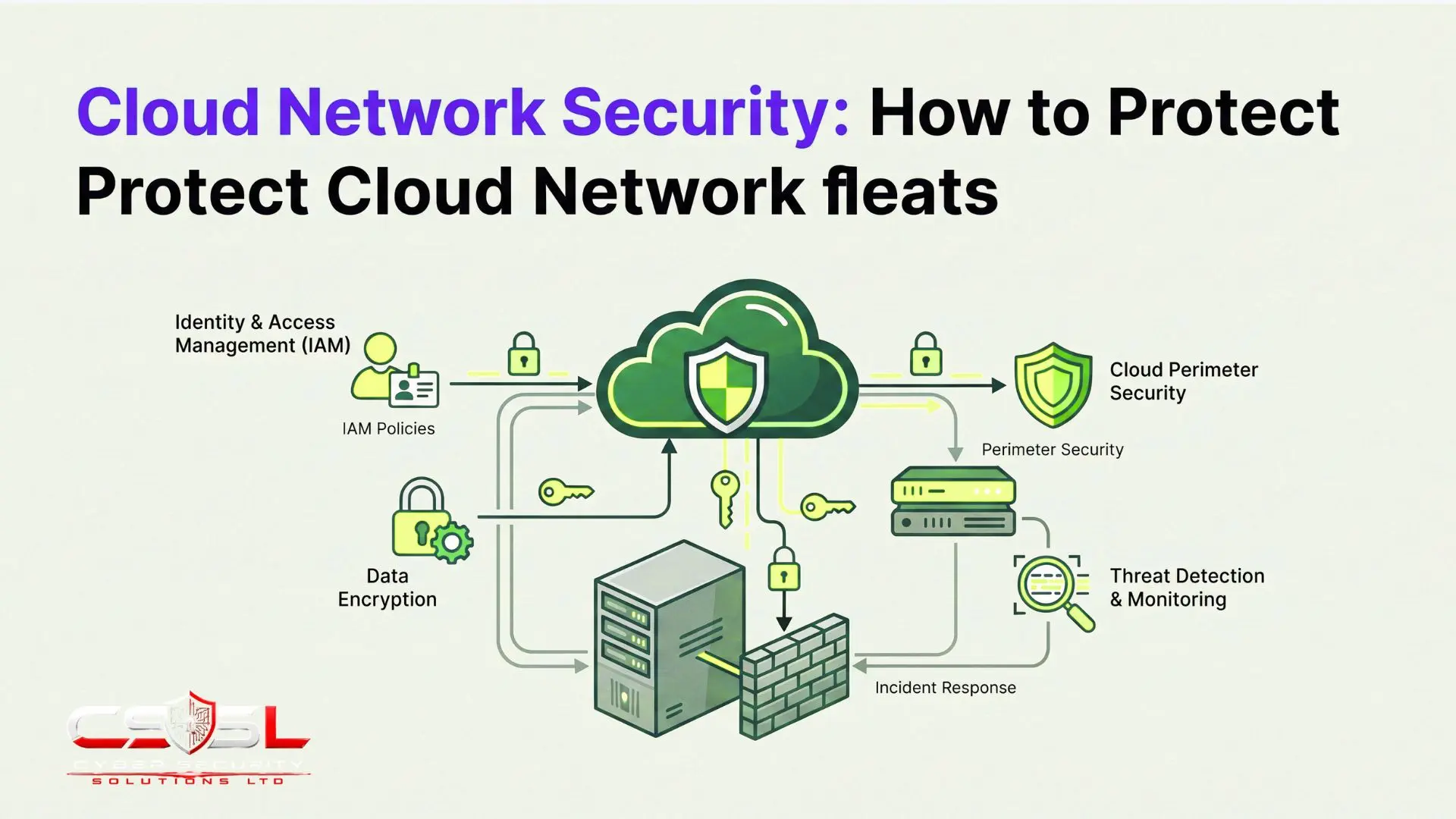
Cloud network security is the practice of designing, segmenting, and controlling traffic within and between cloud environments using virtual networks, security groups, and routing controls. It restricts lateral movement and limits exposure now that the traditional physical network perimeter no longer applies.
If a vendor mentioned a cloud security gateway and you could not tell if they meant CASB, an API gateway, or an actual network gateway, or an attacker who compromised one server was able to reach every other server in the same subnet, this guide gives you the concrete architecture and terminology clarity to fix that.
What Is Cloud Network Security?
Cloud network security is the practice of designing, segmenting, and controlling traffic within and between cloud environments to limit exposure and restrict lateral movement, covering virtual networking, traffic routing, segmentation, and cloud-native perimeter defences.
Traditional network security configured physical switches, routers, and firewalls. Cloud network security configures the same underlying concepts entirely through software-defined constructs, virtual networks, security groups, and route tables, provisioned and changed through APIs, inheriting the same speed-of-change challenge established across cloud security generally.
This post is best understood as the design-side counterpart to CSPM’s detection-side coverage, extending a distinction already established between IAM and CIEM to the network architecture layer specifically. CSPM continuously scans a live cloud environment and flags network configurations that are already wrong: an overly permissive security group rule, a subnet with an unintended route to the internet. This detection capability is genuinely valuable, but it operates entirely after the fact, identifying problems within whatever architecture already exists.
This post covers the earlier, upstream question: how do you design the network architecture itself so fewer of these misconfigurations become possible in the first place. A well-designed zone structure, with route tables that explicitly and deliberately restrict which subnets can reach the internet, dramatically reduces the number of ways a security group misconfiguration on an individual resource can actually result in genuine external exposure, simply because the surrounding architecture does not route that traffic anywhere dangerous even if the resource-level rule is wrong. This is precisely the same relationship that exists between CIEM and IAM: IAM design determines what access structure exists in the first place, and CIEM continuously verifies that structure remains sound. Good network architecture design and CSPM detection are not competing approaches; they are sequential layers, with design reducing the surface area detection later needs to police.
See Cloud Security vs Traditional Security: What Is the Difference? for the perimeter dissolution context this practice responds to, and What Is CSPM? Cloud Security Posture Management Explained for the detection-side counterpart this post’s design focus complements.
What Do People Mean by “Cloud Security Gateway” — And Why Does the Term Have Three Different Meanings?
“Gateway” in cloud security context can mean three genuinely different things. It can refer to a CASB, sometimes bundled with SWG capability, controlling SaaS and web traffic. It can refer to an API Gateway controlling API traffic specifically. Or it can refer to a network gateway, the actual routing component connecting and controlling traffic between VPCs, VNets, on-premise networks, and the internet, which is this post’s specific meaning.
| Gateway Type | What It Does | Typical Use Case |
| Internet Gateway | Provides outbound and inbound internet connectivity for a VPC/VNet | Connecting a public subnet to the internet |
| NAT Gateway | Allows outbound internet access for private resources without inbound exposure | Private resources reaching external APIs or updates |
| VPN Gateway | Provides encrypted connectivity between cloud and on-premise networks | Hybrid environment secure connectivity |
| Transit Gateway | Connects multiple VPCs/VNets and on-premise networks through one hub | Centralized multi-account routing |
Resolving this three-way ambiguity explicitly before proceeding any further is essential, because getting this wrong in a vendor conversation or internal requirement leads directly to evaluating or purchasing entirely the wrong category of tool. A team asked to implement a cloud security gateway without further clarification could reasonably build any of three unrelated things, and the confusion is genuinely common because all three usages are legitimate within different parts of the broader cloud security field.
Within this post’s specific meaning, network gateway, four distinct components exist. An Internet Gateway provides outbound and inbound internet connectivity for a VPC or VNet, the basic component that connects a virtual network to the public internet at all. A NAT Gateway allows outbound internet access for private resources without exposing them to inbound connections, letting a private subnet’s resources reach external services for updates or API calls while remaining unreachable from the internet themselves. A VPN Gateway provides encrypted connectivity between cloud networks and on-premise infrastructure, the component that extends a hybrid environment’s network securely across the public internet. A Transit Gateway, or equivalent hub-based routing service, connects multiple VPCs, VNets, and on-premise networks through a single, centrally managed routing point, covered in more depth in the connectivity section below.
For the CASB and SWG-bundled meaning, see What Is a Cloud Access Security Broker (CASB)? Complete Guide. For the API-traffic-specific meaning, see Cloud Application Security: How to Protect Cloud-Based Apps. This post proceeds using only the network gateway meaning from this point forward.
How Do You Implement Cloud Security Zones at the Network Layer?
Cloud security zones are implemented at the network layer through subnetting. Public subnets host internet-facing resources like load balancers and bastion hosts, routed through an Internet Gateway. Private subnets host application and data resources with no direct inbound internet route. Dedicated subnets handle management and shared security tooling, mirroring the zone pattern of public-facing, application, data, and management layers.
Route tables enforce zone boundaries through explicit routing decisions. Each subnet’s associated route table determines exactly where its traffic is permitted to flow, meaning zone separation is enforced by routing rules rather than convention or documentation alone. See Cloud Security Architecture: How to Design a Secure Cloud Environment for the conceptual zone pattern this section implements in concrete, buildable form.
Security Groups vs NACLs: What Is the Actual Difference, and Why Does It Matter?
Security groups, or Network Security Groups in Azure, are stateful and applied at the individual resource or instance level, meaning a rule permitting inbound traffic automatically permits the corresponding outbound response traffic without a separate explicit rule.
| Criteria | Security Groups | NACLs |
| State | Stateful | Stateless |
| Applies to | Individual resource/instance | Subnet |
| Rule direction required | Inbound implies matching outbound | Inbound and outbound both explicit |
| Typical use | Fine-grained resource-level control | Coarse-grained subnet boundary |
Network ACLs are stateless and applied at the subnet level rather than the individual resource, meaning inbound and outbound rules must both be explicitly defined since return traffic is not automatically permitted.
This distinction is frequently misunderstood or ignored entirely in practice, and the consequence is a genuine, avoidable gap in defence-in-depth that most competitor content does not connect clearly to a practical outcome. Many cloud environments rely exclusively on security groups and leave NACLs at their permissive default settings, effectively wide open, missing the additional, coarser-grained layer of defence NACLs provide specifically at the subnet boundary, one level broader than any individual resource.
Treating security groups and NACLs as a genuine defence-in-depth pair, rather than redundant alternatives where configuring one makes the other unnecessary, is the correct architectural mindset. A security group misconfiguration on a single resource, perhaps an overly broad inbound rule accidentally applied during a rushed deployment, is contained by a correctly configured NACL at the subnet level, which does not care what the individual resource’s own rules say and enforces its own independent boundary. This is the defence-in-depth principle applied concretely at the network layer: two independent enforcement points, one at the resource level and one at the subnet level, mean a single misconfiguration at either layer does not automatically translate into genuine exposure. Environments that configure security groups carefully while leaving NACLs permissive have built exactly one layer of the two-layer defence the architecture actually supports, and are relying entirely on that single layer never containing a mistake.
What Is East-West vs North-South Traffic, and Why Does It Matter in Cloud Environments?
North-south traffic is traffic entering or leaving the cloud environment from the outside world, historically the primary focus of traditional perimeter-based firewall security. East-west traffic is traffic moving laterally between resources within the cloud environment itself, historically under-monitored in traditional architectures that assumed internal traffic was inherently trustworthy.
Cloud environments make east-west traffic control disproportionately important because the disappearance of the traditional perimeter means an attacker who gains initial access to any single resource can attempt to move laterally toward higher-value targets unless east-west traffic is deliberately restricted, precisely the internal blind spot zero trust principles are designed to close.
How Does Micro-Segmentation Work in Cloud Network Security?
Micro-segmentation restricts east-west traffic down to the individual resource or workload level rather than only segmenting broadly by subnet or zone, so that even two resources within the same zone cannot communicate unless explicitly permitted. A compromised resource with micro-segmentation applied can only reach the specific, narrow set of resources it was explicitly permitted to communicate with, rather than every other resource sharing its broader zone or subnet.
Micro-segmentation is a fine-grained addition layered within zones, not a replacement for zone-level segmentation, and this additive relationship deserves explicit clarification because competitor content frequently blurs the two into a single concept or presents them as competing approaches.
Zones and subnets provide coarse-grained separation between broad categories of resource: public-facing systems in one zone, application servers in another, data stores in a third. This coarse separation is necessary but insufficient on its own. Within the application zone, for example, a dozen different application servers might all sit in the same subnet, and traditional subnet-level segmentation treats them as one undifferentiated group: any resource in that subnet can typically reach any other resource in the same subnet by default. Micro-segmentation adds a further, finer layer of rules within that zone, restricting a specific application server to communicating only with the specific database it genuinely needs, nothing else in the same subnet, even though every resource technically shares the same broad zone and subnet boundary.
This is the direct, practical answer to a specific and common failure pattern: an attacker who compromises one server within a subnet gaining the ability to reach every other server in that same subnet, purely because subnet membership alone was treated as sufficient trust. With micro-segmentation applied, that same compromised server can only reach the handful of resources it was explicitly permitted to communicate with, dramatically limiting the blast radius of the initial compromise regardless of how many other resources happen to share its broader zone. Kubernetes Network Policies, covered in dedicated depth elsewhere, are the container-orchestration-layer expression of this exact same principle, operating one level below the VPC and VNet-level controls this section covers, applying the identical logic of default-deny communication between workloads unless explicitly permitted.
How Do You Securely Connect Multiple VPCs, VNets or Accounts Together?
VPC and VNet peering creates direct, point-to-point connections between two networks, appropriate for a small number of connections but creating a rapidly complex mesh as the number of connected networks grows. Transit Gateway or an equivalent hub-and-spoke model provides a centralized routing hub that every VPC or VNet connects to individually, avoiding the point-to-point complexity of a full peering mesh.
Hub-and-spoke is generally the more secure, more manageable connectivity pattern at scale, and the reason extends beyond pure operational convenience into the same identity trust principle governing cloud entitlements more broadly. Centralizing routing through one hub makes it dramatically easier to apply and audit consistent security policy across every connection, compared to reviewing dozens of individual peering relationships each configured slightly differently, often by different teams at different times with no single person holding a complete picture of the resulting mesh.
Poorly governed peering and cross-network routing relationships are a network-layer expression of the same cross-account trust risk that exists at the identity layer: a peering connection set up for a specific, narrow integration reason can, over time, provide broader connectivity than anyone currently remembers authorizing, precisely the way an over-permissive identity role accumulates risk silently. An organization with a growing web of undocumented peering connections between accounts faces the same fundamental problem as one with undocumented identity trust relationships: nobody can confidently answer what can reach what, because the answer is scattered across dozens of individually configured relationships rather than centralized in one auditable place. This reinforces why deliberate, minimal, documented connectivity matters as much at the network layer as it does for identity governance, and why hub-and-spoke’s centralization advantage is fundamentally a security property, not simply an operational convenience.
How Do You Protect Cloud Networks Against DDoS Attacks?
Native cloud DDoS protection services, including AWS Shield, Azure DDoS Protection, and Google Cloud Armor, each provide baseline, often automatically enabled protection against common volumetric and protocol-based DDoS attacks at the infrastructure level. Most providers offer a free or low-cost standard tier providing baseline protection automatically, alongside a paid advanced tier providing enhanced detection, dedicated support during an active attack, and cost protection against traffic spikes caused by the attack itself.
CDN and edge distribution complements this by absorbing and dispersing volumetric traffic before it reaches origin infrastructure, a pattern often deployed alongside WAF capability rather than as a replacement for it. DDoS protection and application security are complementary, not overlapping: DDoS protection addresses volume and infrastructure-level exhaustion attacks, while WAF and API Gateway protections address malicious request content and logic-level attacks, and a complete defence requires both operating together. See Cloud Application Security: How to Protect Cloud-Based Apps for that application-layer detail.
How Do You Monitor Cloud Network Traffic for Threats?
Flow logs, including AWS VPC Flow Logs, Azure NSG Flow Logs, and Google Cloud VPC Flow Logs, are the foundational monitoring data source, capturing metadata about traffic flowing through the network, source, destination, port, and action, without capturing full packet content.
Flow log analysis carries a specific value most competitor content undersells by describing it only as generic monitoring: it functions as a direct validation check confirming whether actual traffic matches the intended zone and segmentation design established earlier, rather than simply a forensic record reviewed after something has already gone wrong.
An organization that has carefully designed zone boundaries, configured route tables, and applied micro-segmentation rules has, in effect, made a specific claim about how traffic should flow through its environment. Flow logs make it possible to check that claim against reality. If the intended design specifies that a particular application server should only ever communicate with one specific database, reviewing flow logs for that resource should show traffic consistent with exactly that pattern. Any traffic outside that expected pattern, connections to unexpected destinations, ports, or resources, represents either a misconfiguration in the intended controls that allowed traffic the design never intended, or genuinely suspicious lateral movement that the segmentation controls failed to block entirely. Reviewing flow logs specifically against the documented intended architecture, rather than scanning them generically for anomalies with no reference point, transforms flow log review from a passive logging exercise into an active verification step confirming the network actually behaves the way its design claims it does.
Network flow data becomes significantly more valuable when correlated with CSPM, CIEM, and identity data covered elsewhere in this cluster, feeding into broader attack path correlation rather than being reviewed as an isolated, disconnected data source.
What Does This Post Not Cover, and Where Does That Content Live Instead?
This post covers networking security controls native to and specific to cloud provider environments: VPC and VNet architecture, security groups, cloud-native gateways, and cloud-native DDoS protection. It does not provide full SASE architecture, ZTNA implementation depth, or traditional firewall and IDS/IPS design spanning both on-premise and cloud infrastructure together.
Stating this scope boundary explicitly, rather than silently avoiding SASE, ZTNA, and cross-environment firewall architecture without explanation, is a deliberate choice worth making transparent to the reader. Most competitor content on cloud network security either attempts to cover the entire network security discipline within a single article, diluting practical depth across too broad a scope, or silently omits the broader provider-agnostic territory without acknowledgement, leaving readers uncertain whether the omission reflects deliberate scoping or simply incomplete coverage.
Cloud-native network constructs and the broader converged network security architecture spanning multiple environments including on-premise infrastructure are different enough in scope and intended audience that combining them fully in one place would genuinely dilute the practical depth of both. A reader working within a single cloud provider’s networking model benefits from depth on VPC design and cloud-native DDoS services without wading through SASE vendor comparisons irrelevant to their immediate task. A reader designing converged security architecture spanning on-premise and multiple cloud environments needs a different, broader treatment this post is not attempting to provide. That provider-agnostic, full-spectrum network security architecture is covered comprehensively within the separate Network Security content area.
How Do You Implement Cloud Network Security Step by Step?
Step 1: Design your VPC/VNet and subnet structure to reflect your zone pattern, separating public, application, data, and management resources.
Step 2: Configure route tables explicitly to enforce which subnets can reach the internet, each other, and any connected on-premise network.
Step 3: Apply both security groups and NACLs together, treating them as complementary layers rather than relying on either alone.
Step 4: Implement micro-segmentation for your highest-value workloads specifically, restricting east-west communication to only what is genuinely required.
Step 5: Choose a hub-and-spoke connectivity model over point-to-point peering as your multi-account or multi-VPC network grows beyond a small number of connections.
Step 6: Enable native DDoS protection at the appropriate tier for your risk profile, layered alongside WAF and API Gateway protections.
Step 7: Enable flow logs across every VPC/VNet and integrate that data into broader cloud security monitoring.
Step 8: Periodically validate actual traffic patterns against your intended zone and segmentation design, using flow log analysis to catch drift or misconfiguration.
Cyber Security Solutions Ltd provides cloud network architecture reviews validating whether actual zone segmentation and traffic controls match intended design, closing the gap between documented architecture and real-world configuration drift.
Conclusion
Cloud network security succeeds when architecture design reduces misconfiguration opportunities before detection tools ever need to catch them, layering zones, security groups, NACLs, and micro-segmentation so no single mistake produces genuine exposure. Visit cybersecuritysolutionsltd.com for a cloud network architecture review to validate whether your actual zone segmentation and traffic controls match your intended design.
FAQs
Cloud network security is the practice of designing, segmenting, and controlling traffic within and between cloud environments using virtual networks, security groups, and routing controls. It restricts lateral movement and limits exposure now that the traditional physical network perimeter no longer applies to cloud-hosted resources.
It depends on context, since the term carries three distinct meanings: a CASB controlling SaaS traffic, an API Gateway controlling API traffic, or a network gateway, Internet Gateway, NAT Gateway, VPN Gateway, or Transit Gateway, controlling routing between networks. Always clarify which meaning applies before evaluating tools.
Security groups are stateful and apply at the individual resource level, automatically permitting return traffic. NACLs are stateless and apply at the subnet level, requiring explicit inbound and outbound rules. Using both together provides genuine defence-in-depth, since a security group misconfiguration is contained by a correctly configured NACL.
North-south traffic enters or leaves the cloud environment from outside. East-west traffic moves laterally between resources within the environment itself. Cloud environments make east-west control disproportionately important since the disappearance of the traditional perimeter means a compromised resource can attempt lateral movement unless deliberately restricted.
Peering suits a small number of direct connections but becomes a complex, hard-to-audit mesh as connections grow. Hub-and-spoke centralises routing through one point, making consistent security policy dramatically easier to apply and audit across every connection as your multi-account or multi-VPC environment scales.
Zones provide coarse separation between broad resource categories like public, application, and data layers. Micro-segmentation adds fine-grained rules within those zones, restricting individual workloads to communicating only with specific resources they genuinely need, even when multiple resources share the same subnet or zone.