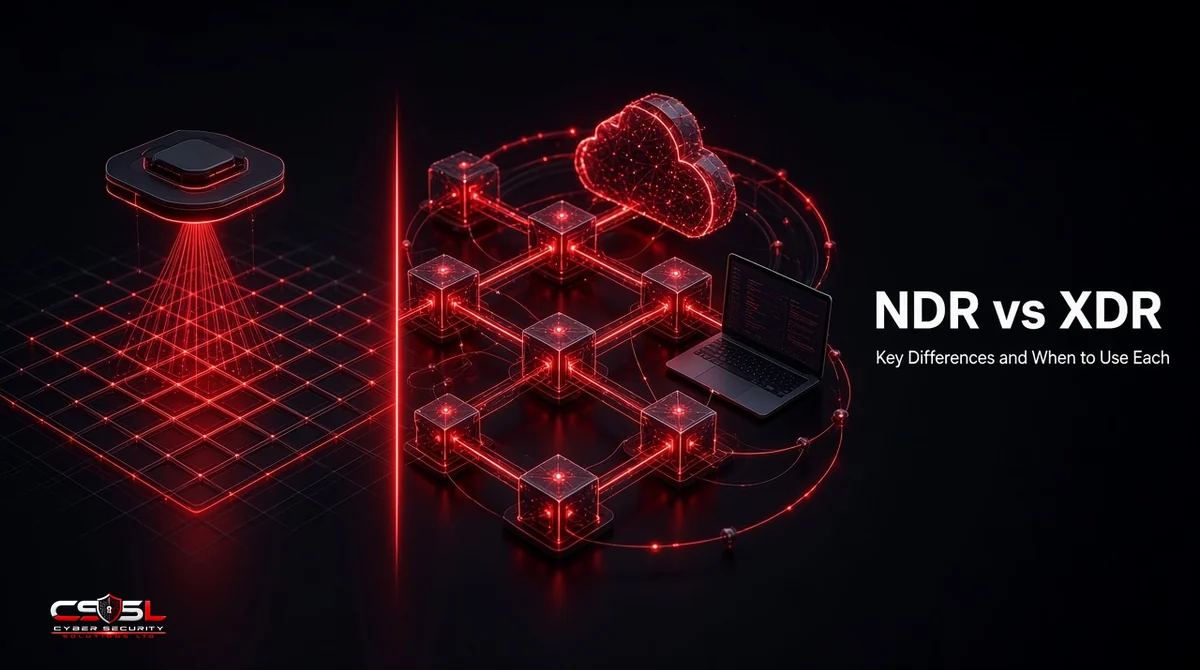
NDR vs XDR: Key Differences and When to Use Each
A common belief is that XDR makes NDR obsolete, because “extended” must cover everything. It does not. The NDR vs XDR question is really about scope: NDR analyzes network traffic, including from devices without agents, while XDR correlates endpoint, email, identity and cloud data. Often, NDR feeds XDR.
NDR vs XDR: The Short Answer
The main difference is scope. NDR analyzes network traffic to detect threats such as lateral movement and exfiltration, including on unmanaged devices. XDR correlates data from endpoints, email, identity, cloud and often the network into one incident view. They are not rivals so much as layers, and many XDR platforms take NDR as an input.
What Is NDR? (Quick Recap)
Network detection and response uses sensors to watch traffic across your network, learns normal behavior and flags anomalies such as scanning, command-and-control beacons and unusual uploads. Its strength is seeing every device that talks on the network, managed or not. Our full guide to NDR covers how it works in detail.
What Is XDR? (Quick Recap)
Extended detection and response collects telemetry from several security layers, usually starting with endpoint agents, then adds email, identity, cloud and network sources. It correlates those signals into single incidents and offers coordinated response across tools. Our XDR guide covers the definition, native and open XDR, and how it works.
Key Differences Between NDR and XDR
Data Sources: Network Traffic vs Cross-Domain Telemetry
NDR’s raw material is packets and flow records from network sensors. XDR’s raw material is events from many products: endpoint agents, email gateways, identity providers, cloud logs, and sometimes NDR itself.
Deployment: Sensors vs Agents and Integrations
NDR deploys sensors on network TAPs, mirror ports or cloud traffic mirroring, with no software on endpoints. XDR depends on agents and integrations; its coverage is only as wide as the sources connected to it.
Detection Strengths and Blind Spots
NDR excels at lateral movement, network reconnaissance, command-and-control and devices that cannot run agents, such as IoT and OT equipment. Its blind spot is what happens inside a device and inside encrypted payloads. XDR excels at linking an endpoint process, a suspicious login and a malicious email into one story. Its blind spot is any device or network segment with no connected source.
Response Actions
NDR responses usually act on the network: blocking a connection through a firewall, quarantining a device at the switch, or asking another tool to act. XDR responses span domains: isolating a laptop, disabling an account, pulling an email from inboxes and blocking an indicator everywhere at once.
Cost, Complexity and Vendor Lock-In
NDR costs include sensors, storage for traffic data and tuning time. XDR costs depend heavily on how much of one vendor’s stack you already own. Native XDR works best inside a single vendor’s ecosystem, which can mean lock-in; open XDR accepts third-party sources but needs more integration work. Be wary of products labeled XDR that are mainly an endpoint tool with a new name; ask exactly which sources it ingests and correlates.
NDR vs XDR Comparison Table
| NDR | XDR | |
|---|---|---|
| Primary data | Network packets and flows | Endpoint, email, identity, cloud and network events |
| Deployment | Network and cloud sensors | Agents plus integrations |
| Sees unmanaged and IoT devices | Yes, if they use the network | Only through a network source |
| Sees processes on devices | No | Yes, through endpoint agents |
| Best at | Lateral movement, C2, exfiltration | Correlating multi-stage attacks across domains |
| Typical response | Block or quarantine on the network | Isolate hosts, disable accounts, remove emails |
| Main risk | Sensor blind spots, encrypted payloads | Coverage gaps, vendor lock-in |
When to Use NDR
Choose NDR first when you have many devices that cannot run agents, such as factory, medical, building or IoT equipment; when you need to watch east-west traffic in a data center; when regulators or auditors expect network monitoring; or when you want an independent view that attackers cannot switch off by disabling an agent.
When to Use XDR
Choose XDR when most of your assets are managed laptops, servers, cloud apps and user accounts; when your team is small and needs correlated incidents instead of separate alert queues; and when you already use a vendor whose endpoint, email and identity products integrate well.
When You Need Both: NDR as an XDR Data Source
Larger and more complex environments often run both. NDR sends its detections and network context into the XDR platform, which links them with endpoint and identity events. The result fills each tool’s blind spot: XDR gains visibility of unmanaged devices and network movement, and NDR alerts gain the endpoint and user context needed to act. When evaluating, check whether your XDR can ingest your NDR’s data natively.
Which Is Better for Small and Midsize Businesses?
For most small businesses, managed endpoint protection, MFA and email security deliver more value first. XDR, often bought as a managed service, is a common next step because it reduces the number of consoles to watch. NDR becomes worth it when you have significant on-premises infrastructure, IoT or OT devices, or sensitive internal servers.
Attack Scenario: How NDR and XDR Each Catch Ransomware
A staff member opens a malicious attachment. XDR sees the email, the suspicious process launched on the laptop and an unusual login from that account, and links them into one incident. The attacker then compromises an unmanaged network storage device and uses it to scan for file servers. XDR has no source there, but NDR sees the scanning and new SMB connections. Together, the two tools show the whole chain and allow the team to isolate both the laptop and the storage device before encryption.
Beyond NDR vs XDR: Think Coverage, Not Acronyms
The better question than NDR vs XDR is “where are we blind?” List your devices, networks, users and cloud services, then check which tool sees each one. Fill the largest gaps first, whether that means sensors, agents or integrations. If you want a coverage review before choosing, contact Cyber Security Solutions Ltd through our contact page.
FAQs
Not always. If nearly all your assets run endpoint agents and connect to cloud services, XDR may cover most risks. If you have unmanaged, IoT or OT devices, significant internal server traffic, or need independent network monitoring, NDR adds visibility XDR cannot get on its own. Check whether your XDR already ingests network data.
Some XDR platforms include basic network detection or ingest firewall and flow data, and some vendors bundle a full NDR product. Many do not include dedicated network sensors at all. Ask each vendor which network data is collected, how deeply it is analyzed, and whether third-party NDR tools can feed the platform.
NDR stands for network detection and response, which monitors network traffic for threats. XDR stands for extended detection and response, which correlates telemetry from endpoints, email, identity, cloud and network into unified incidents. Both share the "detection and response" goal; the first letter tells you the data source or scope.
EDR, endpoint detection and response, monitors processes and behavior on individual devices and is usually the foundation of XDR. Compared with NDR, it sees inside devices but not the traffic between them, especially from devices without agents. Our separate guide on EDR vs NDR explains the trade-offs and how the two work together.
Yes. Managed detection and response providers often operate XDR platforms, and some also deploy and monitor NDR sensors. They handle alert triage, investigation and response around the clock. This suits businesses without an in-house SOC. Confirm which data sources the provider covers and what response actions they can take on your behalf.
It depends on your team and budget. EDR protects devices well on its own, while XDR adds correlation across email, identity and cloud, reducing separate alerts. Many small businesses get XDR through a managed service. Our guides comparing EDR and XDR, and EDR, MDR and XDR, cover the decision in more detail.