CNAPP vs CWPP vs CSPM: What Is the Difference and What Do You Need?
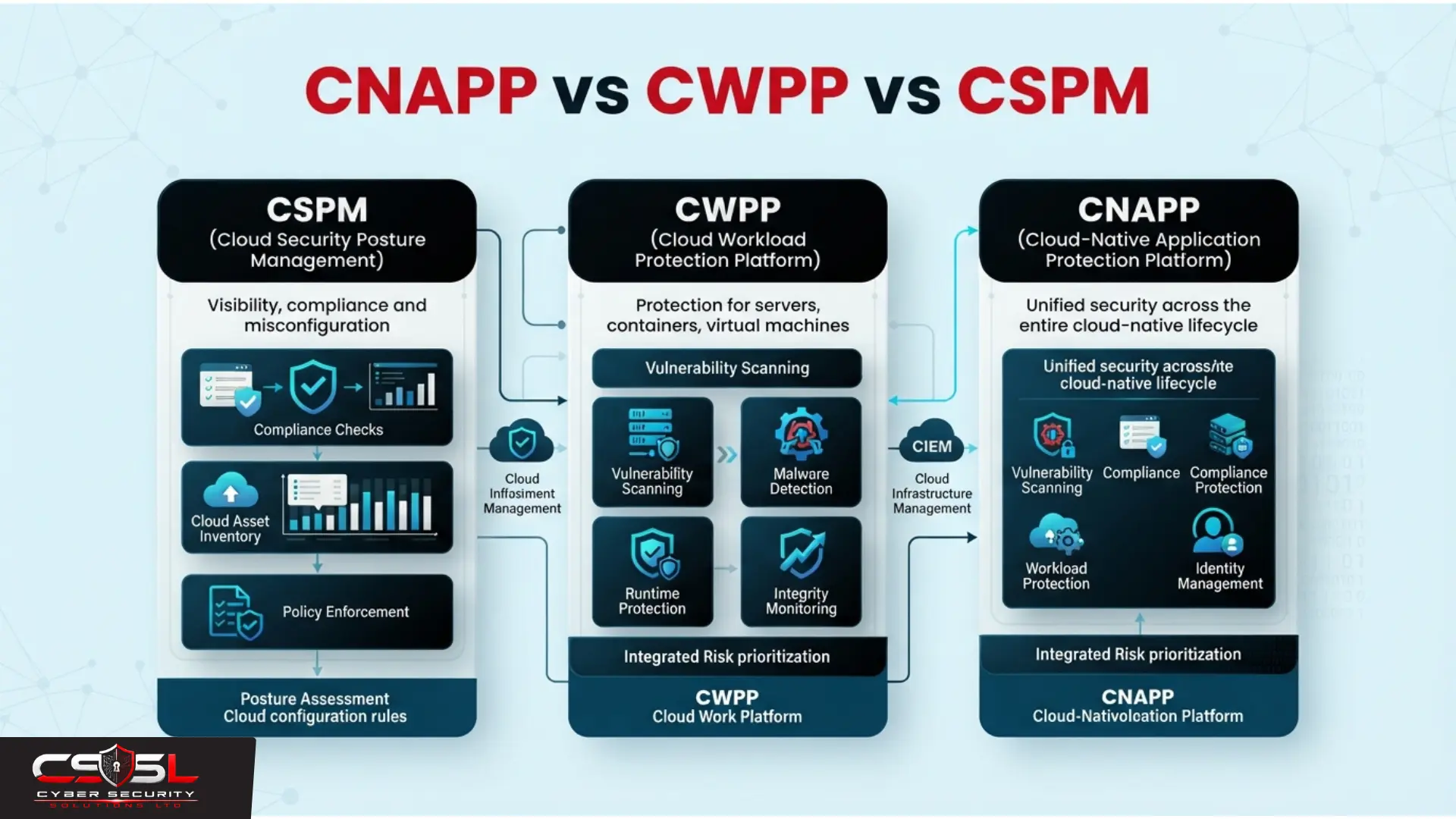
CSPM checks whether your cloud infrastructure is configured correctly. CWPP checks whether a specific workload is currently safe to run. CNAPP unifies both, plus entitlement and data findings, to correlate compound risk neither one alone can see. If you do not want three separate long articles just to figure out what to buy, this guide gets you there fast.
What Each Acronym Means in One Sentence
This is, by a wide margin, the most heavily covered comparison in this series. One prior post already delivered a full, dedicated explainer of CSPM. Another delivered a full explainer of CWPP, including a section addressing its relationship to CNAPP and CSPM directly. Another went further still, with an entire section dedicated to correcting the exact false-binary assumption baked into this post’s own title, concluding the relationship is containment, not rivalry.
This post does not re-explain any of that from scratch. A reader searching this exact three-way title has very often not read those three full explainers yet, wants a fast, confident answer to “what do I actually need,” and would rather be pointed to the right 2,000-word article than read a fourth version of the same one. Think of this post as the TL;DR and triage tool sitting in front of that existing depth, not a fourth independent attempt at the same explanation.
| Tool | Core Question | What It Scans | Standalone Purchase? |
| CSPM | Is this resource configured correctly? | Infrastructure, storage, networking, identity settings | Yes |
| CWPP | Is this workload currently safe to run? | VMs, containers, serverless functions | Yes |
| CNAPP | Is there compound, correlated risk across all of this? | CSPM, CWPP, entitlement and data findings together | Yes, typically as one platform |
What Is CSPM in Cloud Security?
CSPM continuously scans configuration state against rule libraries mapped to standards like CIS Benchmarks, flagging drift before or as it happens. Its honest limitation: no insight into what is actually running inside a workload, no visibility into lateral movement once an attacker has a foothold, and prioritization largely by static severity rather than real environmental context.
This is exactly what CWPP and CNAPP exist to address, and the reason this comparison keeps coming up in search in the first place.
What Is CWPP in Cloud Security?
CWPP protects the workload itself through vulnerability scanning and runtime behavioral detection across VMs, containers and serverless functions, answering “is this workload currently safe to run” rather than CSPM’s “is this resource configured correctly.” CSPM looks at a resource from the outside without looking inside it. CWPP looks inside the workload, and at what it is actually doing while it runs.
The protection model genuinely differs across VMs, containers and serverless functions too, rather than being one uniform capability applied identically everywhere.
CNAPP vs CSPM: Is CNAPP Just “CSPM Plus More,” or Something Different?
CNAPP does include CSPM as one foundational component, but the genuinely differentiating value is not simply more modules. It is the correlation between them. CSPM alone might flag an open network port as a medium-severity finding. CNAPP can determine whether traffic is actually flowing through that port to a known-malicious destination right now, converting a static configuration flag into an active, contextualized risk signal.
Organizations still legitimately choose CSPM alone in some cases. For an organization early in its cloud journey with a relatively simple environment, CSPM’s posture and compliance focus may genuinely be sufficient, and CNAPP’s fuller capability set can represent more platform than is currently needed.
Why “CNAPP vs CWPP” Is a Containment Relationship, Not a Real Rivalry
CWPP predates CNAPP as a category and can still be purchased standalone today, but within a CNAPP platform it functions as one integrated component alongside CSPM and CIEM, not a competing alternative. Buyers naturally compare things offered as alternatives, and vendor marketing for standalone CWPP versus full CNAPP platforms can inadvertently reinforce the impression of a head-to-head choice that does not actually reflect how the two relate.
The one legitimate decision hiding inside this false binary is not “CWPP or CNAPP.” It is a specialized, standalone CWPP tool for deep workload protection specifically, or CWPP delivered as one module within a broader CNAPP platform alongside everything else it correlates.
What Does CNAPP Actually Add That CSPM and CWPP Together Still Don’t Cover?
Tenable’s own 2025 Cloud Security Risk Report found that 29% of organizations still contend with what it names a “toxic cloud trilogy,” workloads that are simultaneously publicly exposed, critically vulnerable and highly privileged at the same time. That figure is down from 38% the year before, but still alarmingly common.
This is precisely the compound risk pattern that neither CSPM nor CWPP alone can fully see, since each only holds one or two pieces of that three-part picture. Even running both as separate, uncorrelated tools still leaves this gap open. A human analyst manually cross-referencing two separate consoles’ findings is attempting, by hand, exactly the correlation a genuine CNAPP platform performs automatically and continuously.
CIEM and DSPM complete this picture. CIEM adds the “who can actually reach it” dimension. DSPM adds the “what sensitive data does it actually hold” dimension. Most CNAPP platforms fold both in alongside CSPM and CWPP, which is precisely why a platform, not two disconnected tools, closes a gap that manual cross-referencing simply cannot close reliably at scale.
So What Do You Need? A Decision Framework by Cloud Maturity
Organizations early in cloud adoption, with a relatively small and simple environment, are frequently well served starting with CSPM alone to establish baseline posture and compliance visibility.
| Stage | Recommended Tool | Why |
| Early, simple cloud footprint | CSPM | Establishes baseline posture and compliance visibility |
| Growing workload complexity | CSPM + CWPP | Containers, Kubernetes and serverless need runtime protection |
| Complex, multi-tool environment | CNAPP | Manual cross-referencing has become impractical |
CWPP becomes the next priority once workloads, particularly containers, Kubernetes and serverless functions, represent a meaningful and growing part of the environment. A full CNAPP platform earns its cost and complexity once manually cross-referencing separate CSPM, CWPP, CIEM and DSPM findings has become genuinely impractical, at which point consolidating onto one correlated platform typically delivers more value than continuing to run components separately.
This is rarely a permanent, one-time choice between three competing products. It is a natural progression most organizations move through as their cloud footprint grows. The right question is not “which one is best” but “which point on this progression matches where we are today.”
What Other Acronyms Will You Run Into Next, and Where Do They Fit?
CIEM and DSPM are the two most important CNAPP components beyond this post’s own three acronyms, both already covered in full elsewhere in this series. ASPM, KSPM and EASM are increasingly folded into full CNAPP platforms as the category continues to expand, and you will likely encounter all three in vendor conversations soon if you have not already. CDR, Cloud Detection and Response, is a term some vendors use for real-time threat detection, functionally overlapping with monitoring territory this series already covers under different terminology.
A quick, honest assessment of where your organization actually sits on the CSPM-to-CNAPP maturity path, rather than being sold a platform ahead of where you genuinely are, is exactly the conversation Cyber Security Solutions Ltd starts with on this exact question.
This post covers the three most commonly confused, most frequently searched acronyms specifically, not the complete family. A full, categorized directory of every tool type exists as a dedicated reference elsewhere in this series.
Conclusion
CNAPP vs CWPP vs CSPM was never really a three-way rivalry to sort through. It is a progression most organizations move through as their cloud footprint grows, from CSPM alone, to CSPM plus CWPP, to a fully correlated CNAPP platform. Start where your actual complexity puts you, not where a vendor pitch suggests you should be. To get a quick, honest assessment of where you actually sit on this maturity path, visit cybersecuritysolutionsltd.com for expert support from Cyber Security Solutions Ltd.
FAQs
What is the difference between CNAPP, CWPP and CSPM?
CSPM checks whether cloud infrastructure is configured correctly. CWPP checks whether a specific workload is currently safe to run. CNAPP unifies both, plus entitlement and data findings, correlating them to surface compound risk that neither tool alone can see on its own.
Does CNAPP replace CWPP?
Not exactly. CWPP predates CNAPP and can still be bought standalone, but within a CNAPP platform it functions as one integrated component, not a competing alternative. The real decision is standalone CWPP for deep workload protection versus CWPP as one module inside a broader platform.
Is CSPM enough for cloud security on its own?
For an early-stage, relatively simple cloud environment, often yes, to establish baseline posture and compliance visibility. CSPM has no insight into what runs inside a workload or lateral movement risk, which is exactly what CWPP and CNAPP exist to address as complexity grows further.
When do I actually need a full CNAPP platform instead of separate tools?
Once manually cross-referencing separate CSPM, CWPP, CIEM and DSPM findings has become genuinely impractical for your team to sustain. A human analyst doing that by hand is attempting exactly the correlation a genuine CNAPP platform performs automatically and continuously across every connected finding available to it.
What is a “toxic cloud trilogy”?
A term from Tenable’s 2025 Cloud Security Risk Report describing a workload that is simultaneously publicly exposed, critically vulnerable and highly privileged. Tenable found 29% of organizations still have at least one, down from 38% the year before, but still a significant risk.
What other cloud security acronyms should I know beyond CNAPP, CWPP and CSPM?
CIEM and DSPM are the most important CNAPP components beyond these three core acronyms. ASPM, KSPM and EASM are newer, adjacent categories increasingly folded into full platforms as the market keeps expanding. CDR overlaps with monitoring and response territory this series already covers under different terminology entirely.