SSPM vs CSPM: What Is the Difference and Which Do You Need?
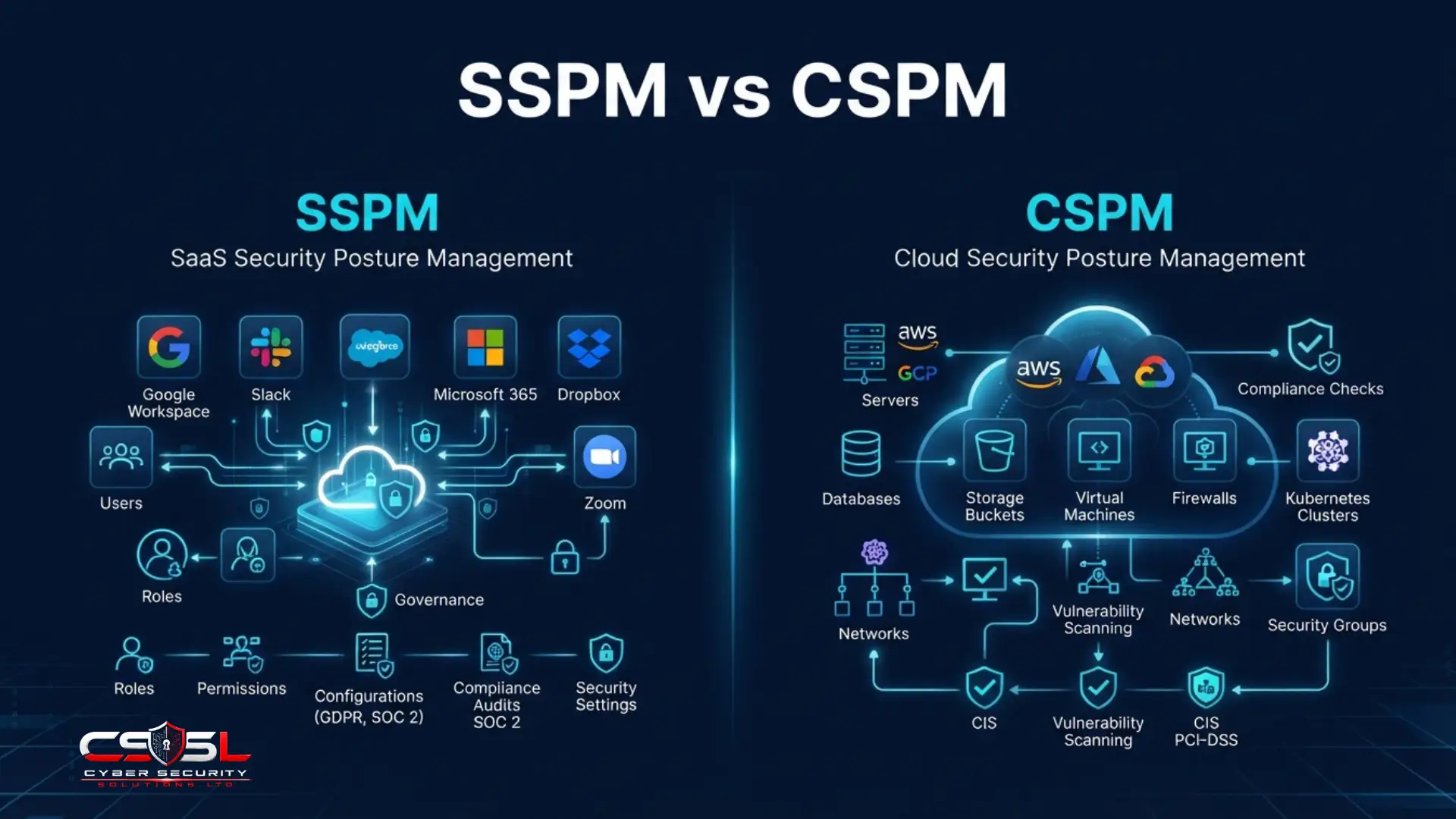
CSPM monitors cloud infrastructure configuration across platforms like AWS and Azure, while SSPM monitors SaaS application configuration across platforms like Microsoft 365 and Salesforce. Most organizations running both cloud infrastructure and SaaS tools need both categories to avoid a structural blind spot.
If you bought a CSPM tool and assumed it covered your Microsoft 365 environment too, then found out it does not see any of that, or you have a limited budget and need to know which posture management tool to prioritize first, this guide gives you the genuine head-to-head comparison and decision framework.
What Is the Difference Between SSPM and CSPM?
CSPM monitors the configuration of cloud infrastructure, AWS, Azure, and Google Cloud compute, storage, networking, and identity, while SSPM monitors the configuration of SaaS applications, Microsoft 365, Google Workspace, Salesforce, Slack, and similar platforms.
| Criteria | SSPM | CSPM |
| What it monitors | SaaS application configuration | Cloud infrastructure configuration |
| Example platforms | Microsoft 365, Google Workspace, Salesforce, Slack | AWS, Azure, Google Cloud |
| Typical buyer profile | SaaS-heavy organizations, all business sizes | Organizations running IaaS/PaaS workloads |
| Common findings | External sharing, OAuth risk, dormant admins | Public storage, permissive security groups |
| Related post | This post | What Is CSPM? |
Both categories share the same underlying philosophy of continuous, automated configuration scanning against a rule library, and both emerged to solve the same fundamental problem: manual review cannot keep pace with cloud-scale configuration surface. But they scan entirely different layers of an organization’s technology stack.
Most competitor content states that CSPM and SSPM cover different layers as a passing fact and moves on, without dramatizing the specific, costly consequence of getting this wrong. Both categories share the exact same underlying philosophy: continuous, automated, API-based scanning against a rule library, checking for misconfigurations and compliance violations. This shared vocabulary is precisely what causes buyers to assume one naturally extends to cover the other.
It does not. Consider a genuinely common scenario: an organization deploys a CSPM tool against a modest AWS footprint, perhaps a single test environment and a few storage buckets supporting a small internal application. The CSPM dashboard shows a clean bill of health, because there is genuinely little to find in that small environment. Leadership reasonably concludes the organization’s cloud security posture is well managed. Meanwhile, that same organization’s actual sensitive data, client contracts, financial records, HR files, and years of email correspondence, lives entirely in Microsoft 365 and a Salesforce CRM, neither of which the CSPM tool has any technical ability to see into. The dashboard is not lying; it is accurately reporting on a small fraction of the organization’s actual data footprint while remaining completely blind to the much larger exposure sitting one layer away. This is not a hypothetical edge case; it reflects the actual environment of a large proportion of SMB and mid-market organizations, where SaaS adoption has outpaced cloud infrastructure adoption significantly.
What Is SSPM and Why Did It Emerge as a Separate Category?
SaaS Security Posture Management is a category of security tooling that continuously scans SaaS application configurations for misconfigurations, excessive permissions, and compliance violations, specifically at the application layer rather than the infrastructure layer.
It emerged as its own category because SaaS applications are configured entirely through their own proprietary admin consoles and APIs. A Salesforce permission set looks nothing like an AWS IAM policy, meaning tools built to interpret cloud infrastructure syntax have no native ability to read SaaS application settings.
The SaaS sprawl problem drives much of SSPM’s necessity. Most organizations, particularly SMBs and mid-market businesses, use dozens of SaaS applications, many adopted directly by individual departments without IT involvement, creating shadow SaaS that traditional cloud infrastructure tooling has no visibility into whatsoever. SSPM specifically catches external sharing links left open indefinitely on sensitive documents, third-party OAuth applications connected to Google Workspace or Microsoft 365 with excessive data access scopes, disabled multi-factor authentication enforcement within a specific SaaS tool even when MFA is enforced at the identity provider level, dormant admin accounts retaining elevated privileges, and inconsistent security settings across departments using the same SaaS platform differently.
What Is CSPM in Comparison?
CSPM continuously scans cloud infrastructure, IaaS and PaaS resources across AWS, Azure, and Google Cloud, for misconfigurations in storage, networking, compute, and identity permissions, detecting issues like publicly exposed storage buckets and overly permissive security group rules, evaluated against standards like CIS Benchmarks.
CSPM’s full technical mechanics, detection methods, and implementation process are covered in complete depth elsewhere; this comparison focuses on the decision-making angle between the two categories rather than re-explaining CSPM’s foundation. See What Is CSPM? Cloud Security Posture Management Explained for that complete technical treatment.
Where Do SSPM and CSPM Overlap, and Where Do They Diverge Completely?
CSPM has no visibility into SaaS application settings; SSPM has no visibility into cloud infrastructure configuration. A perfectly secure AWS environment tells you nothing about whether your Microsoft 365 sharing settings are exposing client data, and vice versa.
Both categories assess access and permissions, but from entirely different angles: CSPM evaluates cloud IAM roles and resource-level policies, while SSPM evaluates application-level user roles and sharing permissions within each SaaS tool. This identity overlap is a distinct source of buyer confusion beyond the general category confusion, since neither tool provides deep, cross-system entitlement analysis. CSPM sees what a cloud role is permitted to do within cloud infrastructure; SSPM sees what a user role is permitted to do within a specific SaaS application. Neither answers the harder question of what a person can effectively do once all their roles, group memberships, and cross-platform access combine, which is precisely the gap CIEM exists to close.
Both categories rely on API-based, agentless connections pulling configuration data continuously against rule libraries mapped to security best practice and compliance frameworks, but the APIs, data structures, and rule libraries involved are completely distinct. Most real businesses running both cloud infrastructure and SaaS applications need both tool categories, since relying on only one leaves a structurally guaranteed blind spot in whichever layer is not covered. See What Is CIEM? Cloud Infrastructure Entitlement Management Guide for the entitlement-depth detail that fills this gap.
What Does SaaS Configuration Drift Look Like, and How Does SSPM Catch It?
SaaS application settings drift from a secure baseline the same way cloud infrastructure configuration drifts, often through well-intentioned but temporary changes that are never reverted. Continuous SSPM monitoring addresses this because these changes are individually minor and rarely trigger any alert through normal admin console usage.
The reason SaaS drift is specifically dangerous, in a way that deserves more explanation than most competitor content provides, is that it is mechanically invisible through normal use, not just organizationally overlooked. Cloud infrastructure consoles at least sometimes provide a visual warning when a resource is configured in a genuinely risky way; AWS, for instance, has built-in indicators that flag certain public-facing storage configurations directly in the console. Most SaaS admin consoles provide no equivalent warning for the settings changes that create the most common exposure.
Consider three concrete examples that illustrate this mechanism precisely. An admin temporarily enables external sharing on a Microsoft 365 SharePoint site to collaborate with a specific client on a project, then forgets to disable it once the project concludes, leaving the site openly accessible indefinitely with no expiry and no reminder prompt from Microsoft’s own interface. A Salesforce integration is granted broad API scope access during a proof-of-concept trial with a third-party tool, and that access is never revoked once the trial ends or the tool is abandoned, since nothing in Salesforce’s admin console flags an unused but still-active integration as a risk requiring review. MFA enforcement is disabled temporarily to troubleshoot a specific user’s login issue, and the exception is never removed once the issue is resolved, because the exception simply sits quietly in the configuration with no expiry mechanism forcing a review.
In each case, the person who made the change had a legitimate, reasonable business reason at the time. None of these changes were malicious or even careless in the moment. The danger is entirely in the absence of any follow-up mechanism: nothing in standard SaaS admin console usage surfaces these changes for review months later, when the original context has been forgotten and the exposure has quietly persisted. Only continuous, automated comparison against a defined secure baseline reliably catches this class of drift before it becomes a genuine, exploitable exposure.
What Are the Leading SSPM and CSPM Tools Available in 2026?
Dedicated SSPM vendors including Adaptive Shield, AppOmni, Obsidian Security, and Valence Security have built their core offering specifically around SaaS posture management, typically supporting Microsoft 365, Google Workspace, Salesforce, and Slack.
CSPM and multi-cloud security posture management tools include native cloud provider options like Microsoft Defender for Cloud, AWS Security Hub, and Google Security Command Center, alongside dedicated multi-cloud platforms including Wiz, Prisma Cloud, Orca Security, and Lacework. Many CNAPP platforms increasingly bundle SSPM capability alongside core CSPM offerings, reflecting a broader market shift toward unified posture management rather than standalone point solutions for each layer.
When evaluating SSPM tools specifically, assess breadth of supported SaaS application integrations, depth of OAuth and third-party app risk assessment, quality of baseline comparison and drift alerting, and how well findings integrate into existing IT ticketing workflows. See Cloud Security Tools: The Complete List for 2026 for the full comparative vendor landscape.
How Do Analysts Categorize SSPM and CSPM Today?
Gartner and other industry analysts increasingly discuss SSPM and CSPM within the wider CNAPP category rather than treating them as entirely separate, isolated markets, reflecting the same consolidation trend seen in vendor product bundling.
Quadrant evaluations and vendor inclusion criteria change between report cycles, and specific vendor positioning should always be verified against current, official analyst reports or vendor-disclosed positioning rather than older or secondhand summaries. Specific vendor quadrant positions are point-in-time snapshots, not permanent facts, and content that states a vendor’s position without a current citation risks repeating something that was true a cycle or two ago but no longer reflects reality. See Top Cloud Security Companies: Gartner Magic Quadrant 2026 Breakdown for a dedicated, properly sourced breakdown including the sourcing caveats relevant to accurately interpreting analyst positioning.
Do You Need Both, or Can One Cover Your Organization?
| Profile | Recommended Approach |
| SaaS-only, no cloud infrastructure | SSPM only |
| Infrastructure-heavy, minimal SaaS | CSPM as baseline, SSPM as SaaS adoption grows |
| Both at meaningful scale | Both categories, genuinely different risk |
| Small business, limited budget | Start with native admin console tools |
A business running entirely on Microsoft 365, Google Workspace, Salesforce, and similar SaaS tools with no self-managed cloud infrastructure genuinely needs SSPM only, since there is no infrastructure layer for CSPM to monitor. A business running significant custom infrastructure or applications on IaaS and PaaS platforms needs CSPM as a baseline, with SSPM becoming increasingly important as SaaS tool adoption grows across the organization.
Most mid-sized and larger organizations run both meaningful cloud infrastructure and a substantial SaaS application footprint simultaneously, meaning both tool categories address genuinely different, equally real risk rather than representing a choice between redundant alternatives. Cyber Security Solutions Ltd conducts posture assessments spanning both SaaS and cloud infrastructure layers, helping organizations identify their actual profile before committing budget to either category.
Which Should You Implement First If You Can Only Start With One?
Audit which environment currently holds more sensitive data, has had less prior security review, and would cause greater business impact if misconfigured, rather than defaulting to whichever category gets more general industry attention.
Most cloud security content defaults to discussing CSPM first and treating SSPM as a secondary afterthought, an ordering that mirrors the greater general industry attention CSPM historically receives rather than reflecting the actual risk profile of most readers researching this comparison. This default ordering assumes an enterprise-infrastructure-first environment: significant custom applications running on AWS or Azure, dedicated cloud engineering teams, and SaaS treated as a secondary concern. For a genuinely large proportion of SMB and mid-market businesses, this assumption is simply wrong.
For many of these organizations, their entire operational technology footprint is SaaS. Client contracts, financial records, HR files, email correspondence, and CRM data live in Microsoft 365, Google Workspace, and Salesforce. Any AWS or Azure usage, if it exists at all, might be a single test environment or a small application with no customer data. For this organization, implementing CSPM first is not merely a suboptimal choice; it actively misdirects limited security budget and attention toward securing an infrastructure footprint that barely exists, while the actual repository of sensitive, regulated, and commercially valuable data sits entirely unaudited.
The correct decision method is not defaulting to whichever category receives more industry attention or vendor marketing volume, but conducting a direct, honest audit: which environment currently holds more sensitive data, which environment has had less prior security review or scrutiny, and which environment would cause greater business impact if a misconfiguration were exploited. For a genuine majority of SMB and mid-market readers, this audit points toward SSPM as the more urgent starting priority, not CSPM.
Organizations with genuinely limited budget should also know that meaningful initial visibility does not require an immediate dedicated platform purchase. The native security and compliance dashboards already included within Microsoft 365 and Google Workspace admin consoles provide real, no-additional-cost starting insight into sharing settings, sign-in risk, and app permissions, offering a practical stepping stone before committing budget to a dedicated SSPM vendor. See Cloud Security for Small Business: Affordable Tools and Best Practices for this specific guidance.
Conclusion
SSPM and CSPM address genuinely different, equally real risk, and the right starting point depends on where your actual sensitive data lives rather than which category gets more industry attention. For many SMB and mid-market organizations, that answer points toward SaaS first. Visit cybersecuritysolutionsltd.com for a posture management assessment spanning both SaaS and cloud infrastructure to identify which layer holds your organization’s actual exposure before committing budget to either tool category.
FAQs
CSPM monitors cloud infrastructure configuration across platforms like AWS and Azure. SSPM monitors SaaS application configuration across platforms like Microsoft 365 and Salesforce. Both use continuous automated scanning, but each has zero technical visibility into the layer the other covers, meaning most organizations need both to avoid a structural blind spot.
Yes, if Microsoft 365 holds sensitive data. SSPM catches drift that occurs silently, external sharing links left open, disabled MFA exceptions, and dormant admin accounts, none of which trigger native alerts in the Microsoft 365 admin console. Native security dashboards provide some initial visibility, but continuous monitoring catches ongoing drift more reliably.
SSPM catches external sharing links left open indefinitely, third-party OAuth applications with excessive data access scopes, disabled MFA enforcement within specific SaaS tools, dormant admin accounts retaining elevated privileges, and inconsistent security settings across departments using the same platform differently.
Most mid-sized and larger organizations running both cloud infrastructure and a substantial SaaS footprint need both. Relying on only one leaves a structurally guaranteed blind spot in the layer not covered. A SaaS-only business with no self-managed cloud infrastructure genuinely needs SSPM only.
No. If your organization runs entirely on Microsoft 365, Google Workspace, or Salesforce with no self-managed AWS, Azure, or Google Cloud infrastructure, there is no infrastructure layer for CSPM to monitor. SSPM addresses your actual risk directly, and CSPM would provide no meaningful coverage for your environment.
Audit which environment holds more sensitive data and has had less prior security review, rather than defaulting to CSPM because it receives more general industry attention. For many SMB and mid-market businesses, SaaS holds the more sensitive and less-reviewed data, making SSPM the more urgent starting priority.