What Is CIEM? Cloud Infrastructure Entitlement Management Guide
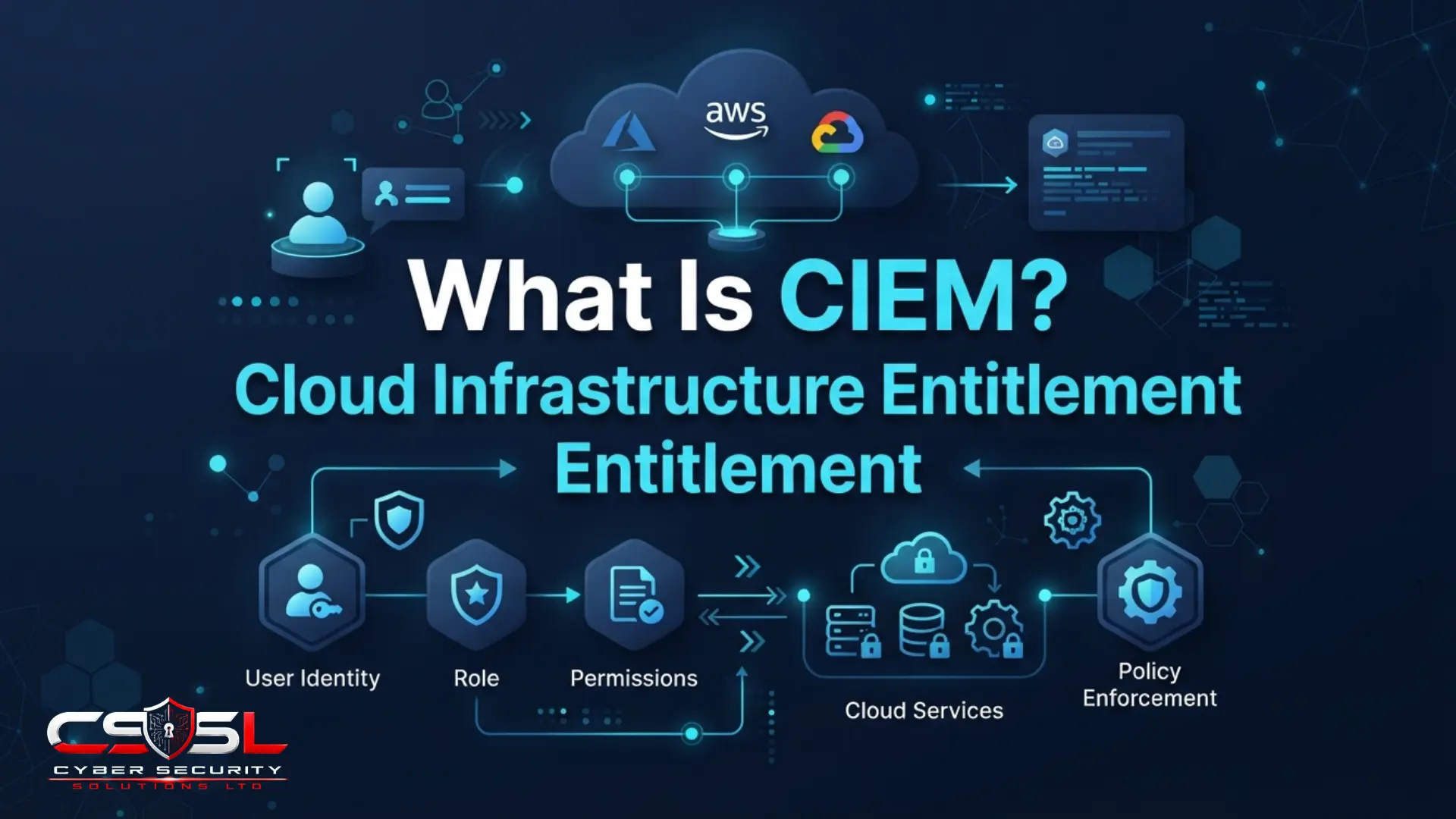
CIEM, Cloud Infrastructure Entitlement Management, is a category of security tooling that continuously calculates the actual effective access every identity holds across a cloud environment. It surfaces excessive, unused, and shadow permissions that accumulate through nested groups, inherited roles, and cross-account trust relationships that manual review cannot realistically trace.
If you reviewed your IAM policies and everything looked fine on paper, then found out a service account had far broader access than anyone intended, or a former contractor’s account still had access to sensitive systems eighteen months after their project ended, this guide explains exactly what CIEM catches and how it works alongside the IAM systems you already run.
What Is CIEM?
Cloud Infrastructure Entitlement Management is a category of security tooling that continuously analyses identity permissions across cloud environments to calculate actual effective access, identifying excessive, unused, and risky entitlements that policy documents alone do not reveal.
Gartner and industry analysts formalized CIEM as its own category because cloud identity systems became too structurally complex for manual permission review to remain reliable at any meaningful scale. Nested groups, inherited roles, cross-account trust, and service-linked roles all combine in ways no manual audit can consistently trace.
Knowing that a policy document grants a specific permission is not the same as knowing what an identity can actually do once every group membership, role inheritance, and cross-account relationship is combined. CIEM computes that combined, real-world answer continuously rather than as a one-off audit exercise. CIEM does not create identities, does not enforce authentication, and is not a directory service. It does not replace IAM; it audits what IAM has already granted.
See What Is CSPM? Cloud Security Posture Management Explained and What Is DSPM? Data Security Posture Management for Cloud Explained for the foundational posture management context this closes out.
How Does CIEM Differ from Cloud IAM?
| Criteria | IAM | CIEM |
| Core function | Creates identities, defines roles, enforces policy | Audits what has actually been granted |
| What it does | Grants and blocks access at authentication | Analyses and surfaces excessive or risky entitlements |
| When it acts | At the point of access | Continuously, after access has been granted |
| Output | Policies, roles, permissions | Effective access findings, remediation recommendations |
| Related post | Cloud IAM Solutions | This post |
IAM is the system that creates identities, defines roles, and enforces policy at the point of access. CIEM does not grant or block anything itself; it continuously analyses what the IAM system has already granted and surfaces what has become excessive or risky over time. IAM is the how-to for structuring access correctly from the outset; CIEM is the ongoing verification that this structure remains sound in a live, constantly changing environment.
A useful working analogy makes this distinction concrete and memorable rather than abstract: IAM is the locksmith who installs the locks and cuts the keys, deciding who gets which key and to which doors. CIEM is the security auditor who walks the building afterward, checking exactly which keys actually open which doors, including doors nobody remembers still exist and locks that were supposed to have been changed months ago but never were.
This distinction matters practically because organizations frequently treat IAM configuration as a one-time project. A well-structured IAM rollout, with carefully designed roles and appropriate initial permissions, genuinely represents good security work. But permissions are granted far more often than they are ever removed, and every subsequent project, every temporary access grant, every new integration adds keys to doors that the original locksmith’s plan never anticipated. Six months after a well-designed IAM structure goes live, the actual effective access across the environment has already begun drifting from what the original design intended, not because IAM failed, but because IAM is a point-in-time granting mechanism, not a continuous verification system.
This is precisely why organizations need both, and why treating CIEM as a replacement for good IAM practice, or treating good IAM practice as sufficient without ongoing entitlement verification, both represent the same underlying mistake: assuming a one-time design decision remains valid indefinitely in an environment that changes continuously. See Cloud IAM Solutions : How Identity and Access Management Secures the Cloud for the complete design and configuration discipline this post’s CIEM focus builds upon and verifies.
What Is Cloud Security Shadow Access, and Why Does It Exist?
Shadow access is access that is technically valid and was legitimately granted at some point, but is invisible through normal review processes because it arises from inherited permissions, nested group memberships, cross-account role assumptions, or legacy grants nobody explicitly revisits. It exists because permission structures accumulate complexity over time far faster than anyone actively removes it.
The specific reason manual review structurally cannot find shadow access deserves concrete illustration rather than the abstract “excessive permissions” language most competitor content settles for, because the problem is genuinely computational, not simply a matter of insufficient diligence.
Consider three specific scenarios that illustrate exactly how this happens. A user sits in Group A, which is nested inside Group B, which has an old policy attached from a project two years ago that nobody currently on the team even remembers existed, granting access no current team member would knowingly approve if asked directly. Checking this user’s own profile shows nothing unusual; the actual grant is buried two group layers deep in a policy attached to a group the user was never directly assigned to, only inherited into through a chain nobody is tracking. A service account created for a one-time data migration retains administrator-level permissions long after the migration project concluded, because decommissioning service account permissions is rarely part of any formal offboarding process the way removing a departing employee’s access is. A cross-account trust relationship set up for a specific integration grants broader access than intended once combined with a compromised identity in the connected account, an indirect path that neither account’s own permission review would surface in isolation, since each account’s administrator would only ever review permissions within their own account boundary.
In each case, the permission in question is frequently not visible anywhere on the user’s own profile or role assignment page. It only becomes visible by manually tracing every applicable group, nested role, and policy chain, a task that scales combinatorially as an environment grows. A small environment with a handful of groups and roles might be traceable by a determined analyst with enough time. An environment with hundreds of groups, thousands of policies, and dozens of cross-account trust relationships makes this task practically impossible through manual effort, regardless of how skilled or diligent the reviewer is. This is not a diligence problem; it is a scale problem that only automated, graph-based analysis can genuinely solve.
How Does CIEM Calculate Effective Permissions Across Complex Role Structures?
CIEM tools build a graph model connecting every identity, role, group, policy, and resource in the environment, then computationally traverse that graph to resolve the actual, cumulative effective access for any given identity or resource, regardless of how many layers of indirection are involved.
Why narrow-looking permissions can combine into broad risk is the specific mechanism that separates privilege escalation path detection from simple excessive permission listing, and this distinction deserves explicit explanation because it represents genuinely different and more serious risk than an individually excessive permission.
A permission that appears entirely reasonable in isolation, such as read access to a specific storage location, can combine with a separate, unrelated permission, perhaps the ability to modify access policies on that same resource, to create a path toward significantly broader access than either permission suggests alone. Neither permission individually looks alarming to a reviewer examining it in isolation. The first grants only read access, a low-risk grant on its own. The second grants only policy modification, which might seem reasonable for an administrative role managing that resource type. Combined, however, an identity holding both permissions can potentially modify the resource’s access policy to grant itself, or another identity it controls, far broader access than either original permission suggested, effectively escalating its own privilege through a path that exists only in the combination, not in either grant reviewed separately.
This is precisely why privilege escalation path detection requires the same graph-based, computational approach as general effective permission calculation, and why it represents a distinct risk category CIEM tools specifically flag rather than treating it as just another item in a list of excessive permissions. Non-human identity coverage deserves particular attention within this analysis, since service accounts and API keys accumulate excessive permissions more readily than human accounts and are reviewed far less often, making them a disproportionate source of exactly this kind of escalation path risk in most real-world cloud environments. CIEM tools also track which granted permissions are actually exercised over a defined observation period, surfacing safe, evidence-based candidates for removal.
How Does CIEM Complete the Toxic Combination Picture Started by DSPM?
| Tool Category | Core Question It Answers | What It Analyses |
| CSPM | Is this resource configured securely? | Cloud infrastructure settings |
| DSPM | What sensitive data is inside, and how exposed is it? | Data content within storage |
| CIEM | Who can actually access this, once every permission is accounted for? | Identity entitlements and effective access |
DSPM answers where sensitive data lives, and whether the container it sits in is exposed. CIEM answers who can actually reach it, once every inherited, nested, and indirect permission is properly accounted for. Correlating these two findings converts a diffuse, hard-to-prioritize alert into a specific, urgent, evidence-based finding a security team can act on immediately.
Imagine a DSPM finding on its own: a specific cloud storage resource contains classified sensitive customer data. This finding alone tells a security team something is worth attention, but not necessarily how urgently, since sensitive data properly locked down to an appropriate small group represents genuinely manageable risk. Now imagine a CIEM finding on its own: an effective permission analysis reveals that forty-three identities, including several rarely-used service accounts nobody actively manages, have effective access to a specific resource. This finding alone is concerning but abstract, since a security team has no way to know whether that resource holds anything genuinely sensitive or is simply a low-value internal log store.
Correlated together, these two findings become something categorically more actionable: this specific resource contains classified sensitive customer data, and forty-three identities including several rarely-used service accounts have effective access to it. This is no longer a diffuse concern requiring investigation to determine urgency; it is a precisely scoped, evidence-based finding that a security team can prioritize immediately above the thousands of individually lower-priority DSPM and CIEM findings their environment inevitably generates. This correlation is the single most valuable output a mature cloud security programme gets from running both tool categories together in a coordinated way, and it is exactly why organizations evaluating either category should seriously weigh how well the two integrate, whether within a single CNAPP platform natively correlating findings, or through deliberate cross-referencing between separate point solutions.
What Is a Cloud Security Identity Fabric, and Where Does CIEM Fit Within It?
Identity fabric is a broader, emerging framing used by industry analysts to describe the connected mesh of identity providers, IAM systems, entitlement management, and identity governance spanning cloud, SaaS, and on-premise environments as a single coordinated layer rather than disconnected, platform-specific silos. CIEM provides the cloud entitlement analysis layer within this wider identity fabric strategy, which for larger organizations may also include identity governance and administration covering broader enterprise identity lifecycle, and identity threat detection and response covering active identity-based attack detection.
Identity fabric deserves an explicit terminology caveat that most competitor content omits, presenting the term as if it carries the same settled, widely-agreed definition as CSPM, DSPM, or CIEM themselves. It does not. Identity fabric is a developing analyst concept without a single universally agreed definition across vendors, and different analysts and vendors describe its precise boundaries somewhat differently depending on their own product positioning.
This matters practically because a reader encountering identity fabric in vendor marketing material should treat it as a useful strategic frame for thinking about identity holistically across environments, rather than a fixed technical standard with agreed certification criteria the way CIS Benchmarks provide for configuration assessment. The underlying strategic insight the term points toward is genuinely valuable and worth taking seriously: treating identity as one connected mesh across cloud infrastructure, SaaS applications, and on-premise directory services avoids the exact kind of gap at platform boundaries that shadow access exploits, since attackers do not respect the organizational silos security tooling is sometimes built around. An attacker who compromises an on-premise identity and finds it grants unexpected cloud access through a federation relationship nobody was monitoring does not care whether that gap exists because of an identity fabric strategy failure or simply poor cross-platform coordination; the practical outcome is identical. Organizations should adopt the strategic thinking the identity fabric concept encourages, coordinated, cross-platform identity governance, without assuming the term itself represents a fixed, purchasable technical category with the same maturity as the more established posture management tools covered elsewhere in this series.
What Are the Leading CIEM Tools Available in 2026?
Native cloud provider capability includes AWS IAM Access Analyzer, Microsoft Entra Permissions Management, and Google Cloud’s policy analyzer and recommender tools, providing native, platform-specific entitlement analysis. CIEM capability is increasingly bundled into broader CNAPP platforms including Wiz, Palo Alto Networks Prisma Cloud, Orca Security, and CrowdStrike Falcon Cloud Security, reflecting the same consolidation trend seen across posture management categories and allowing toxic combination correlation to happen natively within one platform.
Evaluate CIEM tools on breadth of multi-cloud graph coverage, quality and specificity of least-privilege remediation recommendations, non-human identity coverage depth, and whether findings correlate natively with DSPM data or require manual cross-referencing between separate tools. See Cloud Security Tools: The Complete List for 2026 for the full comparative vendor landscape.
What Are the Benefits and Limitations of CIEM?
Benefits include surfacing shadow access invisible to any manual review process, supporting least privilege at genuine environment scale using evidence rather than assumption, identifying privilege escalation paths before attackers do, and bringing particular value to governing non-human identities that traditional access review processes routinely overlook, directly addressing the credential and identity-based breach patterns Verizon DBIR consistently documents.
Remediation risk is a genuine limitation: removing a permission that turns out to be needed for an infrequent but legitimate process, a quarterly batch job or annual compliance export, can break production systems, meaning CIEM-driven remediation requires careful validation rather than blind automated removal. Findings complexity is another limitation, since graph-based effective permission findings can be genuinely difficult for less mature security teams to interpret without strong internal expertise or vendor support. Like CSPM and DSPM, CIEM does not fix anything on its own; it requires a committed organizational remediation process, aligned with NIST SP 800-53 access control guidance, to convert findings into actual risk reduction.
How Do You Implement CIEM Step by Step?
Step 1: Inventory every identity provider, cloud account, and directory service in use, ensuring human and non-human identities across every provider are within scope.
Step 2: Select a CIEM tool or CNAPP platform with CIEM capability matching your specific multi-cloud footprint and existing IAM structure.
Step 3: Connect the tool via read-only API access and allow the initial graph-building and effective permission calculation to complete across the full environment.
Step 4: Review findings prioritized first by privilege escalation paths, then by DSPM-correlated toxic combinations where available, then by broader unused or excessive permission volume.
Step 5: Validate proposed remediation’s against known legitimate but infrequent access needs before removing any permission, to avoid breaking valid but rarely-exercised processes.
Step 6: Establish an ongoing entitlement review cadence rather than treating initial findings as a one-time clean-up exercise, since entitlement sprawl reaccumulates continuously.
Step 7: Pay particular attention to non-human identities during remediation, since these are consistently the most over-privileged and least reviewed category.
Step 8: Integrate CIEM findings with existing DSPM output where both tools are deployed, since this correlation delivers CIEM’s highest-value insight.
Cyber Security Solutions Ltd conducts cloud entitlement reviews to surface shadow access and excessive permissions currently invisible in an organization’s environment, validated against genuine business need before any remediation.
Conclusion
CIEM closes the gap that IAM alone cannot address: continuously verifying what your identity system has actually granted, once every inherited permission and nested relationship is accounted for. Correlated with DSPM through the toxic combination principle, it transforms overwhelming entitlement sprawl into a short, actionable list of genuine risk. Visit cybersecuritysolutionsltd.com for a cloud entitlement review to surface shadow access and excessive permissions currently invisible in your environment.
FAQs
CIEM, Cloud Infrastructure Entitlement Management, is security tooling that continuously calculates the actual effective access every identity holds across a cloud environment. It surfaces excessive, unused, and shadow permissions accumulated through nested groups, inherited roles, and cross-account trust that manual review cannot realistically trace at scale.
IAM is the system that creates identities, defines roles, and enforces access policy at the point of authentication. CIEM does not grant or block anything itself; it continuously audits what IAM has already granted, surfacing entitlements that have become excessive or risky over time as the environment changes.
Shadow access is technically valid access that was legitimately granted at some point but is invisible through normal review because it arises from nested group memberships, inherited role permissions, or cross-account trust relationships. It only becomes visible through automated graph-based analysis, not manual profile review.
CIEM builds a graph model connecting every identity, role, group, policy, and resource, then computationally traverses that graph to resolve cumulative effective access regardless of how many layers of indirection are involved. This reveals permissions inherited through nested groups that never appear directly on a user’s profile.
DSPM identifies where sensitive data lives and how exposed the container is. CIEM identifies who can actually reach that resource once every permission is accounted for. Correlating both findings converts diffuse, individually low-priority alerts into precise, urgent findings that security teams can prioritize and act on immediately.
Not automatically. A permission unused during the observation period might support an infrequent but legitimate process, like a quarterly batch job or annual compliance export. Validate proposed removals against known legitimate use cases before acting, rather than removing flagged permissions through blind automated remediation.