What Is a Cloud Access Security Broker (CASB)? Complete Guide
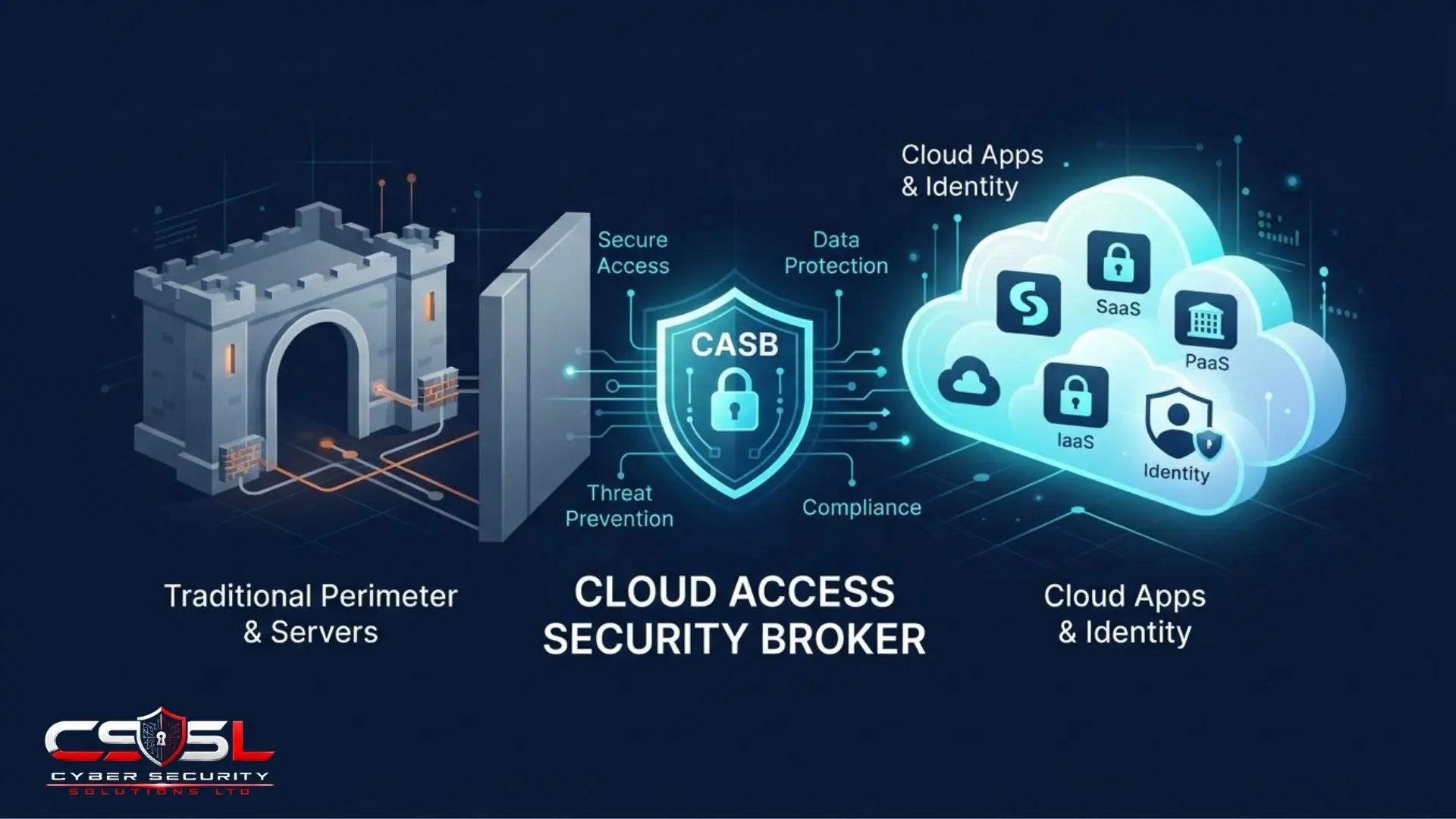
A cloud access security broker sits between your employees and every cloud service they use, watching for shadow IT, blocking risky data movement and enforcing access policy in real time. If a data leak once traced back to a cloud app nobody in IT approved, this is the tool built to close that gap.
What Is a Cloud Access Security Broker (CASB)?
A Cloud Access Security Broker, or CASB, is a security policy enforcement point sitting between cloud service users and cloud providers. It applies your organization’s security policies as employees access cloud resources, whether or not IT approved that service.
Gartner coined the term around 2012, making CASB one of the more established categories in cloud security, predating CSPM, SSPM and CIEM by roughly seven years. It emerged because employees started adopting SaaS tools on their own, and organizations lost visibility they once had under traditional IT.
In one sentence, a CASB gives you a single point to see, govern and protect data as it moves to, from and between cloud services.
Why Did CASB Emerge, and How Does It Fit Alongside Newer Cloud Security Tools?
Posture tools like CSPM and SSPM assess configuration and entitlement state, producing a snapshot of how secure your environment looks right now.
CASB is a genuinely different category. Instead of assessing state, it monitors and controls active traffic and data flow, working closer to a checkpoint than an auditor.
This matters for buyers. Teams with strong CSPM and SSPM coverage sometimes assume they have no remaining SaaS visibility gap. None of those posture tools can discover an application they were never connected to in the first place. That is precisely the gap CASB closes.
What Are the Four Pillars of CASB, According to Gartner?
Gartner defines CASB around four pillars: visibility, compliance, data security and threat protection. Together they cover how a CASB sees, governs and defends cloud usage.
- Visibility: discovering all cloud service usage, including shadow IT applications IT never approved or knew existed
- Compliance: extending regulatory and internal policy coverage to third party SaaS platforms outside traditional compliance tooling
- Data security: applying data loss prevention to data moving to, from and between cloud services
- Threat protection: detecting malware, compromised accounts and unusual behavior across cloud services, including files that could sync automatically to other users
How Does a CASB Work?
CASB works through four deployment modes. Forward proxy and reverse proxy sit inline for real time enforcement. API based mode connects to cloud provider APIs after the fact. Log collection mode analyses existing logs to find shadow IT.
| Mode | How It Works | Real-Time Enforcement | Device Requirement | Best Use Case |
| Forward proxy | Routes traffic inline via agent, proxy file or VPN | Yes | Client-side setup needed | Managed devices needing live blocking |
| Reverse proxy | Redirects auth flow via SAML, no device setup | Yes | None | Unmanaged and BYOD devices |
| API-based | Connects to provider APIs, checks after the fact | No | None | Broad sanctioned SaaS coverage |
| Log collection | Analyses firewall and proxy logs against known domains | No | None | Ongoing shadow IT discovery |
Most competitor explanations list these four modes as options to pick between, missing the point. Each mode closes a different gap, and relying on only one leaves a predictable hole.
Forward proxy needs client side setup, an agent, a proxy file or a VPN tunnel, buying real time blocking at the cost of deployment overhead. Reverse proxy needs no device configuration, typically redirecting the authentication flow through SAML, which is why it suits unmanaged and BYOD devices.
API mode is fast and broad, similar in spirit to agentless scanning elsewhere in cloud security, but it reads logs after the fact, leaving a gap between an action and the CASB knowing about it. Log collection checks existing logs against known cloud domains, catching services nobody told the CASB to look for.
A mature deployment combines several modes: inline for real time blocking, API for broad sanctioned coverage, log based for ongoing discovery. Pick only one, and its blind spot becomes permanent.
What Is a Cloud Security Gateway, and Is It the Same as a CASB?
Cloud security gateway is used inconsistently across the industry. Sometimes vendors mean it as a plain synonym for CASB. Sometimes they mean a broader bundle of CASB and secure web gateway capability together. There is no single settled definition.
Here is the one distinction that matters: scope. A Secure Web Gateway, or SWG, is a general purpose tool covering all web browsing activity, not just cloud services. CASB is purpose built and scoped specifically to cloud service usage: SaaS, IaaS and PaaS.
Many vendors now bundle CASB and SWG together under a cloud security gateway label. Both capabilities are increasingly being absorbed into a broader SASE architecture, alongside ZTNA and SD-WAN.
If a vendor pitches you a cloud security gateway, ask directly whether that means CASB alone, CASB plus SWG, or a full SASE platform. The label alone will not tell you, and the gap between those answers is significant for budget and scope.
SASE and SWG architecture deserve their own treatment elsewhere. For this guide, know which one you are actually buying before you sign.
How Does CASB Differ From SSPM and CSPM?
CSPM assesses cloud infrastructure configuration. SSPM assesses SaaS application configuration. Both produce a snapshot view. CASB monitors actual usage and data flow in real time, and can discover cloud applications nobody has told it about at all.
| Criteria | CASB | SSPM | CSPM |
| What it assesses | Traffic and data flow | SaaS configuration | Infrastructure configuration |
| Discovers unknown apps | Yes | No | No |
| Real-time enforcement | Yes, in proxy modes | No | No |
| Deployment model | Proxy, API, log-based | API-based | API-based |
| Related post | This guide | SSPM vs CSPM | What Is CSPM |
This is the part most explanations skip. SSPM can only assess an application already connected to it. Someone has to hand it API access before it can check a single setting.
CASB does not need that. Its log collection mode reads existing logs and matches traffic against a database of known domains, finding an app nobody in IT ever configured it to look for.
CSPM has the identical limitation, just aimed at infrastructure instead of SaaS. No posture tool in this cluster can replicate CASB’s ability to find what it was never told about.
Once an application is known, CASB and SSPM both apply policy to it from different vantage points. CASB watches traffic and data movement; SSPM checks configuration state. Strong programmes run both.
What Problems Does CASB Solve That Other Cloud Security Tools Do Not?
CASB solves four problems other tools cannot. It discovers shadow IT nobody has told it about, blocks sensitive data moving between cloud services, applies access policy based on device and risk in real time, and extends real control to unmanaged and BYOD devices.
The stakes are real. IBM’s Cost of a Data Breach Report found that a fifth of breached organizations were compromised through unsanctioned tools employees adopted without security sign off, adding roughly $670,000 to the average breach. Visibility is not optional at that price.
Cross cloud data loss prevention is the standout example. Picture a file downloaded from a sanctioned app and re-uploaded to a personal cloud account. CSPM, SSPM and DSPM assess state, not transit, so none of them see that movement. CASB does. This is one of the most common gaps Cyber Security Solutions Ltd finds when reviewing a client’s DLP coverage.
What Are the Leading CASB Tools and Solutions Available in 2026?
Leading CASB options in 2026 include Microsoft Defender for Cloud Apps, tightly integrated with Microsoft Entra ID and Microsoft 365, Netskope, Palo Alto Networks through its Prisma SASE platform, Broadcom following its Symantec acquisition, and Skyhigh Security, formerly McAfee CASB.
As with CSPM, DSPM and CIEM, CASB is increasingly consumed as part of a broader platform rather than bought standalone, most often within a SASE package bundling CASB, SWG and ZTNA.
When evaluating a tool, check the breadth of SaaS connectors, how current the shadow IT database is, whether it supports all three deployment modes, and how deeply it integrates with your existing DLP and identity systems.
What Are the Limitations of CASB, and Where Is the Market Heading?
Full, real time coverage across every device typically needs forward proxy deployment, bringing back the same overhead agent based tools carry elsewhere.
API mode, fastest to deploy, introduces a gap between an action happening and the CASB becoming aware of it, since it never sits inline with live traffic.
Shadow IT discovery is only as reliable as the vendor’s domain database and your log completeness. Genuinely new or niche services can slip through undetected.
Gartner increasingly frames CASB as one piece of a broader SASE architecture rather than a standalone category, part of a platform rather than a lifetime standalone purchase.
How Do You Implement CASB Step by Step?
Implementing CASB starts with a shadow IT discovery scan using existing logs, before you pick a tool. Connect sanctioned apps through API first, layer in proxy deployment where real time enforcement matters, then keep reviewing shadow IT findings on an ongoing basis.
- Run a shadow IT discovery scan using existing firewall and proxy logs before designing any policy. You cannot govern applications you do not know are in use.
- Select a CASB matched to your primary need: strong API mode coverage for SaaS heavy environments, or strong proxy support where real time enforcement matters most.
- Connect the CASB to your primary sanctioned SaaS applications through API integration first, establishing baseline DLP and threat protection.
- Review shadow IT findings and make deliberate sanctioning decisions. Block genuinely risky apps and integrate the business justified ones, rather than blocking everything on sight.
- Layer in proxy based deployment for scenarios that need real time enforcement instead of after the fact detection.
- Define and test DLP policy specifically for cross cloud data movement, the gap most unique to CASB in this cluster.
- Establish ongoing review of shadow IT findings, since new unsanctioned app adoption never really stops.
Step one is the same discovery-first approach experienced security teams use before recommending any CASB policy or vendor.
Conclusion
CASB is not a newer alternative to CSPM or SSPM. It is an older, complementary category built for a different job: watching what actually moves, not just what is configured. Most mature security programmes need all three, plus a clear view of where SASE convergence is heading next. To see exactly which cloud applications your organization is really using, sanctioned and unsanctioned, visit cybersecuritysolutionsltd.com for a free shadow IT discovery scan from Cyber Security Solutions Ltd.
FAQs
No. A firewall controls network traffic broadly, based on ports, protocols and IP addresses. A CASB is purpose built for cloud service access: discovering shadow IT, applying data loss prevention to cloud data flows, and enforcing adaptive access policy based on device, location and risk.
SSPM assesses the configuration of SaaS applications it already knows about, essentially a snapshot check. CASB monitors real time traffic and data flow and can discover applications nobody in IT has ever configured it to look for, through log analysis. Shadow IT discovery is the key distinguishing capability.
Mainly through log collection mode, which analyses existing logs against a database of known cloud service domains. This finds applications employees are using that IT never approved, unlike API based mode, which only sees apps already connected to the CASB.
Not replaced, but increasingly absorbed. Gartner and other analysts now frame CASB as one component within broader SASE architecture, alongside secure web gateway and ZTNA capability, rather than a standalone category. Expect to buy CASB as part of a platform going forward, not as a lifetime standalone product.
Yes, mainly through reverse proxy mode, which needs no software installed on the device. It typically redirects the authentication flow through the CASB, which is why it suits personal phones and laptops where installing an agent is not possible or not allowed under BYOD policy.
For most organizations, yes. CASB and SSPM cover different vantage points. CASB observes traffic and finds unknown applications. SSPM checks the configuration of applications you already know about in far more depth. Strong programmes typically run both rather than treating one as a substitute.