Cloud Security Fundamentals: What Every Business Must Understand
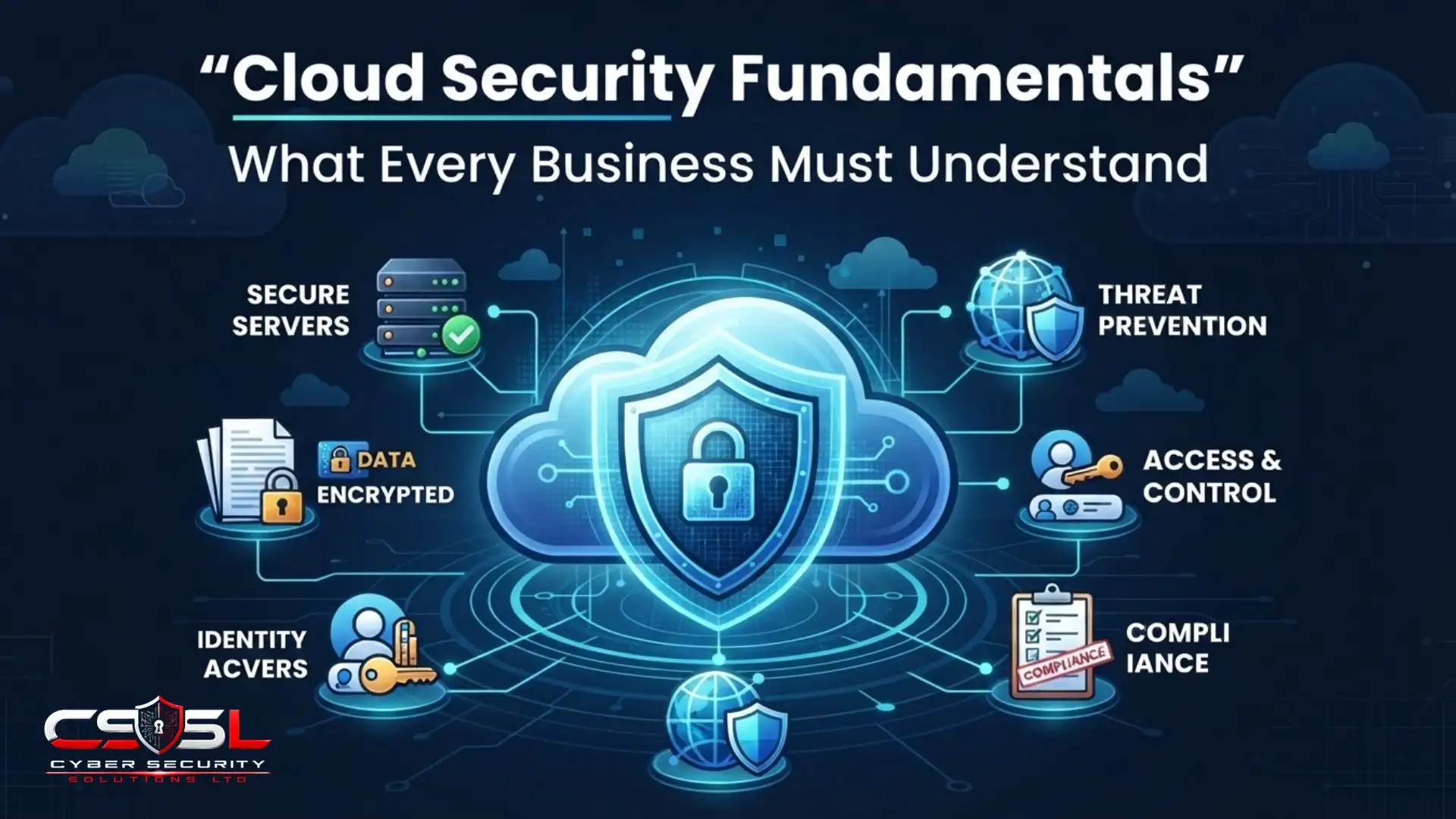
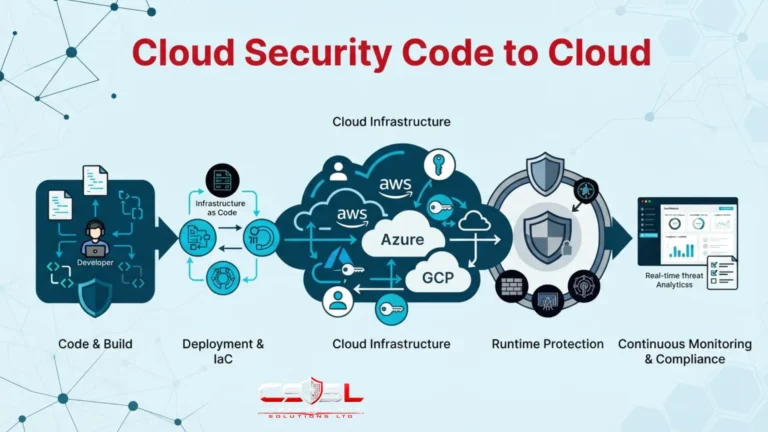
Cloud security fundamentals are the core domains, principles, and structural models that underpin every specific cloud security decision, covering identity and access management, data security, infrastructure protection, threat detection, compliance governance, and the shared responsibility model that defines who is accountable for what.
If your IT team has various cloud security tools but no coherent understanding of how they fit together, or you want to build a cloud security programme but lack a framework to organize it around, this guide gives you the mental model that makes every subsequent security decision coherent rather than disconnected.
What Are the Core Fundamentals of Cloud Security?
Cloud security fundamentals are the foundational concepts, structural models, and core principles that underpin every specific cloud security control, tool, and policy decision. They provide the mental model that makes each security choice coherent rather than isolated from everything else.
Organizations that invest in cloud security tools without a solid understanding of the underlying principles often end up with fragmented, inconsistent protection and significant hidden gaps. Tools only make sense in the context of the domain structure and principles they are designed to address. A firewall configured without understanding network segmentation principles, or MFA deployed without understanding identity as the primary cloud security boundary, addresses symptoms rather than the structural problems that create real-world cloud breaches.
This post covers three interconnected layers: the key domains covering what areas cloud security addresses, the core principles explaining how to think about each decision, and the foundational models providing the frameworks that organize the whole programme. See What Is Cloud Security? A Plain-English Guide for Businesses for the plain-English starting point this post builds on.
What Are the Main Cloud Security Domains?
Cloud security addresses seven distinct domains, each covering a different area of the cloud environment that requires its own specific controls and disciplines.
| Domain | What It Covers | Primary Principle | Foundational Control |
| Identity and access management | Who can access what cloud resources | Least privilege | MFA and centralized identity provider |
| Infrastructure security | Virtual servers, storage, networking | Defence in depth | Configuration management and segmentation |
| Data security | Data at rest, in transit, in use | Confidentiality and integrity | Encryption and data classification |
| Application security | Cloud apps, APIs, dev pipelines | Shift left | Vulnerability scanning, secure API auth |
| Threat detection and response | Anomalous behavior and active attacks | Assume breach | Audit logging and anomaly detection |
| Compliance and governance | Regulatory requirements and policies | Accountability | Documented controls and audit evidence |
| Security posture management | Configuration accuracy across the environment | Continuous improvement | Automated misconfiguration monitoring |
Identity and access management governs who can access which cloud resources, under what conditions, and from which devices. The removal of the traditional network perimeter makes identity the primary security boundary in cloud environments, making IAM the most fundamental domain of all.
Infrastructure security covers the security of virtual servers, storage, networking, and compute resources within cloud environments. Data security protects information at rest, in transit, and in use across cloud services and applications. Application security secures cloud-native and cloud-hosted applications, APIs, and development pipelines. Threat detection and incident response monitors cloud environments for anomalous behavior and enables effective response. Compliance and governance ensures cloud environments meet regulatory requirements including GDPR, HIPAA, and PCI DSS. Security posture management continuously identifies and remediates misconfigurations before they are exploited.
The Cloud Security Alliance Security Guidance for Critical Areas of Focus in Cloud Computing, alongside NIST SP 800-144 on security in public cloud computing, organizes cloud security at greater technical depth for those seeking comprehensive reference frameworks.
What Are the Fundamental Principles of Cloud Security?
Five core principles underpin every specific cloud security decision across all seven domains.
Least privilege means every user, application, and service should have only the minimum permissions necessary to perform its specific function. In cloud environments, overly permissive identity roles are one of the most common and dangerous misconfigurations, since excessive permissions turn any single compromised account into an attack path through everything that account can reach.
Defense in depth means no single control, however effective, should be the sole protection against any given risk. Cloud security applies multiple overlapping controls across different domains so that the failure of any one control does not create an undefended gap.
Assume breach means designing cloud security architecture on the assumption that some controls will eventually fail and some level of compromise will occur, focusing on limiting the blast radius through segmentation, monitoring, and rapid response rather than relying entirely on prevention.
Shift left means integrating security into the earliest stages of cloud resource provisioning and application development rather than adding it as an afterthought, since security gaps are significantly cheaper and easier to address before deployment than after live systems have been in use for months.
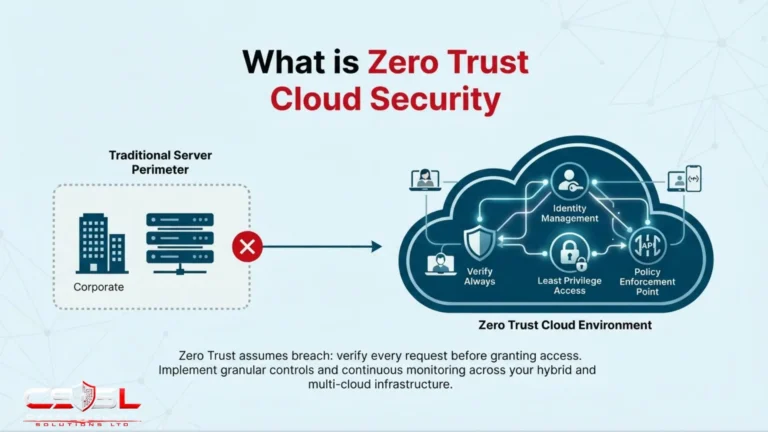
Zero trust means extending no implicit trust to any user, device, or network location simply because they are inside the cloud environment or previously authenticated, instead requiring continuous verification of identity and intent for every access request.
What Is the Cloud Security Model Every Business Needs to Understand?
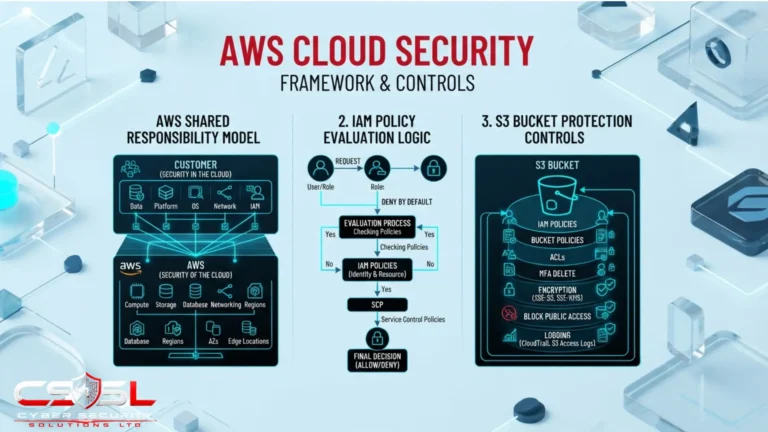
The shared responsibility model is the single most important structural concept in cloud security, defining which security responsibilities belong to the cloud provider and which belong to the customer. Misunderstanding or ignoring this model is the root cause of a significant proportion of real-world cloud breaches.
At the IaaS level, including AWS EC2 and Azure virtual machines, the provider secures the physical infrastructure and hypervisor. The customer is responsible for the operating system, middleware, applications, data, and network configuration within their virtual environment.
At the PaaS level, including AWS RDS and Azure App Service, the provider additionally secures the runtime and middleware. The customer remains responsible for application code, data, and access configuration.
At the SaaS level, including Microsoft 365, Salesforce, and Google Workspace, the provider manages the application and infrastructure. The customer is responsible for data, user access configuration, and how content is used and shared within the platform.
The critical implication: the higher up the service stack you go toward SaaS, the more the provider handles technically, but the customer never fully hands over responsibility for data and access. A misconfigured SaaS permission setting that exposes company data to unauthorized users is a customer responsibility regardless of how secure the SaaS provider’s own infrastructure is. See Cloud Security Shared Responsibility Model for the complete breakdown by service type.
How Does the CIA Triad Apply to Cloud Security?
The CIA triad, Confidentiality, Integrity, and Availability, is the foundational security framework applied across all of information security. Using it as an organizing lens makes the entire cloud security domain structure feel logically derived rather than arbitrarily listed, giving IT teams a coherent mental model rather than a memorization exercise, which is what genuinely useful foundational content provides and what most competitor articles in this space consistently fail to deliver.
Confidentiality in the cloud means ensuring that data stored, processed, and transmitted within cloud environments is accessible only to authorized users and systems. Cloud computing creates specific confidentiality challenges that traditional IT did not face at the same scale: data is accessible from anywhere by design, shared storage infrastructure creates logical separation requirements, and cloud platforms’ built-in collaboration and sharing features can expose data far more broadly than intended with a single misconfigured permission. Every identity and access management control, every encryption requirement, and every data classification policy exists as a direct response to the confidentiality risks that cloud’s inherent accessibility creates.
Integrity in the cloud means ensuring that data within cloud environments has not been improperly modified, whether by attackers, accidental user action, or system error. Cloud’s speed and scale advantages create specific integrity risks: configuration changes can propagate across an entire cloud environment in seconds, audit trails for who changed what are absent if logging is not enabled, and the number of systems and users with write access to cloud data can be dramatically larger than in a controlled on-premise environment. Audit logging, change management controls, and cryptographic verification exist specifically to address the integrity dimension, separately and alongside the confidentiality controls that receive more attention in most cloud security discussions.
Availability in the cloud means ensuring that cloud services and data remain accessible when needed, despite potential attacks, provider outages, or misconfigurations that could restrict access. This is where cloud dependency creates its sharpest business risk: organizations that have moved email, file storage, financial systems, and communication platforms to cloud services have concentrated critical operations into an environment where an availability failure stops the entire business simultaneously. Redundancy design, backup architecture, and business continuity planning exist to address this availability dimension directly.
The value of the CIA triad as a mental model is that it shows precisely why every cloud security control exists. Every encryption requirement addresses confidentiality. Every audit log and integrity check addresses the integrity pillar. Every redundancy and backup investment addresses availability. Understanding this connection makes the entire domain structure feel logically necessary rather than arbitrarily imposed by a vendor or a standards body.
What Are the Cloud Security Basics Every IT Team Must Have in Place?
Step 1: Understand the shared responsibility model for each cloud service in use, confirming exactly what the provider handles and what falls to the organization before making any other security investment decision.
Step 2: Implement multi-factor authentication and centralized identity management across all cloud accounts. A single authoritative identity provider, such as Microsoft Entra ID, Okta, or Google Workspace Directory, governing access to all cloud services provides significantly stronger control than separate, disconnected identity management per platform.
Step 3: Enable encryption for sensitive data at rest and in transit, verifying that encryption is correctly configured for all sensitive data across cloud storage, databases, and transmission paths.
Step 4: Enable cloud audit logging and retain logs long enough to support incident investigation. All activity in cloud environments, including admin actions, access events, and configuration changes, must be logged and monitored.
Step 5: Apply least privilege consistently across all user and service permissions, reviewing and removing permissions no longer needed to prevent the gradual accumulation of excessive access rights.
Step 6: Conduct a cloud security risk assessment to prioritize remaining gaps based on specific cloud services, data types, and threat exposure.
Step 7: Build domain by domain using structured content for each area, addressing each systematically rather than attempting everything at once.
How Do Cloud Security Fundamentals Differ Across IaaS, PaaS and SaaS?
| Responsibility Area | IaaS | PaaS | SaaS |
| Physical infrastructure | Provider | Provider | Provider |
| Network controls | Customer | Provider | Provider |
| Operating system | Customer | Provider | Provider |
| Application security | Customer | Customer | Provider |
| Data security | Customer | Customer | Customer |
| Access management | Customer | Customer | Customer |
IaaS security responsibilities are the broadest for the customer. Since the customer controls the operating system, applications, and network configuration, the full range of infrastructure security practices from vulnerability patching to network segmentation falls within the customer’s domain.
PaaS narrows the customer’s infrastructure responsibility. The customer focuses primarily on application security and data security, with the provider handling the underlying infrastructure and runtime layer.
SaaS is the narrowest customer responsibility but the most frequently underestimated. Since the customer controls only data, users, and configuration settings, many assume the provider handles everything. Misconfigured sharing settings, weak access controls, and unmanaged user accounts remain common customer-side vulnerabilities even in fully managed SaaS platforms.
Every cloud tool an organisation uses falls into one of these categories, and understanding which one determines exactly what the IT team is responsible for securing. See What Are the Security Risks of Cloud Computing? for the specific risks arising within each service model.
How Do You Build on These Fundamentals Into a Complete Programme?
Cloud security fundamentals are the starting point, not the destination. The domains, principles, and models covered here provide the conceptual framework. Subsequent cluster posts cover each domain and tool category in the depth needed to actually implement them.
Priority sequencing should start with identity and access management, given its status as the highest-impact and most frequently exploited domain, followed by data security for its direct regulatory exposure, then security posture management for the broadest visibility across the environment.
Cloud Security Architecture: How to Design a Secure Cloud Environment covers the structural design decisions that turn these principles into a functioning architecture. Cloud Security Best Practices: The Definitive 2026 Checklist makes the fundamentals here actionable as a concrete implementation list. A structured risk assessment translates these fundamentals into an organization-specific priority order.
Cyber Security Solutions Ltd helps organizations move from foundational understanding to a structured, prioritized cloud security programme tailored to specific cloud environments and business contexts.
Conclusion
Cloud security fundamentals provide the mental model that makes every specific control decision coherent: the domains define what to protect, the principles define how to think about each decision, and the shared responsibility model defines who is accountable for what. Building a programme without this foundation produces fragmented tools rather than integrated protection. Visit cybersecuritysolutionsltd.com for expert guidance on turning these cloud security fundamentals into a structured, prioritized programme tailored to your specific cloud environment and risk profile.
FAQs
Cloud security fundamentals are the core domains, principles, and structural models that underpin every specific cloud security decision, including identity management, data security, infrastructure protection, threat detection, compliance governance, and the shared responsibility model. They provide the mental model that makes every subsequent cloud security control coherent rather than disconnected.
The seven main cloud security domains are identity and access management, infrastructure security, data security, application security, threat detection and incident response, compliance and governance, and security posture management. Each addresses a distinct area of the cloud environment requiring its own specific controls and expertise.
The CIA triad stands for Confidentiality, Integrity, and Availability, the three core properties cloud security controls are designed to protect. Confidentiality ensures data is accessible only to authorized users, integrity ensures data has not been improperly modified, and availability ensures services remain accessible when needed. Every cloud security control addresses one or more of these properties.
Least privilege is foundational, ensuring users and systems have only the minimum permissions necessary to function. Assume breach is equally critical for resilience, ensuring security architecture limits damage even when prevention fails. Together they address the most common and costly real-world cloud security failure patterns documented in CSA and Verizon DBIR research.
IaaS gives customers the broadest responsibility, covering operating system, applications, and network configuration. PaaS narrows this to application and data security. SaaS leaves customers responsible only for data, user access, and configuration settings, though customers never fully hand over data and access responsibility regardless of service model.
Start with the shared responsibility model to confirm exactly what your provider handles, then implement MFA and centralized identity management as the highest-impact immediate control. Enable encryption verification and audit logging next. A formal cloud security risk assessment then prioritizes remaining gaps based on your specific cloud services and threat exposure.