Cloud Security Risk Assessment: Step-by-Step Guide for Businesses
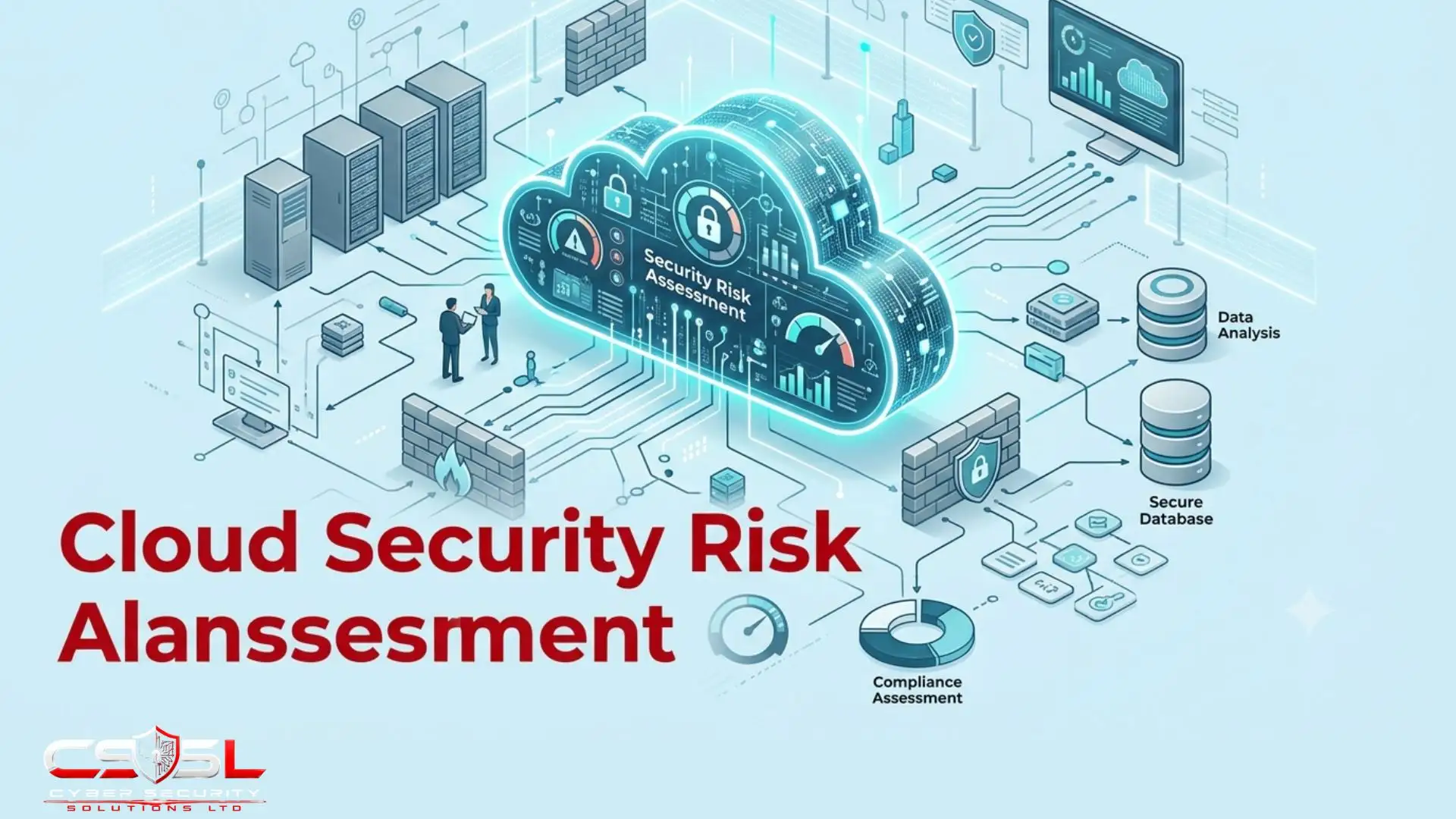
A cloud security risk assessment identifies, scores and prioritizes threats by likelihood and business impact, distinct from an audit, which checks conformance against a fixed standard instead. If you have a long list of cloud risks from various tools but no way to tell which ones actually matter most, this guide gives you the scoring process to find out.
What Is a Cloud Security Risk Assessment, and How Is It Different From an Audit?
This is a structured process for identifying, scoring and prioritizing threats by likelihood and business impact. An audit checks conformance against a defined standard, with no equivalent standard checked against here.
A system can pass every audit against existing policy while still representing significant, unaddressed risk, simply because no existing policy happens to address that specific exposure. That is the value this process delivers that an audit structurally cannot.
Earlier posts in this series have each referenced this methodology as an input without ever delivering it in full. This is that delivery.
What Is the Cloud Security Risk Universe You Are Assessing?
The existing risk catalogue, misconfiguration, identity and credential attacks, insecure APIs, accidental oversharing, supply chain risk, AI powered credential attacks, cloud adapted ransomware, is the fixed input this process scores. It is not re-explained here.
CSA’s Top Threats to Cloud Computing research is the evolving external reference this risk universe should be checked against periodically, since new threat patterns emerge faster than any static list can capture.
No organization faces every risk in that catalogue with equal likelihood or impact. That catalogue told you what the risks are. This section, and everything after it, establishes which of those risks actually matter for your environment.
How Do You Identify and Scope Threats Specific to Your Own Environment?
Start with an asset inventory, since you cannot assess risk to a resource you do not know exists. This connects directly to the visibility gap named earlier in this series, and the inventory building function CSPM already provides.
Walk through your architecture’s zones, or the 4 Cs rings, systematically rather than treating the environment as one undifferentiated whole, stepping through each to identify where each catalogued risk type could realistically materialize.
Scope using the shared responsibility model too, deliberately excluding risks that sit entirely on the provider’s side of the line, physical data centre security, hypervisor integrity, focusing limited effort on what the organization can actually influence and treat. Categorize threat sources as you go: external attackers, malicious insiders, accidental human error and third-party or supply chain sources.
How Do You Score Likelihood in a Cloud Context?
Likelihood scoring is genuinely harder in cloud than in static, traditional environments. Configuration drifts constantly, so likelihood is not a fixed, one time judgement, it shifts as your environment changes.
| Score Level | Likelihood Criteria | Impact Criteria |
| Low | No known exploitable technique or confirmed finding | Minimal disruption, no sensitive data involved |
| Medium | Known technique exists, no confirmed exploitable finding yet | Limited disruption or non-sensitive data exposure |
| High | Actively exploited technique with a confirmed, exploitable finding | Significant disruption or sensitive data exposure |
| Critical | Actively exploited technique, confirmed finding, high-value target | Severe financial, regulatory or reputational consequence |
Ground likelihood in actual telemetry rather than pure guesswork. CSPM findings, CIEM entitlement data and threat intelligence all provide objective evidence that should inform a score, rather than relying on an assessor’s subjective impression alone.
Here is the concrete criterion that separates a defensible score from a guess two different assessors would rate completely differently. High should require an actively exploited technique combined with a confirmed, exploitable finding already present in your environment, not a theoretical possibility alone. Medium might mean a known technique exists but no confirmed exploitable finding sits in your environment yet. This kind of evidence-anchored definition is what most competitor content skips, offering vague labels with no criteria attached.
A simple Low, Medium, High, Critical scale works well, provided each level has defined, concrete criteria rather than a vague label left to individual interpretation. Without that anchoring, the same risk gets scored differently by different people on your team, and nobody trusts the resulting numbers.
How Do You Score Business Impact?
Impact means business consequence, not just technical severity. Score financial cost, operational disruption, regulatory exposure and reputational harm, referencing real breach cost data rather than guessing at a number.
The CIA triad, confidentiality, integrity and availability, is the structuring tool for impact scoring. Score each independently for a given resource, rather than collapsing everything into one vague severity rating that hides which specific consequence matters most.
DSPM’s specific contribution here is knowing exactly what sensitive data a resource actually holds. That is what allows impact to be scored accurately rather than assumed, extending the same toxic combination logic already established elsewhere in this series.
How Do You Calculate and Prioritize Overall Risk?
Risk is a function of likelihood and impact together, visualized through a risk matrix or heat map that immediately surfaces which combinations demand attention first.
This is the exact methodology referenced earlier in this series for scoring the seven cloud security domains against risk and maturity for sequencing purposes. The formula does not change. Only the subject being scored does.
The risk register is the living, practical output: a structured, maintained log of identified risks, scores, named owners and treatment status. It is distinct from, but feeds directly into, the audit findings tracker covered elsewhere in this series.
Qualitative vs Quantitative Risk Assessment: Do You Need FAIR?
Qualitative scoring, Low, Medium, High, Critical, is fast and accessible but prone to inconsistency between assessors. FAIR, Factor Analysis of Information Risk, is an established quantitative methodology translating risk into estimated monetary loss ranges instead.
| Criteria | Qualitative Scoring | Quantitative (FAIR) |
| Speed | Fast | Slower, more analysis-intensive |
| Consistency between assessors | Prone to inconsistency | More consistent, evidence-driven |
| Output format | Relative label (Low to Critical) | Estimated monetary loss range |
| Best suited for | The full risk register | Highest-priority risks specifically |
Most competitor content on this exact topic never reaches this depth. FAIR is an established, industry recognized methodology, maintained by the FAIR Institute, translating risk into estimated monetary loss ranges rather than a relative label. Instead of “high,” it gives you a range, an estimated annual loss exposure between two specific dollar figures.
Here is the direct forward connection worth stating plainly. Quantified, monetary risk output is precisely the input a defensible, cost avoidance business case for security investment requires. A red amber green rating does not survive a budget conversation with a finance director the way an estimated dollar range does.
Practical guidance, not an absolutist rule: most organizations should start with qualitative scoring across the full risk register, then apply FAIR selectively to their highest-priority risks only. Attempting full quantitative analysis across every catalogued risk simultaneously rarely justifies the time investment.
How Do You Treat, Accept, Transfer or Avoid Identified Risks?
Four options apply. Treat means implementing a specific control, such as enforcing MFA in direct response to a credential risk finding. Accept means a conscious, documented decision with named executive sign off. Transfer means cyber insurance or a contractual arrangement. Avoid means declining to adopt a specific risky configuration or service at all.
Transfer needs particular care in cloud specifically, and this is the caveat most content skips entirely. Identity and data responsibility never fully transfers to a provider regardless of contractual language. That means transfer as a treatment option addresses financial consequence, not the underlying operational responsibility itself.
Picture what this means in practice. Your organization buys cyber insurance covering a specific class of cloud incident. A credential based breach occurs anyway. The insurance pays out for the financial damage. It does not retroactively fix the excessive permissions or missing MFA that let the breach happen, and it does not stop the same exposure from causing the same breach again next year.
An insured breach is still a breach. Treat transfer as addressing the bill, not the exposure, and pair it with genuine treatment for anything with meaningful likelihood of recurrence, rather than treating a signed insurance policy as though the underlying risk has been closed.
What Makes Cloud Risk Assessments Genuinely Difficult?
Four pitfalls recur constantly. Treating the assessment as a single, point-in-time exercise in a continuously changing environment repeats the same one-time project failure pattern already named for IAM and strategy elsewhere in this series, now at the assessment level.
Purely subjective likelihood scoring with no reference to actual CSPM, CIEM or DSPM evidence produces inconsistent, unreliable results that do not hold up to later scrutiny.
Conflating raw alert volume with genuine risk priority is a specific, common trap. Teams flooded with CSPM and CIEM findings sometimes mistake sheer quantity of alerts for actual risk ranking, when a genuine assessment weights by likelihood and impact together, not alert count alone.
Producing a risk register nobody actively tracks to treatment delivers documentation without the risk reduction the exercise was meant to achieve. An unactioned risk register is the single most common finding Cyber Security Solutions Ltd encounters when reviewing a client’s previous assessment.
How Do You Conduct a Cloud Security Risk Assessment Step by Step?
Conducting an assessment starts with scoping via shared responsibility, confirming your asset inventory from existing CSPM, DSPM and CIEM data, identifying threats against the existing catalogue, scoring likelihood from telemetry, scoring impact via the CIA triad and DSPM, calculating a prioritized risk register, deciding treatment with named owners, and tracking to closure on an ongoing cadence.
- Define scope, using the shared responsibility model to focus effort on what is genuinely the organization’s to assess and treat.
- Build or confirm your asset inventory, drawing on existing CSPM, DSPM and CIEM data rather than starting from a manual list.
- Identify threats and vulnerabilities against that inventory using the existing risk catalogue and your own architecture as structured reference points.
- Score likelihood for each identified risk, grounded in available telemetry rather than assumption alone.
- Score impact using the CIA triad plus DSPM data on actual data sensitivity and any relevant compliance exposure.
- Calculate overall risk and build a prioritized risk register or heat map.
- Decide treatment for each risk, treat, accept, transfer or avoid, assigning a named, accountable owner.
- Report findings to governance stakeholders and track treatment to closure on a regular, ongoing cadence rather than as a one-off exercise.
Conclusion
A cloud security risk assessment is not a report you produce once and file away. It is a living process that gets more accurate every time you feed it fresh telemetry instead of a guess. Score by likelihood and impact together, treat the highest priorities first, and revisit the register on a real cadence, not just when an auditor asks for it. To get an independent assessment that scores your actual environment rather than relying on generic checklists or raw alert volume, visit cybersecuritysolutionsltd.com for expert support from Cyber Security Solutions Ltd.
FAQs
No. An audit checks conformance against a defined standard, producing a pass or gap-based finding. A risk assessment identifies and prioritizes threats by likelihood and impact with no fixed standard being checked against. A system can pass every audit while still carrying significant, unaddressed risk.
Treating it as a single, one-time exercise is a common pitfall, since cloud environments change continuously. Revisit the assessment on a regular, ongoing cadence, and specifically whenever architecture changes materially, a new service gets adopted, or existing CSPM and CIEM findings shift significantly.
A risk register is a structured, maintained log of identified risks, their likelihood and impact scores, named accountable owners and current treatment status. It is the living output of the assessment process, and it only delivers value if someone actively tracks it toward treatment.
Most organizations should start with qualitative Low, Medium, High, Critical scoring across the full risk register, since it is fast and accessible. Apply FAIR’s quantitative, monetary methodology selectively to your highest-priority risks only, particularly where you need a dollar figure to justify security spend.
Only the financial consequence. Identity and data responsibility never fully transfers to a provider or insurer regardless of contractual language. Transfer as a treatment option addresses the cost of a breach, not the underlying operational exposure, which still requires its own direct treatment.
Because raw alert volume gets mistaken for risk priority. A genuine assessment weights each finding by likelihood and impact together, not by how many alerts exist. High alert counts can include many low-priority findings alongside a small number of genuinely critical ones.