Public Cloud vs Private Cloud Security: Which Is More Secure?
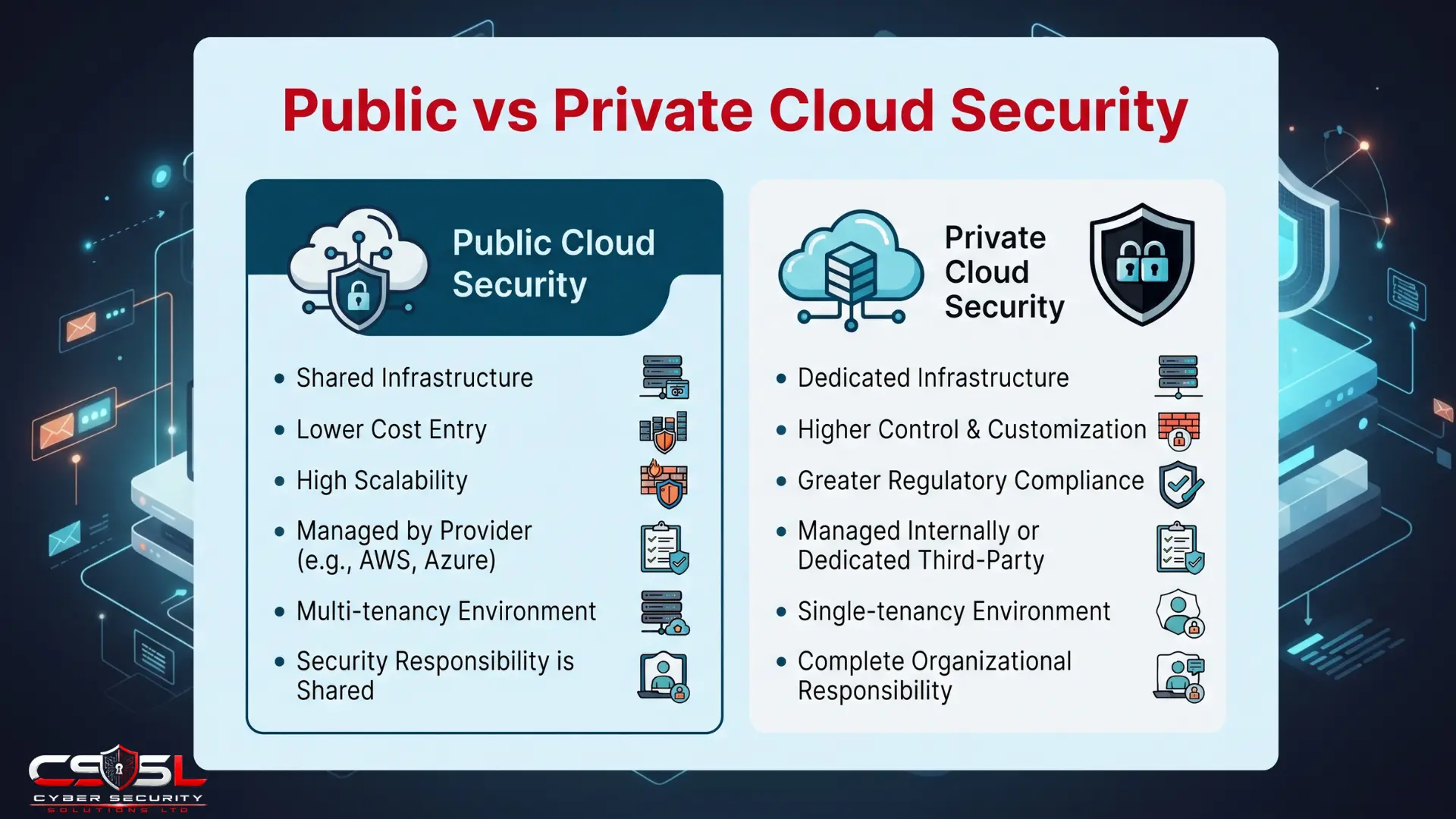
Neither side of the public vs private cloud security debate wins universally. Public cloud eliminates infrastructure management but introduces multi-tenancy risk. Private cloud eliminates that shared-tenancy exposure but requires matching a hyperscaler’s own security engineering independently. If you were told private cloud is automatically more secure, this guide explains exactly where that intuition holds and where it does not.
What Is the Difference Between Public and Private Cloud?
Public cloud is infrastructure provisioned for open use, existing on the provider’s own premises and shared across many customers. Private cloud is infrastructure provisioned for exclusive use by a single organization, which may exist on or off that organizations own premises. Both definitions come directly from NIST SP 800-145.
This is the second post in a short series on deployment models. Hybrid cloud was covered previously; this post covers the private versus public axis directly; multi-cloud comes next.
Here is the reframe this guide commits to, stated now rather than as a closing hedge. Security outcomes depend far more on configuration quality, tooling maturity and skilled operation than on deployment model alone. A well-configured public cloud environment with mature CSPM and CIEM coverage routinely outperforms a poorly-resourced private cloud, and the reverse is equally true.
Private cloud’s single-tenancy intuitively feels more secure, and this guide takes that intuition seriously rather than dismissing it. The sections ahead address exactly where it holds and where it does not.
Before comparing public and private cloud specifically, here is the full four-model taxonomy NIST actually defines.
| Deployment Model | Tenancy | Typical Hosting | Related Guide |
| Private cloud | Single organization | On-premises or third-party hosted | This guide |
| Public cloud | Multiple customers, shared | Provider’s own premises | Shared Responsibility guide |
| Community cloud | Defined group with shared concerns | Shared or third-party hosted | Briefly covered below |
| Hybrid cloud | Mixed, spans models | Combination of the above | Hybrid Cloud guide |
How Is Private Cloud Different from the Traditional On-Premise IT Already Contrasted in This Cluster?
Traditional on-premise IT lacks cloud characteristics entirely: no self-service provisioning, no software-defined infrastructure, no elastic pooling of virtualized resources, as established elsewhere in this series.
Private cloud adds exactly those characteristics on top of traditional infrastructure: self-service provisioning portals, virtualization and software-defined networking, and resource pooling that behaves elastically within an organization’s own owned capacity. Private cloud sits genuinely between that traditional baseline and public cloud, not as a synonym for “our own servers.”
This distinction matters for buyers specifically. An organization still describing traditional, non-virtualized infrastructure as “private cloud” is asking a different question than one asking about a genuine private cloud platform, and conflating the two leads to mismatched vendor conversations.
Where Does Community Cloud Fit?
Community cloud is infrastructure provisioned for exclusive use by a specific community of organizations sharing common concerns, such as compliance requirements or mission. It closes out the full four-model taxonomy this series opened with.
It gets named briefly here rather than given dedicated treatment because it sits conceptually closest to private cloud, similarly restricted access rather than open to the general public. That makes this the most natural home for a short, honest acknowledgment rather than a forced, thin standalone post.
Government-community and healthcare-community cloud arrangements shared across a defined set of eligible organizations are the real-world examples worth naming, distinct from both a single-tenant private cloud and an open public cloud.
What Security Risks Does Public Cloud’s Multi-Tenancy Introduce That Private Cloud Eliminates by Design?
Multi-tenancy risk means multiple customers’ workloads share the same underlying physical hardware on public cloud, separated only by the hypervisor and software-defined isolation layers.
Cross-tenant and side-channel risk describes theoretical and demonstrated attack classes exploiting shared physical resources, CPU cache, memory, to leak information across tenant boundaries. This is a risk category that simply cannot exist on genuinely single-tenant private cloud infrastructure by architectural design. No shared hardware means nothing to leak across.
Here is why this matters specifically for how you should think about the single-tenancy intuition. Hyperscalers invest heavily in hypervisor isolation precisely because of this risk category. The isolation boundary already described elsewhere in this series as the provider’s own “security of the cloud” responsibility exists largely to contain exactly this exposure. Public cloud customers are trusting the provider’s own isolation engineering rather than eliminating the underlying shared-hardware condition entirely.
Named directly, this is the specific risk category the “private cloud is safer” intuition is actually responding to. Naming it precisely, rather than gesturing at single-tenancy vaguely, is what lets you weigh it honestly against what private cloud gives up in return, covered next.
What Security Risks Does Private Cloud Introduce That Hyperscaler Infrastructure Doesn’t?
Eliminating multi-tenancy risk does not mean eliminating risk. It means trading it for a different set of exposures the organization now owns entirely itself.
AWS, Azure and Google Cloud each employ security teams and invest in physical and infrastructure-layer protections at a scale few organizations can realistically replicate for their own private cloud platform.
Reduced geographic redundancy is a direct extension of a concentration-risk trade-off named elsewhere in this series. A self-hosted private cloud typically runs from a small number of an organization’s own data centers, lacking the global, multi-region redundancy a hyperscaler offers by default. Private cloud can trade systemic hyperscaler-concentration risk for a more acute single-point-of-failure risk instead. Slower security patching rounds this out, since private cloud updates depend entirely on the organization’s own operational discipline.
How Does Shared Responsibility Change Across Three Deployment Types, Not Two?
A fully self-owned, on-premise private cloud carries no shared responsibility boundary at all. The organization is fully responsible for every layer, exactly as in the traditional-IT baseline, simply delivered through cloud-like self-service tooling.
| Criteria | Public Cloud | Self-Owned Private Cloud | Hosted Private Cloud |
| Tenancy model | Multi-tenant, shared hardware | Single-tenant, fully owned | Single-tenant, third-party operated |
| Cost structure | Operational expenditure | Capital expenditure | Mixed, often subscription |
| Shared responsibility split | Provider secures infrastructure | No split; organization owns everything | Host manages hardware and hypervisor |
| Tooling coverage | Native, hyperscaler-built support | Often outside native coverage | Depends on host’s platform |
| Skills required | Hyperscaler-specific expertise | Platform engineering (VMware, OpenStack, Nutanix) | Blend of both |
A hosted or managed private cloud, infrastructure owned and operated by a third party but dedicated exclusively to one customer, introduces a genuine, distinct shared responsibility split. This is different in character from the public cloud model, since there is no multi-tenant infrastructure to secure, but the hosting party still typically manages the underlying hardware and hypervisor.
Public cloud’s existing shared responsibility model, covered fully elsewhere in this series, applies unchanged here.
Many organizations describe their environment simply as “private cloud” without recognizing which of these two genuinely different responsibility models actually applies to their specific arrangement. That gap between the label and the actual arrangement is exactly where accountability quietly falls through the cracks during an incident.
Does Your Existing CSPM, CWPP and DSPM Tooling Work on a Private Cloud Platform?
Most cloud-native posture and workload tools are built as agentless, API-driven services against hyperscaler-specific endpoints. A VMware Cloud Foundation, OpenStack or Nutanix-based private cloud platform frequently sits entirely outside their native coverage.
This is a direct extension of an argument already made for hybrid environments generally in this series, now applied to named private cloud platforms specifically. VMware Cloud Foundation is Broadcom’s current flagship private cloud platform, following Broadcom’s 2023 acquisition of VMware, a consolidation worth flagging directly. OpenStack remains the leading open source private cloud platform. Nutanix offers hyperconverged infrastructure with its own cloud-like management layer.
Here is the practical verification question every private cloud operator should ask directly. Does a given CNAPP platform offer a genuine, dedicated connector for this specific private cloud platform, or does coverage require a separate agent-based deployment with materially different depth than the same vendor’s hyperscaler-native coverage?
Assuming coverage without verifying it recreates the exact pattern already warned against for hybrid environments elsewhere in this series. A cloud security tool’s marketing claim does not automatically mean genuine, equal-depth coverage of a private cloud platform specifically.
Is “Government Cloud” Private Cloud? Resolving a Common Point of Confusion
AWS GovCloud, Azure Government and Google Cloud’s Assured Workloads are dedicated, isolated public cloud regions restricted to authorized government and government-adjacent customers, not true single-tenant private cloud.
This distinction matters practically because these regions still operate on hyperscaler multi-tenant infrastructure, shared among authorized customers rather than dedicated to one organization. That means the public cloud shared responsibility model, not the private cloud models developed above, continues to apply.
The closest genuine parallel is community cloud, named earlier. A government cloud region restricted to a defined community of eligible customers functions conceptually closer to that model than to true, single-tenant private cloud.
How Do Cost, Skills and Control Trade-Offs Actually Compare?
Private cloud typically requires significant upfront capital investment in owned hardware and licensing. Public cloud’s consumption-based pricing shifts cost toward ongoing operational expenditure instead.
Building and operating a private cloud platform is the furthest point on the “build” end of the build-versus-buy spectrum already established in this series.
Two distinct, equally scarce but genuinely different skills markets exist here. Private cloud requires specialized VMware, OpenStack or Nutanix platform engineering expertise. Public cloud requires the hyperscaler-specific expertise discussed elsewhere in this series, meaning the skills gap named generally earlier manifests as two different hiring problems depending on which path an organization chooses.
Depth of control is private cloud’s most defensible advantage: full control over physical infrastructure, network design and hypervisor configuration, relevant where regulatory or contractual requirements demand infrastructure control public cloud’s shared model cannot offer.
So Which Is Actually More Secure, and How Do You Choose for Your Organization?
Neither model is inherently more secure. A well-resourced, properly configured deployment of either model outperforms a poorly-resourced deployment of the other, making the deployment model itself a less decisive factor than operational maturity. The public vs private cloud debate matters less than how well either one actually gets run.
Choose private cloud where regulatory or contractual control requirements are genuinely non-negotiable and the organization can realistically resource specialist platform engineering. Choose public cloud where hyperscaler-scale security engineering, geographic redundancy and mature, widely available CSPM and CIEM tooling matter more than absolute infrastructure control. Choose hybrid where elements of both genuinely apply.
Weighing compliance requirements, skills and budget against all three models, rather than assuming one is universally more secure, is exactly the assessment Cyber Security Solutions Ltd runs for a client facing this decision.
The right question was never which is more secure in the abstract. It was always which model your organization can realistically operate securely given your actual skills, budget and compliance requirements.
Conclusion
Public vs private cloud security was never really the right question. The right one is which model you can actually operate securely with your real skills, budget and compliance needs. Name your constraints honestly, then match the deployment model to them, rather than picking based on which one feels more secure by reputation alone.
FAQs
Neither is inherently more secure. Public cloud eliminates infrastructure management burden but introduces multi-tenancy risk. Private cloud eliminates that shared-tenancy exposure but requires matching a hyperscaler’s own security engineering and redundancy independently. Outcomes depend far more on configuration and skilled operation than on the model itself.
No. Private cloud means applying genuine cloud characteristics, self-service provisioning, virtualization, elastic resource pooling, to infrastructure dedicated to one organization. Traditional, non-virtualized on-premise infrastructure lacks those characteristics entirely, even though both may physically sit in the exact same data center location.
Often not to the same depth as its hyperscaler coverage. Most posture and workload tools are agentless and API-driven against hyperscaler-specific endpoints. Ask your vendor directly whether they offer a genuine, dedicated connector for your specific private cloud platform, rather than assuming their marketing claim covers it automatically.
No. GovCloud, Azure Government and Assured Workloads are dedicated public cloud regions restricted to authorized customers, not single-tenant private cloud. They still run on multi-tenant hyperscaler infrastructure, so the public cloud shared responsibility model continues to apply, not a private cloud model.
A self-owned private cloud carries no shared responsibility boundary; the organization owns every layer itself. A hosted private cloud is dedicated to one customer, but the hosting party manages the underlying hardware and hypervisor, creating a genuinely distinct, third responsibility split.
Community cloud is infrastructure shared exclusively among a defined group of organizations with common concerns, like compliance requirements, rather than one single organization. It sits conceptually closest to private cloud, restricted access rather than open to the public, but is not the same as true single-tenant private cloud.