Cloud Security Architecture: How to Design a Secure Cloud Environment
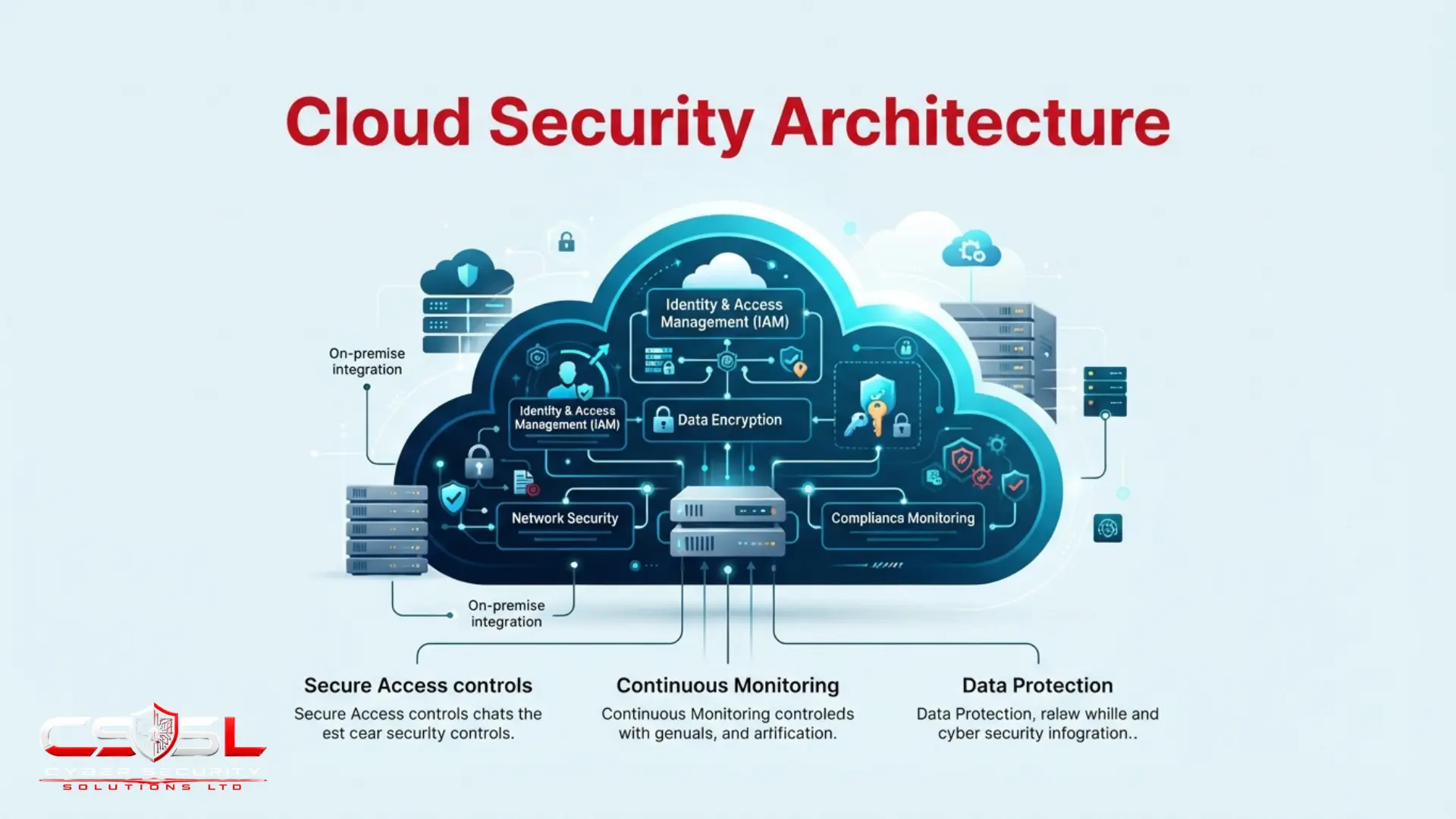
Cloud security architecture is the deliberate, documented design behind how identity, network, compute, application and data actually connect across your cloud environment. If every team at your organization has built their cloud setup differently, with nothing consistent between them, that inconsistency is exactly what a real architecture is supposed to prevent.
What Is Cloud Security Architecture?
This is the deliberate, documented design determining how identity, network, compute, application and data layers are structured, segmented and connected across a cloud environment. It is the blueprint every specific tool and control covered so far in this series actually operates within.
This is the point where those pieces get shown as components of one coherent, designed system rather than a collection of separate purchases. Architecture is not the risks or the tools themselves. It is the structural design decisions that determine how those tools, zones and boundaries interact.
Architecture is difficult to retrofit for a reason. A misconfigured setting is something CSPM can flag and a team can fix in minutes. A poorly designed architecture, a single flat account with no zone separation, requires fundamental rework once real workloads and data already depend on it.
What Is a Cloud Security Reference Model, and How Does It Differ From a Compliance Framework?
A reference model, or reference architecture, is a documented, reusable pattern describing how an organization’s cloud environments should be structured, giving every new project a template to build against instead of reinventing security decisions each time.
Here is a distinction worth resolving directly, since the word framework gets used two different ways across this series. Here, reference model and framework mean a technical pattern: how you structure accounts, zone your network, design identity. Elsewhere in this series, framework means something else entirely: compliance and governance standards like NIST CSF, ISO 27017 or the CSA Cloud Controls Matrix, used for audit and regulatory alignment.
Conflating the two causes real problems. A team told to align with a framework has no way to know from that word alone whether someone means restructure your accounts or prepare for an audit.
Without a documented reference model, different teams build cloud environments inconsistently, each making their own ad hoc security decisions. That is precisely the kind of drift CSPM exists to catch after the fact, rather than prevent from happening. A reference model typically documents account structure, network topology, an identity and federation model, a centralized logging baseline, and default policy guardrails applied automatically to every new environment.
What Are the Core Layers of a Secure Cloud Architecture?
Six layers structure a secure cloud environment: identity, network, compute and workload, application, data, and governance and policy. Each is where a specific discipline already covered in this series actually operates.
| Layer | What It Governs | Related Post |
| Identity | The primary boundary once no network perimeter exists | Cloud IAM Guide |
| Network | Segmentation, zoning and traffic control | Cloud Network Security |
| Compute and workload | VMs, containers, serverless functions | CWPP / Container Security |
| Application | Code, APIs and application logic | Cloud Application Security |
| Data | Classification, encryption and exposure | DSPM Guide |
| Governance and policy | Posture, entitlement and compliance | CSPM, CIEM, Frameworks |
The identity layer is where cloud IAM operates, the foundational layer, since the absence of a network perimeter makes identity the primary boundary everything else depends on. The network layer is where segmentation and zoning happen, covered conceptually here and in full network-engineering depth elsewhere in this series.
The compute and workload layer is where CWPP and container security operate. The application layer is where the application security guidance already covered applies. The data layer is where DSPM’s classification and encryption work happens. The governance and policy layer is where CSPM, CIEM and the compliance frameworks covered separately all sit.
This is a genuinely different framing from zero trust’s pillars, covered earlier in this series. Zero trust describes continuous verification principles applied across identity, devices, network, applications and data. This layered model describes the actual physical and logical arrangement of an environment, the blueprint layout itself, that zero trust principles then get applied across once the layers already exist. These are logical layers organized around identity and data sensitivity, not a physical network perimeter model, since that perimeter no longer meaningfully exists.
What Are Cloud Security Zones, and How Do You Design Them?
Security zones are logical groupings of resources sharing a common trust level and sensitivity, used to control what can communicate with what and apply differentiated scrutiny based on exposure rather than treating every resource identically.
Common patterns include a public-facing zone for internet-exposed components like load balancers and WAFs, an application zone for internal business logic, a data zone for databases and storage subject to the most restrictive access, and a management or shared-services zone housing logging, identity and security tooling.
Zones still matter without a physical perimeter. The disappearance of the traditional network perimeter does not mean the disappearance of differentiated trust. Zones recreate that differentiation logically, through network segmentation, IAM boundaries and policy, rather than physical network position.
What Is a Landing Zone, and Why Is It the Foundation of Good Architecture?
A landing zone is a pre-configured, secure, multi-account environment providing foundational guardrails, account structure, network baseline, identity federation and centralized logging that every future cloud resource gets provisioned into, rather than each new project starting from an unconfigured, blank account.
Most content leaves reference architecture as an abstract diagram. Here is what actually building one looks like. AWS Control Tower and Landing Zone Accelerator, Azure Landing Zones, and Google Cloud’s own landing zone guidance are each provider-specific implementations of the exact pattern just described. You are not designing this from a blank page. You are adopting and customizing a template a provider has already built and tested.
A well-designed landing zone provides automated account provisioning with security guardrails already applied, centralized logging active from day one rather than bolted on later, a network foundation already zoned according to the pattern established above, and identity federation already connected rather than configured ad hoc per account.
Starting with a landing zone is dramatically easier than retrofitting one, which reinforces the opening point about architecture being hard to correct after the fact. Organizations that provision accounts individually without a landing zone template typically discover the resulting inconsistency only once CSPM or an audit surfaces it.
How Do You Structure Multi-Account or Multi-Subscription Environments Securely?
Separating environments, development, testing, production, and separating distinct business units into separate accounts provides a strong blast radius boundary enforced by the cloud provider’s own isolation, rather than relying entirely on correctly configured internal permissions within one shared account.
Account vending is the practice of programmatically provisioning new, pre-secured accounts on demand from the landing zone template, rather than manually configuring each new account’s security posture individually.
Cross-account trust relationships were already named as a specific shadow access risk vector. This section addresses the discipline that limits that risk at the design stage: deliberately minimal, explicitly documented cross-account roles designed in from the outset. Centrally federated identity across every account avoids the fragmented, per-account identity stores already flagged as a common mistake.
How Does Cloud Security Architecture Differ From Cloud Security Strategy?
Architecture is the technical blueprint: layers, zones, account structure and network topology. Strategy, covered separately in this series, is the broader business-aligned planning process governing risk tolerance, budget sequencing, organizational roadmap and how the architecture actually gets adopted, funded and rolled out over time.
| Criteria | Architecture | Strategy |
| What it defines | Layers, zones, account structure | Budget, sequencing, risk tolerance |
| Primary output | A technical blueprint | An adoption roadmap |
| Owned by | Architects, engineers | Leadership, security programme owners |
| Related post | This guide | Cloud Security Strategy |
A useful working analogy: architecture is the blueprint for the building itself. Strategy is the project plan determining how, in what order, and with what resourcing that building actually gets constructed. An excellent architectural blueprint with no realistic adoption strategy behind it remains theoretical. A well-resourced strategy built around a poorly designed architecture simply executes the wrong plan efficiently.
How Do the Well-Architected Frameworks and NCSC Design Principles Fit In?
Each major provider publishes its own Well-Architected Framework security guidance, AWS’s Security Pillar, Azure’s Well-Architected Framework Security, Google Cloud’s Architecture Framework Security, encoding recommended patterns for the zones, layers and landing zone concepts described throughout this guide.
The UK NCSC’s 14 Cloud Security Principles offer a vendor-neutral, government-backed reference point covering data protection, identity, operational security and supply chain considerations, particularly relevant for UK-based organizations wanting an independent standard.
These are a starting reference, not something to build entirely from scratch. Using established, well-tested patterns avoids reinventing architectural decisions already validated across many other organizations. One practical caveat: these frameworks are largely single-provider or general in scope. Multi-cloud organizations need to actively reconcile guidance across frameworks that do not always align perfectly, a genuine and often underestimated task.
What Should a Cloud Security Architecture Review Actually Examine?
An architecture review examines whether the design itself follows sound patterns, distinct from a formal compliance audit checking regulatory adherence or a risk assessment prioritizing already-identified findings, though results from an architecture review commonly feed into both.
A genuine review checks whether zones are actually enforced through technical controls or merely conceptual and undocumented, whether the landing zone template is consistently applied to every new account, whether identity federation genuinely covers every connected account, whether cross-account trust relationships are minimal and documented, and whether logging and monitoring are centralized rather than fragmented per account.
This is the exact checklist Cyber Security Solutions Ltd works through in an architecture review, before any compliance audit or risk assessment even begins.
How Do You Design Cloud Security Architecture Step by Step?
Designing this starts with a documented reference model, then zone design by trust level, a landing zone applying guardrails automatically, multi-account structure with account vending, centrally federated identity, mapping existing tools onto the layers, checking against a Well-Architected Framework or NCSC principles, and periodic architecture review.
- Define your reference architecture and document it before provisioning further cloud resources.
- Design your zone structure based on trust level and data sensitivity.
- Build or adopt a landing zone that applies security guardrails automatically to every new account.
- Establish multi-account structure with account vending rather than manual, inconsistent provisioning.
- Federate identity centrally across every connected account.
- Map the tools already covered across this series onto the layers and zones defined in your architecture.
- Reference the relevant Well-Architected Framework for your provider, or NCSC’s principles for a vendor-neutral check.
- Conduct a periodic architecture review distinct from your formal compliance audit cycle.
Conclusion
Cloud security architecture is not a document that sits in a drawer after one planning meeting. It is the structure every tool, zone and account decision in your environment either follows or quietly drifts away from. Get the layers, zones and landing zone right early, and everything built afterward inherits that consistency automatically.
FAQs
A reference model is a technical pattern for account structure, network zoning and identity design. A compliance framework, like NIST CSF or ISO 27017, governs audit and regulatory alignment instead. Both get called framework casually, but they answer different questions about your environment.
Not usually. AWS Control Tower, Azure Landing Zones and Google Cloud’s landing zone guidance each provide a provider-specific starting implementation of the same underlying pattern. Most organizations adopt and customize one of these rather than building the entire guardrail structure independently.
Architecture is the technical blueprint: layers, zones, account structure. Strategy is the business planning process, budget, sequencing, risk tolerance, governing how that blueprint actually gets built and adopted over time. An excellent architecture with no strategy behind it tends to stay theoretical.
Account vending means programmatically provisioning new, pre-secured accounts from your landing zone template, rather than manually configuring each account’s security posture individually from scratch every time. It keeps every new account consistent with your reference architecture from the moment it exists.
Yes. Zones do not depend on a physical perimeter. They recreate differentiated trust logically, through network segmentation, IAM boundaries and policy, based on each resource’s actual sensitivity and exposure rather than its position on a network diagram that no longer really exists.
An architecture review checks whether the design itself, zones, layering, landing zone consistency, follows sound patterns. A compliance audit checks adherence to a specific regulatory standard. Findings from an architecture review often feed into an audit, but they examine fundamentally different things.