Cloud Governance Framework: Policies, Roles and Controls That Work
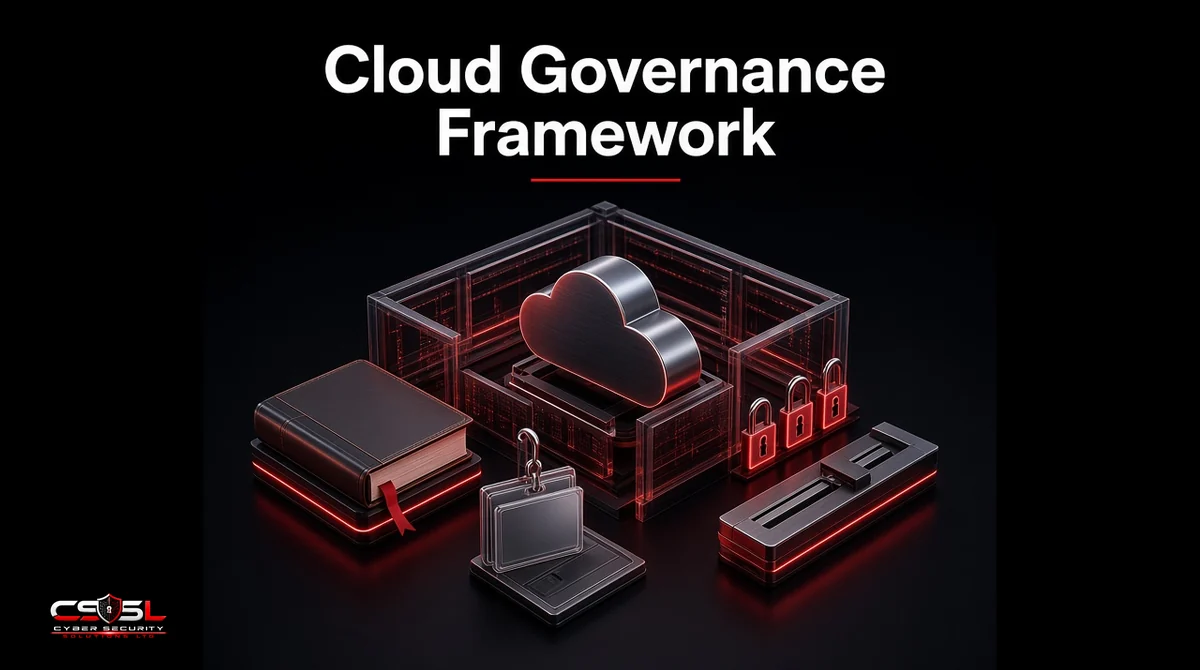
A cloud governance framework is the set of policies, named owners and automated controls that decide how your organization uses the cloud securely, compliantly and within budget. Without one, every team builds its own way, and the first sign of trouble is usually a surprise bill or a public storage bucket.
Governance vs Security vs Compliance in the Cloud
These three overlap but answer different questions. Governance asks who decides, what the rules are and how they are enforced. Security asks how you protect systems and data. Compliance asks whether you can prove you meet a law, contract or standard such as UK GDPR, HIPAA or SOC 2.
Governance sits above the other two. A security control without an owner decays, and a compliance report without enforced policy is a snapshot that goes out of date the next day. NIST recognized this when it added a Govern function to the Cybersecurity Framework in version 2.0, published in February 2024.
The Five Pillars of Cloud Governance
Most mature frameworks, including the Govern guidance in Microsoft’s Cloud Adoption Framework, cover the same five areas.
Security and Identity
Who can access what, how privileged access is approved, and how identities are reviewed. Under the shared responsibility model, this is always your side of the line.
Compliance and Data Residency
Which regulations apply, where data may be stored, and how evidence is collected. UK and EU personal data often comes with location requirements.
Cost Management (FinOps)
Budgets, alerts, ownership of spend and rules for shutting down idle resources. The FinOps Foundation’s practices are a common reference.
Operations and Resource Consistency
Naming, tagging, approved regions and services, backup standards and patching expectations.
Deployment and Change Management
How changes reach production: through pipelines, with infrastructure as code and review, rather than by hand in a console.
Cloud Governance Policies You Need First
Start with four short policies. Each should fit on a page and name an owner.
- Account and landing zone policy: every workload lives in a managed account, subscription or project created from an approved template, separated by environment.
- Identity and access policy: single sign-on, multi-factor authentication, least privilege, no long-lived keys without an exception.
- Data classification and encryption policy: what counts as sensitive, where it may live and how it is encrypted.
- Tagging and cost allocation policy: mandatory tags such as owner, environment, cost center and data class.
Roles and Responsibilities in Cloud Governance
Governance fails when ownership is vague. Many organizations form a small cloud center of excellence (CCoE) that sets standards, while product teams own their workloads. In a small business, the CCoE may be two people: the IT lead and a finance contact.
Example Cloud Governance RACI Matrix
| Activity | Responsible | Accountable | Consulted | Informed |
|---|---|---|---|---|
| Approve new cloud accounts | Cloud platform team | Head of IT | Security | Finance |
| Set identity and access policy | Security | CISO or IT director | Platform team | All engineers |
| Monthly cost review | FinOps or finance | CFO | Workload owners | Leadership |
| Exception approval | Security | CISO or IT director | Workload owner | Auditors |
Turning Policy Into Enforced Cloud Governance Controls
A written policy only matters when a control enforces it. This mapping is where most frameworks stay vague, so build it explicitly.
| Policy rule | Preventive control | Detective control | Owner |
|---|---|---|---|
| Only approved regions | AWS service control policies, Azure Policy, Google Cloud Organization Policy | CSPM finding for resources elsewhere | Platform team |
| No public storage | Block-public-access settings enforced by policy | CSPM and audit log alert | Security |
| Mandatory tags | Policy denying untagged resources | Weekly untagged-resource report | FinOps |
| No long-lived keys | Policy restricting key creation | Alert on key age | Security |
Preventive, Detective and Policy-as-Code Controls
Preventive controls stop a bad change before it happens. Detective controls, such as cloud security posture management (CSPM) and audit logs, find what slipped through. Policy as code, using tools such as Open Policy Agent or HashiCorp Sentinel, checks infrastructure code in the pipeline, so mistakes are caught before deployment.
Here is the decision rule we use in reviews: any rule that has caused a real incident or audit finding should be preventive, while new or debated rules start as detective for 30 days. That avoids blocking engineers with untested guardrails, which is the fastest way to make teams route around governance. Picture an illustrative retailer that blocks all untagged resources on day one: a failed release on launch night and an angry exception request later, the policy gets disabled entirely. Starting with a report, then enforcing, would have kept it alive.
Track each guardrail through three stages: report only, warn in the pipeline, then block. Move a rule forward only when its violation count has dropped close to zero and every remaining case has an approved exception with an expiry date. Publish that status on one page so engineers can see which rules are coming next and plan for them, instead of discovering a block during a release.
Frameworks to Build On
You do not need to invent a framework. Microsoft’s Cloud Adoption Framework, the AWS Well-Architected Framework and the Google Cloud Architecture Framework each describe governance for their platforms. For control catalogs, use the Cloud Security Alliance Cloud Controls Matrix (CCM), NIST CSF 2.0 and CIS Benchmarks. In the UK, the NCSC’s 14 cloud security principles help you assess providers and your own configuration. Use one provider framework for structure and one control catalog for audit mapping, rather than all of them at once.
How to Build a Cloud Governance Framework in 7 Steps
- Inventory every cloud account, subscription and project, including shadow ones on company cards.
- Name an accountable owner for governance and form a small CCoE.
- Write the four starter policies above.
- Set up a landing zone with separate accounts per environment.
- Map each policy rule to preventive and detective controls.
- Define an exception process with expiry dates.
- Review metrics monthly: policy violations, untagged spend and open exceptions.
Cloud Governance Tools
Native tools come first: AWS Organizations and Control Tower, Azure Policy and management groups, and Google Cloud Organization Policy Service. CSPM tools add cross-cloud visibility, and policy-as-code tools enforce rules in pipelines. Choose tools after policies, never before.
Common Cloud Governance Challenges
The usual problems are shadow accounts outside central control, policies nobody enforces, exceptions that never expire and multi-cloud estates with three sets of rules. Each one traces back to missing ownership, so fix the RACI before buying more tooling.
FAQs
Policies, named roles, preventive and detective controls, an exception process and regular metrics, across security, compliance, cost, operations and change.
Compliance sets external requirements. Governance turns them into enforced rules and produces the evidence auditors ask for.
A named executive is accountable, usually the CISO, CIO or IT director, with a CCoE or platform team doing the daily work.
Where AI services run in your cloud, yes. Approved services, data handling and access rules can sit in the same policy and control structure.
A security framework lists controls. A governance framework decides who owns them, how they are enforced and how exceptions are handled.
At least yearly, and after any major incident, new regulation or new cloud provider.
Making Your Cloud Governance Framework Stick
A cloud governance framework succeeds when every rule has an owner, a control and a metric. If you want help mapping your policies to enforced controls, Cyber Security Solutions Ltd offers a free, no-obligation review through our contact page.