Cloud IAM Solutions: How Identity and Access Management Secures the Cloud
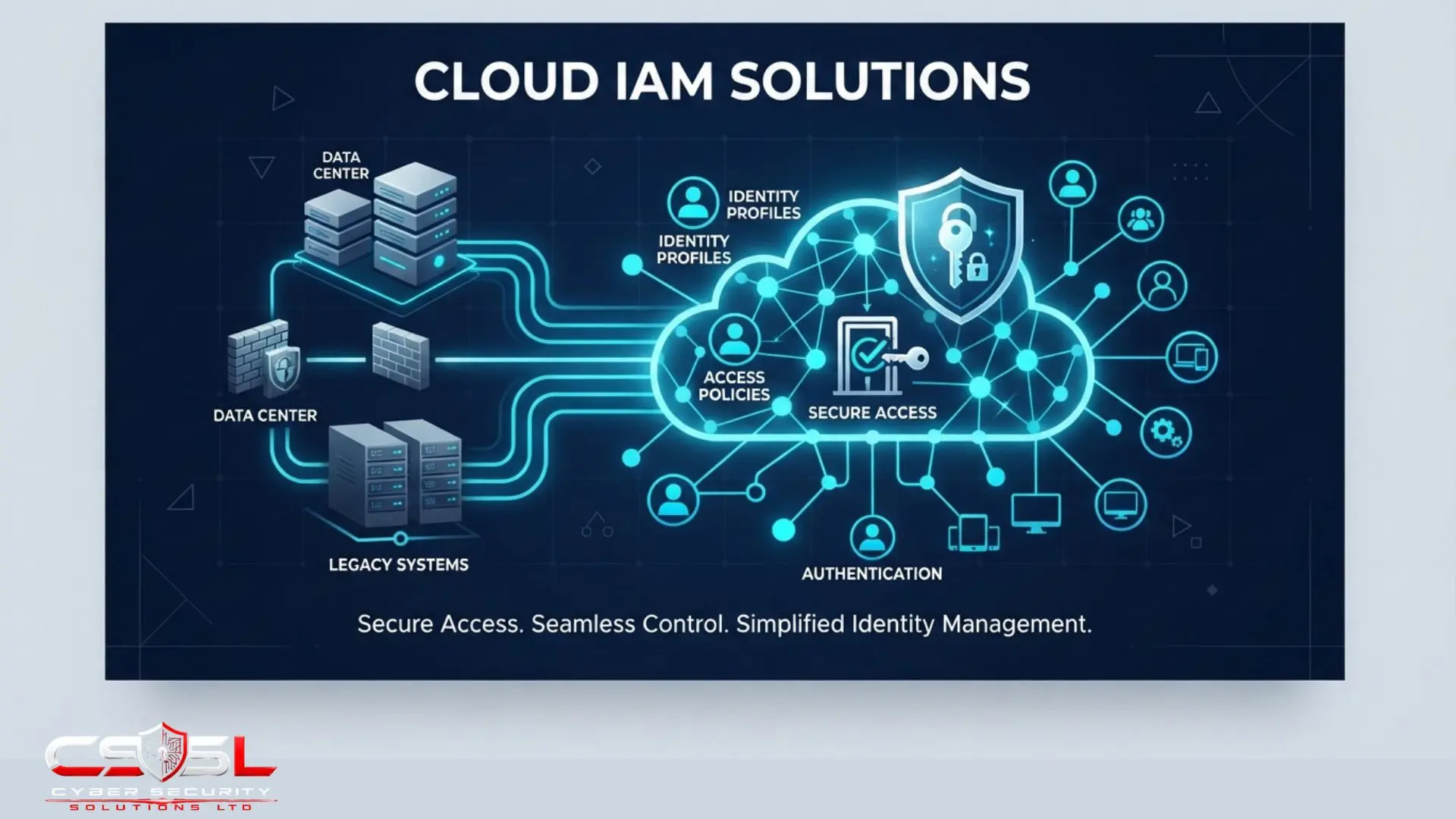
Cloud IAM solutions decide who gets into your cloud environment and what they can touch once inside. Once the network perimeter disappears, identity becomes your main line of defense. If a contractor’s access from eighteen months ago never got removed, that gap is exactly what strong IAM design closes.
What Is IAM in Cloud Security?
Identity and Access Management, or IAM, is the framework of policies and technologies that makes sure the right identities, human and non-human, get the right access to the right cloud resources, under the right conditions, and nothing more.
IAM is the first of seven cloud security domains for good reason. Once the traditional network perimeter disappears, identity becomes the primary, often the only, reliable security boundary left.
Think of IAM as the locksmith who installs the locks and cuts the keys. This post covers doing that job well.
What Are the Core Building Blocks of Cloud IAM?
Cloud IAM rests on six building blocks: identities, authentication, authorization, RBAC, ABAC and policies. Together they decide who can act, prove who they are, and what they may do.
| Building Block | What It Governs | Example |
| Identities | Who or what is requesting access | Employee account, service account |
| Authentication | Proving an identity is genuine | MFA, passkey, certificate |
| Authorization | What a verified identity can do | Read-only vs. admin permission |
| RBAC | Permissions grouped into reusable roles | “Database administrator” role |
| ABAC | Access decided by context | Blocked from an unmanaged device |
| Policies | The documents encoding all of the above | AWS JSON policy, Azure role definition |
Identities split into two camps: human, covering employees, contractors and partners, and non-human, covering service accounts, workload identities and API keys. In mature cloud environments, non-human identities now outnumber human ones.
Here is what most explainers skip. Non-human identities usually get governed with far less rigour. Nobody reviews a service account the way they review an employee. That gap is exactly where excess access piles up for years.
Authentication proves an identity is who it claims to be, through passwords, MFA, certificates or passkeys. Authorization decides what that identity can actually do, enforced through policies on roles or individuals.
RBAC, role-based access control, groups permissions into reusable roles, like “database administrator.” ABAC, attribute-based access control, goes further, deciding access from context: department, project tag, time of day, device compliance. Most programmes use RBAC as the baseline and layer ABAC on top where finer control matters.
Policies are where this gets written down, in a format that varies by provider: JSON policies in AWS, role definitions in Azure, policy bindings in Google Cloud.
How Does Cloud IAM Differ From Traditional On-Premise IAM?
In previous articles already covers this comparison in depth, including the shift from trusting network location to making explicit, granular access decisions.
One addition belongs here specifically. Cloud IAM has to manage far more distinct resource types and permission combinations than most on premise Active Directory ever needed, since every cloud service layers its own resource-level permissions on top of identity itself.
What Are the Fundamental Principles Every Cloud IAM Strategy Should Follow?
Five principles anchor a strong cloud IAM strategy.
- Least privilege: custom, narrowly scoped roles instead of broad, convenient built-in roles that grant more access than any identity needs
- Separation of duties: no single identity can both perform a sensitive action and approve or audit it, especially for key management, covered next
- Just-in-time access: elevated access only for the specific window it is genuinely needed, not permanent standing privilege
- Zero standing privileges: JIT taken further, where privileged roles hold no active permissions until explicitly activated
- Federation over duplication: one centrally managed identity source of truth, federated across every provider, not separate stores per platform
How Does Cloud IAM Govern Encryption and Key Management?
Cloud key management services like AWS KMS and Azure Key Vault are themselves cloud resources governed by IAM policy. That means access to the keys that decrypt sensitive data is fundamentally an identity decision, not a separate encryption decision.
Here is the connection most competitor IAM content misses. Encryption offers little real protection if the IAM policy governing key access is overly permissive. An over-privileged insider who can reach both the encrypted data and the key that unlocks it makes the encryption meaningless.
Mature IAM design applies separation of duties specifically here. The identity that accesses encrypted data should not automatically be the identity that manages or rotates the keys protecting it. One admin role that does everything quietly undoes the point of encrypting anything.
Key rotation and deletion permissions deserve the same rigour as any other highly privileged permission. Accidental or malicious key deletion causes immediate, irreversible data loss, no matter how well the data was backed up.
Customer-managed keys keep IAM control inside your own policy framework. Provider-managed keys hand that control to the cloud provider. Neither is automatically wrong, but it should be a deliberate choice.
This is the exact intersection Cyber Security Solutions Ltd checks first in an IAM configuration review, since encrypted but overexposed data is a common gap found. This post governs who can use the keys that make it mean anything.
How Does Strong IAM Design Prevent Cloud Security Shadow Access From Forming?
Shadow access gets full treatment including nested groups and forgotten service accounts. This section covers something different: the IAM design choices that stop it from forming, rather than catching it after the fact.
Prevention comes down to a handful of concrete habits. Avoid deeply nested group structures that obscure what a role can actually do once every layer stacks up. Make sure temporary access grants are genuinely time-bound, with an expiry date attached at creation, not left open until someone remembers.
Connect provisioning and deprovisioning directly to your HR system. When someone leaves, access should disappear automatically, not through a manual ticket missed during a busy week. Apply mandatory expiry and review dates to every service account, the same discipline you would apply to a human employee.
Here is the honest part most vendor content skips. Even excellent IAM design will not prevent every bit of shadow access from accumulating in a large, continuously changing environment. New services get spun up, and roles get copied instead of rebuilt.
What Is a Cloud Security Identity Fabric, and How Does IAM Form Its Foundation?
An identity fabric is the connected mesh of identity systems spanning cloud, SaaS and on premise environments, a concept introduced with CIEM as its entitlement-analysis layer.
This post’s angle is different. Cloud IAM systems themselves, Entra ID, AWS IAM, Google Cloud IAM, Okta, and any Active Directory still running, are the physical components making up that fabric, not an abstract concept floating above them.
Federation protocols are the connective tissue. SAML, OIDC and SCIM let otherwise separate IAM systems function as one coordinated fabric instead of isolated silos. Fragmentation, separate identity stores per platform, creates exactly the boundary gaps shadow access and attackers both exploit.
What Are the Leading Cloud IAM Solutions Available in 2026?
Cloud native systems are the mandatory baseline: AWS IAM, Microsoft Entra ID, formerly Azure Active Directory, and Google Cloud IAM, each governing resources on its own platform.
For cross-cloud federation, third-party identity providers like Okta, Ping Identity and JumpCloud give you a single, centrally managed identity source of truth across multiple providers and SaaS applications at once.
For an organization’s most sensitive administrative access, privileged access management tools like CyberArk, Delinea and BeyondTrust extend core IAM with just-in-time and privileged session capability.
When evaluating a solution, check federation protocol support, how deeply it governs non-human identities, HR integration quality, and how complete its audit logging actually is.
What Are the Most Common Cloud IAM Mistakes Organizations Make?
Six mistakes show up again and again.
- Treating IAM configuration as a one time project instead of ongoing governance requiring continuous review
- Defaulting to broad, convenient built-in roles, like assigning “Owner” liberally in Azure, instead of custom least-privilege roles
- Governing non-human identities with far less rigour than human ones, even though service accounts often accumulate excess permissions faster
- Lacking automated deprovisioning tied to HR offboarding, leaving departed staff with active access for months
- Applying no separation of duties around encryption key management specifically
- Running each cloud provider’s IAM in isolation, without federation, creating the fragmented identity picture that undermines the whole fabric
How Do You Implement Cloud IAM Solutions Step by Step?
Implementing strong cloud IAM starts with federating every platform to one identity provider, then layering custom roles, universal MFA, separation of duties for key management, HR-linked deprovisioning, just-in-time access and scheduled recertification, with CIEM as the ongoing safety net.
| Criteria | Standing Access | Just-in-Time Access |
| Exposure window | Always active | Open only when needed |
| Review burden | Constant, easy to skip | Reviewed at each request |
| Attack surface if compromised | Full permission set, anytime | Limited to the active window |
| Operational friction | Low day to day | Slightly higher per request |
| Recommended use case | Routine, low-risk tasks | Privileged, high-risk actions |
- Establish one centrally managed identity provider and federate every cloud provider and SaaS application to it, rather than letting separate identity stores persist.
- Design custom, least-privilege roles for every function instead of defaulting to broad built-in roles for convenience.
- Enforce MFA universally across all identities, extending to non-human identities wherever supported. Verizon’s 2026 DBIR found only 23 percent of third-party organizations had fully remediated missing or misconfigured cloud MFA.
- Apply deliberate separation of duties to encryption key management and other high sensitivity permission sets.
- Connect provisioning and deprovisioning directly to HR and offboarding systems to automate access removal.
- Implement just-in-time access for privileged and administrative roles instead of permanent standing access.
- Establish a regular, scheduled access recertification cadence, not a one-off initial review.
- Layer CIEM on top as an ongoing audit safety net, since even well designed IAM needs continuous verification.
Conclusion
Cloud IAM solutions are not a one time setup you finish and forget. They are the ongoing discipline of deciding who gets in, what they can touch and for how long, especially around the encryption keys guarding your most sensitive data. Pair strong IAM design with CIEM auditing, and you get a good locksmith and a good inspector. To find out where your own permissions and key access might already be too wide, visit cybersecuritysolutionsltd.com for a free IAM configuration review from Cyber Security Solutions Ltd.
FAQs
IAM is the system that grants and governs access in the first place. CIEM audits that access afterward, detecting shadow permissions that accumulated over time. Think of IAM as installing the locks and cutting the keys, and CIEM as auditing which locks still make sense.
RBAC assigns permissions through reusable roles, like database administrator, simplifying management at scale. ABAC makes access decisions using context, like department or device compliance, for finer grained control. Most mature organizations use RBAC as the baseline and layer ABAC on top for sensitive cases.
Cloud key management services like AWS KMS and Azure Key Vault are cloud resources governed by IAM policy, so key access is an identity decision. Strong IAM design keeps the identity accessing encrypted data separate from the identity that manages or rotates the keys protecting it.
Just-in-time access grants elevated permissions only for the specific window they are genuinely needed, instead of maintaining permanent standing access that sits unused and unreviewed for months. It significantly shrinks the window an attacker or a compromised account could actually exploit at any given moment.
No single design fully prevents it in a large, continuously changing environment. Strong IAM meaningfully reduces how much shadow access accumulates, through time-bound grants and automated deprovisioning, but ongoing auditing remains a necessary safety net rather than a one-time fix.
It depends on your footprint. Single-cloud organizations can often rely on that provider’s native IAM system without adding anything else. Multi-cloud or hybrid organizations typically need a provider like Okta to federate identity as one centrally managed source of truth across every platform and SaaS application.