AI in Cloud Security: How Machine Learning Is Changing Protection
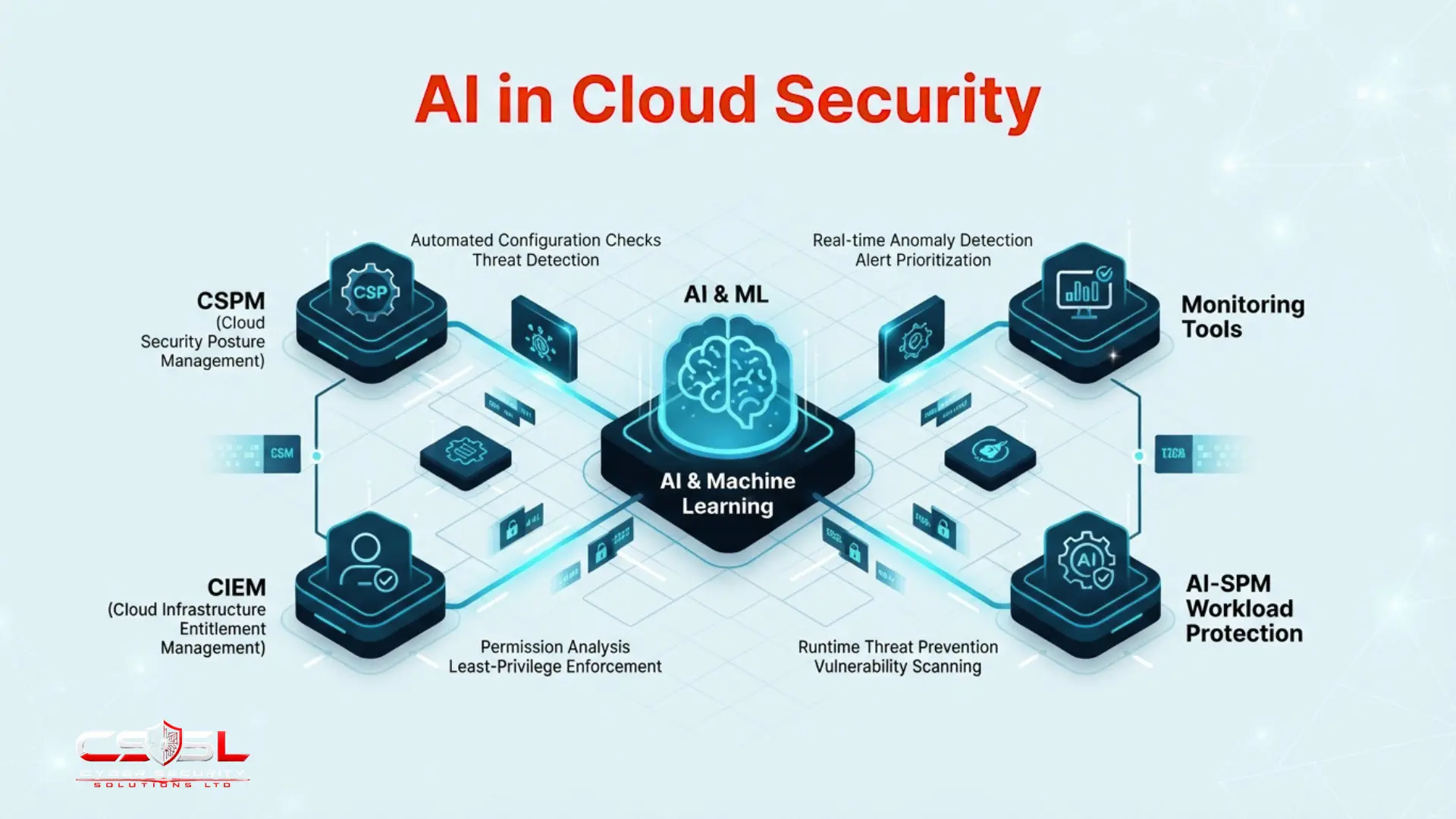
AI is not a standalone cloud security category but a capability increasingly layered into existing tools like CSPM, CIEM, and monitoring platforms for prioritization and anomaly detection, with the one genuine exception being AI-SPM, an emerging category securing AI and ML workloads themselves.
If every vendor now claims their tool uses AI and you cannot tell what is genuinely different from simple automation with a new label, or you started running your own LLM endpoints in the cloud and have no idea if your existing security tools even see them, this guide gives you the precise distinctions you need.
Is AI a New Cloud Security Tool Category, or Something Else Entirely?
AI is not a discrete tenth category sitting alongside CSPM, DSPM, CIEM, and CASB. It is a capability increasingly woven through several of those categories simultaneously, changing how each one prioritizes, classifies, and detects rather than replacing any of them outright.
A vendor pitching an AI cloud security tool as though it were its own standalone category is often describing an AI-enhanced version of a category already established elsewhere. Understanding which underlying category is actually being enhanced is the first, necessary evaluation step. The one genuine exception this article covers in full detail is AI and ML workloads themselves, which have produced one authentically new posture management category.
What Is the Difference Between Cloud Security Automation and AI-Driven Detection?
| Criteria | Automation | AI/ML Detection |
| Underlying logic | Codified, deterministic | Learned, probabilistic |
| Adaptability to novel patterns | None, requires explicit rule | Genuine, statistical deviation flagged |
| Requires learning period | No | Yes, baseline period needed |
| Typical use | Fixed remediation actions | Anomaly and prioritization scoring |
Automation executes codified, deterministic logic with no learning involved. A rule stating that a publicly accessible storage bucket should have public access revoked automatically requires zero machine learning to function correctly. AI and ML, by contrast, learn patterns from data and make probabilistic judgements about things never explicitly defined in advance, flagging an access pattern as anomalous because it statistically deviates from a learned baseline rather than matching a pre-written rule.
Many “AI-powered” security products are automation with a marketing label attached, and this conflation matters because genuine ML-based detection and simple rule automation solve fundamentally different problems requiring different evaluation questions entirely. The specific, usable diagnostic that separates the two is straightforward once named: ask whether the capability was explicitly told what pattern to look for in advance, in which case it is automation regardless of what label sits on the marketing page, or whether it learned that pattern from observed data without being explicitly programmed to recognize that exact scenario, in which case it is genuine machine learning.
A rule that says flag any login from a country the user has never logged in from before is automation, a clearly defined, deterministic condition. A model that learns an individual user’s typical login behavior across dozens of variables and flags a login as anomalous based on a statistical deviation from that learned pattern, without anyone having explicitly defined what unusual looks like in advance, is genuine machine learning. The practical relationship between the two matters as much as the distinction itself: AI is increasingly what determines the confidence score feeding an automation-tier decision, which findings are safe for full auto-remediation versus requiring human approval, meaning the two layers work together but are not interchangeable. A vendor conflating them deserves direct scrutiny during any evaluation conversation.
How Is AI Already Embedded Across the Tool Categories This Cluster Has Covered?
| Category | Application | Status |
| DSPM | Data classification | Existing |
| CWPP | Runtime baselining | Existing |
| CSPM | Finding prioritization | New |
| CIEM | Behavioral entitlement analysis | New |
| Monitoring | UEBA | New |
DSPM already uses machine learning and increasingly large language model-based classification to identify sensitive data categories in unstructured content far more accurately than rule-based pattern matching alone. CWPP runtime behavioral monitoring already observes process activity deviating meaningfully from an established baseline, implicit behavioral ML already embedded without previously being named as such.
Mapping AI’s genuine contribution onto specific, already-established categories with this level of structural precision, rather than treating it as a single, vague enhancement, is precisely the distinction most competitor content fails to make. When a vendor says their CSPM platform uses AI, this specifically means finding prioritization: taking a raw list of thousands of configuration violations and ranking them by which patterns have historically correlated with actual exploited incidents, rather than applying a static severity label uniformly. When a vendor says their CIEM platform uses AI, this means entitlement behavioral baselining: not identifying that a permission exists, which is deterministic graph traversal requiring no learning at all, but learning what normal usage of that permission looks like for a specific identity, so an admin account suddenly accessing resources it has never touched before gets flagged even though no rule was ever written defining that specific scenario.
User and Entity Behavior Analytics extends this same anomaly-detection principle to monitoring, applying learned patterns to login behavior, geographic anomalies, and unusual API call sequences. Understanding this specific mapping means a buyer can ask a precise, category-appropriate question rather than accepting a generic assurance: does your AI improve finding prioritization, behavioral entitlement analysis, runtime baselining, data classification, or login anomaly detection? A vendor unable to specify which one their AI claim addresses is likely describing a marketing label rather than a demonstrable capability.
What Is AI-SPM, and Why Do AI and ML Workloads Need Their Own Posture Management?
Organizations increasingly run their own AI and ML workloads in the cloud, training pipelines, LLM inference endpoints, vector databases, and retrieval-augmented generation pipelines, and these are cloud workloads in every sense already covered elsewhere, just with AI-specific risks layered on top. AI-SPM is the direct, structural extension of this posture-management taxonomy applied specifically to AI and ML pipelines: discovering what models exist, what data trained them, what endpoints expose them, and how exposed those endpoints actually are.
AI-SPM deserves recognition as a genuinely new emerging category, not a rebrand of CSPM applied to a different resource type, because the risks it addresses have no meaningful equivalent in traditional infrastructure security. Prompt injection against exposed LLM endpoints is a risk traditional CSPM has no mechanism to detect, since it involves crafted natural-language input manipulating a model’s behavior rather than a misconfigured network rule. Training data poisoning exists entirely upstream of anything a configuration scanner would ever examine, since the vulnerability lives in the data pipeline feeding the model. Model exfiltration through an over-permissioned inference endpoint represents a data theft pattern specific to AI workloads, where sufficient query access can allow reconstruction of meaningful portions of the model itself. Unintentionally exposed vector databases containing embeddings derived from sensitive source data represent a particularly under-recognized risk, since a vector database can expose meaningful information about underlying documents even without exposing the documents directly, a subtlety no traditional DSPM approach was designed to catch.
The OWASP Top 10 for LLM Applications provides the authoritative reference point for these risks, giving this emerging category the same kind of credible external anchor CIS Benchmarks provide for CSPM. This matters even for organizations not building their own custom models: many now consume third-party LLM APIs or embed AI features into existing applications, meaning genuine exposure exists even without a full custom training pipeline.
How Does AI Change Identity and Access Management for Non-Human Agents?
An AI agent with tool-calling capability that autonomously invokes cloud APIs represents a new class of non-human identity, distinct from the service accounts and API keys already governed elsewhere. MITRE ATLAS, the Adversarial Threat Landscape for Artificial-Intelligence Systems, provides the direct AI-specific parallel to MITRE ATT&CK, giving this new governance challenge its own authoritative technique reference.
This new identity type is genuinely harder to govern than any category already established, and the specific reason deserves direct explanation. A traditional service account’s behavior is fully determined by pre-written code, meaning every possible action path was explicitly authored by a human before the code ever ran. Reviewing that account’s permissions alongside the code using them gives a complete, static picture of everything that identity can ever do.
An AI agent’s specific actions are determined by a model’s output at runtime, not by pre-written code defining every possible action in advance. An agent given the ability to call cloud APIs decides, based on its own inference at the moment of execution, which specific APIs to call and in what sequence, within whatever bounds its permissions allow. This means the same least-privilege scoping discipline established for traditional accounts matters more, not less, for AI agents, precisely because the agent’s own behavior is inherently less predictable in advance. An overly broad permission granted to a service account is a known, bounded risk, since the code using it only does what it was written to do. An overly broad permission granted to an AI agent is a genuinely open-ended risk, since the model may eventually determine, through its own reasoning, to exercise that permission in a way no human ever anticipated. Treat every AI agent’s cloud API access with the same entitlement review discipline already applied to non-human identities, with even tighter scoping given the greater unpredictability involved.
How Are Attackers Using AI Against Cloud Environments?
Generative AI is lowering the skill barrier for convincing, personalized credential phishing targeting cloud account access. Attackers with initial cloud access increasingly use AI tooling to chain together potential attack paths faster than manual enumeration previously allowed. Attackers also deliberately craft inputs designed to evade AI-based detection models, an evasion arms race now specifically relevant to cloud-native AI detection layers.
Once an attacker gains initial cloud access, perhaps through a single compromised credential, the next step in a real attack is typically identifying what that access actually enables: which resources are reachable, which permissions combine into a genuinely exploitable path, and which target represents the highest-value next move. This is precisely the same toxic combination analysis defenders use posture tooling to correlate proactively, sensitive data location combined with effective access combined with exposure. An attacker with AI tooling can now perform an analogous correlation from the offensive side, feeding discovered permissions and configuration details into a model capable of rapidly identifying the most valuable, least-defended path forward, compressing what previously required extensive manual enumeration into a task AI assistance makes accessible to a broader range of less experienced attackers.
The honest, calibrated framing worth maintaining is that this represents an evolving contest, not a fixed advantage for either side. Defenders applying AI to posture correlation and behavioral baselining are running the same fundamental capability that accelerates attacker reconnaissance, applied toward closing gaps before they are found rather than exploiting them after discovery.
What Are the Genuine Limitations of AI in Cloud Security?
AI models tuned for high sensitivity can flag legitimate but statistically unusual activity, contributing directly to alert fatigue, an unresolved cost that remains genuinely real. Behavioral baselining requires a learning period before it becomes reliably accurate, during which detection quality is genuinely lower, a cold-start problem affecting both entitlement use and runtime activity baselining.
These limitations deserve honest, direct statement as a deliberate counterweight to hype, because vendor-adjacent content overwhelmingly oversells AI without naming its specific, real operational costs. The cold-start problem is not a minor caveat; it is a genuine, unavoidable reality that any organization adopting AI-driven behavioral baselining must plan around. A CIEM or CWPP tool learning what normal behavior looks like for a specific identity or workload cannot produce reliable, low-noise output on day one, because the model has not yet observed enough genuine baseline behavior to distinguish normal variation from genuine anomaly. Organizations should expect elevated false positives immediately following deployment as an expected, temporary phase rather than a sign the tool is broken.
Explainability challenges compound the existing human-in-the-loop approval gate problem: a finding flagged by a model that cannot clearly articulate why that pattern was considered anomalous is genuinely harder for a reviewer to confidently approve or reject than a finding flagged by a clear, human-readable rule. Most fundamentally, AI-enhanced prioritization does not reduce the underlying need for foundational controls like MFA, least privilege, and encryption. AI changes how efficiently existing findings are triaged; it does not change whether the foundational work still needs doing.
How Do You Evaluate AI Claims from Cloud Security Vendors?
Ask specifically which underlying category the AI capability enhances, CSPM prioritization, CIEM behavioral baselining, CWPP runtime detection, or monitoring anomaly detection, rather than accepting “AI-powered” as a sufficient answer. Ask whether the capability is genuinely adaptive machine learning or codified automation using an AI label. Request evidence of model training methodology, update frequency, and whether detection improves using data specific to your own environment over time. Apply the same critical, disclosure-based sourcing discipline used for analyst positioning claims to any AI-related certification a vendor cites.
Cyber Security Solutions Ltd helps organizations evaluate vendor AI claims against the specific underlying category being enhanced, distinguishing genuine adaptive capability from automation with a marketing label attached.
How Do You Start Applying AI-Enhanced Cloud Security Step by Step?
Step 1: Confirm which existing tool categories in your current stack already include AI-enhanced capability you may not be using fully.
Step 2: Inventory your own AI and ML workloads specifically, including third-party LLM API consumption, not just custom-trained models.
Step 3: Apply DSPM-equivalent discovery and classification logic to that AI-specific inventory, identifying exposed endpoints and the data feeding them.
Step 4: Extend your CIEM entitlement review explicitly to any AI agent identities with cloud API access.
Step 5: Ask targeted, category-specific questions of any vendor claiming AI capability.
Step 6: Monitor for AI-specific attack patterns using the OWASP LLM Top 10 and MITRE ATLAS as reference frameworks.
Step 7: Maintain the foundational controls established throughout your programme regardless of AI adoption.
Conclusion
AI genuinely changes how efficiently cloud security tools prioritize and detect, but it threads through categories you likely already own rather than requiring an entirely new purchase, with AI-SPM as the one authentic exception securing your own AI workloads. Visit cybersecuritysolutionsltd.com for help evaluating whether your existing tools already include AI capability worth using fully, and whether your own AI workloads need dedicated posture management.
FAQs
No. AI is a capability layered into existing categories like CSPM, CIEM, DSPM, and monitoring, improving prioritization and anomaly detection rather than replacing them. The one genuine exception is AI-SPM, an emerging category securing AI and ML workloads themselves as new cloud resources.
Automation executes codified, deterministic logic explicitly defined in advance, requiring no learning. AI and ML learn patterns from data and flag statistical deviations from a learned baseline without being explicitly told what to look for. AI increasingly feeds the confidence scoring behind automation decisions.
AI Security Posture Management is an emerging category discovering and assessing AI and ML workloads specifically, LLM endpoints, training pipelines, and vector databases, addressing risks like prompt injection and model exfiltration that traditional CSPM has no mechanism to detect.
AI agents represent a new non-human identity class whose actions are model-determined at runtime rather than pre-written in code. This makes their behavior inherently less predictable than traditional service accounts, requiring even tighter least-privilege scoping and dedicated entitlement review.
Yes. Generative AI lowers the skill barrier for convincing credential phishing and accelerates attacker reconnaissance, helping identify exploitable attack paths faster than manual enumeration. This represents an evolving contest, not a settled advantage for either attackers or defenders.
Ask whether the capability was explicitly programmed to recognize a specific pattern, which is automation, or whether it learned that pattern from observed data without explicit programming, which is genuine machine learning. Request evidence of training methodology and environment-specific improvement over time.