Cloud Security Alliance Certifications: CCSK and STAR Guide
A cloud security alliance certification is either a personal credential, such as the Certificate of Cloud Security Knowledge (CCSK), or an organizational assurance listing in the CSA STAR program. People pass exams; cloud providers publish assessments or audits. Buyers and job seekers often confuse the two, and that confusion wastes budget on the wrong one.
Individual Credentials vs Organizational STAR Certification
The Cloud Security Alliance (CSA) is a nonprofit that publishes vendor-neutral cloud security guidance. Its certifications split cleanly by who holds them.
| Credential | Who it is for | Format |
|---|---|---|
| CCSK | Security, IT, audit and engineering staff | Online, open-book exam |
| CCAK (Certificate of Cloud Auditing Knowledge) | Auditors and compliance staff | Online exam |
| CCZT (Certificate of Competence in Zero Trust) | Architects and security leads | Online exam |
| STAR Level 1 | Cloud service providers | Published self-assessment |
| STAR Level 2 | Cloud service providers | Third-party certification or attestation |
If you are hiring or studying, read the CCSK sections. If you are buying cloud services or selling them, skip to STAR.
CCSK: Certificate of Cloud Security Knowledge
The CCSK is CSA’s flagship credential and the most common answer when someone asks which CSA certification to take first. It tests broad, vendor-neutral knowledge rather than one provider’s console.
What the CCSK v5 Covers
According to CSA, CCSK v5 consolidates the syllabus into 12 domains: cloud computing concepts and architectures; cloud governance; risk, audit and compliance; organization management; identity and access management; security monitoring; infrastructure and networking; cloud workload security; data security; application security; incident response and resilience; and related technologies and strategies. CSA says v5 adds AI and generative AI, weaves zero trust across domains, expands DevSecOps and serverless content, and reduces detailed legal and regulatory material.
CCSK Exam Format, Cost and Passing Score
CSA’s CCSK page (checked October 30, 2026) states the exam is online and open-book, with 60 multiple-choice questions drawn from a larger pool, a 120-minute limit and an 80% minimum passing score. The exam purchase costs $445 and includes two test attempts, to be used within two years. There are no formal experience prerequisites. Fees change, so confirm the current price on cloudsecurityalliance.org before you buy.
How Hard Is the CCSK Exam?
Open-book does not mean easy. An 80% pass mark across 60 questions leaves room for only 12 wrong answers, and 120 minutes is not enough time to look up every question. Candidates who fail usually know cloud well in one provider but have not read CSA’s own guidance, which the questions follow closely.
How to Prepare for the CCSK
CSA offers a free prep kit. A practical plan:
- Read the CSA Security Guidance end to end once.
- Skim the Cloud Controls Matrix so control domain names feel familiar.
- Build a one-page index of key terms by domain for fast lookups.
- Take practice questions under a timer.
Paid options include self-paced courses, instructor-led classes and CCSK Plus, which adds hands-on labs.
Other CSA Credentials: CCAK, CCZT and AI Safety
CSA offers credentials beyond the CCSK. The CCAK, developed with ISACA, targets auditors who need to assess cloud controls using the Cloud Controls Matrix. The CCZT focuses on planning and implementing zero trust architectures. CSA has also introduced the Trusted AI Safety Expert (TAISE) program for AI governance and security. Each has its own exam rules and pricing, so check the relevant CSA page directly.
CCSK vs CCSP: Which Should You Choose?
The CCSP (Certified Cloud Security Professional) comes from ISC2, the body behind the CISSP. The two certifications answer different needs.
| Factor | CCSK (CSA) | CCSP (ISC2) |
|---|---|---|
| Experience required | None | Five years of IT experience, including cloud and security, per ISC2 |
| Exam style | Online, open-book | Proctored, closed-book |
| Depth | Broad foundation | Professional-level |
| Maintenance | Check CSA’s current policy | Continuing education and annual fee |
A simple decision rule: take the CCSK if you need a credible cloud security foundation now, or if you plan to sit the CCSP later and want structured preparation. Choose the CCSP if you already meet the experience requirement and a job posting or contract names it. In US federal and defense roles, check the employer’s approved certification list, since requirements vary.
CSA STAR Program for Cloud Providers
The Security, Trust, Assurance and Risk (STAR) program lets cloud providers publish how they meet CSA’s controls. Every entry appears in the public STAR Registry, which buyers can search for free.
STAR Level 1: Self-Assessment With the CAIQ
At Level 1, a provider completes the Consensus Assessments Initiative Questionnaire (CAIQ) and publishes it. Nobody independently checks the answers. It is useful for transparency, but it is the provider describing itself.
STAR Level 2: Third-Party Certification and Attestation
Level 2 adds independent validation. STAR Certification builds on an ISO/IEC 27001 audit, extended with the Cloud Controls Matrix. STAR Attestation builds on a SOC 2 examination by a CPA firm, extended in the same way. Many US buyers expect SOC 2, while UK and European buyers often ask for ISO 27001, so providers tend to pick the route that matches their customers.
How to Use the STAR Registry to Vet Vendors
Consider an illustrative example. A 40-person UK accountancy firm is choosing between two cloud document platforms. Both claim to be “CSA STAR compliant.” A five-minute registry search shows one holds Level 2 certification renewed last year, while the other posted a Level 1 questionnaire four years ago.
That gap changes the procurement decision. Use this vetting checklist:
- Search the vendor by legal name in the STAR Registry.
- Note the level and the date of the entry.
- For Level 2, request the full ISO 27001 certificate scope or the SOC 2 report under NDA.
- Confirm the scope covers the exact service you are buying, not a different product line.
- Treat a Level 1 entry older than two years as a prompt for fresh questions, not as assurance.
The registry does not replace your own due diligence, but it gives you a structured, comparable starting point for every vendor.
Cloud Controls Matrix and CAIQ Explained
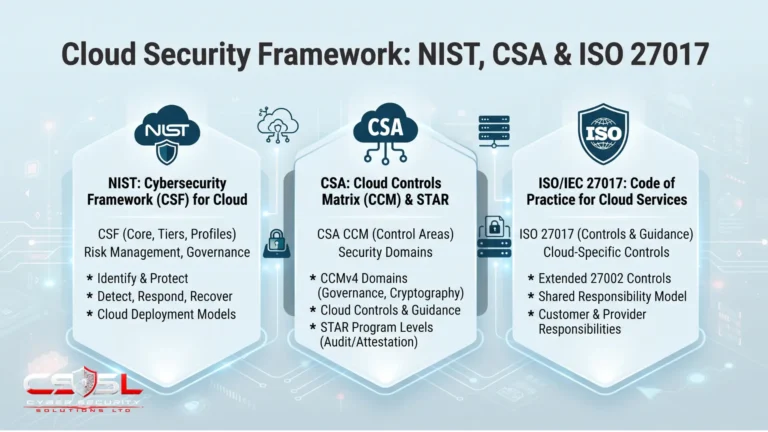
The Cloud Controls Matrix (CCM v4) is CSA’s control framework for cloud computing, organized into 17 control domains and mapped to standards such as ISO 27001 and NIST guidance. The CAIQ is the matching questionnaire that turns those controls into yes-or-no questions a provider answers. Buyers can send the CAIQ to vendors that are not in the registry, which saves writing a security questionnaire from scratch.
Is a CSA Certification Worth It in the US and UK?
For individuals, the CCSK is a low-cost, fast way to show broad cloud security knowledge. It is not a substitute for experience, and some hiring managers rate it below the CCSP for senior roles. For entry and mid-level cloud, audit and pre-sales roles, it is a reasonable investment.
For providers, the answer depends on buyers. STAR is separate from FedRAMP, which US federal agencies require for cloud services, so STAR does not open federal sales by itself. In the UK, public sector buyers using G-Cloud may weigh NCSC cloud security principles, Cyber Essentials and ISO 27001; a STAR Level 2 entry complements those rather than replacing them.
FAQs
Yes. CSA states the CCSK exam is open-book and taken online. You can use the CSA Security Guidance and your notes. The 120-minute limit for 60 questions still means you need to know the material, because looking up every answer will run you out of time before you finish.
No. The exam itself is paid. CSA's CCSK page listed the exam purchase at $445 as of October 30, 2026, including two attempts usable within two years. The study material is free: CSA offers a free prep kit, and the Security Guidance and Cloud Controls Matrix can be downloaded at no cost.
CSA has updated its credential policies over time, including with the move to CCSK v5. Check the current CCSK page and your certificate details on cloudsecurityalliance.org for renewal or version requirements. If an employer asks for a "current" CCSK, confirm whether they expect the v5 version specifically.
No. FedRAMP is a US government authorization program for cloud services used by federal agencies. ISO 27001 is an international information security management standard. STAR Level 2 certification builds on an ISO 27001 audit with extra cloud controls, but it is a separate program from both and does not replace either.
It depends on background. Someone already working in cloud security might be ready after a few weeks of evening study, while a newcomer may need longer to absorb all 12 domains. The real measure is whether you can pass timed practice questions above 80%, not a fixed number of hours.
STAR Level 1 is a self-assessment: the provider publishes its own CAIQ answers with no independent check. Level 2 requires a third-party audit, either STAR Certification based on ISO 27001 or STAR Attestation based on SOC 2. For vendor risk decisions, Level 2 carries far more weight.
Match the Certification to the Decision in Front of You
Pick the cloud security alliance certification that matches the decision you are making: the CCSK for a person building cloud security skills, STAR Level 2 for a provider proving controls to buyers, and the STAR Registry for anyone vetting a vendor. This week, look up your top three cloud vendors in the registry and note their level and date. If the results raise questions about your vendor risk, Cyber Security Solutions Ltd offers a free, no-obligation cyber security assessment through our contact page.