Cloud Data Compliance: How to Pass a Cloud Compliance Audit
Cloud data compliance means storing, processing and protecting data in cloud services in line with laws and standards such as GDPR, HIPAA, PCI DSS and SOC 2, and being able to prove it. The proof is where most businesses struggle. An auditor will not accept “it is in AWS” as evidence that customer data is encrypted, retained correctly or kept in the right country.
Cloud Data Compliance vs Cloud Security
Security is about stopping harm; compliance is about meeting defined rules and showing evidence that you do. A cloud account can be well defended and still fail an audit because nobody can show where personal data lives or who reviewed access last quarter. The reverse also happens: a business can hold a certificate while running weak controls the auditor never sampled. Treat compliance as the documented, testable subset of your security program.
The Shared Responsibility Model for Compliance
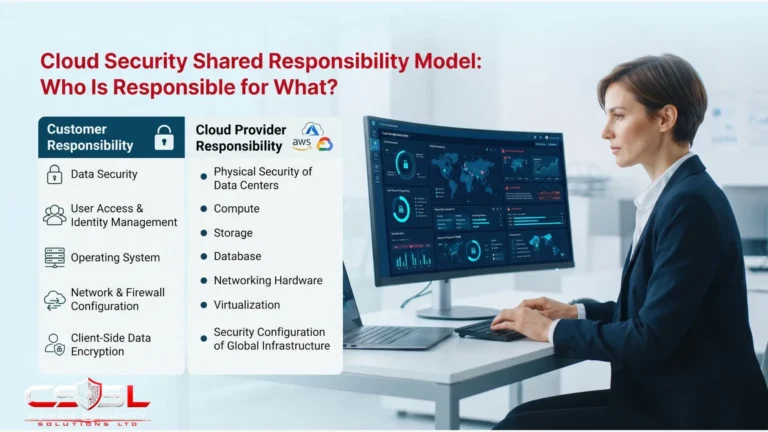
AWS, Microsoft Azure and Google Cloud all publish shared responsibility models. The provider secures the physical data centers, hardware and core services. You remain responsible for your data, identities, configurations and how you use each service.
For compliance, this splits evidence in two. The provider’s certifications (SOC 2 reports, ISO 27001 certificates, PCI DSS attestations) cover their layer. Your auditor still needs evidence for your layer. A provider’s ISO 27001 certificate says nothing about whether your storage bucket is public.
Regulations and Standards That Govern Cloud Data
Which rules apply depends on what data you hold, where your customers are and what you sell. Confirm scope with counsel or your auditor, since obligations vary by sector and contract.
US: HIPAA, SOC 2, PCI DSS, FedRAMP and State Privacy Laws
- HIPAA: covered entities and business associates handling protected health information must meet the Security Rule and sign a business associate agreement (BAA) with cloud providers that store that data, per HHS guidance on cloud computing.
- SOC 2: an AICPA attestation framework that customers often require of service providers, assessed against the Trust Services Criteria.
- PCI DSS v4.0: applies wherever cardholder data is stored, processed or transmitted, including cloud workloads.
- FedRAMP: required for cloud services used by US federal agencies.
- State privacy laws: California’s CCPA, as amended by the CPRA, and similar state laws set rights and duties for personal information.
UK and EU: UK GDPR, Data Protection Act 2018 and GDPR
UK GDPR and the Data Protection Act 2018 govern personal data in the UK, enforced by the Information Commissioner’s Office (ICO). The EU GDPR applies to personal data of people in the EU. Both require security appropriate to risk, records of processing, data protection impact assessments (DPIAs) for high-risk processing, and lawful mechanisms for international transfers.
ISO 27001, 27017 and 27018
ISO/IEC 27001 sets requirements for an information security management system. ISO/IEC 27017 adds cloud-specific security controls, and ISO/IEC 27018 covers protection of personal data in public clouds. Many providers hold all three, which helps your evidence pack but does not certify your own use.
Data Residency, Sovereignty and Cross-Border Transfers
Data residency is where data is physically stored. Data sovereignty is which country’s laws can reach it. The two are not the same, and confusing them is behind many failed questionnaires.
A UK business can store data in a London region and still face transfer questions if support staff in another country can access it, or if the provider is US-owned. Under UK GDPR, transfers to the US can rely on the UK-US Data Bridge (the UK Extension to the EU-US Data Privacy Framework) for certified US organizations, or on the International Data Transfer Agreement (IDTA) or the UK Addendum to EU standard contractual clauses, per ICO guidance.
The US CLOUD Act lets US authorities seek data held by US providers, including data stored abroad, through legal process. That does not make US cloud services unlawful under UK GDPR, but it should appear in your transfer risk assessment. A practical decision rule: for each data set, record the storage region, every country from which it can be accessed, the transfer mechanism, and whether customer-managed encryption keys limit provider access. If you cannot fill in all four, the data set is not audit-ready.
Common Cloud Compliance Challenges
- Shadow data: copies in test accounts, exports and SaaS tools nobody inventoried.
- Configuration drift: a control that passed last quarter changed after a deployment.
- Multi-cloud evidence: three providers, three log formats and three evidence portals.
- Retention conflicts: backups and logs kept longer than your policy or the law allows.
- Vendor sprawl: SaaS apps processing personal data without a contract or DPIA.
How to Pass a Cloud Compliance Audit: Step by Step
These steps prepare you for a regulatory or certification audit of cloud data compliance. Technical control testing methodology is a separate exercise.
Step 1: Define Audit Scope and Applicable Frameworks
Agree which frameworks, accounts, services and data types are in scope. Write it down and get the auditor to confirm it. Scope creep during fieldwork is the most common cause of delays.
Step 2: Inventory and Classify Cloud Data
List every data store, its owner, its classification (for example public, internal, confidential, regulated) and its region. Include SaaS apps.
Step 3: Map Controls to Requirements
Build a matrix of each requirement against the control that meets it and the evidence that proves it. NIST CSF 2.0 or NIST SP 800-53 can serve as a common control set when you face several frameworks at once.
Step 4: Collect Evidence From Your Cloud Provider and Your Own Controls
Download provider reports from AWS Artifact, the Microsoft Service Trust Portal or Google Cloud’s compliance reports manager. Then gather your own: configuration exports, access reviews and logs.
Step 5: Run a Readiness Assessment and Fix Gaps
Test a sample yourself the way the auditor will. Fix gaps before fieldwork, and keep a dated record of each fix.
Step 6: Support the Auditor During Fieldwork
Name one coordinator, answer requests within an agreed time, and supply evidence in the format requested. Do not volunteer undocumented controls.
Cloud Compliance Audit Checklist: Documents to Prepare
Have these ready before the auditor asks:
- Data inventory with classification, owner and region for every store
- Records of processing activities and completed DPIAs (UK and EU)
- Data flow diagrams, including cross-border transfers and mechanisms used
- Encryption standards and key management records, including key rotation
- Quarterly access reviews for privileged and data-owner roles
- Logging and retention configuration, with log samples
- Provider reports (SOC 2, ISO 27001, PCI DSS) and signed contracts, BAAs and data processing agreements
- Incident response plan and the last test or exercise record
- Data retention and deletion policy with proof of deletion runs
- Change management records for in-scope cloud resources
Why Cloud Compliance Audits Fail
Here is an illustrative example, not a client story. A 60-person US healthcare billing company moves claims processing to Microsoft Azure and signs Microsoft’s BAA. The SOC 2 auditor samples access reviews and finds the last one was nine months ago. A developer’s test subscription holds a copy of real patient data, outside the documented scope. Log retention is set to 30 days, while the company’s own policy says one year.
None of those are exotic failures. They come from three patterns: scope that does not match reality, controls that exist but have no dated evidence, and policies written without checking cloud settings. The practical takeaway: before any audit, run a scan for regulated data across all accounts, compare every policy number (retention days, review frequency, key rotation) against the live configuration, and close mismatches by changing either the setting or the policy.
Automating Continuous Cloud Compliance
Point-in-time audits leave months of drift unseen. Continuous compliance tools check configurations against frameworks daily. Native options include AWS Audit Manager and AWS Config, Microsoft Purview Compliance Manager and Defender for Cloud regulatory compliance dashboards, and Google Cloud Audit Manager. Cloud security posture management (CSPM) tools do the same across providers. Automation gathers evidence; a person still has to review exceptions and sign off.
FAQs
It depends on the framework and scope. A SOC 2 Type 1 examination looks at a single point in time, while a Type 2 covers an observation period, commonly several months. ISO 27001 certification has two audit stages. Readiness work before fieldwork often takes longer than the audit itself.
No. Providers certify their own infrastructure under the shared responsibility model. You remain responsible for your data, identity settings, encryption choices, retention and access reviews. Provider reports from AWS Artifact or the Microsoft Service Trust Portal support your evidence, but your own controls must be documented and tested separately.
It is a risk factor to assess, not an automatic barrier. The CLOUD Act allows US authorities to request data from US providers through legal process. Under UK GDPR, document the transfer mechanism, assess the risk, and consider controls such as customer-managed keys. Confirm your position with counsel or ICO guidance.
Formal certification audits usually run annually, with ISO 27001 surveillance audits between recertifications. Internally, review access quarterly, check configurations continuously with automated tools, and re-run your data inventory whenever you add a cloud service, region or SaaS app that handles regulated data.
Data residency is the physical location where data is stored, such as a London or Virginia region. Data sovereignty is which country's laws apply to that data, which can depend on the provider's ownership and who can access it. A business can satisfy residency rules and still face sovereignty questions.
Yes, if they hold personal, health or payment data. UK GDPR applies regardless of company size, HIPAA applies to covered entities and business associates of any size, and PCI DSS applies to anyone handling card data. Customer contracts increasingly require SOC 2 or ISO 27001 evidence from small suppliers too.
Make Every Policy Number Match a Live Setting
The fastest path to passing cloud data compliance reviews is evidence that lines up: inventory, policy and configuration telling the same story. As a final step this month, pick your most sensitive data set and complete the residency, access, transfer and key record for it, then repeat for the next. Cyber Security Solutions Ltd offers a free, no-obligation cyber security assessment through our contact page if you want a second view before the auditor arrives.