Hybrid Cloud Security: Challenges, Solutions and Best Practices
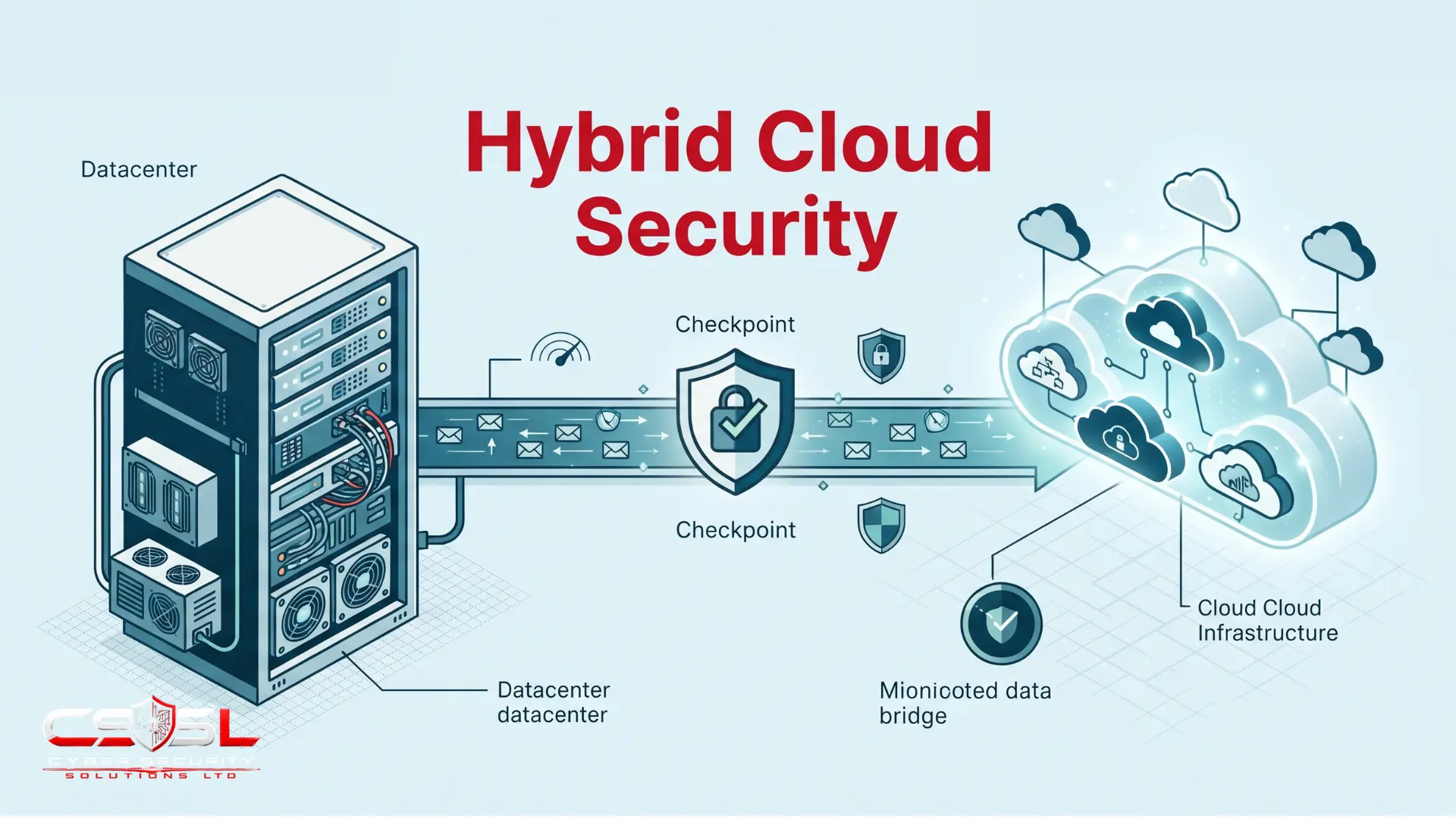
Hybrid cloud security means protecting a permanent architecture that combines public cloud with on-premises infrastructure, not the temporary state during a migration project. If you have run hybrid for years and just realized your cloud security tools never actually scanned your on-premises servers, this guide explains why that gap exists.
What Is Hybrid Cloud Security?
This means protecting a permanent, deliberate architecture combining public cloud with on-premises or edge infrastructure, a steady state rather than a transitional condition.
A prior post used “hybrid” for a temporary migration window with a defined end date. This post’s hybrid has no planned end date, so temporary controls suited to a cutover do not apply here.
NIST SP 800-145 names hybrid cloud as one of four formal deployment models, the same source this series cited at the very start. Hybrid combines cloud with on-premises infrastructure. Multi-cloud combines multiple public cloud providers with no on-premises component necessarily involved.
Why Do Organizations Choose Permanent Hybrid Architecture Rather Than Completing Migration to the Cloud?
Data sovereignty requirements, latency-sensitive workloads, legacy hardware dependencies and cost all drive deliberate, permanent hybrid decisions, not unfinished migrations.
This section names a fourth, distinct meaning of “cloud security challenges”: the difficulty of maintaining consistent tooling, policy and visibility across two infrastructure paradigms operating side by side indefinitely, distinct from three prior meanings already established elsewhere in this series.
What Are the Three Genuinely Different Hyperscaler Approaches to Hybrid Infrastructure?
AWS Outposts ships physical AWS hardware into your datacenter. Azure Arc extends only Azure’s management plane over existing infrastructure with no dedicated hardware required. Google Distributed Cloud, the current name for what was previously called Anthos, extends Kubernetes-style orchestration across on-premises and edge environments.
| Provider | Product | Extension Model | What It Extends |
| AWS | Outposts | Physical hardware | Cloud infrastructure, physically |
| Microsoft Azure | Arc | Management plane only | Governance over existing hardware |
| Google Cloud | Distributed Cloud | Orchestration layer | Kubernetes-style management |
These are three genuinely different philosophies, not interchangeable brand names. Outposts extends cloud hardware physically into your datacenter. Arc extends cloud governance over hardware you already own. Distributed Cloud extends a specific orchestration layer across environments. The right choice depends entirely on whether your real need is physical infrastructure consistency, governance consistency, or container orchestration consistency.
Google’s naming here deserves a direct note, since it has changed more than once. Anthos as a standalone brand has been retired. The broader container management branding moved to GKE and GKE Enterprise, while the on-premises hybrid extension itself now lives under the Distributed Cloud name specifically.
Hybrid-capable CNAPP platforms are a fourth, vendor-neutral category worth naming too. Some full platforms extend workload protection to on-premises hosts specifically, a capability you should verify explicitly rather than assume.
VPN vs Dedicated Connectivity: How Do You Connect On-Premise and Cloud Securely?
AWS Direct Connect, Azure ExpressRoute and Google Cloud Interconnect each provide a private, non-internet-routed circuit, distinct from a VPN’s encrypted tunnel over the public internet.
| Criteria | VPN | Dedicated Connection |
| Routing path | Public internet, encrypted | Private, non-internet-routed |
| Bandwidth consistency | Variable | Consistent |
| Typical use case | Flexible, lower-bandwidth | Sustained, latency-sensitive |
| Security consideration | Requires encryption, monitoring | Still requires encryption, monitoring |
A private circuit is not automatically a secure one. Encryption, access control and monitoring remain necessary exactly as they do on a VPN. VPN suits lower-bandwidth, flexible needs. Dedicated connections suit sustained, high-bandwidth, latency-sensitive workloads.
How Do You Unify Identity Across On-Premise and Cloud Environments in Practice?
Microsoft’s Entra Connect synchronizes on-premises Active Directory identities into Entra ID. AWS’s Directory Service and IAM Identity Center support federation with on-premises Active Directory via SAML. Google’s Cloud Identity combined with Workforce Identity Federation extends its IAM model to external and on-premises identity sources.
A permanent hybrid identity federation is an indefinite trust relationship requiring continuous entitlement review, applied across a boundary that will never fully close.
Why Does the Hybrid Connection Itself Become a Zero Trust Blind Spot?
A VPN tunnel or dedicated connection is routinely treated, once configured, as an inherently trusted pipe, with traffic crossing it granted implicit trust simply because it originates from inside the organization’s own connected infrastructure.
Why does this directly recreate the exact problem zero trust principles were built to eliminate? The entire premise of zero trust is that no traffic should be trusted based on network location alone, yet the hybrid connection is frequently the one place that old, perimeter-based assumption quietly survives, precisely because it feels more secure than the open internet.
The practical fix applies zero trust principles directly at this boundary. Traffic crossing the hybrid connection should be subject to the same per-session, per-resource authorization and continuous verification as traffic from anywhere else, rather than receiving an implicit trust upgrade purely for arriving via a VPN tunnel or dedicated circuit. The same reasoning that favors a narrower, per-resource access model over broad network access for remote workers applies with equal force to this site-to-site connection.
What Hybrid Cloud Security Risks Does Data Replication and Synchronization Introduce?
Data replicated or synchronized between on-premises and cloud storage can end up subject to inconsistent encryption, access control or DLP policy depending on which side of the boundary it currently resides on.
Most cloud-native DSPM tooling operates agentlessly against cloud provider APIs specifically, meaning a data copy sitting on-premises may fall entirely outside that tool’s visibility even though it contains identical, equally sensitive content to its cloud counterpart.
This is a genuine, commonly overlooked blind spot, not a theoretical edge case. An organization confident in its DSPM coverage because it scans its cloud environment continuously may have no equivalent visibility at all into replicated copies sitting on-premises, since agentless scanning was never built to reach that far.
Inventory every data replication pathway crossing the hybrid boundary and confirm classification and protection controls apply consistently on both sides, rather than assuming cloud-side coverage implies on-premises coverage automatically.
Do Your Existing Cloud Security Tools Cover Your On-Premise Environment?
Many CWPP and container security tools were built primarily for cloud-hosted virtual machines and Kubernetes clusters. On-premises coverage, where it exists at all, may be materially shallower or require a separate licensing tier. Ask directly whether your current platform genuinely scans on-premises hosts, or only the cloud-hosted portion of your environment.
How Do You Extend Consistent Policy Enforcement and Security Zones Across the Hybrid Boundary?
Azure Arc’s own extension of Azure Policy to on-premises and other-cloud resources gives “consistent policy enforcement” its first concrete, product-level instance in this series. The zone pattern already established for cloud architecture should extend logically across on-premises infrastructure too.
A cloud security group rule with no on-premises equivalent recreates the exact configuration drift problem already warned against elsewhere in this series, now occurring at the seam between two paradigms rather than within one.
What Are the Best Practices for a Genuinely Secure Hybrid Cloud Environment?
Treat the hybrid connection as untrusted by default. Federate identity using a concrete mechanism rather than separate stores. Verify, rather than assume, existing tooling covers on-premises. Inventory replication pathways. Extend zone-based segmentation logically across the boundary.
Verifying whether existing CSPM, CWPP and DSPM tooling genuinely covers the on-premises side is exactly the check Cyber Security Solutions Ltd runs first in any hybrid environment review.
How Do You Build Hybrid Cloud Security Step by Step?
Building hybrid security starts with confirming your hybrid state is genuinely permanent, selecting the right extension approach, choosing connectivity with equal scrutiny, and applying zero trust to the connection itself.
- Confirm whether your hybrid state is genuinely permanent, or an unfinished migration that should follow the completion path instead.
- Select a hybrid extension approach matching your actual need, rather than defaulting to your primary hyperscaler.
- Choose VPN or dedicated connectivity based on bandwidth and latency, applying identical security scrutiny to either.
- Implement identity federation using the appropriate mechanism for your primary cloud provider.
- Apply zero trust verification specifically to traffic crossing the hybrid connection itself.
- Verify explicitly that your CSPM, CWPP and DSPM tooling covers your on-premises environment.
- Inventory data replication pathways crossing the boundary and confirm consistent protection.
- Extend your existing zone-based architecture logically across the on-premises side.
Conclusion
Hybrid cloud security is not solved by a VPN and a firewall rule. Verify your tooling actually reaches on-premises, treat the hybrid connection as untrusted, and pick your hyperscaler extension approach based on your real need. To get a hybrid environment review covering tooling coverage and connection trust, visit cybersecuritysolutionsltd.com for expert support from Cyber Security Solutions Ltd.
FAQs
Hybrid cloud combines public cloud infrastructure with on-premises or edge infrastructure directly. Multi-cloud combines multiple public cloud providers with no on-premises component necessarily involved at all. The two get frequently confused but describe genuinely different architectures with different security implications entirely.
Outposts ships physical AWS hardware into your datacenter. Arc extends only Azure’s management plane over existing infrastructure with no dedicated hardware. Google Distributed Cloud, the current name for what was Anthos, extends Kubernetes-style orchestration across environments instead of hardware or governance alone.
No. A VPN or dedicated connection is often treated as an inherently trusted pipe once established, but this recreates the exact perimeter-based trust zero trust principles exist to eliminate. Traffic crossing it should receive the same per-session verification as traffic from anywhere else.
Not necessarily. Many CSPM, CWPP and DSPM tools are agentless and API-driven against cloud provider endpoints specifically, meaning on-premises infrastructure may sit entirely outside their visibility. Verify directly with your vendor rather than assuming a “cloud security” claim covers it.
Use a federation mechanism rather than separate identity stores: Entra Connect for Microsoft environments, AWS Directory Service or IAM Identity Center for AWS, or Google Cloud Identity with Workforce Identity Federation. Each synchronizes on-premises identities into the provider’s identity system directly.
Not automatically. Avoiding the public internet does not eliminate the need for encryption, access control and monitoring. Both VPN and dedicated connections require the same security scrutiny; “private” describes the routing path taken, not the trust level granted to whatever crosses it.