Google Cloud Security: Best Practices and Tools Explained
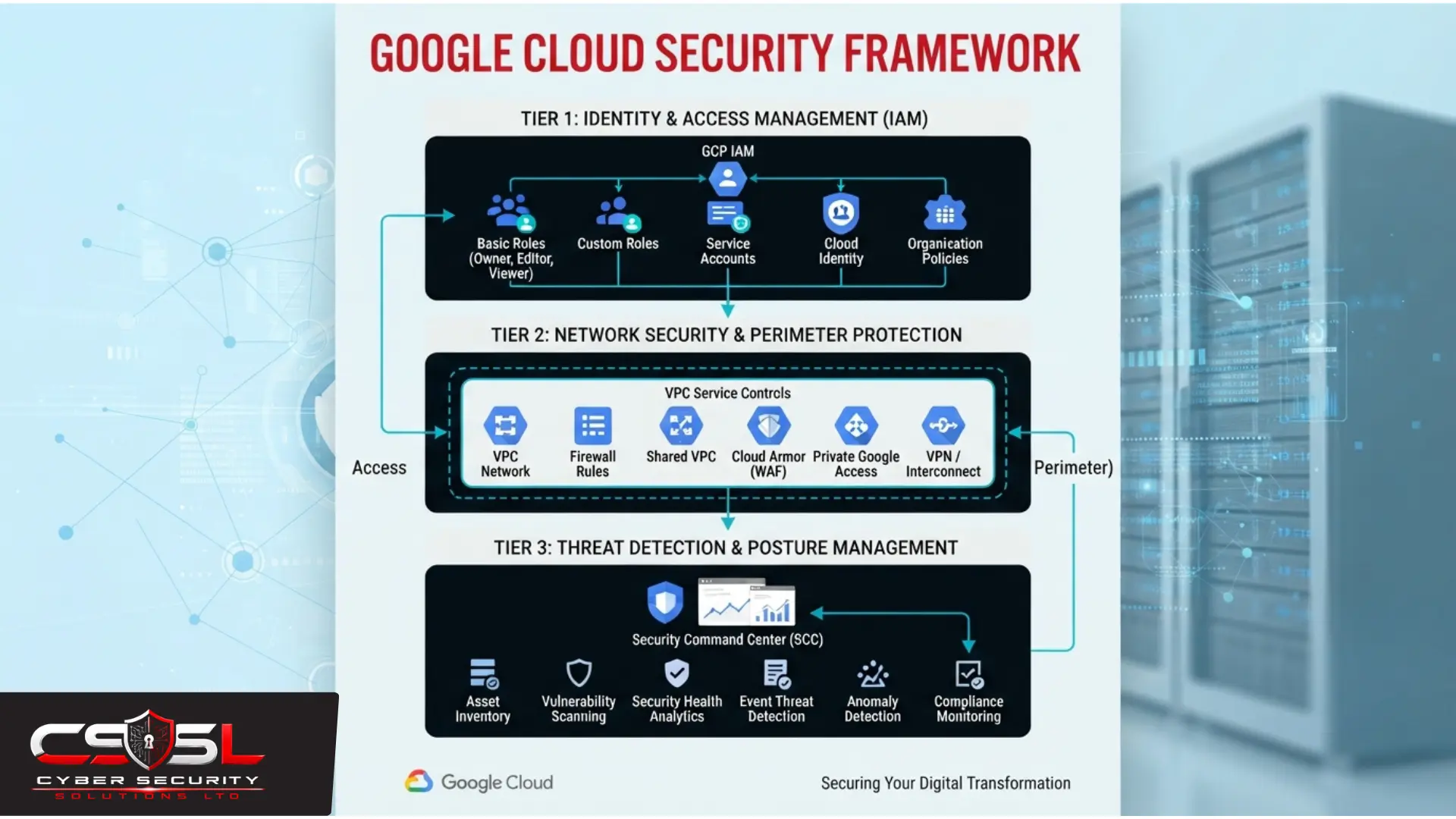
Google Cloud’s shared responsibility model, framed alongside Google’s own “shared fate” concept, shifts by service, with customers holding full patching and firewall configuration responsibility on Compute Engine, only code and service account scoping on Cloud Functions, and complete IAM and access control responsibility on Cloud Storage.
If you keep assigning the Owner role because it is the easiest option and just realized how much access that actually grants, or you enabled Security Command Center and assumed you had full coverage before discovering you were only on the Standard tier, this guide gives you the concrete Google Cloud mechanics that fix both problems.
What Does Google Cloud-Specific Security Add Beyond the General Principles Already Covered in This Cluster?
Every principle this cluster has established applies fully to Google Cloud. This guide shows what those principles look like against Google’s actual named services and permission model. Google Cloud IAM, Security Command Center, and the Architecture Framework have each been named in passing without ever being assembled into one coherent reference until now.
This post assumes general cloud fundamentals, shared responsibility as a concept, zero trust principles, and the resource-hierarchy contrast already established between AWS and Azure, none of which are re-explained from scratch. See AWS Cloud Security: Complete Guide to Securing Amazon Web Services and Azure Cloud Security: How to Secure Microsoft Azure Environments for the two platform comparisons this guide builds directly on.
How Does Shared Responsibility, and Google’s “Shared Fate” Model, Play Out Across Specific Google Cloud Services?
| Service | Google Responsibility | Customer Responsibility |
| Compute Engine | Physical infrastructure, hypervisor | Guest OS patching, firewall rules, network access |
| Cloud Functions | Entire runtime environment | Function code, service account scope |
| Cloud SQL | Engine patching, underlying infrastructure | Access control, encryption configuration |
| Cloud Storage | Storage infrastructure | IAM bindings, bucket-level access settings |
Google Cloud’s shared responsibility model, framed alongside Google’s own shared fate concept, shifts by service. Google positions shared fate as taking a more active role in secure-by-default configuration rather than a purely transactional handoff, though this does not change the underlying reality that identity, data, and configuration decisions never fully transfer to any provider regardless of how reassuring that provider’s framing sounds.
On Compute Engine, the customer patches the guest OS, configures firewall rules, and manages network access. On Cloud Functions, Google manages the entire runtime, and the customer is responsible only for function code and the scope of the attached service account. On Cloud SQL, Google manages engine patching while the customer manages access control and encryption configuration. On Cloud Storage, Google manages the storage infrastructure entirely, but the customer holds full responsibility for IAM bindings and bucket-level access settings.
How Does Google Cloud’s Resource Hierarchy Compare to AWS’s and Azure’s Models?
| Level | AWS | Azure | Google Cloud |
| Top-level container | Organization | Management Group | Organization |
| Mid-level grouping | Organizational Unit | Subscription | Folder |
| Primary trust/billing boundary | Account | Subscription | Project |
| Individual resources | Resources | Resources | Resources |
| Policy enforcement | Service Control Policies | Azure Policy + RBAC inheritance | IAM inheritance |
Google Cloud’s structure runs Organization at the top, Folders grouping related Projects, Projects as the primary billing, isolation, and trust boundary, and Resources sitting directly within Projects with no separate intermediate container layer. AWS’s flatter Organization and Accounts model is reconciled through Service Control Policies, Azure’s four-level hierarchy is inheritance-driven, and Google’s three-level structure occupies a genuinely distinct middle position. Policies applied at the Organization or Folder level cascade downward automatically to every Project and Resource beneath them.
Google Cloud’s Enterprise Foundations Blueprint is Google’s own concrete, deployable landing-zone-equivalent guidance, giving this cluster’s earlier passing mention its first named, specific treatment.
Google Cloud VPC networks being global resources by default deserves direct, explicit statement, because this represents a genuine structural contrast with AWS’s regional VPCs and Azure’s regional VNets that most network security content implicitly assumes as a universal working model.
On AWS and Azure, a VPC or VNet exists within a specific region, and connecting resources across regions requires deliberate additional configuration, peering, transit gateways, or equivalent cross-region connectivity mechanisms. A Google Cloud VPC network, by contrast, is a global resource capable of spanning every region simultaneously without any additional cross-region connectivity configuration at all. Subnets within that single global VPC can exist in different regions while remaining part of the same network construct, communicating with each other without the explicit peering or gateway configuration AWS and Azure both require for equivalent cross-region communication.
This structural difference has real, practical implications for how network segmentation and regional isolation decisions should actually be made on Google Cloud specifically. An architect accustomed to AWS or Azure’s regional VPC model, where network boundaries naturally align with regional boundaries, may reasonably assume the same alignment applies on Google Cloud, when in fact achieving genuine regional isolation on GCP requires deliberate additional segmentation within a single global VPC construct, rather than relying on the network boundary itself to provide that regional separation the way it more naturally does on the other two platforms. Organizations migrating architecture patterns directly from AWS or Azure to Google Cloud without accounting for this specific difference risk either under-segmenting regions they assumed were naturally isolated, or over-engineering connectivity solutions for a cross-region communication challenge Google Cloud’s global VPC model already solves natively.
How Do Google Cloud IAM, Basic Roles and IAM Conditions Actually Work?
Google Cloud IAM assigns roles, Basic, Predefined, or Custom, to members at any level of the resource hierarchy, with permissions inheriting downward. IAM Conditions are attribute-based conditions attached directly to individual role bindings, evaluating context such as time, resource attributes, or request origin before a granted permission actually applies.
Basic Roles deserve treatment as this section’s central, genuinely distinctive pitfall, because the character of this problem differs fundamentally from the IAM challenges already established for the other two major cloud platforms. Owner, Editor, and Viewer are legacy roles still defaulted to in many environments, each granting extremely broad permissions across an entire Project. Owner in particular grants the ability to modify IAM policy itself, meaning a single Basic Role assignment can represent dramatically more access than most administrators realize they are granting.
This is a genuinely different character of problem from what AWS or Azure administrators face. AWS’s challenge is reconciling multiple, separately-evaluated policy document types correctly, a technical complexity problem. Azure’s challenge is understanding inheritance correctly across a four-level hierarchy, again a complexity problem centered on structural understanding. Google’s challenge is structurally different: the easiest, most convenient path, assigning a Basic Role rather than researching and applying an appropriately scoped Predefined or Custom role, is also the least secure path available. This makes Google’s IAM risk a design-incentive problem as much as a technical-complexity one.
An administrator under time pressure, setting up a new Project quickly, is naturally drawn toward the Owner role precisely because it is the simplest option requiring no research into which specific Predefined role might actually match the task at hand, and this convenience gap is precisely what makes Basic Role overbreadth such a persistent, well-documented, and still-common finding in real Google Cloud environments even years after Google’s own documentation has consistently recommended against it. Recognizing that this is fundamentally a convenience-versus-security trade-off, not a comprehension problem, changes how organizations should address it: the fix requires making appropriately scoped roles as convenient to find and apply as Basic Roles currently are, not simply better documentation explaining why Basic Roles are risky.
What Is VPC Service Controls, and Why Does It Go Beyond IAM Permissions?
VPC Service Controls creates a service perimeter around Google Cloud resources, restricting access to specified APIs and services based on network context and identity attributes, functioning as an additional, independent control layer that applies even when IAM permissions would otherwise allow access.
This is a genuinely unique security perimeter concept with no direct equivalent named elsewhere in this cluster, and most competitor content either ignores VPC Service Controls entirely or describes it vaguely as Google’s version of a network boundary mechanism, missing what actually makes it distinct and valuable.
IAM’s own logic operates on a specific assumption: if an identity holds a valid permission, that permission should be honored. This assumption is entirely reasonable for IAM’s intended purpose, but it creates a specific blind spot. A compromised or malicious identity holding genuinely valid IAM read permissions to sensitive data will, under IAM’s logic alone, successfully read that data, because IAM has no mechanism to question a permission it has already validated as legitimately held.
VPC Service Controls addresses exactly this blind spot by introducing an entirely separate evaluation layer that IAM’s permission logic does not touch at all. A service perimeter defines which APIs and services can be accessed, and crucially, from which network context that access is permitted to originate. A compromised or malicious identity holding valid IAM permissions to read data can still be blocked by a correctly configured service perimeter if the access attempt originates from outside the perimeter’s permitted context, addressing a risk category IAM alone structurally cannot cover since IAM’s own logic assumes a valid permission should always be honored regardless of where the request originated.
This specifically matters for data exfiltration risk, arguably the single most damaging outcome of a compromised credential. An attacker who successfully phishes valid credentials still needs to actually move data out of the organization’s environment to complete a genuine exfiltration attack. VPC Service Controls can block that final exfiltration step even when every preceding step, credential theft, authentication, and IAM permission validation, has already succeeded from the attacker’s perspective, functioning as a last-line control specifically addressing the scenario where identity-layer defences have already failed. AWS and Azure offer their own network-boundary mechanisms, but VPC Service Controls’ specific framing as a perimeter around API access itself represents a genuinely distinct security model worth understanding on its own terms.
How Do You Secure Google Cloud Storage, the Most Common Source of GCP-Specific Misconfiguration?
Google actively recommends disabling legacy, fine-grained Access Control Lists in favor of access governed purely through IAM bindings at the bucket level, a genuinely different direction from other platforms’ storage models requiring multiple access-control documents checked together. Google has moved toward consolidating this complexity rather than requiring multi-document reconciliation.
Google Sensitive Data Protection, formerly Cloud DLP, is Google’s native data classification and sensitive-data-discovery service, scanning Cloud Storage and other Google data stores for PII and other sensitive patterns, completing this cluster’s native-DSPM coverage alongside equivalent tools on other platforms. Enabling default encryption and object versioning protects against both unauthorized access and the ransomware-targets-backups pattern established elsewhere in this cluster. See What Is DSPM? Data Security Posture Management for Cloud Explained for the broader discovery discipline Sensitive Data Protection implements natively.
What Native Google Cloud Security Tools Should Form Your Baseline Stack?
Security Command Center provides a Standard tier with baseline asset discovery and CSPM findings at no additional cost, and a Premium tier unlocking Event Threat Detection, deeper Security Health Analytics, Web Security Scanner, and vulnerability findings from VM Manager. IAM Recommender provides native entitlement analysis. Google Security Operations, formerly Chronicle, serves as the correlation and monitoring layer sitting above Security Command Center’s findings. VPC Service Controls and Sensitive Data Protection complete this baseline stack alongside Cloud Audit Logs for the audit trail function.
Security Command Center’s tiering deserves the same specific, detailed treatment as an equivalent tiering confusion already identified on another major platform, because “we use Security Command Center” can describe meaningfully different actual protection depending entirely on which tier is active, and this false-confidence risk is genuinely common and rarely addressed with specificity.
An organization running only the free Standard tier has baseline asset discovery and CSPM configuration findings, genuinely useful visibility but fundamentally limited to posture assessment without active threat detection capability. Event Threat Detection, the capability that actually identifies active threats and suspicious behavior in near real time, is a Premium-tier feature, not included in the free Standard offering. An organization that enabled Security Command Center expecting comprehensive threat monitoring, based on the product’s own broad-sounding name, may be running only asset inventory and configuration scanning, with no active threat detection running at all, until the Premium tier is specifically and separately activated.
This mirrors precisely the same licensing-tier confusion pattern already documented for an equivalent tool on another major platform: a single product name conceals meaningfully different actual capability depending on which specific tier sits behind it. Before relying on Security Command Center for active threat monitoring specifically, verify Premium tier activation rather than assuming the product’s presence and its name alone guarantee that capability.
How Do You Secure Google Cloud Compute — Compute Engine, Cloud Functions and GKE?
Compute Engine represents the customer’s fullest responsibility surface, requiring guest OS patching, firewall rule configuration, and general workload protection practices. Cloud Functions requires scoping the attached service account as narrowly as it genuinely requires. Google Kubernetes Engine applies general Kubernetes control-plane practices alongside GKE Workload Identity, connecting Kubernetes service accounts to Google Cloud IAM without embedded credentials. Artifact Registry is the natural point for container image scanning before deployment.
Workload Identity Federation deserves recognition as genuinely new capability extending well beyond the GKE-specific case most competitor content stops at, because its broader mechanism addresses non-human identity governance more comprehensively than equivalent tools on other platforms have been shown to reach.
Workload Identity Federation allows external workloads, including systems running on other cloud providers, on-premise infrastructure, and CI/CD platforms like GitHub Actions, to authenticate to Google Cloud without ever downloading a service account key. This is a meaningful advance because downloaded service account keys represent a persistent, static credential risk: once downloaded, a key can be copied, embedded in code, accidentally committed to a repository, or otherwise exposed in ways that create standing risk entirely disconnected from Google Cloud’s own access controls. Workload Identity Federation eliminates this specific risk category by establishing trust through a federation relationship rather than a distributable static credential, meaning there is no key file that can be stolen, leaked, or forgotten in the first place, because no such file needs to exist at all.
Binary Authorization completes this compute security picture as a deploy-time enforcement mechanism requiring container images to carry valid attestations before GKE will run them, giving artifact-signing practices established elsewhere their first concrete, native enforcement point specifically. Rather than relying purely on process discipline to ensure only properly signed and verified images reach production, Binary Authorization enforces this requirement at the platform level, refusing to deploy any image lacking the required attestation regardless of who attempts the deployment or through which pipeline. Google originated Kubernetes itself before donating it to the Cloud Native Computing Foundation, giving GKE a genuine credibility anchor as the platform where these container orchestration security patterns were first developed.
What Does the Google Cloud Architecture Framework’s Security Perspective Recommend, and Where Does BeyondCorp Fit In?
Google’s official architectural guidance is built around principles including implementing security by design, implementing zero trust, applying shift-left practices, layering preventive, detective, and corrective controls, and meeting regulatory and privacy requirements. BeyondCorp is Google’s own internal zero trust implementation, developed and publicly documented years before zero trust became industry-standard vocabulary.
BeyondCorp deserves anchoring as this post’s strongest historical and credibility contribution, and this connection gives the Architecture Framework’s zero trust principles genuine intellectual payoff that most competitor content entirely misses by treating zero trust as simply an external framework Google, like every other vendor, has adopted.
Unlike a framework that references zero trust as an adopted industry principle developed elsewhere and subsequently embraced, Google can trace its own architectural guidance directly back to an internal initiative widely credited as one of the concept’s original practical implementations. BeyondCorp emerged from Google’s own internal need to secure access for a workforce operating outside a traditional corporate network perimeter, developed and documented publicly years before zero trust became the vocabulary the broader security industry now uses as standard terminology.
This matters for readers beyond mere historical trivia, because it gives the otherwise abstract zero trust tenets, verify explicitly, apply least privilege, assume breach, a concrete, historically grounded origin story specifically tied to this platform rather than treating zero trust as an externally imposed framework Google simply complies with alongside every other cloud vendor. When Google’s Architecture Framework recommends implementing zero trust, it is recommending an approach the organization itself pioneered internally and subsequently productized into the platform capabilities, including IAM Conditions and VPC Service Controls, that readers now have direct access to configure. This historical grounding explains why Google Cloud’s own native tooling for context-aware access control tends to feel like a natural extension of the platform’s own architectural philosophy, rather than a bolted-on feature responding to external market pressure.
What Google Cloud-Specific Compliance, Government Cloud and SAP-on-GCP Considerations Exist?
Assured Workloads is Google Cloud’s compliance-focused environment supporting FedRAMP High, CJIS, and other regulated workload requirements. The CIS Google Cloud Platform Foundation Benchmark is the Google-specific configuration baseline extending the general CIS Benchmark reference. Google Cloud’s Compliance Reports Manager provides on-demand access to Google’s own compliance certifications.
SAP on Google Cloud deserves an honest, explicitly narrow scope statement rather than any implication of broader SAP security coverage this guide has never developed, and stating this limitation plainly serves readers far better than vague reassurance that general cloud security principles adequately cover SAP workloads.
Organizations running SAP HANA or other SAP workloads on Google Cloud’s certified infrastructure inherit the standard Compute Engine shared-responsibility line already covered for the underlying infrastructure layer: guest OS patching, firewall configuration, and general workload protection apply to the infrastructure hosting SAP exactly as they would for any other Compute Engine workload. This is the extent of what general Google Cloud security guidance can honestly address.
SAP’s own application-layer authorization model, authorization objects, SAP GRC, and SAP-specific role-based access within the SAP application itself, is an entirely separate discipline that this guide has never covered and does not pretend to address here. SAP’s internal authorization model operates according to SAP’s own architecture and governance framework, genuinely distinct from anything Google Cloud’s infrastructure-level security controls touch or influence. Readers with genuine SAP security requirements running on Google Cloud should treat SAP application security as its own distinct specialism requiring dedicated SAP security expertise, rather than assuming that securing the underlying Google Cloud infrastructure extends any meaningful protection to SAP’s own internal authorization layer. The two are related only in that one hosts the other; they do not share a security model, a control set, or an evaluation framework.
Is Google Professional Cloud Security Engineer Certification Worth Pursuing, or Does General Cloud Expertise Suffice?
General cloud security principles transfer across providers, but Google Cloud’s specific mechanics, Basic Role risk, VPC Service Controls, and the resource hierarchy, genuinely reward dedicated platform expertise at meaningful scale. The Google Cloud Certified: Professional Cloud Security Engineer credential is a named, relevant professional certification worth considering for teams reaching this point. Organizations lacking in-house Google Cloud-specific depth may reasonably consider an MSSP with genuine Google Cloud specialism.
Cyber Security Solutions Ltd helps organizations assess whether their team’s Google Cloud-specific depth is sufficient, or whether specialist certification, hiring, or managed support genuinely fits their environment.
How Do You Build a Google Cloud Security Baseline Step by Step?
Step 1: Structure your Organization, Folder, and Project hierarchy deliberately, deciding at which level IAM policies should be applied for correct inheritance.
Step 2: Audit existing IAM bindings specifically for Basic Role assignments and replace them with narrowly-scoped Predefined or Custom roles.
Step 3: Implement VPC Service Controls around your most sensitive Projects and data services.
Step 4: Enable uniform bucket-level access on Cloud Storage buckets and disable legacy ACLs where possible.
Step 5: Enable Sensitive Data Protection to classify data across Cloud Storage and other data stores.
Step 6: Confirm which Security Command Center tier is active and enable Premium-tier capability where your risk profile warrants it.
Step 7: Scope Cloud Functions service accounts and GKE Workload Identity bindings as narrowly as each workload genuinely requires.
Step 8: Benchmark your environment against the CIS Google Cloud Platform Foundation Benchmark and the Architecture Framework’s security perspective.
Conclusion
Google Cloud’s genuine differentiators, Basic Role convenience risk, VPC Service Controls as an identity-independent perimeter, and BeyondCorp’s historical zero trust origin, deserve their own dedicated attention rather than treating this platform as AWS or Azure with different product names. Visit cybersecuritysolutionsltd.com for a Google Cloud security audit that identifies exactly which IAM bindings, service perimeters, or Security Command Center tier need your attention first.
FAQs
It shifts by service. Customers hold full patching and firewall configuration responsibility on Compute Engine, only code and service account scoping on Cloud Functions, and complete IAM and access control responsibility on Cloud Storage regardless of how the underlying storage is managed by Google.
These Basic Roles grant extremely broad permissions across an entire Project, with Owner even allowing modification of IAM policy itself. They remain popular because they are the easiest option to assign, making this a convenience-over-security design pitfall rather than a technical complexity problem.
VPC Service Controls creates a service perimeter restricting API access based on network context, applying even when IAM permissions would otherwise allow access. It addresses data exfiltration risk that IAM structurally cannot cover, since IAM assumes a valid permission should always be honoured.
BeyondCorp is Google’s own internal zero trust implementation, developed and documented years before zero trust became industry-standard vocabulary. It gives Google’s Architecture Framework a genuine historical origin, since Google pioneered rather than simply adopted these principles.
No. The free Standard tier provides baseline asset discovery and CSPM findings only. Active threat detection through Event Threat Detection requires the paid Premium tier, meaning “we use Security Command Center” can describe very different actual protection depth.
You inherit standard Compute Engine responsibility for the underlying infrastructure, guest OS patching and firewall configuration. SAP’s own application-layer authorization model, authorization objects and GRC, is an entirely separate discipline requiring dedicated SAP security expertise, not covered by general cloud security guidance.