Managed Cloud Security Services: What They Are and Who Needs Them
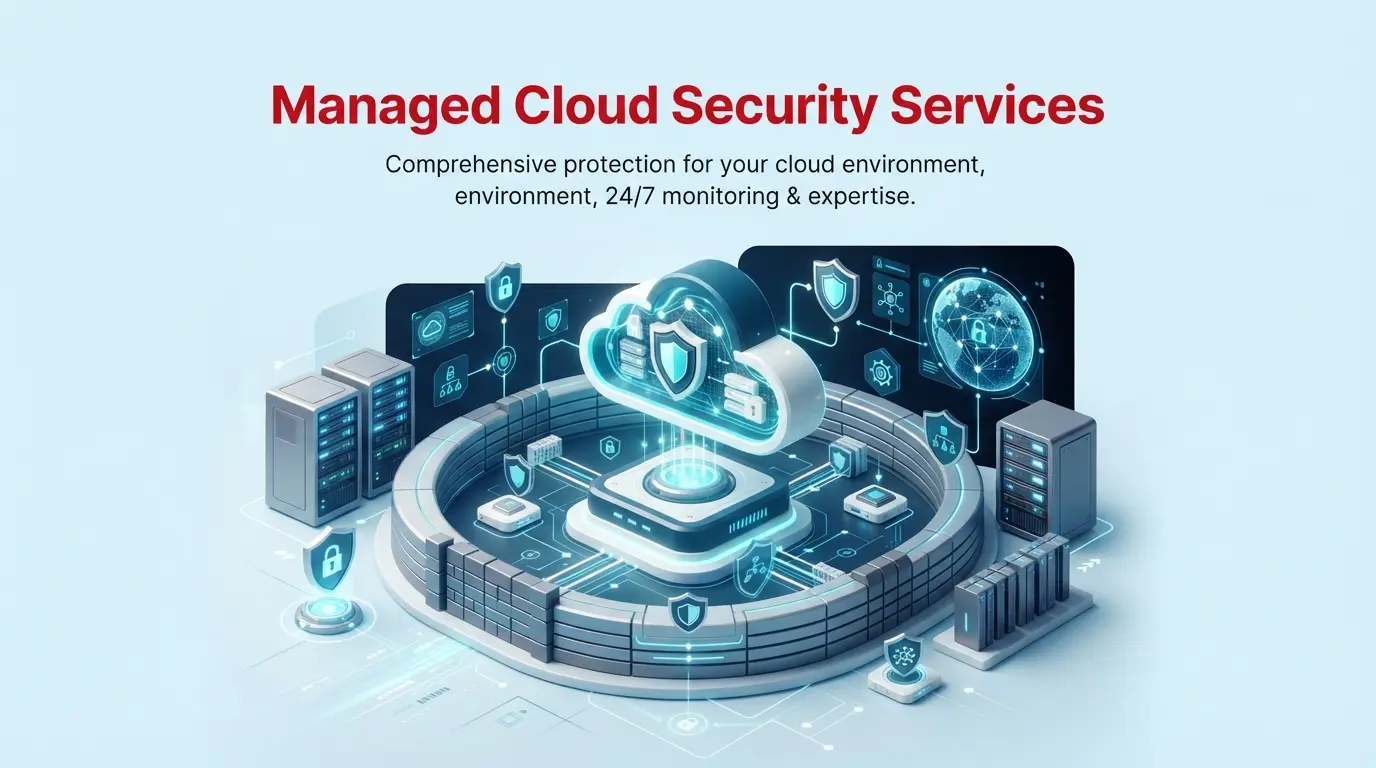
Managed cloud security services involve a third-party provider taking ongoing operational responsibility for monitoring, remediation, and compliance evidence across an organization’s cloud environment. This is distinct from consulting, which delivers a one-time strategy or policy that the client’s own team then implements.
If you hired an MSP for general IT support and assumed they were also properly handling your cloud security, or you paid for a great cloud security strategy but nobody is actually operating the tools it recommended, this guide clarifies exactly what you are buying in either scenario and how to fix the gap.
What Are Managed Cloud Security Services?
A managed cloud security service is an arrangement where a third-party provider takes ongoing, operational responsibility for deploying, configuring, monitoring, and acting on findings across some or all of an organization’s cloud security stack, rather than the organization’s own team performing that work directly.
This addresses a parallel question to choosing a platform to operate yourself: whether to instead buy the operational capacity to run that platform from someone else entirely. Build, buy, or managed is a recurring, domain-by-domain decision every organization faces across its cloud security programme, and this is the full, dedicated treatment of the managed option specifically.
What Is the Difference Between Cloud Security Consulting and a Managed Service?
| Engagement Type | Example Deliverables | Natural Endpoint |
| Consulting | Strategy, architecture design, written policy, risk assessment, compliance readiness | Yes, defined project completion |
| Managed service | Monitoring, remediation execution, posture management, incident response support | No, ongoing by design |
Consulting is typically project-based or periodic expert engagement producing a defined deliverable: a strategy, an architecture design, a written policy, a risk assessment, or audit and compliance readiness preparation. The engagement has a natural endpoint; the client’s own team then implements and operates the result. A managed service is ongoing, continuous operational responsibility for actually running specific functions day to day: monitoring, automated remediation execution, continuous posture and entitlement management, and incident response support. There is no natural project endpoint by design.
This distinction genuinely matters because organizations often need both, sequenced correctly, and confusing the two purchase types leads directly to wasted spend. A brilliant strategy that nobody operates delivers a plan, not risk reduction: an organization that pays for expert strategic guidance, receives a well-considered document naming specific priorities and recommended tools, then has no operational capacity to actually implement and run what the strategy recommends, has purchased planning rather than protection. Conversely, a managed service operating tools without a coherent underlying strategy behind it risks operating the wrong things well rather than the right things at all, efficiently monitoring and remediating findings across a tool stack that was never actually prioritized against the organization’s genuine risk profile in the first place.
This cluster’s own content maps cleanly onto this distinction, offering a genuinely useful reference point. Architecture design, strategy building, policy writing, risk assessment, and compliance readiness preparation are naturally consulting-shaped: each produces a specific, defined deliverable with a clear endpoint, after which the engagement is genuinely complete unless a new, separate deliverable is commissioned. Continuous posture management, entitlement monitoring, day-to-day monitoring and triage, automated remediation execution, and incident response support are naturally managed-service-shaped: each represents ongoing operational work with no natural completion point, since a monitoring function does not conclude the way a written policy does. Understanding which category a specific piece of work falls into, before entering any vendor conversation, prevents the common and costly confusion of expecting ongoing operational protection from what is actually a one-time deliverable engagement, or vice versa.
What Is “Cloud Security as a Service,” and How Is That Different from IaaS/PaaS/SaaS?
IaaS, PaaS, and SaaS describe how computing resources themselves are consumed. Cloud security as a service describes how security capability is delivered, and can sit on top of any of those three underlying models. What “as a service” specifically signals is cloud-hosted, subscription-based technology, entirely separate from whether a human team is actively managing it.
This disambiguation deserves direct, explicit statement rather than assuming readers already understand it, because the phrase “as a service” already carries a specific, established meaning elsewhere in cloud terminology, and readers encountering “cloud security as a service” for the first time reasonably risk conflating it with that existing framework. IaaS, PaaS, and SaaS answer the question of how much of the technology stack a customer manages versus how much a provider manages, a question about infrastructure consumption. Cloud security as a service answers a different question entirely: is the security capability itself delivered as cloud-hosted, subscription-based technology, regardless of which underlying infrastructure consumption model the organization uses.
The practical buyer question this creates is genuinely important and easily overlooked: a “security as a service” offering advertised by a vendor might be a self-service tool that the customer’s own internal team configures, monitors, and operates entirely themselves, purchased on a subscription basis but requiring the same internal operational capacity a self-hosted tool would need. Alternatively, the identical underlying technology might be wrapped with a fully managed operational layer, where the vendor’s own staff configure, monitor, and act on findings on the customer’s behalf, with the customer receiving reports rather than performing hands-on operation. These are two fundamentally different purchases, one requiring the customer to provide their own operational staffing and expertise, the other providing that staffing as part of the offering, and confirming explicitly which version is on the table in any specific vendor conversation avoids a costly, easily avoidable misunderstanding that only becomes apparent after signing, when the customer discovers they were expected to operate a tool they assumed came with a managed team attached.
What Does a Managed Cloud Security Service Provider Actually Cover, Day to Day?
A managed cloud security service provider typically covers deployment and configuration of CSPM, CWPP, CIEM, or CNAPP tooling tailored to the client’s environment. Continuous monitoring and triage manage the signal-to-noise and alert fatigue challenge, while remediation execution happens through automation frameworks or direct, human-led fixes where automation is not yet appropriate.
Compliance evidence and reporting maintain continuous evidence collection mapped to applicable frameworks or regulatory regimes. Incident response support acts as some or all of the organization’s response capability during a live incident. Architecture design and strategic decision-making generally remain the client’s own responsibility or a separate consulting engagement, since these are business and risk-tolerance decisions rather than operational execution.
How Does Shared Responsibility Change When a Third Party Enters the Picture?
The original shared responsibility model was a two-party relationship between cloud provider and customer. Engaging a managed provider introduces a third party, and the customer’s own responsibility does not simply transfer wholesale to that new provider.
Most competitor content treats hiring a managed provider as if it straightforwardly removes the customer’s responsibility, a framing that misrepresents what is actually happening and creates genuine, avoidable risk. Engaging a managed provider redistributes responsibility across a now three-party relationship rather than simply transferring it wholesale from the customer to the provider.
Two specific categories of obligation remain genuinely non-transferable regardless of how comprehensive the managed arrangement appears. Final legal accountability for regulatory compliance stays with the organization itself: under HIPAA, GDPR, or FedRAMP, the organization remains the accountable party regardless of who operates the underlying technical controls, meaning a managed provider’s operational failure does not shift legal liability away from the customer who engaged them. Strategic risk-acceptance decisions similarly cannot transfer, since these represent genuine business judgement, decisions about which residual risks an organization is willing to accept given its specific circumstances, that no third party can exercise on the client’s behalf regardless of technical expertise, because the provider does not bear the business consequences of that judgement the way the organization itself does.
The governance implication is direct and practical: a mature cloud security policy should explicitly document where the managed provider’s responsibility begins and ends, using the same named, accountable-role discipline organizations apply to their own internal teams, now extended to a named external party. Without this explicit documentation, organizations frequently discover the gap only after an incident, when it becomes apparent that neither the customer nor the provider believed a specific responsibility was theirs, precisely the ambiguity gap that unowned technical responsibilities create at the internal team level, now recurring at the third-party relationship level instead.
Managed vs Co-Managed vs Fully In-House — Which Model Fits Which Organization?
| Criteria | Fully In-House | Co-Managed | Fully Managed |
| Staffing requirement | Significant, 24/7 capacity | Lean internal team, defined scope | Minimal internal |
| Control level | Highest | High, retained strategic control | Delegated, contracted scope |
| Speed to capability | Slowest | Moderate | Fastest |
| Best suited for | Large, well-resourced organizations | Organizations wanting judgement retained | Limited internal capacity |
Fully in-house means the organization’s own team handles every operational function directly, requiring significant depth and 24/7 staffing capacity, realistic primarily for larger, well-resourced organizations. Fully managed means the provider handles the full operational scope, suiting organizations with limited or no internal specialist capacity. Co-managed is the increasingly common middle path, where the organization retains strategy, architecture, and high-sensitivity decisions while the provider handles defined operational functions, letting a lean internal team focus on the judgement work only they can genuinely own.
This decision should be made domain by domain rather than as one blanket organizational choice: an organization might reasonably keep IAM governance fully in-house while fully outsourcing 24/7 monitoring and CSPM remediation, reflecting genuinely different maturity and resourcing realities across different domains simultaneously.
What Is an MSSP, and How Is It Different from a General IT MSP?
A Managed Security Service Provider specializes specifically in security operations, distinct from a general Managed Service Provider whose core business is broader IT support and infrastructure management, with security as one offering among many rather than a central specialism.
This is a genuinely common and consequential point of confusion that deserves direct naming rather than a passing mention. Organizations with an existing general IT MSP relationship, often a long-standing arrangement covering help desk support, hardware management, and general network administration, may reasonably assume that provider is already equipped for genuine cloud security depth, simply because security is listed somewhere among their broader service offerings.
The specific expertise cloud security genuinely requires, deep, current knowledge of CSPM, CIEM, cloud-native threat detection, and rapidly evolving cloud-specific attack patterns, is a distinct specialism that a generalist MSP focused primarily on broader IT support may not hold in-house at all. Many general MSPs address this gap by subcontracting cloud security specifically to a separate MSSP behind the scenes, presenting a unified service to the customer while the actual specialist work happens through a different organization entirely, an arrangement the customer may never be explicitly told about unless they ask directly.
The direct question worth asking any existing MSP relationship is precisely this: is cloud security delivered by the MSP’s own dedicated specialist team, or subcontracted to a separate MSSP behind the scenes. This matters for two distinct reasons. It affects service quality expectations directly, since a subcontracted arrangement may involve an additional layer of communication and potentially slower response during an active incident. It also affects the third-party responsibility mapping covered earlier, since a subcontracting arrangement potentially introduces a fourth party into what should be a clearly documented chain of accountability, an additional layer of complexity that deserves explicit clarification rather than remaining an unexamined assumption.
How Do You Evaluate a Cloud Security Service Provider?
Request an explicit breakdown against named tool categories and disciplines, CSPM, CWPP, CIEM, monitoring, automation, incident response, rather than accepting a vague comprehensive coverage claim. Ask which underlying platform the provider operates, since this affects both capability and future transition risk. Apply a disclosure-based, critical sourcing lens to any analyst recognition or accreditation the provider claims, rather than accepting an unverified marketing statement. Request sample reporting and a defined incident response SLA, testing whether it provides genuine, board-usable insight.
Data portability and exit terms deserve treatment as a genuine, specific risk requiring pre-signing negotiation, not a generic contract-review afterthought most competitor content mentions only in passing. A managed cloud security relationship accumulates significant, valuable operational history over time: configuration decisions, findings history documenting the organization’s actual risk trajectory over months or years, and access permissions built up as the relationship matured. This accumulated history has genuine value independent of the relationship itself, both for demonstrating compliance progress over time and for any future provider transition.
Confirming, explicitly and in writing before signing rather than after the relationship is operationally entrenched, exactly what happens to this accumulated configuration state, findings history, and access continuity if the relationship ends is essential, and this is analogous to platform lock-in concerns that deserve the same critical attention in cloud security tooling generally. An organization that discovers only during an actual provider transition that findings history is not portable, or that reconstructing months of accumulated configuration context requires starting largely from scratch with a new provider, has effectively been locked into the original relationship regardless of contractual notice periods, since the practical cost of leaving includes losing valuable historical context the organization cannot easily reconstruct. Negotiating explicit data portability terms before signing, rather than assuming reasonable behavior will follow if the relationship ever ends, protects against this specific and genuinely common risk.
What Does Managed Cloud Security Cost, and How Does That Connect to ROI?
Managed cloud security pricing typically follows a per-asset, per-cloud-account, or tiered structure based on scope, monitoring only versus full remediation and incident response inclusion. The full financial comparison methodology, weighing fully loaded in-house cost against managed cost using realistic time-to-competence, determines whether a given price represents good value for your specific risk profile.
Who Genuinely Needs Managed Cloud Security Services, and How Do You Get Started?
Organizations genuinely needing managed cloud security services include those without in-house capacity to properly staff 24/7 monitoring or safely interpret and automate remediation, those experiencing cloud growth outpacing their internal team’s ability to keep pace with new accounts, and those pursuing formal compliance needing continuous, audit-ready evidence without the resourcing to build that capability from scratch.
Step 1: Complete a risk assessment and maturity assessment first, scoping the engagement against genuine, evidenced priorities rather than a generic package.
Step 2: Decide domain by domain which functions suit managed, co-managed, or in-house delivery.
Step 3: Shortlist providers and request an explicit coverage breakdown against named tool categories.
Step 4: Confirm the shared responsibility mapping explicitly in writing, extending the two-party model to the new third party.
Step 5: Negotiate data portability and exit terms before signing, not after the relationship is operationally entrenched.
Step 6: Build the financial case using cost-avoidance methodology.
Step 7: Review the relationship on the same governance cadence established for your broader cloud security strategy.
Cyber Security Solutions Ltd helps organizations assess whether managed cloud security, co-managed support, or a consulting engagement represents the right starting point for their specific environment and team capacity.
Conclusion
Managed cloud security services genuinely redistribute responsibility rather than simply removing it, and understanding the structural difference between consulting and managed service, alongside what remains non-transferable regardless of any arrangement, protects you from the exact gaps most organizations discover only after an incident. Visit cybersecuritysolutionsltd.com for a consultation to assess whether managed cloud security, co-managed support, or a consulting engagement is the right starting point for your specific environment and team capacity.
FAQs
Managed cloud security services involve a third-party provider taking ongoing operational responsibility for monitoring, remediation, and compliance evidence across an organization’s cloud environment. This differs from consulting, which delivers a one-time strategy or policy that the client’s own team then implements themselves.
Consulting produces a defined deliverable with a natural endpoint, a strategy, policy, or architecture design, after which the client implements it. A managed service is ongoing operational responsibility with no natural endpoint, covering functions like continuous monitoring, remediation, and incident response support day to day.
It describes how security capability is delivered, cloud-hosted and subscription-based, separate from the IaaS, PaaS, and SaaS framework describing how compute resources are consumed. It can mean a self-service tool your team manages, or the same technology wrapped with a fully managed operational layer.
An MSSP specializes specifically in security operations. A general MSP’s core business is broader IT support with security as one offering among many, sometimes subcontracted to a separate MSSP behind the scenes. Ask directly whether your existing MSP delivers cloud security through their own specialist team.
No. Final legal accountability for regulatory compliance stays with your organization regardless of who operates the technical controls. A managed provider’s expertise does not automatically absorb this obligation unless explicitly contracted, and strategic risk-acceptance decisions similarly cannot transfer to a third party.
Decide domain by domain rather than as one blanket choice. Fully managed suits limited internal capacity, fully in-house suits large, well-resourced organizations, and co-managed lets a lean internal team retain strategic control while outsourcing defined operational functions like monitoring and remediation.