The 4 Cs (Cloud ,Cluster, Container, Code) of Cloud-Native Security Explained
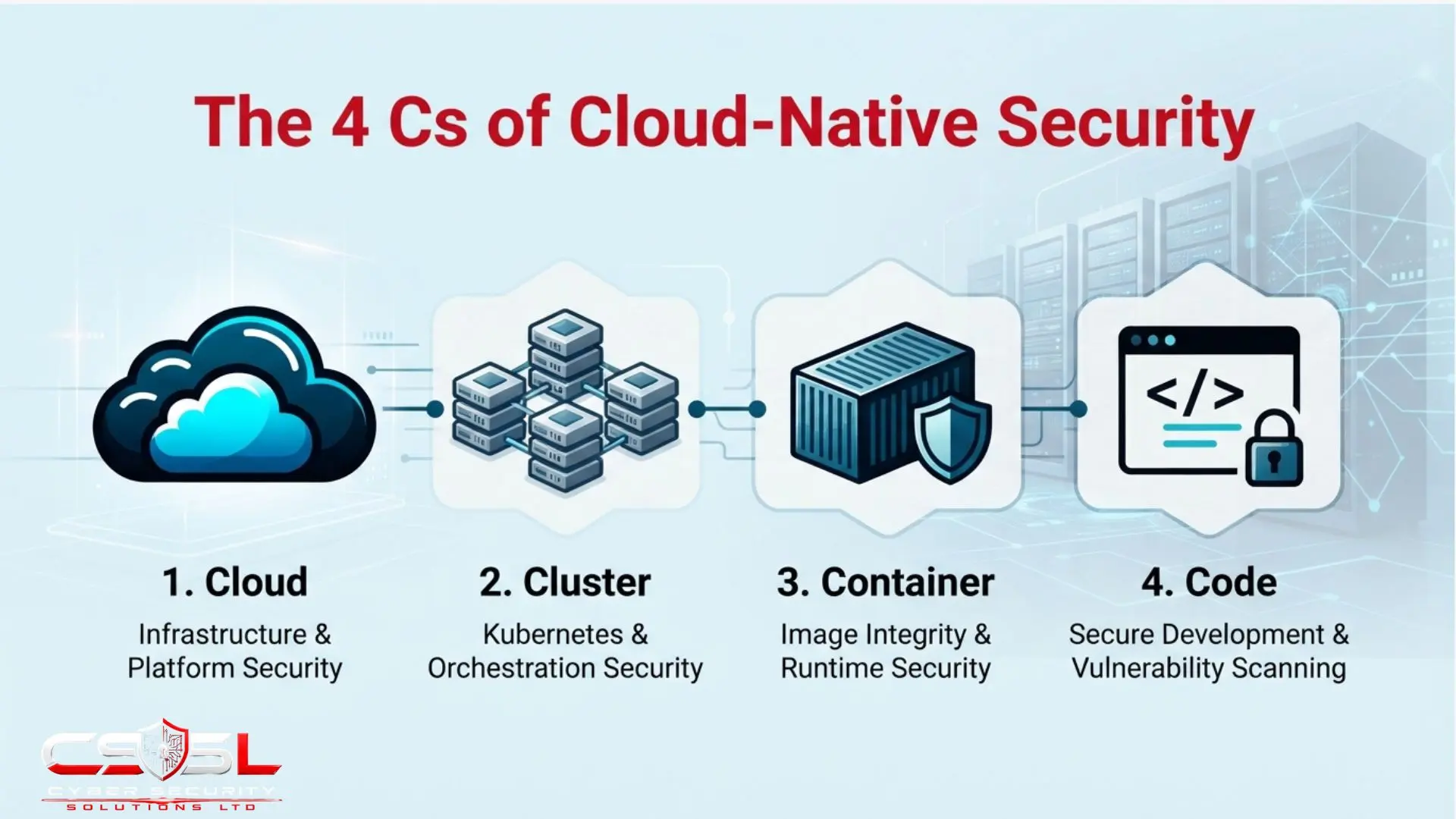
The 4 Cs of cloud native security, Cloud, Cluster, Container and Code, is Kubernetes’ own official model for reasoning about container security, where each ring depends on the ring around it. If you hardened your cloud account and Kubernetes cluster and still got breached through your own application code, this model explains exactly why that happens.
What Are the 4 Cs of Cloud-Native Security?
This is a concentric reference model from Kubernetes’ own documentation describing four nested rings of security responsibility: Cloud, Cluster, Container and Code. Each inner ring depends on the security of the ring surrounding it.
| Ring | What It Covers | Related Posts |
| Cloud | Provider infrastructure, account, network, identity | CSPM, Cloud IAM, Zero Trust, Architecture |
| Cluster | Kubernetes control plane: API server, etcd, RBAC | Container Security |
| Container | Image, vulnerabilities, user, isolation boundaries | CWPP, Container Security |
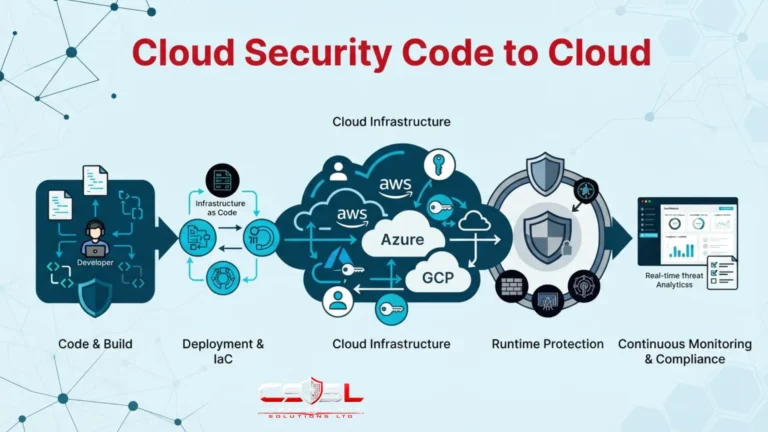
| Code | Application logic, authentication, data handling | Application Security, Code to Cloud |
The core principle in one sentence: you cannot fully compensate for poor security at an outer ring purely through excellent security at an inner ring, but strengthening an inner ring remains valuable even when outer rings are imperfect.
This is a mental model, not a checklist. It gives teams a shared, simple vocabulary for locating exactly where a specific control or vulnerability sits, rather than treating cloud native security as one undifferentiated topic.
Where Does the 4 Cs Model Come From, and Why Does Kubernetes Documentation Use It?
The model originates from and is maintained within official Kubernetes project documentation, part of the Cloud Native Computing Foundation, reflecting the Kubernetes community’s own framing for reasoning about securing a cluster and the workloads running on it.
Here is why Kubernetes specifically needed this framing. Container security already established that Kubernetes introduces a genuinely separate control plane attack surface from the containers it orchestrates, the API server, etcd and RBAC, all governed by entirely different configuration than the containers themselves. The 4 Cs model formalizes that exact distinction, then extends it two rings further: outward to Cloud, capturing everything beneath the cluster, and inward to Code, capturing what runs inside the container itself.
Why has this spread beyond pure Kubernetes contexts? So much modern cloud native architecture gets built around containers and Kubernetes, even in organizations that are not exclusively container-based, that the model now functions as a general teaching tool for cloud native security broadly. The underlying logic, responsibility narrowing as you move from raw infrastructure to running code, holds regardless of how much of the stack is strictly Kubernetes-native.
What Is the Cloud Layer, and What Security Does It Cover?
The Cloud layer is the outermost ring, covering the security of the underlying cloud provider infrastructure and, critically, the organization’s own account, network and identity architecture built on top of it.
This ring is effectively where cloud posture management, cloud IAM, zero trust and account and zone architecture all sit, since no inner ring can be considered secure if the foundational cloud account, network and identity layer beneath it is compromised or misconfigured.
Kubernetes’ own documentation is explicit that securing this outer ring sits largely outside what Kubernetes or any orchestration tooling can control or compensate for. That is exactly why this series covered these foundational domains extensively before ever reaching containers.
What Is the Cluster Layer, and How Does It Differ From the Cloud Layer?
The Cluster layer is the second ring: the Kubernetes cluster itself, both its own components, the API server, etcd, kubelet and scheduler, and the configuration governing what workloads inside the cluster are permitted to do.
This ring is precisely the separate control plane attack surface established earlier in this series. API server hardening, etcd encryption, RBAC and Network Policies all sit specifically at this ring, not the ring outside or inside it.
Keeping this ring conceptually separate from Cloud matters. A perfectly secured cloud account and network provides no protection against a misconfigured Kubernetes API server or an overly permissive RBAC binding, since these are governed by entirely separate configuration systems.
What Is the Container Layer Within the 4 Cs Model?
The Container layer is the third ring: the security of the individual container itself, what image it was built from, what vulnerabilities that image contains, what user it runs as, and what capabilities and isolation boundaries it holds.
Image scanning, non-root users, minimal base images and container escape prevention, all covered in practical depth earlier in this series, are this ring’s specific concern, distinct from the cluster orchestrating the container and the application code running inside it.
This ring sits between Cluster and Code for a reason. A secure cluster configuration cannot compensate for a container image built from an outdated, vulnerable base image. A hardened, minimal image still depends on the cluster around it not granting excessive privileges or unrestricted network access.
What Is the Code Layer, and Why Is It the Ring You Control Most Directly?
The Code layer is the innermost ring: the actual application code and its logic, running inside the container, on the cluster, on the cloud infrastructure that forms every ring outside it.
Unlike the Cloud ring, governed largely by provider security decisions, or the Cluster and Container rings, governed substantially by configuration and orchestration choices, Code is where developers write the actual logic determining how authentication, authorization and data handling behave.
Application vulnerabilities like BOLA, injection and broken authentication, and the pipeline checks like SAST and dependency scanning that catch them before deployment, are this ring’s specific concern. Because this is the innermost ring, a genuinely severe Code layer vulnerability, such as an authentication bypass, can be exploited regardless of how well the three outer rings are secured. That is exactly why infrastructure passing every scan while still getting breached is a coherent, common outcome, not a contradiction.
How Does the 4 Cs Model Differ From the Layered Architecture?
The layered architecture model describes how to structure any cloud environment generally, container-based or not. The 4 Cs model is Kubernetes’ own narrower, industry-standard reference model specifically for container and cluster-based workloads, with more precise nested dependency.
| Criteria | 4 Cs Model | Layered Architecture Model |
| Scope | Container and cluster-based workloads | Any cloud environment generally |
| Origin | Kubernetes project documentation | Enterprise architecture best practice |
| Best used for | Reasoning about one containerized application | Designing or reviewing a whole environment |
| Related post | This guide | Cloud Security Architecture |
Here is the direct disambiguation worth stating plainly, since related terms already carry meaning elsewhere in this series. The general layered architecture model describes the full breadth of an enterprise environment, including things the 4 Cs model does not address at all: data classification, SaaS, broader identity federation.
The 4 Cs model instead describes, with more specific nested precision, exactly how responsibility narrows and compounds for a containerized workload moving from raw infrastructure down to the code running inside it. Both coexist usefully rather than competing.
A practical guide to when to reach for each: use the layered architecture model when designing or reviewing an entire cloud environment. Use the 4 Cs model when reasoning about or communicating the security of one specific containerized application, since its concentric framing communicates the each-ring-depends-on-the-ring-outside-it relationship more precisely than a general layer list.
What Cloud Security Design Principles Does the 4 Cs Model Reinforce?
Defence in depth, named as a general principle earlier in this series, gets a concrete embodiment here, showing precisely how overlapping, nested layers of protection combine rather than relying on any single ring alone.
Assume breach, also named earlier, gets a direct, practical illustration too. The model’s own logic, that a compromise at an outer ring is not automatically fatal if inner rings remain independently hardened, and that a breach at Code can still occur with pristine outer rings, is exactly what designing for eventual partial failure looks like in practice.
Shift left, covered fully elsewhere in this series, gets reinforced by the model’s explicit ordering. With Code as the innermost, most directly controllable ring, pushing security checks as early and as close to the Code ring as possible remains the highest-value investment available to most development teams.
How Do You Apply the 4 Cs Model to Assess Your Own Environment?
Applying the model starts with identifying what sits at each ring for a specific application, then assessing each ring independently rather than assuming strength at one implies strength at another. Identify the weakest ring specifically, since it defines genuine exposure, use the model as shared vocabulary across teams, and revisit periodically as any ring changes.
Most content stops at listing the four rings as a definition to memorize. Here is what makes the model genuinely useful instead of merely descriptive. A system’s real exposure is defined by its weakest ring specifically, not some blended average across all four.
Picture an application with a beautifully architected cloud account, a hardened cluster, and a clean container image, all genuinely excellent work, sitting on top of application code with an unpatched authentication bypass. Averaging those four rings would suggest a strong security posture. The model’s own dependency logic says otherwise. That single weak ring is where an attacker actually gets in, and it alone defines how exposed the system genuinely is.
This exact ring-by-ring weakest-point exercise is what Cyber Security Solutions Ltd runs in a cloud native security assessment. It rarely lands where a client expects. Teams that have invested heavily in cloud and cluster hardening often assume that investment automatically extends to their application code, and the assessment is usually the first time anyone has actually checked that assumption directly.
- For any specific application under review, explicitly identify what sits at each of the four rings: cloud account and network, cluster, container images, and code.
- Assess each ring independently against the specific controls already covered in this series, rather than assuming strength at one ring implies strength at another.
- Identify the weakest ring specifically, since that ring, not the average of all four, most accurately represents genuine exposure.
- Use the model as a shared communication tool across teams, since infrastructure, platform and development teams typically each own a different ring.
- Revisit the assessment periodically as any individual ring changes, since a strengthened Cloud ring does not retroactively improve a weak Code ring.
Conclusion
The 4 Cs model will not tell you your system is secure. It will tell you exactly where to look first. Cloud, Cluster, Container and Code each depend on the ring around them, and your weakest ring, not your strongest, defines your real exposure. To find out which ring actually represents your biggest gap, visit cybersecuritysolutionsltd.com for a free cloud native security assessment from Cyber Security Solutions Ltd.
FAQs
It originates from Kubernetes documentation, but has spread beyond pure Kubernetes contexts as a general cloud native teaching tool, since so much modern architecture is built around containers even where not exclusively so. It applies most precisely to containerized, cluster-orchestrated workloads specifically.
Not fully. The model’s core principle is that you cannot completely compensate for poor security at an outer ring purely through excellent security at an inner ring, though strengthening that inner ring still remains valuable even when outer rings are imperfect.
The 4 Cs is Kubernetes’ own narrower model for container and cluster-based workloads specifically, describing nested dependency. General cloud security layers describe how to structure any cloud environment regardless of whether containers are involved. Use each for a different job, not as competing options.
Because Code is the innermost ring, and a genuinely severe Code layer vulnerability, like an authentication bypass, can be exploited regardless of how well the three outer rings are secured. Excellent outer-ring security narrows the attack surface but does not eliminate risk sitting inside the code itself.
Assess each ring independently against its relevant controls, then identify the weakest one specifically. The model’s logic means that single weakest ring, not an average across all four, most accurately represents your system’s actual, genuine exposure at any given moment in time.
No. It is a narrower, container-specific reference model, not a replacement for a full architectural blueprint covering identity, data, network and governance across an entire environment. Use a broader architecture model to design the environment, and the 4 Cs to reason about a specific workload within it.