Reverse Proxy Explained: How It Works and How It Protects Web Servers
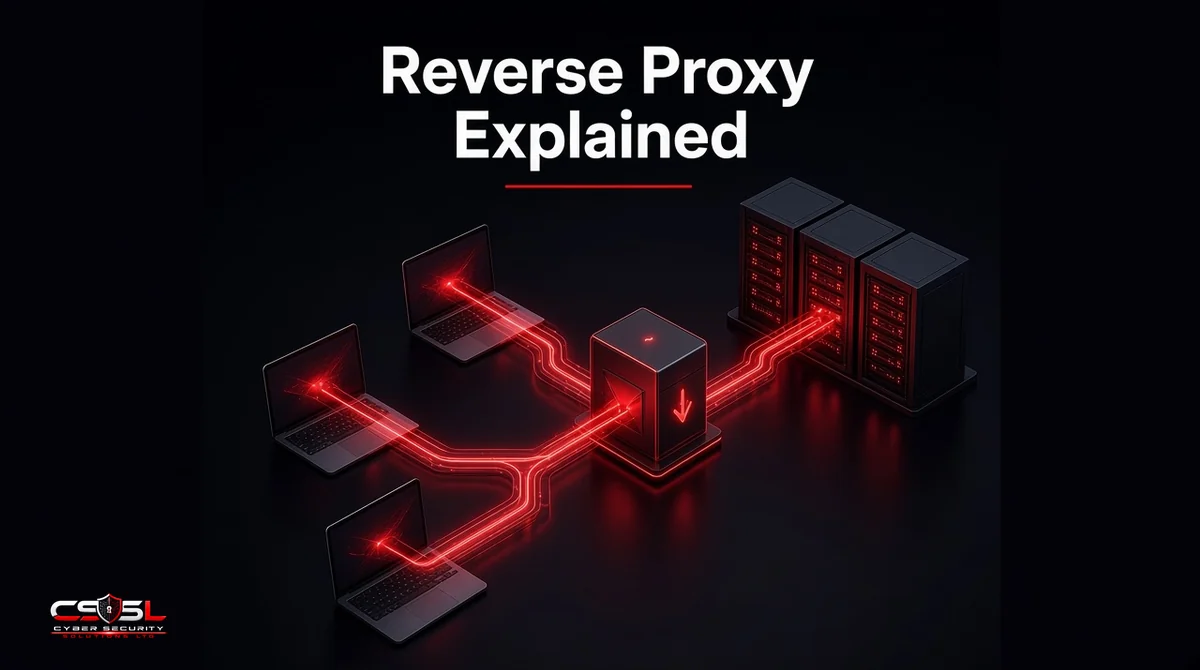
A reverse proxy is a server that sits in front of your web servers, receives every visitor request first, and passes only valid traffic to the real server behind it. Your website’s public address points to the proxy, so attackers scanning the internet see the proxy and never touch the machine running your application.
A Simple Analogy and the Forward Proxy Difference
Think of a hotel front desk. Guests never walk straight to a staff member’s office; they ask the desk, which checks the request and routes it. The reverse proxy is the front desk for your servers.
A forward proxy is the opposite. It sits in front of users, such as staff browsing the web through a company proxy, and represents them to outside sites. A forward proxy protects clients. A reverse proxy protects servers.
How Does a Reverse Proxy Work?
Every request follows the same path, which is why a reverse proxy is a natural place to enforce security.
The Request Path, Step by Step
- A visitor’s browser looks up your domain and gets the proxy’s IP address.
- The browser opens an encrypted TLS connection to the proxy.
- The proxy decrypts and inspects the request, checking rules, rate limits and authentication.
- It forwards approved requests to an origin server on a private network.
- The origin replies to the proxy, which sends the response back to the visitor.
Where It Sits: Edge, DMZ or Cloud
Self-hosted proxies usually sit in a demilitarized zone (DMZ) between the internet and internal servers. Cloud and content delivery network (CDN) services place the proxy at the provider’s edge, close to visitors, with your origin anywhere behind it.
How a Reverse Proxy Protects Web Servers
Each protection below works because the proxy, not your server, faces the internet.
Hiding the Origin Server’s IP Address
Attackers cannot directly target a server whose real address they do not know. This only holds if the origin refuses connections from anywhere except the proxy.
TLS Termination and Certificate Control
The proxy handles encryption, so certificates, TLS versions and cipher settings are managed in one place instead of on every server.
Filtering Requests and Hosting a WAF
Many proxies can run a web application firewall (WAF) that blocks common attacks such as SQL injection and cross-site scripting, the kinds of flaws listed in the OWASP Top 10.
Absorbing DDoS Traffic and Rate Limiting
Rate limits cap how many requests a single client can send. Large cloud proxy networks can absorb distributed denial-of-service (DDoS) floods that would overwhelm a single server.
Centralized Authentication and Access Control
Admin panels and internal apps can require single sign-on and multi-factor authentication at the proxy, before the application ever sees the request.
Stripping Server Headers and Error Details
The proxy can remove version banners and replace detailed error pages, which denies attackers easy clues about your software.
Performance Benefits: Load Balancing, Caching and Compression
Security is not the only payoff. A reverse proxy can spread traffic across several servers, cache static files so the origin does less work, and compress responses so pages load faster. That is why most busy websites run one even when security was not the original reason.
Reverse Proxy vs Load Balancer vs WAF vs CDN vs API Gateway
These terms overlap because many products do several jobs. The table shows the main purpose of each.
| Tool | Main job | Is it a reverse proxy? |
|---|---|---|
| Reverse proxy | Front door for servers | Yes |
| Load balancer | Spread traffic across servers | Usually, at layer 7 |
| WAF | Block application attacks | Often runs inside one |
| CDN | Cache content near users | Yes, distributed |
| API gateway | Manage and secure APIs | Yes, API-focused |
Common Reverse Proxy Software and Services
Choice depends on whether you want to run it yourself. This list is neutral and unranked.
Self-Hosted Options
NGINX, HAProxy, Apache HTTP Server (with mod_proxy), Traefik, Envoy and Caddy are widely used. Traefik and Caddy suit container setups with automatic certificates. HAProxy and Envoy are common at high traffic volumes.
Cloud and CDN Services
Cloudflare, Akamai and Fastly run proxy networks at the edge. AWS Application Load Balancer and Azure Application Gateway provide managed reverse proxy functions inside those clouds.
Reverse Proxy Security Risks and How to Avoid Them
A reverse proxy adds protection, but a careless setup can create new holes. These three cause most of the problems we see in reviews.
Origin Bypass When the Server IP Leaks
The most common failure is a hidden origin that is not hidden. Old DNS records, mail headers, a forgotten subdomain or a test server can reveal the real IP. Attackers then go straight to the origin, skipping every rule on the proxy.
Picture an illustrative online shop that puts a cloud WAF in front of its store. Months earlier, its mail server and an old “dev” subdomain pointed at the same IP. A scanner finds the address in historical DNS data and attacks the origin directly. The WAF logs look clean because the attacks never pass through it.
The fix is a firm rule: the origin must accept web traffic only from the proxy. Use a host firewall or cloud security group that allows only the proxy provider’s published IP ranges, or use an authenticated tunnel or mutual TLS between proxy and origin. Then move the origin to a new IP address, since the old one is already known. Test by trying to load the site directly by IP from outside; it should fail.
Header Spoofing (X-Forwarded-For) and Request Smuggling
Applications behind a proxy often trust the X-Forwarded-For header to learn the visitor’s IP. If the proxy passes through whatever the client sends, attackers can spoof addresses to dodge rate limits or IP allowlists. Configure the proxy to overwrite the header and the application to trust it only from the proxy. Keep proxy and server software patched, because mismatched parsing between them enables HTTP request smuggling.
Single Point of Failure
If one proxy carries all traffic, its failure takes the site down. Run at least two instances or use a managed service with built-in redundancy.
Reverse Proxy Security Checklist
- Origin accepts traffic only from the proxy
- TLS 1.2 or higher, with automatic certificate renewal
- WAF rules enabled and tuned
- Rate limits on login and search pages
- Server version headers removed
- X-Forwarded-For overwritten at the proxy
- Proxy and origin patched on a schedule
- Logs sent to your SIEM or log platform
FAQs
Not by itself. It controls and inspects web traffic, and many proxies can host a WAF, but it does not replace a network firewall.
Yes. It is internet-facing software, so patch it, restrict its admin access and monitor its logs like any critical server.
A CDN already acts as a reverse proxy. You may still use a local proxy for routing between internal services.
NGINX is a web server that is very commonly configured as a reverse proxy and load balancer.
Usually the opposite. Caching and compression often make pages faster, with a small added step for each request.
Yes. A cloud CDN or proxy service is often the simplest option and needs no extra hardware.
Checking Your Own Front Door
Before relying on any reverse proxy, try reaching your origin server directly by IP from outside. If it answers, the proxy is a sign on the door, not a lock. If you want help testing your web exposure, Cyber Security Solutions Ltd offers a free, no-obligation assessment through our contact page.