Why Is Network Security Important? Risks, Costs and Business Impact
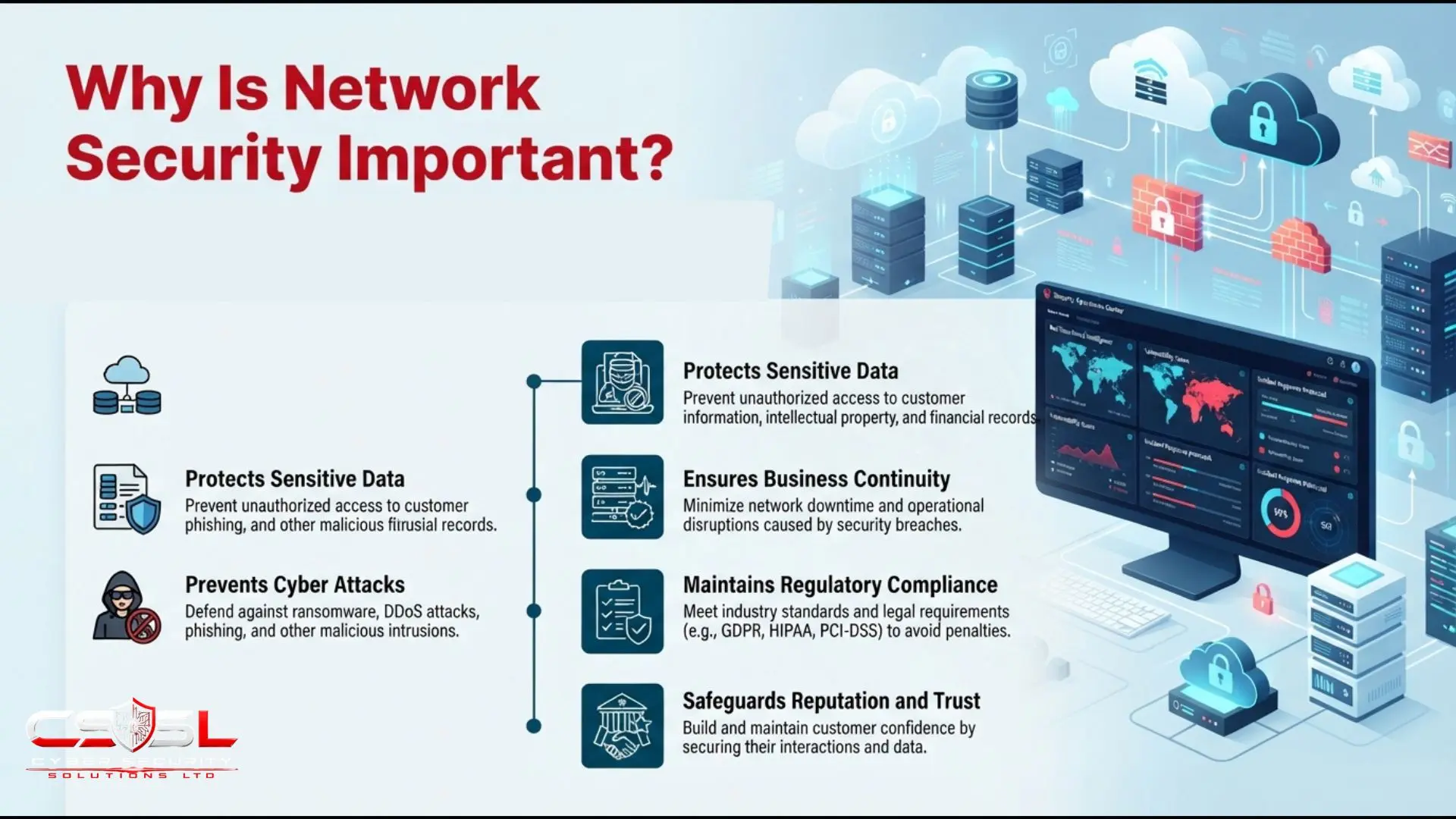
Network security protects the three core goals of confidentiality, integrity and availability. Failing to secure a network exposes a business to malware, unauthorized access and denial-of-service attacks capable of causing real financial loss, regulatory penalty and downtime. If you know network security matters but cannot get budget approved without a clear business case, this guide gives you one.
Why Is Network Security Important for Businesses Today?
Virtually every business now depends on its network for far more than internet access. Payment processing, customer data, internal communications, connected devices and remote work all pass through it, making a compromised network a business-halting event, not a technical inconvenience.
The attack surface has expanded structurally, not just in volume. Every connected device, every remote worker’s home network and every third-party integration is an entry point that simply did not exist for most businesses a decade ago.
Regulatory obligations apply fully regardless of business size, and data protection law does not exempt smaller organizations from the consequences of a breach exposing customer or employee data. A serious network incident today typically means simultaneous loss of email, file access, customer systems and communication tools, all at once.
What Are the Objectives of Network Security, and What Are Its 3 Core Goals?
Network security’s three core goals are widely known as the CIA triad: Confidentiality, Integrity and Availability. A quick human aside worth mentioning: this has nothing to do with the intelligence agency of the same initials, a mix-up that genuinely trips people up on first hearing it.
| Goal | What It Means | Example Control | What Happens When It Fails |
| Confidentiality | Only authorized people can see data | Encryption, access control | Sensitive information falls into the wrong hands |
| Integrity | Data stays accurate and untampered | Checksums, version control | Decisions get made on corrupted data |
| Availability | Systems stay accessible when needed | Redundancy, DDoS protection | Legitimate users get locked out |
Confidentiality means data and network resources stay accessible only to those authorized to see them, achieved through encryption, access control and authentication. When it fails, sensitive information falls into the wrong hands.
Integrity means data is not altered, corrupted or tampered with, whether by accident or on purpose, achieved through checksums, hashing and version control. When it fails, decisions get made on data that has been silently changed without anyone noticing.
Availability means network resources and data remain accessible to authorized users when needed, achieved through redundancy, failover systems and DDoS protection. When it fails, legitimate users, including customers and staff, get locked out of systems they depend on daily.
In practice, businesses translate these three technical goals into higher-level objectives: protecting revenue, meeting compliance obligations, preserving customer trust and enabling safe, confident growth. A retail business losing availability during a holiday sale is not just facing a technical outage. It is losing revenue by the minute, in front of customers who will simply buy elsewhere. That is what gives the CIA triad genuine, felt business relevance rather than leaving it an abstract framework nobody outside IT cares about.
What Are the Most Common Network Security Threats Businesses Face?
Malware and ransomware spread across network-connected systems on their own, with ransomware specifically capable of encrypting network-accessible file shares and bringing operations to a halt within hours of the first infected device.
Phishing and social engineering remain one of the single most common ways an attacker first gains network access at all, tricking an employee into handing over credentials or clicking something they should not.
Distributed denial of service attacks deliberately overwhelm network bandwidth or resources to make systems unavailable to legitimate users, striking directly at the availability goal covered above.
Man-in-the-middle attacks intercept or alter data as it travels across the network, particularly on poorly secured wireless networks or unencrypted connections where nobody notices anything unusual happening.
Unauthorized access and credential-based attacks rely on weak, default or stolen credentials, one of the most direct and common paths into a network, frequently requiring no sophisticated technique at all.
Insider threats come from two directions: malicious insiders misusing legitimate access, and, more commonly, negligent employees creating exposure through careless configuration or unauthorized device use with no bad intent involved.
Advanced persistent threats involve sophisticated, well-resourced attackers who gain network access and deliberately remain undetected for extended periods, often targeting larger or higher-value organizations specifically over months rather than hours.
Unmanaged and IoT device risk grows quietly. Every unmanaged or unauthorized device connecting to the network expands the attack surface in ways many businesses have never fully inventoried, a risk covered in full depth elsewhere in this series.
What Is the Real Cost of a Network Security Breach?
| Threat | How It Occurs | Typical Business Impact |
| Ransomware | Encrypts network file shares | Operational halt, ransom demand |
| Phishing | Employee tricked into access | Initial breach entry point |
| DDoS | Traffic overwhelms resources | Systems unavailable to users |
| Credential theft | Weak or stolen passwords | Direct unauthorized access |
Direct financial costs include incident response, legal fees, regulatory fines, customer notification obligations and, where ransomware is involved, potential ransom payments.
Indirect costs, customer churn, reputational damage and increased cyber insurance premiums following a claim, frequently exceed the direct costs over time.
Operational disruption often represents the single largest cost component for network-wide incidents, since a compromised network can take down every dependent system at once rather than one isolated area.
Smaller organizations face proportionally more severe consequences than headline breach-cost figures suggest, since they typically have far less financial and operational capacity to absorb extended disruption than the large enterprises those figures usually describe.
What Are the Biggest Network Security Challenges Organizations Struggle With?
Budget and resourcing constraints put network security in competition for limited IT spending against other priorities, particularly acute for smaller organizations without a dedicated security line item.
Complexity keeps outpacing available expertise, since modern networks spanning on-premise infrastructure, cloud services, remote workers and IoT devices have grown genuinely harder to secure than the simpler, single-location networks of the past.
A persistent skills gap makes building and retaining in-house expertise a real challenge for most organizations, and constantly evolving attacker techniques mean network security is never a one-time project.
Balancing security with usability matters too. Overly restrictive controls push employees toward risky workarounds, so effective network security has to account for how people work day to day, not just theoretical best practice sitting in a policy document nobody reads.
What Are the Benefits of Strong Network Security?
Strong network security limits the blast radius when incidents occur, rather than letting a single compromise take down the entire business at once.
Properly secured, documented network controls give organizations the evidence needed to demonstrate compliance during audits, reducing both regulatory risk and audit burden considerably.
Clients and partners increasingly expect evidence of genuine network security maturity as a condition of doing business, making it a commercial enabler as much as a defensive measure.
Organizations with mature network monitoring and response capability consistently experience lower breach costs, since faster detection directly reduces the scope and financial impact of any incident.
Why Does Network Security Matter More as Businesses Grow?
The attack surface grows proportionally with the business, since every new employee, office location, connected device and third-party integration expands the network’s own exposure.
Regulatory exposure increases with scale, as growing businesses increasingly encounter customers, partners and contracts requiring demonstrable security maturity that smaller, earlier-stage businesses were never asked to prove.
The cost of a breach scales with what is at stake. A network breach affecting a business with significant customer data, revenue or operational dependency costs proportionally more than the same incident affecting a smaller, earlier-stage organization.
What Happens to Businesses That Ignore Network Security?
Helping a business understand its own real exposure, in plain terms, before recommending anything specific, is exactly how Cyber Security Solutions Ltd starts this conversation with new clients.
An unpatched network device or a default admin password left unchanged results in unauthorized access with no sophisticated attack technique required at all. A ransomware incident spreading unchecked across an inadequately segmented network takes down every connected system at once, rather than staying contained to a single affected area. A network breach exposing customer data triggers notification obligations, regulatory scrutiny and public disclosure regardless of how the incident occurred in the first place.
Conclusion
Network security is not a cost center you fund once and forget. It protects the revenue, trust and continuity your business depends on daily, and the price of ignoring it grows right alongside your company. Start by understanding which of the risks above genuinely applies to your own operation.
FAQs
Network security protects the three core goals of confidentiality, integrity and availability. Without it, a business risks malware, unauthorized access and denial-of-service attacks capable of causing significant financial loss, regulatory penalty and operational downtime across every system that depends on the network.
Confidentiality, Integrity and Availability, together known as the CIA triad. Confidentiality keeps data accessible only to authorized users, Integrity keeps data accurate and untampered, and Availability keeps systems accessible when legitimate users need them most, whether that is a customer or an employee.
Phishing and credential-based attacks remain the most common entry points. Weak, default or stolen credentials often require no sophisticated technique at all, and phishing remains one of the most common ways an attacker first gains network access into a business.
Costs fall into direct expenses like incident response and fines, indirect costs like customer churn and higher insurance premiums, and operational disruption, often the largest single cost, since a compromised network can take down every dependent system simultaneously across the whole business.
Small businesses are genuinely at risk, often more severely than the headlines suggest. They typically have far less financial and operational capacity to absorb extended disruption than larger enterprises, meaning the same incident proportionally costs a smaller business more relative to its size and reserves.
Budget constraints, complexity outpacing available expertise, a persistent skills gap, constantly evolving attacker techniques, and balancing security with usability day to day. These challenges intensify as a business grows, since the network itself grows more complex and harder to defend alongside it.