What Is Offensive Security? Ethical Hacking Explained for Businesses

Offensive cyber security is the proactive discipline of simulating real attacks against your own systems to find and fix weaknesses before criminals exploit them, covering strategy, risk assessment, and hands-on testing rather than a single activity.
This “think like a hacker” approach flips traditional defense on its head. Instead of waiting for an incident and responding afterward, offensive security actively probes your network, applications, and people, then hands you a prioritized list of exactly what needs fixing, backed by proof-of-concept evidence rather than theoretical risk.
Ethical hacking, penetration testing, and red teaming: how they connect
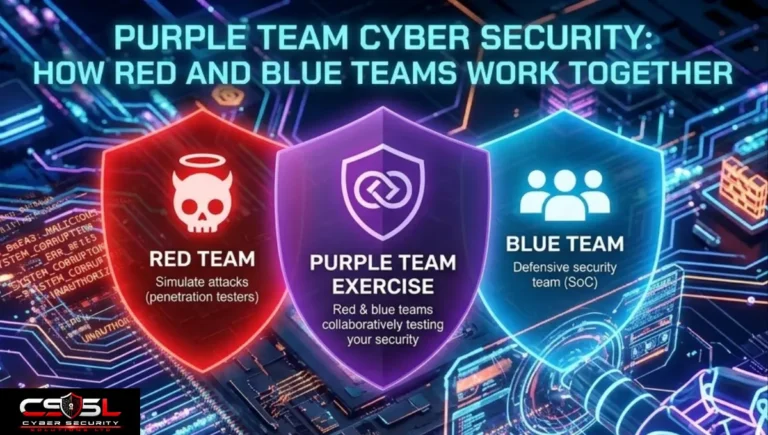
Offensive security is the umbrella discipline. Ethical hacking is the broader authorized-attack philosophy sitting inside it. Penetration testing is a structured, scoped, contractually-defined engagement type within ethical hacking. Red team cyber security sits at the most advanced end, emulating a stealthy adversary without alerting defenders in advance.
Each layer answers a different question at a different depth. A vulnerability scan tells you what’s exposed. A penetration test proves what’s exploitable. A red team engagement proves what a persistent, realistic adversary could actually achieve inside your specific environment, undetected, given time.
Black box, white box, and grey box: choosing the right testing model
Black box white box grey box testing describes how much information testers receive before starting. Black box means zero knowledge, simulating a pure external attacker. White box means full access, source code and architecture included. Grey box sits between the two, with limited credentials and documentation.
| Model | Knowledge Given | Best For |
| Black box | None | External attacker realism |
| Grey box | Partial (standard credentials, basic architecture) | Web apps, APIs, identity-centric attacks |
| White box | Full (source code, full access) | Comprehensive vulnerability coverage |
Grey box has become the most common model in 2026, used in roughly 70% of engagements, because it strips out the time-consuming reconnaissance phase without sacrificing the realism that matters most for identity and authorization-based attack paths, which now dominate real-world breaches.
The five-phase penetration testing workflow
A standard penetration testing methodology runs through five phases: planning and reconnaissance, scanning, gaining access, maintaining access, and analysis with reporting, each building directly on the evidence the previous phase produced.
Planning defines scope and rules of engagement before any technical work starts. Reconnaissance and scanning map the target and identify potential weaknesses. Gaining access attempts real exploitation, proving a vulnerability isn’t just theoretical. Maintaining access tests how far a compromise could realistically spread. Reporting translates every finding into prioritized, CVSS-scored recommendations a business can actually act on, not just a raw vulnerability dump.
Certifications that matter: OSCP, CREST, and beyond
OSCP CREST certification and similar credentials matter because they prove hands-on exploitation skill, not just theoretical knowledge. OSCP is the baseline for network and infrastructure testing; CRTO and CRTE demonstrate advanced Active Directory and red team competency specifically.
Beyond the certification itself, review a tester’s demonstrated output directly: published research, CVE discoveries, and prior client references. A credential without demonstrated practical results tells you less than a smaller firm with a documented track record of real findings. For web application depth specifically, BSCP and OSWE indicate genuinely deep application-layer testing skill most generalist certifications don’t require.
NCSC CHECK and CREST accreditation: what UK businesses should verify
CREST CHECK NCSC accredited penetration testing matters directly for UK businesses: CHECK is the NCSC’s own scheme specifically for government and Critical National Infrastructure systems, requiring providers to first hold CREST accreditation before undergoing additional NCSC assessment.
A simple rule cuts through most confusion here: if you’re in doubt, you likely need CREST accreditation as your baseline requirement, since CHECK is only mandatory where NCSC or a specific contract explicitly requires it. CHECK team members must hold SC-level government security clearance given the sensitivity of the systems involved, a detail that explains why CHECK engagements cost meaningfully more than standard CREST-accredited testing. UK government procurement policy PPN 014 now requires CREST accreditation for government suppliers directly, and DORA mandates CREST or CHECK-level testing specifically for financial services threat-led penetration testing.
What does a defensible penetration test require?
A defensible penetration test requires a signed rules of engagement document, testers using recognized methodologies like PTES or OSSTMM, and a report containing CVSS-scored findings with proof-of-concept evidence, not just a list of scanner output copied into a template.
Verify these specific elements before accepting any report as genuine evidence of testing quality: did testers attempt actual exploitation, not just identification, does the report demonstrate business impact for each finding, and is there a clear, prioritized remediation roadmap rather than an undifferentiated list. A business already maintaining vulnerability assessment and penetration testing as an ongoing program should hold every vendor to this same defensibility bar consistently, not just for the first engagement.
Regulatory drivers: DORA, NIS2, and PCI DSS 4.0
Penetration testing regulatory drivers DORA NIS2 now make testing a legal obligation for many businesses, not just a best practice: DORA Article 26 mandates threat-led penetration testing for significant EU financial entities, NIS2 Article 21 requires it more broadly, and PCI DSS 4.0 Requirement 11.4 mandates multi-layered testing annually for any business handling card data.
ISO 27001:2022’s Annex A.8.8 adds a further compliance layer many businesses discover only during a certification audit. These aren’t overlapping suggestions, they’re distinct, enforceable requirements, and a business subject to more than one framework needs a testing program scoped to satisfy the strictest applicable standard, not the loosest one it can technically justify.
What does this cost, and what’s the lowest legitimate price?
Legitimate penetration testing in 2026 realistically starts around $5,000 to $10,000 for a scoped engagement, and pricing below that range is very likely automated vulnerability scanning marketed with pentest language rather than genuine manual testing.
Real pentesting is labor-intensive by design, 95% manual effort testing real attack chains, not automated scanning alone, which is exactly why the price floor exists. Ask any vendor quoting below that range directly what percentage of the engagement is manual versus automated, and request a sample report showing proof-of-concept exploitation, not just a vulnerability list, before signing.
A realistic first offensive security engagement for a smaller business
A realistic starting engagement for a business without prior offensive security experience is a grey box web application or external network test, scoped narrowly, with a CREST-accredited provider, rather than jumping straight to a full red team engagement your organization isn’t yet mature enough to benefit from.
Cyber Security Solutions Ltd guides first-time clients through exactly this scoped entry point, since the businesses that start with an appropriately sized, properly accredited test build the internal process maturity a more advanced engagement later actually requires to deliver real value.
FAQs
Offensive security is the proactive discipline of simulating real cyberattacks against your own systems to find and fix weaknesses before criminals exploit them. It encompasses strategy, risk assessment, and hands-on testing methods like penetration testing and red teaming.
Black box testing gives testers no prior knowledge, simulating an external attacker. White box gives full access, including source code. Grey box sits between the two with partial credentials, now the most common model at roughly 70% of engagements.
OSCP is the standard baseline for network and infrastructure testing. CRTO and CRTE indicate advanced Active Directory competency. Beyond credentials, review published research and client references, since certifications alone don’t guarantee demonstrated practical skill.
CHECK is the NCSC’s assurance scheme for penetration testing of UK government and Critical National Infrastructure systems. Providers must first hold CREST accreditation, then pass additional NCSC assessment, and team members require SC-level security clearance.
Legitimate testing realistically starts around $5,000 to $10,000 for a scoped engagement in 2026. Pricing below that range is very likely automated vulnerability scanning marketed with pentest terminology rather than genuine manual exploitation testing.
Often yes, though scaled appropriately. A narrowly scoped grey box test on a web application or external network is a realistic starting point, rather than a full red team engagement most smaller organizations aren’t yet mature enough to fully benefit from.
DORA mandates threat-led penetration testing for significant EU financial entities. NIS2 requires it more broadly across essential and important entities. PCI DSS 4.0 mandates annual multi-layered testing for businesses handling card data, alongside ISO 27001:2022’s Annex A.8.8.