
Purple Team Cyber Security: How Red and Blue Teams Work Together
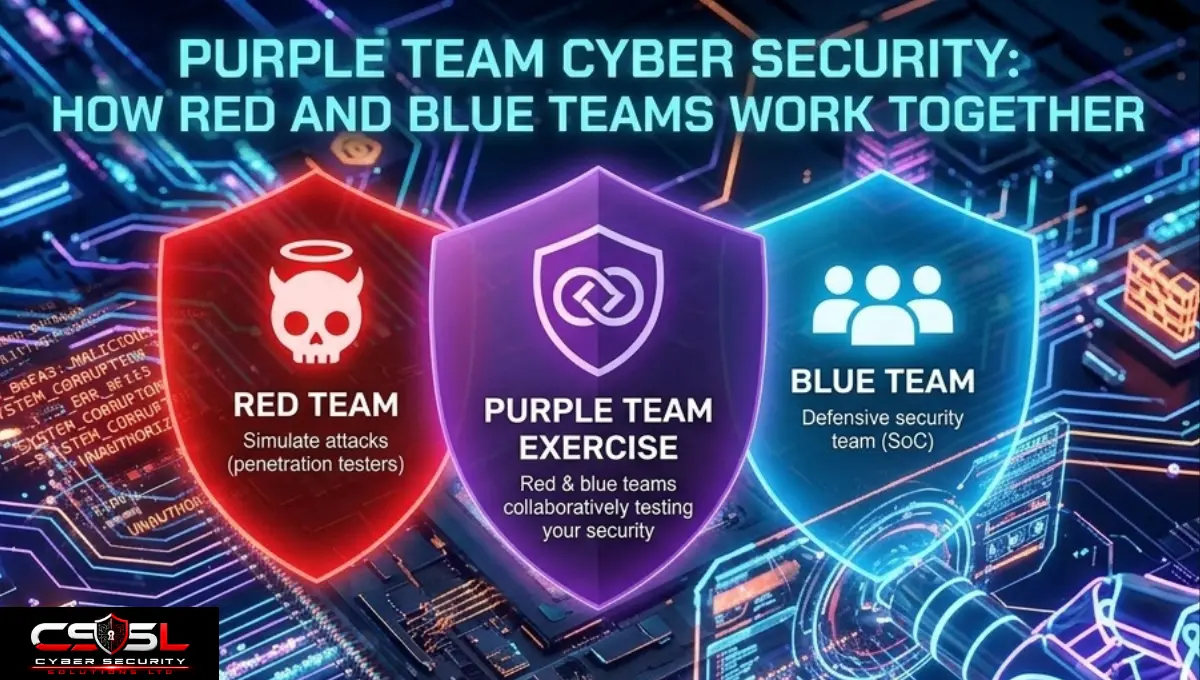
Purple team cyber security is the collaborative process where red team attackers and blue team defenders share information in real time during an exercise, rather than working in separate silos and comparing notes afterward in a final report.
Red simulates the attack. Blue tries to detect and respond. Purple is what happens when both teams work the same technique together, live, so a missed detection becomes an immediate fix instead of a line item discovered weeks later. This collaborative model only works cleanly, though, when a fourth role sits above both teams keeping the exercise safe, fair, and properly scoped, which is exactly where white team responsibility begins.
What is offensive security, and where does red teaming fit within it?
It is the broader discipline of proactively simulating real attacks to find weaknesses before criminals do, encompassing strategy, risk assessment, and testing methodology, not just the act of hacking itself. Red teaming sits at the most advanced, realistic end of that discipline.
Offensive security contains a clear hierarchy: penetration testing is a structured, scoped, contractually-defined engagement type; ethical hacking is the broader authorized-attack philosophy penetration testing sits inside; red teaming is the most advanced expression of that philosophy, emulating a persistent, stealthy adversary across multiple phases without alerting the defenders in advance. Most security experts recommend penetration testing at least annually, quarterly for organizations in high-risk industries, with red teaming reserved for genuinely mature programs ready for that level of realism.
White team cyber security: the referee nobody talks about
NIST’s own glossary defines the white team plainly: the group responsible for refereeing an engagement between red and blue, acting as judges who enforce rules, score results, resolve disputes, and ensure the exercise doesn’t cause real operational harm to the business being tested.
White team members stay independent from both red and blue, typically including the engagement sponsor, security leadership, and a small number of defenders deliberately briefed in advance specifically so they can halt the exercise if genuine risk emerges, a safety valve most published explanations of red versus blue never mention. This distinction matters because purple teaming, the collaborative technique-by-technique feedback loop, and white teaming, the structural referee role, solve different problems entirely: purple team functions like a coach giving live feedback, white team functions like the referee setting and enforcing the rules that make the whole exercise legitimate in the first place.
Rules of engagement: how the white team keeps an exercise safe and fair
Rules of engagement, or ROE, is the document dictating exactly how an assessment happens, which systems are in scope, what actions are permitted, and what’s explicitly off-limits, and it must be formally signed by both parties before any testing begins.
Skipping this step isn’t a minor procedural gap, it’s a genuine legal exposure. Without a properly signed ROE, offensive security activity by ethical hackers is considered a violation of the Computer Fraud and Abuse Act in the United States, a federal crime, with equivalent prosecutable laws in other jurisdictions including the UK. The white team owns this document from drafting through enforcement, monitoring the live exercise specifically to confirm red stays within agreed boundaries and halting activity immediately if a real, unplanned risk surfaces mid-engagement.
White team vs black team: a distinction worth getting right
White team vs black team genuinely varies by source, and getting this wrong in a client conversation is an easy, avoidable mistake. In the most common convention, black team refers to pure observers who evaluate the exercise with zero interference, more judge than referee, and the role is rare enough that white teams often absorb it when no dedicated black team exists.
A second, entirely different convention uses black team to describe physical security assessments specifically, borrowing the “black ops” naming from covert, non-attributable stealth operations. Both usages appear across the industry without a single settled standard, so the practical fix is simple: never assume which definition a vendor or client means, ask directly whether “black team” in their context refers to a non-interfering observer role or a physical penetration testing function, since the two require entirely different scoping conversations.
How white team documentation becomes audit evidence
White team documentation, the rules of engagement, scoring records, and dispute resolutions from a completed exercise, becomes genuine audit evidence, demonstrating an organization tested its defenses under realistic, controlled conditions rather than assuming protection existed.
This connects directly to compliance frameworks businesses already navigate: SOC 2 audits increasingly expect documented evidence of tested detection capability, and PCI DSS 4.0’s mandatory annual multi-layered testing requirement is satisfied more convincingly by a properly white-team-documented red team exercise than a checkbox pentest report. A business already maintaining a cyber security audit checklist has the natural home for this documentation, since white team records answer exactly the “how do you know your controls work” question an auditor is trained to ask.
Running a coordinated exercise: who does what, and when
A coordinated exercise runs in a clear sequence: white team drafts and gets sign-off on the ROE first, red team executes within that scope while blue team defends without advance warning of specifics, and white team monitors throughout, ready to pause the exercise the moment a genuine safety issue appears.
Scoring happens continuously, not just at the end. White team tracks what red attempted, what blue detected, and where the gap sits, producing the raw material for the debrief regardless of whether the exercise later transitions into a collaborative purple team session. This sequencing matters specifically because it’s what separates a properly governed engagement from an unofficial, undocumented test that offers no defensible audit trail afterward.
Purple team methodology: turning findings into tested detections
Purple team methodology in practice means taking each white-team-documented finding and immediately closing the loop: red demonstrates a specific technique, blue checks live whether their detection stack caught it, and any gap gets fixed in the same session rather than filed for later.
This is where the exercise earns its real value. A finding that stays in a report becomes a remediation backlog item competing for attention months later. A finding worked through collaboratively, in the room, with the white team’s documented ROE ensuring both sides stay within agreed boundaries, becomes a tested, working detection rule before anyone leaves the exercise.
Building this capability without a large, dedicated security team
Smaller organizations can build a lightweight version of this same structure: designate one person as the informal white team lead responsible for scope and safety, even for a basic exercise using free tools like Atomic Red Team, before ever committing to a full outsourced red team engagement.
The discipline matters more than the scale. A one-person white team function, drafting a simple written scope document and staying available to pause testing, still closes the legal and safety gap an undocumented “let’s just try attacking ourselves” exercise leaves wide open. Cyber Security Solutions Ltd helps smaller clients build exactly this scaled-down governance structure before their first formal purple team exercise, since the businesses that skip this step are the ones who discover the CFAA implications the hard way.
Every exercise your business runs without a documented referee is a legal and operational gap waiting to surface at the worst possible moment. Cyber Security Solutions Ltd can help you build that governance structure properly at cybersecuritysolutionsltd.com.
FAQs
Purple team cyber security is the collaborative process where red team attackers and blue team defenders share findings in real time during an exercise, rather than comparing notes afterward. It turns individual attack techniques into immediately tested, tuned detection rules.
Offensive security is the broader discipline of proactively simulating real attacks to find weaknesses before criminals exploit them, including strategy, risk assessment, and testing methodology. Penetration testing and red teaming are specific, more narrowly scoped activities within this wider discipline.
The white team referees the engagement between red and blue teams, defining rules of engagement, monitoring execution, scoring results, resolving disputes, and halting the exercise if genuine operational risk emerges. They remain independent from both offensive and defensive sides.
This varies by source. Most commonly, black team refers to a pure observer role with no interference, distinct from white team’s active referee function. A separate convention uses black team specifically for physical security assessments, so always confirm which definition applies.
Rules of engagement, or ROE, is a formally signed document defining what systems are in scope, what actions are permitted, and what’s off-limits during a security exercise. Without it, offensive security testing can violate federal computer fraud laws.
White team records, including the signed ROE and exercise scoring, serve as genuine audit evidence demonstrating tested, verified detection capability. This directly supports SOC 2 audits and PCI DSS’s mandatory annual multi-layered testing requirement.
Yes. Designating one person as an informal white team lead to draft a basic scope document and monitor safety, paired with free tools like Atomic Red Team, provides a legitimate, lightweight structure without requiring a full outsourced engagement.