Software Defined Network Security: How SDN Changes Protection
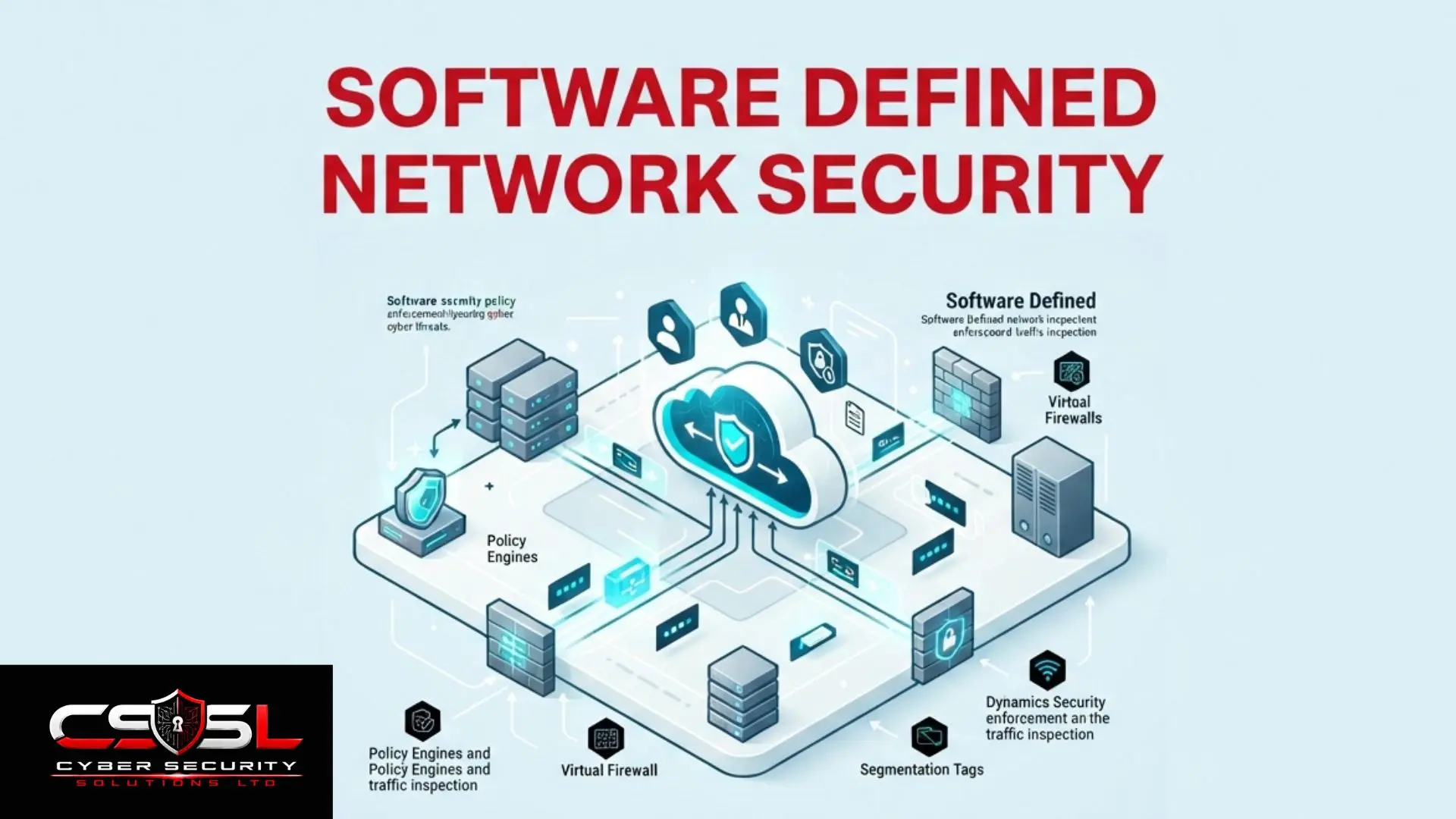
Software defined network security separates a network’s control logic from its underlying hardware into one centralized, programmable controller. This makes consistent, network-wide security policy possible and turns fine-grained segmentation from a theoretical goal into something you can actually deploy at scale.
But there’s a catch most vendors skip over, and it matters just as much as the benefits.
What Is SDNand How Is It Different from Traditional Networking?
Software Defined Networking splits a network into two layers: the control plane, which decides how traffic should be routed and treated, and the data plane, the actual hardware forwarding packets. SDN centralizes that decision-making into a software controller instead of leaving each device to figure things out on its own.
Picture how traditional networking works today. Every router and switch makes its own local forwarding decisions based on its own individual configuration. Want to change a security rule across fifty switches? Someone logs into each one, manually, one at a time. That’s slow, and it’s exactly how configuration drift creeps in: one device gets updated, another gets missed, and now your policy is inconsistent across the network without anyone noticing.
OpenFlow is the protocol that made centralized control practical in the first place. It established a standard way for a controller to communicate with and program the underlying hardware, which is why it’s referenced constantly in SDN conversations.
Here’s why this distinction matters immediately for security. A policy defined once, centrally, gets applied consistently and simultaneously everywhere it’s needed. That closes the exact configuration drift problem manual, device-by-device updates create.
How Does SDN Change Network Protection in Practice?
SDN changes protection by centralizing policy enforcement, enabling automatic threat response, and speeding up how fast security changes reach your entire network.
Instead of configuring firewall rules and access lists separately on dozens of devices, you define policy once at the controller, and it propagates everywhere that policy applies. That alone eliminates a huge source of human error.
The more powerful shift is dynamic response. Picture a compromised device on your network sending suspicious traffic. A network built on SDN can automatically reprogram the switches around that device, isolating it in seconds, without anyone manually touching hardware during an active incident. That speed matters. The FBI’s IC3 report consistently shows that response time is one of the biggest factors separating a contained incident from a costly one.
New security requirements roll out network-wide through the controller in a fraction of the time manual reconfiguration would take. In practical terms, the SDN controller becomes your network security platform: the single place where policy gets defined, applied, and monitored.
How Does SDN Make Micro-Segmentation Genuinely Achievable?
Fine-grained micro-segmentation, restricting communication down to the individual device or workload level, sounds great on paper. Traditional hardware makes it genuinely painful to deliver in practice.
Here’s the real problem. Implementing that level of granular segmentation using traditional VLANs and manually configured switches becomes exponentially harder as the number of segmented workloads grows. Add ten new workloads and you’re not adding ten new rules, you’re adding dozens of interdependent configuration changes across multiple devices, each one a chance for a mistake that either breaks something legitimate or leaves a gap an attacker can use.
This is exactly where SDN earns its place. A centralized controller can define and enforce thousands of individual, granular segmentation rules from one coordination point. That’s a fundamentally different, more manageable problem than manually configuring the equivalent across distributed, independent hardware.
Think about what this means for a business running, say, thirty separate application servers that each need different, narrow access permissions. On traditional hardware, that’s a multi-week project involving careful, error-prone manual configuration across every switch those servers touch. Through an SDN controller, that same segmentation gets defined as policy and pushed out consistently, with far less room for the kind of manual mistake that creates a security gap.
This is the piece that turns micro-segmentation from an aspirational goal into something a mid-sized business can realistically deploy. Without SDN’s centralized control, most organizations simply don’t have the operational capacity to manage segmentation at that level of detail, no matter how much they want the security benefit it provides. SDN is what makes the difference between wanting fine-grained segmentation and actually running it.
What Is Network Security Orchestration and Why Does SDN Enable It?
Network security orchestration means coordinating multiple devices, tools, and policies to work together as one consistent system, rather than each one operating independently based on its own local configuration.
Orchestration and automation get used interchangeably, but they’re different concerns. Orchestration is about coordination: making sure your firewall, your access controls, and your monitoring tools are all working from the same consistent policy. Automation is about automated action: systems doing something on their own without a person clicking a button. Orchestration is the coordination layer that later makes real automation possible, but the two aren’t the same discipline.
SDN is the natural technical foundation for orchestration specifically. A centralized controller with visibility and control across your entire network is exactly the coordination point orchestration requires. Without that central point, coordinating dozens of independent devices and tools into one consistent security posture is genuinely difficult.
SDN provides the coordination and the programmability. The specific automated actions built on top of that foundation, like automated remediation playbooks, are a separate operational discipline worth its own dedicated attention once your coordination foundation is solid.
SDN Security Has Two Meanings — the One Nobody Talks About Matters Just as Much
Most articles on this topic only cover one side of “SDN security”: how SDN improves protection. That’s half the story, and skipping the other half leaves you with a real blind spot.
The second meaning is the security of the SDN infrastructure itself. Because the controller holds centralized authority over your entire network’s traffic behavior, compromising it is a fundamentally more severe event than compromising any single traditional device. An attacker with control-plane access could potentially reprogram traffic flows across your whole network at once, not just one segment of it. That’s not a theoretical risk. It’s the direct consequence of concentrating that much authority into one system.
There’s a second, quieter risk most business owners never hear about: southbound communication, the channel between the controller and the actual network devices it manages. This channel commonly uses OpenFlow, and it needs its own genuine authentication and encryption. An attacker able to intercept or spoof that communication gains significant control over your network without ever directly breaching the controller itself. If that channel isn’t properly secured, the controller’s own defenses barely matter.
Here’s the honest trade-off worth naming plainly. The same centralization that makes SDN so operationally powerful also concentrates risk in a way distributed, traditional hardware never did. With traditional networking, an attacker compromising one switch gets that switch. With SDN, an attacker compromising the controller potentially gets everything. That doesn’t mean SDN is a bad idea. It means the controller needs the same layered, defense-in-depth rigor you’d apply to any other genuinely critical asset, not less scrutiny just because it’s centralized and convenient.
SDN vs NFV — A Quick Clarification
SDN and Network Function Virtualization get used interchangeably by vendors constantly, and that’s genuinely confusing if nobody ever draws the line between them.
SDN, as covered above, separates and centralizes network control logic away from the underlying hardware. NFV is a different idea: it virtualizes specific network functions themselves, things like firewalls, load balancers, or intrusion detection systems, running them as software instead of requiring dedicated physical hardware appliances for each one.
SDN vs NFV
| Criteria | SDN | NFV |
| What it separates or virtualizes | Network control logic from hardware | Specific network functions from hardware |
| Primary purpose | Centralized, programmable network control | Software-based delivery of network functions |
| Typical example | Cisco ACI, VMware NSX | Virtual firewalls, virtual load balancers |
A modern software-defined network commonly uses both together: SDN for centralized control, NFV for flexible, software-based security functions running on top of it. They’re complementary, not competing ideas, and understanding that difference avoids real confusion the next time a vendor pitches you one or the other.
SDN vs Traditional Networking for Security Purposes
| Criteria | Traditional Networking | SDN |
| Policy consistency | Manual, prone to drift | Centrally defined, consistently applied |
| Speed of change | Slow, device by device | Fast, network-wide via controller |
| Segmentation granularity | Limited, complex at scale | Fine-grained, tractable at scale |
| Single point of failure risk | Low, distributed | Higher, concentrated in controller |
Working with a team like Cyber Security Solutions Ltd during this transition helps you plan for that concentrated risk properly rather than discovering it after the fact.
How Do You Adopt SDN Securely, Step by Step?
- Confirm your scale actually justifies SDN. The operational benefit is most pronounced in larger, more dynamic environments, not small, relatively static networks.
- Treat the controller as a critical, high-value asset from day one. Apply the same layered protection you’d give any other genuinely critical system, rather than assuming centralization is automatically secure.
- Secure southbound communication explicitly. Authenticate and encrypt the channel between controller and devices rather than assuming it’s automatically trusted.
- Use SDN’s centralized control to close your micro-segmentation gap first, prioritizing your highest-value workloads.
- Build genuine, coordinated orchestration across your security tooling before layering full automation on top of it.
- Maintain redundancy and failover planning specifically for the controller, given the single point of failure risk this creates.
Conclusion
Software defined network security genuinely changes what’s operationally possible, but it isn’t a free upgrade. Protect the controller with the same seriousness you’d give any critical system, and the segmentation and orchestration benefits become real rather than risky. If you’re weighing an SDN move and want a straight answer about whether your network is ready for it, Cyber Security Solutions Ltd can walk through it with you.
FAQs
No. SDN separates and centralizes a network’s control logic away from hardware. NFV virtualizes specific network functions, like firewalls or load balancers, as software. They’re often used together but solve different problems.
An attacker with control-plane access could potentially reprogram traffic flows across the entire network at once. That’s why the controller needs the same layered, defense-in-depth protection as any other critical asset.
It can be if you don’t plan for it. Centralizing control concentrates risk alongside its operational benefits, so redundancy and failover planning for the controller itself are essential, not optional.
SDN lets you define security policy once at a central controller and apply it consistently across every device, closing configuration drift risk and enabling much faster network-wide policy changes than manual reconfiguration allows.
Traditional hardware struggles to support fine-grained, per-workload segmentation at scale. A centralized SDN controller can define and enforce thousands of granular segmentation rules from one coordination point, making that level of segmentation realistic.
SDN’s benefit is most pronounced in larger, more dynamic environments with frequent policy changes. Smaller, relatively static networks may not see enough return to justify the added complexity and controller risk.