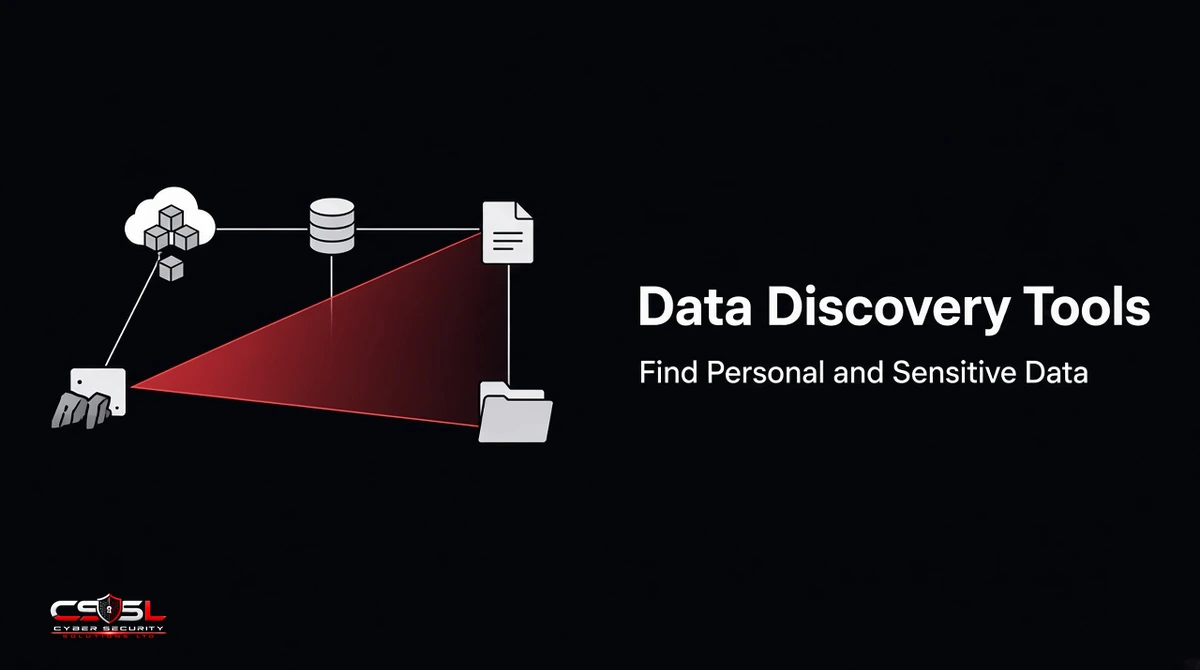
Data Discovery Tools: Find Personal and Sensitive Data
A customer sends a subject access request, and your team spends two weeks searching shared drives, inboxes and old databases for their records. An auditor asks where card data lives, and nobody is sure. Sensitive data discovery tools solve that problem by scanning your systems and showing exactly where personal and sensitive data sits.
What Are Sensitive Data Discovery Tools?
Sensitive data discovery tools are software that automatically scan databases, file shares, cloud storage, SaaS apps and endpoints to find personal and sensitive information, such as names, ID numbers, card data and health records. They classify what they find, map where it lives and flag risky exposure so you can protect or remove it.
Security Data Discovery vs BI Data Discovery
“Data discovery” also describes business intelligence tools that help analysts explore data for insights. Security data discovery is different: it hunts for sensitive information to reduce risk and meet privacy duties. It also differs from eDiscovery, which collects records for legal cases and investigations.
Why You Need a Data Discovery Tool
You Can’t Protect Data You Can’t Find
Sensitive data spreads into spreadsheets, email attachments, test databases, backups and cloud buckets. Encryption, access control and DLP only work on data you know about.
Compliance, DSARs and Audit Scope
Privacy laws require you to know what personal data you hold, answer access and deletion requests, and limit what you keep. Discovery also helps define PCI DSS scope by showing every place card data appears.
How Sensitive Data Discovery Works
Scanning Structured and Unstructured Data
Tools connect to databases and data warehouses (structured data) and to file shares, documents, email and collaboration apps (unstructured data), using agents, APIs or cloud-native connectors.
Pattern Matching, Machine Learning and OCR
They detect data using patterns such as card number formats with checksum validation, dictionaries, proximity rules and machine learning models that recognize context. Optical character recognition reads text inside scanned images and PDFs.
Classification and Labeling
Findings are grouped into categories, such as PII, financial or health data, and can apply sensitivity labels that other tools use for protection.
Key Features to Look For
- Coverage for on-premises, cloud, SaaS and endpoints
- Accurate detection with low false positives
- Support for UK and US data types, such as National Insurance and Social Security numbers
- OCR for images and scanned documents
- Classification and labeling that integrates with DLP
- Access and exposure insights: who can reach each data set
- Remediation options: delete, move, mask, encrypt or restrict
- Reporting for audits and DSARs
12 Sensitive Data Discovery Tools to Compare in 2026
These tools are listed for reference, not ranked. Names and ownership were checked on vendor and official press pages.
Microsoft Purview
Microsoft’s data security and governance suite discovers and classifies sensitive data across Microsoft 365 and other sources, with sensitivity labels that feed DLP.
Varonis
A data security platform that discovers and classifies sensitive data across file shares, cloud storage and SaaS apps, with a focus on who can access it.
BigID
A data discovery and intelligence platform covering structured and unstructured data across cloud and on-premises sources.
Securiti
Now part of Veeam, which completed its acquisition of Securiti AI in December 2025. It combines discovery with DSPM, privacy and governance.
Cyera
A cloud-native data security platform focused on discovery, classification and DSPM across cloud and SaaS environments.
Sentra
A cloud data security platform that discovers and classifies data across cloud environments as part of DSPM.
Spirion
Now part of archTIS, which completed its acquisition of Spirion in October 2025. Known for sensitive data discovery, classification and remediation.
Ground Labs Enterprise Recon
A discovery tool that scans servers, endpoints, databases and cloud storage for personal and payment data, often used for PCI DSS scoping.
PII Tools
A discovery tool aimed at finding personal data in documents and file stores for privacy and breach assessments.
Amazon Macie
An AWS service that discovers sensitive data in Amazon S3 using machine learning and pattern matching.
Google Cloud Sensitive Data Protection
Google Cloud’s service for discovering, classifying and de-identifying sensitive data in Google Cloud storage and databases.
OneTrust
A privacy and data governance platform that includes data discovery to support data mapping and privacy requests.
Data Discovery Tools Comparison Table
| Tool | Main focus | Strongest coverage |
|---|---|---|
| Microsoft Purview | Governance and protection | Microsoft 365 and Azure |
| Varonis | Data security and access | File shares, cloud and SaaS |
| BigID | Discovery and intelligence | Hybrid and multicloud |
| Securiti (Veeam) | DSPM, privacy and governance | Multicloud and SaaS |
| Cyera | DSPM | Cloud and SaaS |
| Sentra | DSPM | Cloud |
| Spirion (archTIS) | Discovery and remediation | Endpoints and file stores |
| Ground Labs Enterprise Recon | PII and card data | Servers, endpoints, databases |
| PII Tools | Personal data in documents | File stores |
| Amazon Macie | Cloud-native discovery | Amazon S3 |
| Google Cloud Sensitive Data Protection | Cloud-native discovery | Google Cloud |
| OneTrust | Privacy and data mapping | Privacy programs |
Data Discovery vs DSPM vs DLP
Data discovery finds and classifies sensitive data. Data security posture management (DSPM) builds on discovery to assess risk across cloud data stores, such as public exposure, excess access or missing encryption. Data loss prevention (DLP) watches data in motion and blocks it from leaving through email, web, devices or apps. Many platforms now combine all three, but the jobs remain distinct.
How to Choose the Right Data Discovery Tool
Where Your Data Lives (On-Premises, Cloud, SaaS)
Match coverage to your estate. Cloud-native services suit single-cloud setups; hybrid estates need tools that reach file servers, endpoints and SaaS.
Accuracy and False Positives
Run a proof of concept on real data. Too many false positives bury real findings; missed data creates false confidence.
Pricing and Deployment Model
Pricing may be based on data volume, data sources, users or scans. Ask vendors directly, and include scan infrastructure and staff time in the total cost.
How to Roll Out Data Discovery in 5 Steps
- Agree goals: privacy compliance, PCI scope, breach risk or cloud posture.
- Start with the highest-risk sources.
- Tune detection rules to cut false positives.
- Assign data owners to review and act on findings.
- Schedule ongoing scans and track risk reduction over time.
US and UK Compliance Uses
US: PCI DSS Scope, HIPAA and State Privacy Laws
Discovery shows where card data and health information sit, which helps reduce PCI DSS scope and supports HIPAA risk analysis. State privacy laws require businesses to honor access and deletion requests, which depends on knowing where data is.
UK: UK GDPR Records, DSARs and the ICO
UK GDPR requires records of processing and timely responses to subject access requests. The ICO expects organizations to know what personal data they hold, and discovery makes that practical at scale.
Rethinking Sensitive Data Discovery Tools
Sensitive data discovery tools are often bought for one audit and then forgotten. Their real value is ongoing: a living map of your riskiest information that guides encryption, access reviews and deletion. Treat discovery as the first step in every data security decision, not a one-off project. For help choosing or rolling out a discovery program, contact Cyber Security Solutions Ltd through our contact page.
FAQs
Some cloud providers include discovery features within their services, charged by usage, and some vendors offer trials or limited free tiers. Open-source scanners exist for specific patterns, but they usually lack classification, reporting and remediation. For business use, expect to pay for meaningful coverage and accuracy.
Data discovery finds where data lives across your systems. Data classification labels that data by type and sensitivity, such as public, internal, confidential or restricted. Discovery usually comes first, then classification assigns categories that drive protection rules, retention and access decisions. Most tools do both together.
Many can. Tools connect through APIs to cloud storage, databases and SaaS apps such as Microsoft 365, Google Workspace and Salesforce. Coverage varies widely, so list the services you use and confirm each one is supported, including how often it is scanned and what permissions the tool needs.
No. Discovery finds and classifies data where it is stored, while DLP monitors data as it moves and blocks risky transfers. They work best together: discovery labels sensitive data, and DLP uses those labels to enforce policies on email, web uploads, devices and cloud apps.
Continuously or at least regularly. New files, databases and cloud resources appear every day, so a one-time scan quickly goes out of date. Many tools support scheduled or event-driven scanning. Scan high-risk sources more often, and rescan after major projects, migrations or acquisitions.
Usually security or privacy teams run the tool, but data owners in each department must review findings and decide what to keep, protect or delete. Clear ownership matters, because discovery produces long lists of findings that only help if someone acts on them.