Data Sovereignty vs Data Localization: Meaning and Rules
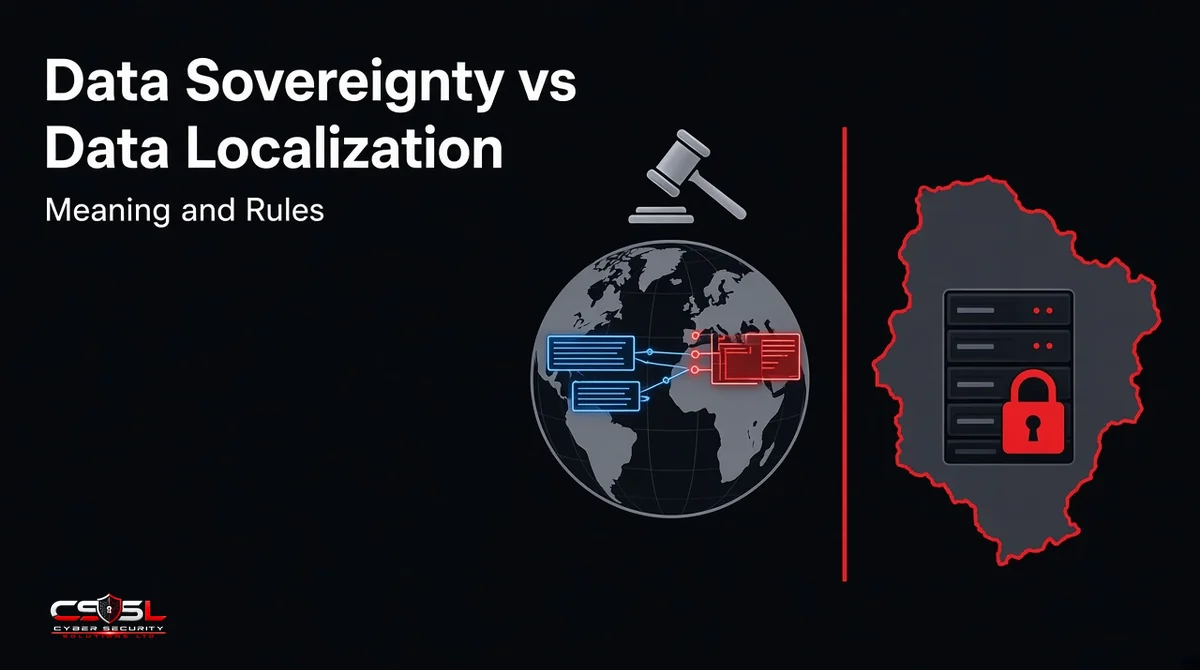
Think of data like a traveler. Data sovereignty decides whose laws the traveler must obey. Data localization decides whether the traveler is allowed to leave the country at all. The data sovereignty vs data localization question matters for any business using cloud or SaaS services across borders, because the two rules create very different obligations.
Data Sovereignty vs Data Localization: The Short Answer
Data sovereignty means data is subject to the laws of the country where it is collected, stored or controlled. Data localization is a legal requirement to keep certain data, or a copy of it, inside a specific country. Sovereignty is about whose rules apply; localization is about where the data must physically stay.
What Is Data Sovereignty?
Data sovereignty is the idea that digital information falls under the legal authority of a particular country. That country’s privacy, security and government-access laws govern how the data is handled, who can demand it and what happens if it is misused.
How Data Sovereignty Is Determined (Location, Citizenship and Provider Jurisdiction)
Three factors usually decide which laws apply: where the data is physically stored, where the people it describes live, and where the company holding it is based. These can overlap. Data about UK customers stored in Ireland by a US cloud provider may be subject to UK, EU and US law at the same time.
What Is Data Localization?
Data localization is a law or rule requiring data to be stored, and sometimes processed, within national borders. It is usually applied to specific categories, such as personal data, financial records, health data or government information.
Strict vs Partial Data Localization
Strict localization bans transfers abroad for covered data. Partial localization allows transfers but requires a local copy, a government approval or a security assessment first.
Data Localization Meaning in Practice (Storage vs Processing vs Copy in Country)
In practice, a rule may require only that the primary copy stays local, that all processing happens locally, or that a full copy is kept in the country while processing happens elsewhere. Reading the exact wording of each rule matters.
Where Data Residency Fits In
Data residency is a business choice about where data is stored, often to meet customer expectations, contracts or performance needs. It is not a legal mandate. A company may choose UK data residency even though no law requires it.
Data Sovereignty vs Data Localization vs Data Residency (Comparison Table)
| Data sovereignty | Data localization | Data residency | |
|---|---|---|---|
| What it is | Legal authority over data | Legal requirement to keep data in-country | Chosen storage location |
| Driven by | Laws of the relevant countries | Specific national laws | Business or contract decisions |
| Key question | Whose laws apply? | Can the data leave? | Where do we store it? |
| Typical example | US CLOUD Act reaching US providers’ data abroad | Rules requiring local storage of citizens’ data | Picking a UK cloud region |
Data Sovereignty and Localization Rules in the US
The CLOUD Act and Data Stored Abroad
The Clarifying Lawful Overseas Use of Data (CLOUD) Act of 2018 allows US authorities, with proper legal process, to require US-based providers to produce data in their control even when it is stored in another country.
DOJ Bulk Sensitive Data Rule (28 CFR Part 202)
The Department of Justice rule, effective in 2025, restricts or prohibits certain transactions that would give countries of concern, such as China and Russia, access to bulk US sensitive personal data or government-related data.
PADFA and Data Brokers
The Protecting Americans’ Data from Foreign Adversaries Act of 2024 bars data brokers from selling or making available sensitive data about Americans to foreign adversary countries or entities they control. The FTC enforces it.
Federal Contracts: FedRAMP, ITAR and CJIS
Some federal work carries location and personnel rules. FedRAMP authorizes cloud services for federal agencies, ITAR controls defense-related technical data, and the FBI’s CJIS Security Policy governs criminal justice information.
US State Privacy Laws (No General Localization Mandate)
State privacy laws regulate how personal data is collected and used, but none imposes a general requirement to keep data inside the state or the US.
Data Sovereignty and Localization Rules in the UK and EU
GDPR International Transfers (Adequacy, SCCs and the EU-US Data Privacy Framework)
The EU GDPR does not require localization, but it restricts transfers outside the EEA unless the destination has an adequacy decision or safeguards such as standard contractual clauses are used. US companies certified under the EU-US Data Privacy Framework can receive EU data under its adequacy decision. On December 19, 2025, the European Commission renewed the UK’s adequacy decisions, which now run until December 27, 2031.
UK GDPR and the Data (Use and Access) Act 2025
The UK applies its own transfer rules under UK GDPR. The Data (Use and Access) Act 2025 changed them, and its international transfer provisions came into force on February 5, 2026. The new “data protection test” asks whether protection in the destination is not materially lower than in the UK. The ICO’s guide to international transfers explains how to apply it.
The US-UK Data Access Agreement
This agreement, made under the CLOUD Act, lets each country’s law enforcement request data related to serious crime directly from service providers in the other country, subject to safeguards.
The EU Data Act and Non-Personal Data
The EU Data Act, which applies from September 2025, covers non-personal data, including rules requiring cloud providers to take steps against unlawful foreign government access to non-personal data held in the EU.
Countries With Strict Data Localization Laws (China, Russia, India and More)
Several countries go further than Europe. China’s laws require certain operators to store specified personal and important data locally and to pass security assessments before some transfers abroad. Russia requires personal data of its citizens to be initially recorded and stored in databases located in Russia. India’s approach is sector-based, with rules such as payment data storage requirements from its central bank, while its general data protection law allows transfers except to countries the government restricts. Rules change often, so confirm current requirements with local counsel before expanding.
Why Data Sovereignty Matters for Cloud and SaaS Users
Sovereign Cloud Options From AWS, Microsoft and Google
The major cloud providers now offer sovereign or region-restricted services, such as EU-only data boundaries and European sovereign cloud regions run by local staff. Names, locations and availability change, so check each provider’s own documentation.
Why Region Choice Alone Does Not Equal Sovereignty
Picking a UK or EU region sets residency, not sovereignty. If the provider is a US company, US legal process may still reach the data. Support staff abroad, backups in other regions and telemetry can also move data across borders.
Pros and Cons of Data Localization
Pros: clearer legal control, easier local oversight, and some protection from foreign access.
Cons: higher costs, duplicated infrastructure, fewer provider choices, weaker resilience if backups cannot leave the country, and friction for global operations.
How to Comply With Data Sovereignty and Localization Rules
Map Where Your Data Lives and Flows
Inventory where each data set is stored, processed, backed up and accessed, including by vendors and support teams.
Choose Regions and Providers by Jurisdiction
Match each data category to the regions and providers whose jurisdiction fits your legal duties.
Control Your Encryption Keys (BYOK and HYOK)
Bring your own key (BYOK) or hold your own key (HYOK) setups keep decryption under your control, which limits what any provider can hand over.
Use Transfer Mechanisms and Contracts
Rely on adequacy, standard contractual clauses or the UK International Data Transfer Agreement, and record your transfer risk assessments.
Document It for Audits
Keep records of data locations, transfer mechanisms and decisions so you can show regulators and customers how you comply.
Data Sovereignty vs Data Localization: A Challenge for Your Team
Data sovereignty vs data localization is not a theory question; it decides where your systems can run and who can demand your data. Try this: pick your most sensitive data set and trace every country it touches in a normal week, including backups and support access. If the answer surprises you, start your map there. For help reviewing your cloud data locations, contact Cyber Security Solutions Ltd through our contact page.
FAQs
No. Data residency is where a business chooses to store data, usually for contractual or performance reasons. Data sovereignty is about which countries' laws govern the data. You can keep data resident in the UK while a US provider's home laws still apply, so residency alone does not guarantee sovereignty.
Not generally. The US has no broad requirement to keep data inside the country. Instead, it restricts certain transfers, such as bulk sensitive data to countries of concern under the DOJ rule and PADFA, and sets location rules for some federal contracts, defense data and criminal justice information.
No. Neither EU GDPR nor UK GDPR requires personal data to stay in the country. Both restrict transfers abroad unless the destination is adequate or safeguards, such as standard contractual clauses, are in place. In the UK, the Data (Use and Access) Act updated the transfer test from February 2026.
Potentially, yes. Under the CLOUD Act, US authorities with proper legal process can require US-based providers to produce data in their control, even if stored abroad. Providers may challenge requests, and encryption with customer-held keys limits what can be disclosed, so key control matters.
A sovereign cloud is a cloud service designed to keep data, operations and often staff within a specific jurisdiction, with controls that limit foreign access. Offerings range from region-restricted services by global providers to clouds run by local partners. Check the provider's operating model, not just its data center location.
Not by itself. Keeping data in one country can simplify legal oversight, but it does not make systems harder to attack. Security still depends on encryption, access control, monitoring and patching. Localization can even weaken resilience if backups cannot be stored in another region.