Network Security Architecture: How to Design a Secure Network
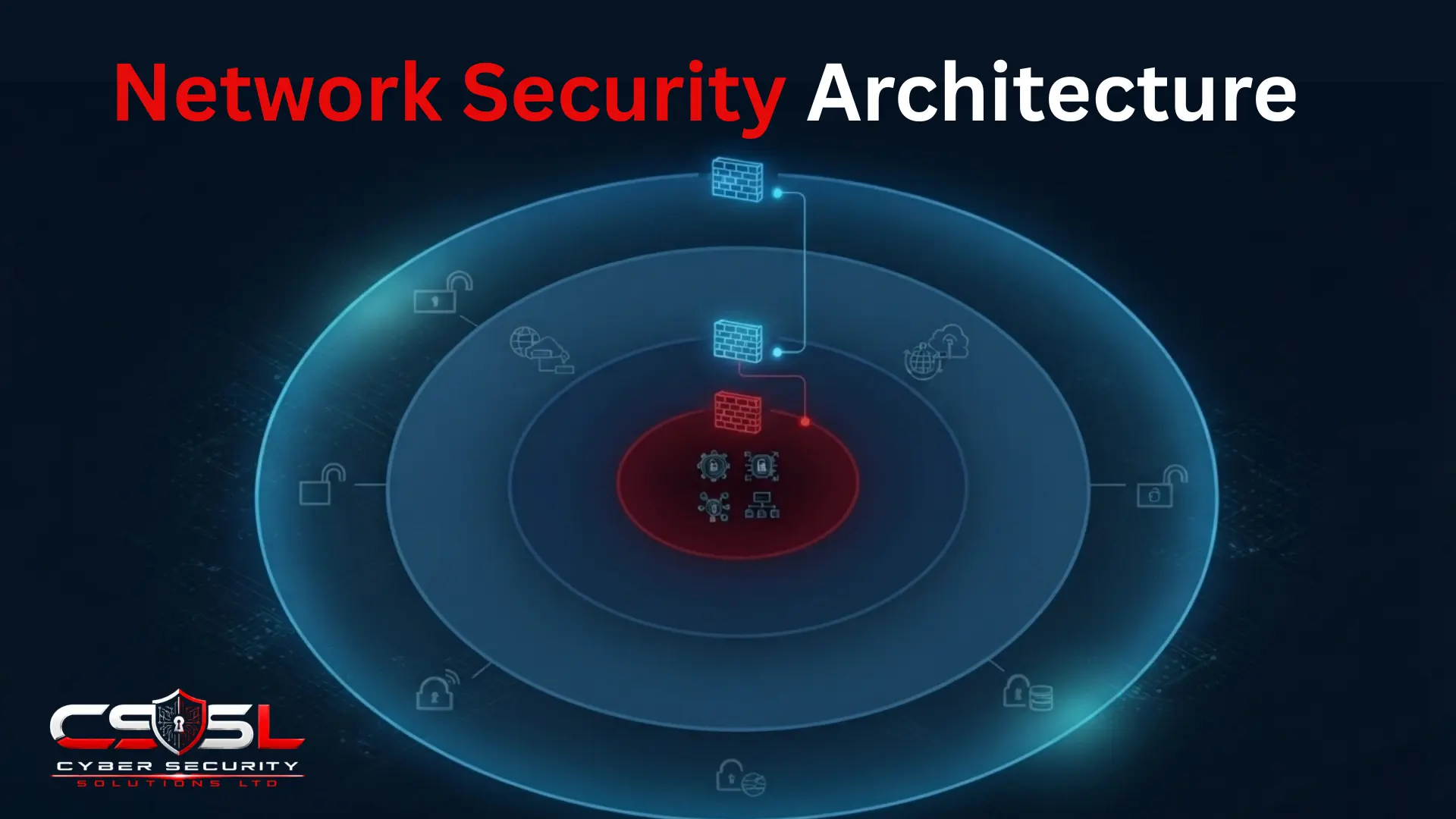
Network security architecture is the deliberate design determining where security controls sit and how a network divides into zones of differing trust, typically following a classic model of untrusted, DMZ, internal and restricted zones. If you bought good security tools but your network is still one flat space where anything can reach everything else, this guide explains why.
What Is Network Security Architecture?
An excellent firewall placed on an otherwise flat, undifferentiated network still leaves an attacker who breaches any single point free to reach everything else. The architecture itself created no meaningful internal boundary to stop them, and no amount of tool spending fixes that on its own.
This guide assumes the OSI and TCP/IP technical foundation already established elsewhere in this series and builds architectural design decisions on top of it. It also opens the Architecture and Design section of this pillar, introducing the zone-based pattern and defense-in-depth principle properly.
Four specific questions get deliberately set aside for their own dedicated guides: whether the perimeter concept remains relevant, zero trust as an architectural alternative, software-defined networking’s role in implementing this pattern, and segmentation implementation mechanics like VLANs. This guide is the blueprint those four each build on.
What Is Defense in Depth, and How Is That Different From the “Layers”?
Defense in depth is the principle that no single security control should be relied on alone. Multiple, independent layers of defense are deliberately stacked so the failure of any one does not leave the network fully exposed.
| Criteria | Defense-in-Depth Layers | OSI Protocol Layers |
| What it describes | Architectural security principle | Technical protocol stack |
| Example | Perimeter, network, host, application, data | Layer 2, 3, 4, 7 |
| Related concept | Where controls sit in your design | Where controls technically operate |
Here is a disambiguation worth making directly. This guide’s “layers” means something genuinely different from the OSI protocol stack layers covered elsewhere in this series, even though both legitimately use the same word. One describes an architectural security principle. The other describes a technical protocol stack.
The typical defense-in-depth layers are worth naming directly. Perimeter covers firewalls and intrusion detection. Network covers internal segmentation and internal firewalls. Host covers endpoint-level protection, a sibling discipline with its own coverage in this brand’s separate Endpoint Security content.
Application covers Layer 7 filtering and Web Application Firewalls specifically. Data covers encryption directly.
Why does this principle matter practically, not just as a diagram? An attacker who defeats the perimeter layer should still face a genuinely different, independent set of obstacles at the network and host layers, not simply reach an open, undefended interior. A phishing email that gets past email filtering and lands a foothold on one workstation should not automatically mean the attacker can walk straight to the finance server.
What Are Network Security Zones and How Does Zone Architecture Work?
A security zone is a defined segment of the network grouped by trust level, with all traffic flowing between zones deliberately controlled and inspected at defined boundary points, rather than the network operating as one single, undifferentiated space.
| Zone | Trust Level | Typical Contents | Example Control |
| Untrusted/External | None | The public internet | Perimeter firewall |
| DMZ/Perimeter | Semi-trusted | Public web servers, mail gateways | Dual-firewall or multi-interface separation |
| Internal/Trusted | Trusted | General staff systems | Internal segmentation |
| Restricted/Highly Trusted | Highest | Domain controllers, financial systems | Strict access control, monitoring |
The classic, foundational four-zone model deserves genuine depth here, since it is the pattern most real network designs are still built around. The Untrusted or External zone is the public internet, treated as inherently hostile by default. The DMZ or Perimeter zone is semi-trusted, covered fully in the next section. The Internal or Trusted zone holds general staff systems and day-to-day business traffic. A Restricted or Highly Trusted zone holds an organization’s most sensitive systems specifically, domain controllers, financial systems, core databases.
Why does this remain the foundational pattern despite newer architectural ideas gaining attention? Even as later guides in this series examine specific evolutions, zero trust and software-defined approaches among them, the underlying logic of grouping resources by trust level and controlling the boundaries between those groups remains the design principle those evolutions build on top of, not replace outright.
What Is the DMZ and Why Does It Still Matter in a Zone-Based Design?
DMZ stands for Demilitarized Zone, borrowed terminology describing a network segment sitting between the untrusted internet and the trusted internal network. It exists specifically to host servers that genuinely must be reachable from outside, public web servers, mail gateways, VPN endpoints, without exposing the internal network directly.
Here is why this specific pattern matters, explained concretely rather than abstractly. If a DMZ-hosted server gets compromised, the zone design is specifically intended to prevent that compromise from directly reaching the internal, trusted network. The blast radius stays contained to the DMZ itself, rather than spreading to payroll systems or customer databases sitting on the trusted side.
Common, practical implementation takes one of two forms. Some organizations run two separate firewalls: an external firewall between the internet and the DMZ, and an internal firewall between the DMZ and the trusted zone. Others use a single firewall appliance with three or more distinct interfaces, achieving the same logical separation. Either approach works, provided the separation is genuine rather than assumed. A company hosting its public website on the same subnet as its internal file server, with no boundary control between them, does not genuinely have a DMZ, regardless of what anyone calls it internally.
What Does the Network Security Design Process Look Like?
The design process runs through five steps. Inventory assets and classify their sensitivity, identifying which systems genuinely need to be reachable from outside the organization and which do not. Map required traffic flows between systems, understanding legitimate communication patterns before deciding where boundaries should sit. Assign each asset to an appropriate zone based on its sensitivity and its genuine exposure requirement.
Define and enforce boundary controls at every point where traffic crosses from one zone into another. Document the resulting design formally. An undocumented architecture is difficult to audit, maintain or hand over to new team members, which makes documentation a genuine step in the process, not paperwork tacked on afterward.
Network Security Framework: One Clarification Before You Go Further
In this guide’s architectural sense, “framework” means a technical design pattern, like the zone model just covered, or a named reference architecture like Cisco’s SAFE framework, a well-documented, vendor-published reference for structuring exactly this kind of design.
The regulatory and compliance sense of the word, NIST CSF, ISO 27001, PCI DSS, is a distinct topic covered fully elsewhere in this series. If a vendor mentioned a network security framework and you were not sure which meaning they intended, this is the distinction worth asking about directly.
Where Does This Architecture Evolve From Here?
This zone model evolves in four specific directions, each covered elsewhere in this series. Whether the perimeter concept remains fully relevant given cloud adoption, remote work and mobile devices gets examined directly and honestly. Zero trust reconsiders trust itself as an architectural evolution, rather than simply reinforcing zone boundaries. Software-defined networking offers a modern way to implement this same zone logic more flexibly than fixed physical hardware allows. VLANs cover the practical, implementation-level mechanics of building the segments this guide describes conceptually.
Reviewing whether an existing network design still matches this classic zone model, or has quietly drifted into an undocumented flat structure over time, is exactly the architecture review Cyber Security Solutions Ltd offers.
How Do You Design a Secure Network Step by Step?
- Inventory every network asset and classify its sensitivity and exposure requirement.
- Map legitimate traffic flows before making any zoning decisions.
- Assign systems to the appropriate zone using the four-zone model as your starting reference.
- Design a DMZ specifically for any system that genuinely must be reachable from outside the organization.
- Apply defense-in-depth thinking across every layer, not relying on the perimeter alone.
- Define and enforce boundary controls at every zone transition point.
- Document the architecture formally and review it on a recurring basis, not just once at initial design.
Conclusion
Good network security architecture is not a single decision made once. It is a zone model, a defense-in-depth mindset and a documented design that gets revisited as your network changes. Start by mapping where your own boundaries genuinely sit today, not where you assume they sit. To get a genuine architecture review of your network’s zone structure and boundary controls, visit cybersecuritysolutionsltd.com for expert support from Cyber Security Solutions Ltd.
FAQs
Network security architecture is the deliberate design determining where security controls sit and how a network is divided into zones of differing trust, forming the blueprint specific tools like firewalls, IDS and filtering get deployed within, rather than being scattered without a plan.
A DMZ, Demilitarized Zone, is a network segment between the untrusted internet and the trusted internal network, hosting servers that must be reachable from outside, like web servers or mail gateways, without exposing the internal network directly if that server is compromised.
Untrusted/External, the public internet, treated as inherently hostile; DMZ/Perimeter, semi-trusted, hosting externally reachable servers; Internal/Trusted, general staff systems and day-to-day business traffic; and Restricted/Highly Trusted, an organization’s own most sensitive systems, like domain controllers and financial systems, its highest-value assets.
OSI layers describe the technical protocol stack, where specific tools operate, Layer 2 through Layer 7. Defense-in-depth layers describe an architectural security principle, perimeter, network, host, application, data, stacking independent defenses so one failure does not expose everything. Both are legitimately called layers.
Defense in depth is the principle that no single security control should be relied on alone. Multiple, independent layers, perimeter, network, host, application and data, are deliberately stacked so the failure of any one does not leave the network fully exposed to an attacker.
It depends on context. In an architectural sense, it means a technical design pattern like the zone model or a named reference architecture like Cisco SAFE. In a regulatory sense, it means compliance frameworks like NIST CSF or ISO 27001, a distinct topic covered separately.