EDR Evaluation Guide: How to Choose the Right Solution for Your Business
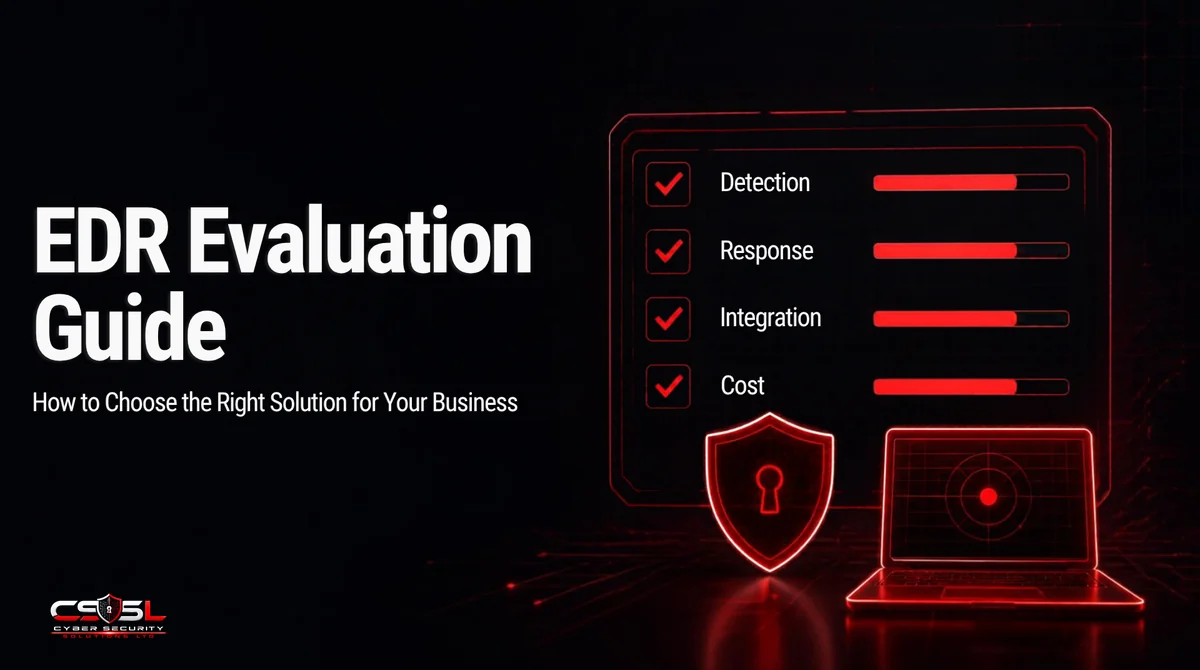
How to choose EDR comes down to comparing quotes that rarely use the same pricing unit, then matching the right tier to your actual management capacity, not the vendor with the best sales deck. Most businesses get three quotes in three different formats and give up trying to compare them properly. This guide fixes that.
What does EDR cost in 2026?
EDR pricing in 2026 splits into three clear tiers: entry-level runs $3 to $8 per endpoint monthly, mid-market runs $8 to $18, and enterprise platforms with advanced features run $18 to $35 or more. Managed options that bundle 24/7 monitoring typically start around $3.30 per endpoint monthly, SOC included.
| Tier | Price Range (per endpoint/month) | Example Vendors |
|---|---|---|
| Entry-level | $3-$8 | Microsoft Defender for Business, Malwarebytes EDR |
| Mid-market | $8-$18 | SentinelOne Singularity Core, CrowdStrike Falcon Go |
| Enterprise | $18-$35+ | CrowdStrike Falcon Prevent + Insight, SentinelOne Singularity Complete |
A 50-endpoint business choosing a mid-market tool spends roughly $6,000 to $10,800 annually on licenses alone, before deployment, tuning, or incident response retainer costs get added. Verizon’s 2025 DBIR found small and medium-sized businesses account for nearly half of all data breaches, precisely because they lack enterprise-grade defenses while holding data attackers value, which is the practical reason SMB-focused, flat-rate EDR pricing has become genuinely competitive rather than a compromise choice.
Self-managed or managed? The 10-hour rule
The 10-hour rule gives a concrete threshold for this decision: if your in-house security team would need to spend more than 10 hours a week managing EDR, MDR is almost certainly cost-competitive once you account for loaded labor costs, not just the license price difference.
This rule matters because most businesses evaluate self-managed EDR against MDR by comparing license fees alone, missing the real driver of total cost: staff time. Ten hours weekly translates to roughly a quarter of a full-time security role, alert triage, tuning detection rules, investigating false positives, at a fully loaded cost that frequently exceeds the price gap between self-managed tooling and a managed option. Businesses in the 100 to 250 endpoint range often land on a middle path: a co-managed model retaining direct EDR software control while outsourcing 24/7 monitoring, typically costing 20% to 40% less than full MDR while preserving more operational flexibility. Before committing to self-managed EDR, estimate your realistic weekly management time honestly, most first-time buyers underestimate this figure by half or more, and check it against the 10-hour threshold before assuming self-managed is automatically cheaper.
Why vendor quotes are so hard to compare: three pricing axes explained
Vendor quotes use inconsistent units across three separate axes, per endpoint, per user, and per device-class, meaning a “$10 per endpoint” quote and a “$6 per user” quote from a different vendor aren’t directly comparable until you normalize both against the same actual headcount and device count.
Per-endpoint pricing charges for every protected device individually, meaning a user with a laptop and a phone counts as two units. Per-user pricing charges once per person regardless of how many devices they use, which can be cheaper for multi-device users but more expensive for a business with many shared or unstaffed devices, kiosks, servers, IoT endpoints. Per-device-class pricing, less common but appearing in some enterprise and government quotes, prices servers, workstations, and mobile devices at different rates entirely, reflecting the genuinely different risk and monitoring cost each device type carries. Before comparing any two quotes, convert both to a single, consistent figure: total annual cost divided by total actual devices protected, which strips away the unit confusion and gives you the number that actually matters for budgeting.
A worked example: converting three quotes into one comparable figure
Consider three real quote formats for the same 60-person business with 75 total devices: Vendor A quotes $12 per endpoint monthly, Vendor B quotes $18 per user monthly, and Vendor C quotes a flat $1,200 monthly regardless of count.
| Vendor | Quoted Rate | Annual Cost | Normalized (per device/year) |
|---|---|---|---|
| A | $12/endpoint/month | $10,800 | $144 |
| B | $18/user/month | $12,960 | $172.80 |
| C | $1,200/month flat | $14,400 | $192 |
Once normalized to the same per-device annual figure, Vendor A is genuinely the cheapest option here, despite Vendor B’s per-user quote looking lower on paper at first glance and Vendor C’s flat rate seeming simplest. This exact conversion, annual total divided by actual device count, is the single calculation most buyers skip, and it’s the difference between comparing quotes accurately and comparing them by whichever number happens to look smallest without context.
What should your RFP ask vendors to prove?
A working EDR RFP should require vendors to prove five things directly: published detection rates against recent threats, real total cost including deployment and tuning, average false positive rate in similar-sized environments, incident response SLA specifics, and named customer references at your approximate size.
Don’t accept vague marketing claims in place of specifics, ask each vendor to answer these questions in writing: what is your average false positive rate in environments our size, what does onboarding and deployment support cost beyond the license, are server endpoints priced separately from workstations, what integrations are included versus sold as add-ons, and what are your renewal price escalation terms specifically. This last question matters more than most buyers realize, since year-one pricing frequently understates real multi-year cost once renewal increases compound. Require every vendor response in writing, not verbal assurance during a sales call, since a written commitment is what you’ll actually be able to hold them to during contract negotiation or renewal.
Why kernel-level protection costs more, and when it’s worth it
Kernel-level EDR platforms, which run inside the operating system kernel itself using technology like eBPF rather than hooking into user-space APIs, cost meaningfully more because the underlying instrumentation is technically complex, meaning fewer vendors compete in this space and less price competition exists.
Traditional agents monitor from user space, limiting what they can see. Kernel-level platforms see system calls, network events, and process behavior directly, genuinely stronger visibility, particularly for Linux and containerized environments, but this depth requires specialized engineering both to build and to operate correctly. Most organizations deploying kernel-level tooling, from vendors like Aqua Security, Sysdig, or Elastic, also need a managed support layer on top, since tuning eBPF-based detection effectively requires genuine Linux kernel expertise most internal teams don’t have readily available. This tier is worth the premium specifically for businesses running significant Linux, Kubernetes, or containerized infrastructure, where the visibility gap in traditional agents is largest. For a standard Windows and Mac desktop fleet, kernel-level EDR’s added cost rarely buys proportional additional protection.
How does real government procurement evaluate EDR?
Alameda County’s public EDR procurement record shows exactly how initial contract pricing understates real multi-year cost: an original three-year contract with Optiv Security, awarded at $713,033 in 2020, grew to $776,106 through a 2022 amendment, then to $1,070,310 through a second 2023 amendment, a 50% increase over the original award before the contract even reached its full term.
This publicly documented escalation is a genuinely useful reference for any business evaluating a multi-year EDR contract, since it shows contract amendments and scope changes driving real cost growth well beyond the initial quoted figure, exactly the risk the renewal escalation question in your RFP should surface upfront. The county’s original statement of work explicitly required detection capability against “zero-day, file-less and other type of attacks,” language worth borrowing directly into your own RFP if your current protection genuinely doesn’t cover those categories. Government procurement processes, formal evaluation committees, structured bid forms, written scoring criteria, are more rigorous than most SMBs need to replicate fully, but the underlying discipline, requiring written commitments and multi-year cost projections before signing, applies at any organization size.
A dual-market look: comparing a real US RFP and the UK’s own G-Cloud pricing
UK public sector EDR pricing, visible directly on the government’s G-Cloud Digital Marketplace, ranges from £6 per user monthly to £1,000 per unit annually depending on vendor and service depth, a spread comparable in shape to the US per-endpoint tiers covered earlier, though quoted in different units and currency.
| Market | Pricing Example | Unit |
|---|---|---|
| US (Alameda County, escalated) | $1,070,310 over amended 3-year term | Full county EDR contract |
| UK G-Cloud (Secure Nexus Ltd) | £1,000 | Per unit, per year |
| UK G-Cloud (Creative Networks) | £6 | Per user |
The UK G-Cloud listings are genuinely useful because they’re publicly published, unlike most US vendor quotes, which require a sales call to obtain. This transparency lets UK buyers directly compare listed rates before ever speaking with a vendor, a real procurement advantage over the quote-gated US market. Both markets share the same underlying lesson though: the headline unit price tells you less than the total, normalized annual cost across your actual device count, exactly the calculation covered in the worked example above.
A realistic proof-of-concept process if you’re not running an enterprise procurement team
Run a structured 30-day proof of concept against 10 to 20 real devices spanning your riskiest categories, rather than accepting a vendor’s polished demo environment as sufficient evidence before committing to a full deployment.
Select devices representing genuine diversity in your environment, a mix of workstations, at least one server, and any device type carrying elevated risk, rather than testing only the easiest, cleanest machines. Track three things specifically during the proof of concept: false positive volume against your real daily activity, actual deployment time versus what the vendor quoted, and whether support response times match the SLA promised in writing. Cyber Security Solutions Ltd runs exactly this structured proof-of-concept process with clients evaluating EDR platforms, and it consistently surfaces the gap between vendor demo performance and real-world behavior in a business’s actual environment, the exact gap a polished sales presentation is designed to avoid showing.
Conclusion
Choosing EDR becomes with converting every quote to the same comparable figure, checking your real management capacity against the 10-hour rule, and testing any finalist against your actual devices before signing. Skip the vendor demo and run the real proof of concept instead. If you want help normalizing vendor quotes or structuring your own EDR RFP, Cyber Security Solutions Ltd can walk through it with you at cybersecuritysolutionsltd.com.
FAQs
Start by normalizing every vendor quote to the same per-device annual figure, then check whether your team's realistic weekly management time exceeds 10 hours, the threshold where managed EDR typically becomes cost-competitive. Run a structured proof of concept against real devices before committing to a full deployment.
2026 pricing falls into three tiers: entry-level runs $3 to $8 per endpoint monthly, mid-market runs $8 to $18, and enterprise platforms run $18 to $35 or more. Managed options bundling 24/7 monitoring typically start around $3.30 per endpoint monthly with SOC included.
Per-endpoint pricing charges for every protected device individually, so a user with two devices counts twice. Per-user pricing charges once per person regardless of device count. Compare both by converting to the same total annual cost divided by actual devices protected.
Use the 10-hour rule: if your team would need more than 10 hours a week managing EDR, managed detection and response is almost certainly cost-competitive once loaded labor costs are included, not just the license price difference between self-managed and managed options.
Require vendors to answer in writing: average false positive rate in similar environments, total cost including deployment and tuning, whether server endpoints are priced separately, what integrations are included versus add-ons, and specific renewal price escalation terms, not verbal sales assurances.
Kernel-level platforms using technologies like eBPF cost meaningfully more than traditional user-space agents, since the underlying instrumentation is technically complex, meaning fewer vendors and less price competition, and most deployments require a managed support layer for proper tuning.
Government procurement typically uses formal RFPs with structured evaluation committees and written bid forms. Alameda County's public EDR contract grew from $713,033 to $1,070,310 through amendments over roughly three years, showing why multi-year cost projections matter more than the initial quoted figure.