
False Positives in Cyber Security: How They Waste Time and Put You at Real Risk
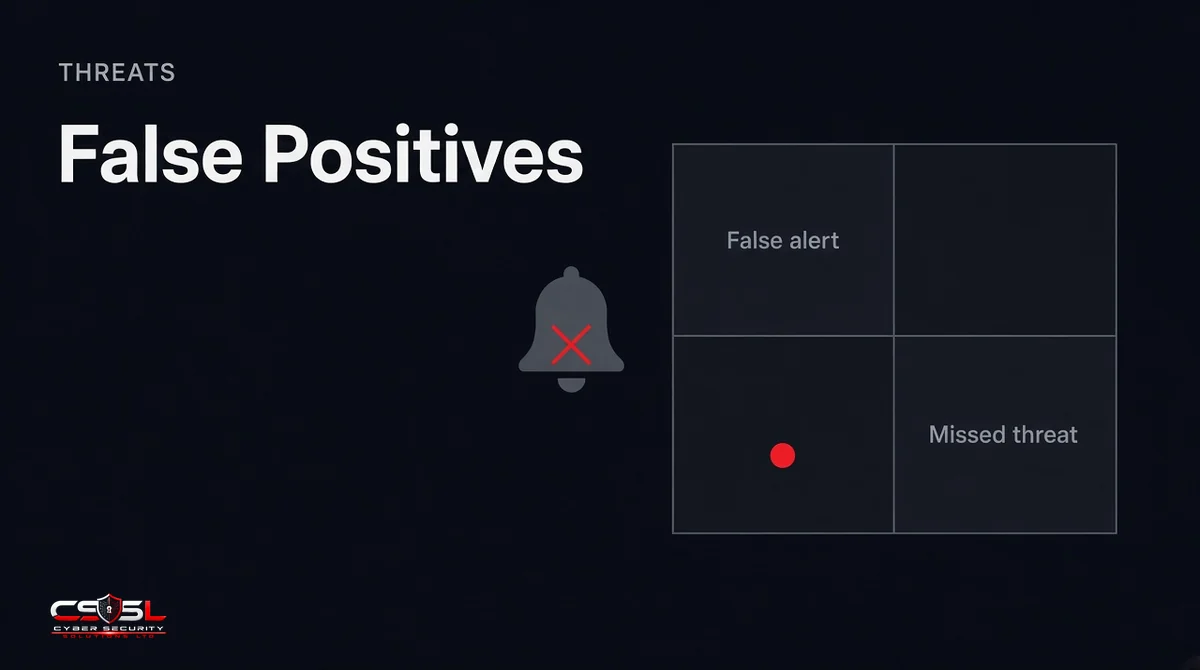
A false positive in cyber security is an alert flagging a threat that isn’t actually there, and the real danger isn’t the wasted time reviewing it, it’s what gets ignored once your team stops trusting alerts altogether. If you have ever dismissed a security warning assuming it was probably nothing, that pattern is exactly what let one of history’s largest breaches go unstopped.
What Is a False Positive in Cyber Security?
A false positive occurs when a security tool flags activity as malicious or vulnerable when it genuinely isn’t, generating an alert requiring investigation time that ultimately leads nowhere. This happens across every category of security tooling, intrusion detection, static code analysis, endpoint monitoring, whenever a detection rule matches a pattern resembling a real threat without actually being one.
False Positive vs False Negative: Genuinely Different Kinds of Danger
A false positive wastes time, an analyst investigates something harmless. A false negative is considerably more dangerous, a genuine threat goes completely undetected because the system failed to flag it at all. These represent fundamentally different risks, not two versions of the same minor inconvenience.
The relationship between them matters directly for how security tools get tuned. Reducing false positives too aggressively, by making detection rules stricter, often increases false negatives simultaneously, since a rule narrow enough to eliminate all noise frequently misses genuine variations of a real threat too. Genuine tuning requires balancing both risks deliberately, not simply minimizing one at the other’s expense.
The Confusion Matrix, Explained Simply
| Predicted Threat | Predicted Safe | |
|---|---|---|
| Actually Threat | True Positive | False Negative |
| Actually Safe | False Positive | True Negative |
A confusion matrix simply organizes every possible outcome into four categories: true positives, genuine threats correctly flagged, true negatives, genuinely safe activity correctly ignored, false positives, safe activity incorrectly flagged, and false negatives, genuine threats incorrectly missed.
Precision measures how many flagged alerts were actually genuine threats, directly reflecting your false positive rate. Recall measures how many genuine threats actually got flagged, directly reflecting your false negative rate. These two metrics trade off against each other constantly, and understanding both together, not just one in isolation, is what genuinely tells you whether a security tool is performing well.
Why Some Vulnerability Types Generate Far More False Positives Than Others
Static Application Security Testing tools illustrate this problem starkly. Untuned SAST tools commonly produce false positive rates between 30 and 60 percent, and one empirical study found a widely used SAST tool’s baseline precision at just 35.7%, meaning roughly two-thirds of its findings were not genuine vulnerabilities at all.
This happens because certain vulnerability categories require deep contextual understanding, whether user input actually reaches a dangerous function, whether a flagged pattern is genuinely exploitable given surrounding code, that pattern-matching rules alone cannot reliably assess. Vulnerability types requiring this kind of contextual judgment consistently generate more noise than categories with clearer, more mechanically verifiable patterns.
Can AI Actually Fix This? What Current Research Shows
Here is a genuinely important distinction worth making honestly, since research results and real-world deployed performance currently differ considerably. Recent academic research testing AI-assisted triage against the OWASP Benchmark, a standardized test set of 2,740 Java test cases, achieved an 88.6% reduction in false positives, from 560 down to 64, while sacrificing only 3.1% of recall, a genuinely impressive result under controlled research conditions.
A separate 2026 study achieved comparable results, reducing 225 false positives down to just 20, alongside a 91% reduction in average triage time. These are real, rigorous research findings, not marketing claims. Here is the honest gap worth stating directly, though: commercially deployed AI features currently claim more modest improvements, one major vendor’s own AI-assisted triage feature reports roughly a 20% reduction in false positive noise in real-world use, a genuine, meaningful improvement, but considerably smaller than the dramatic reductions research demonstrates as theoretically achievable. This gap reflects the difference between a controlled benchmark and the genuine messiness of production codebases and live environments. AI genuinely helps reduce false positive burden today, but organizations expecting research-grade reduction rates from currently available commercial tools should calibrate expectations against what is actually shipping, not what recent papers demonstrate is possible.
A Real Case Where Ignoring False Positives Cost a Company Dearly
Target’s 2013 breach remains the clearest illustration of what happens when alert skepticism, born from genuine, chronic false positive fatigue, causes a real threat to get dismissed. FireEye’s monitoring system correctly flagged the attackers’ malware at the highest severity level, but the alert carried a generic label security staff had learned to treat skeptically, precisely the pattern chronic false positive exposure creates.
The malware continued running for weeks afterward, ultimately exposing 40 million payment cards. This is not a story about a missing alert. It is a story about a genuine alert lost among the accumulated skepticism false positive fatigue produces, exactly the risk this entire guide has been developing throughout.
A Practical, Sequenced Approach to Actually Reducing Your False Positive Rate
Start by tuning detection rules specifically to your own environment, replacing generic default configurations with rules reflecting your actual codebase, network patterns and typical activity. Implement whitelisting deliberately for known, verified safe patterns your tools repeatedly flag incorrectly, rather than manually dismissing the same false positive category every single time it recurs.
Layer AI-assisted triage on top of tuned rules specifically, using it to prioritize what genuinely warrants human attention rather than expecting it alone to solve an untuned, noisy baseline. Cyber Security Solutions Ltd builds this sequenced approach directly into client deployments, since AI triage applied to poorly tuned detection rules still produces considerably more noise than the same AI layered onto genuinely well-tuned foundations.
How This Connects to Your Ongoing Compliance Monitoring
False positive fatigue does not stay contained to security alerting alone, it directly undermines ongoing compliance monitoring too. A compliance program generating constant, low-value alerts trains staff to deprioritize monitoring notifications generally, precisely the pattern that can mean a genuine compliance gap goes unnoticed until an actual audit or incident reveals it.
Treating false positive management as a genuine, ongoing discipline, not a one-time tuning exercise, protects both your security posture and your compliance evidence trail simultaneously, since both depend on the same underlying trust in what your monitoring tools actually tell you.
Conclusion
False positives are not simply an efficiency problem, they are the mechanism that trains teams to dismiss the one genuine alert that actually matters, exactly what happened at Target. Start by honestly assessing your own false positive rate before assuming AI alone will fix an untuned baseline. To build a properly tuned detection and triage approach, visit cybersecuritysolutionsltd.com for expert support from Cyber Security Solutions Ltd.
FAQs
A false positive flags safe activity as a threat, wasting investigation time. A false negative fails to flag a genuine threat at all, letting it go undetected. False negatives are considerably more dangerous, since they represent a real, missed risk rather than wasted effort.





One Comment