Cloud Security Incident Response: What to Do When a Breach Happens
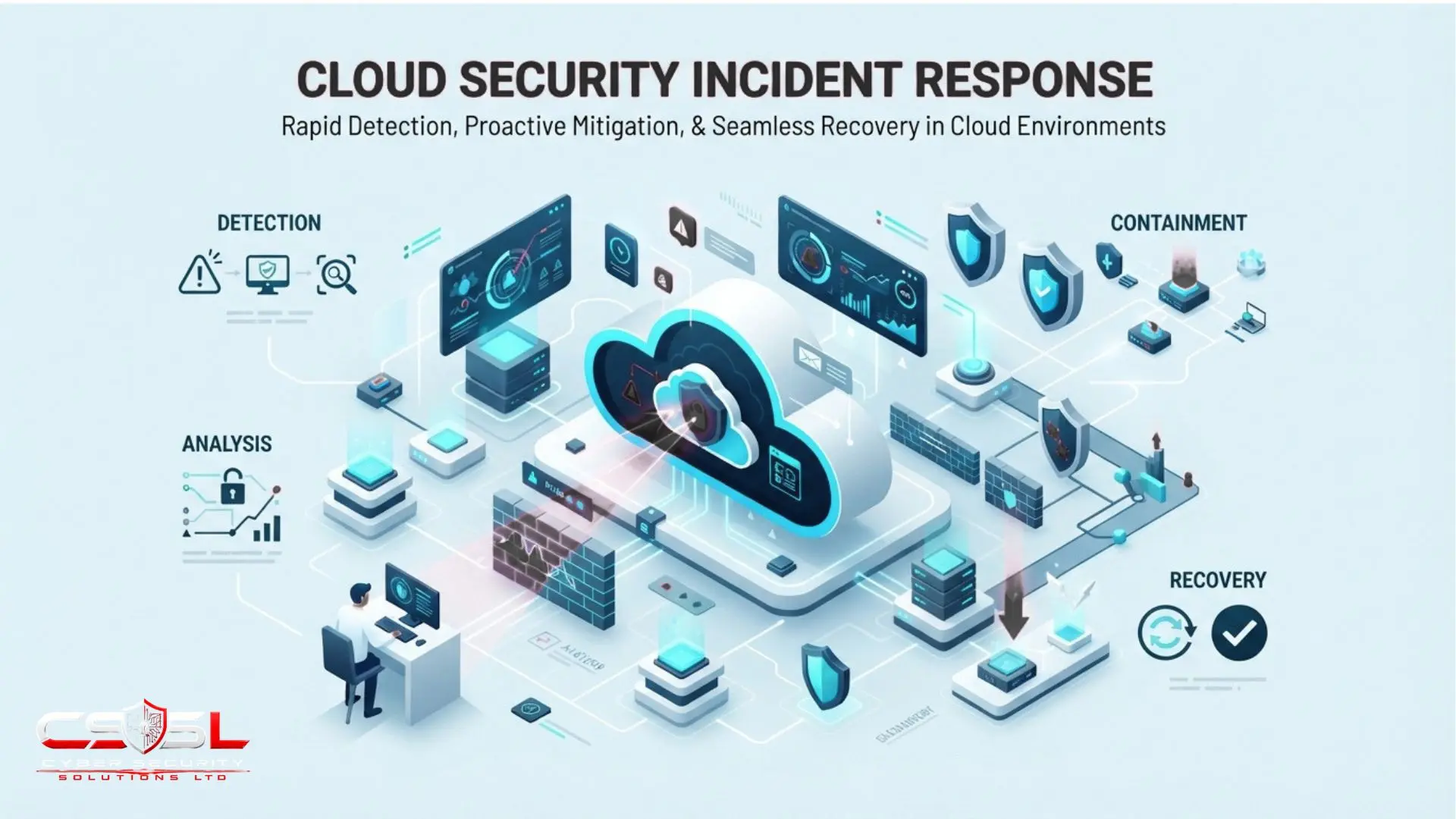
Cloud security incident response is the structured process of detecting, containing, eradicating and recovering from a confirmed cloud security breach. If you reset every password after a breach and later found the attacker was still inside through a Lambda function nobody checked, this guide explains exactly what genuine eradication actually requires.
What Is Cloud Security Incident Response, and How Does It Differ From Routine Cloud Security Operation?
This is the structured process of detecting, containing, eradicating and recovering from a confirmed security incident affecting cloud infrastructure, workloads or data, activated once an event exceeds what routine monitoring and automated remediation can safely resolve alone.
This post is the operational expression of assume breach, named as a core principle earlier in this series but never given its own dedicated treatment, the same relationship zero trust held to its own coverage.
The three-post arc matters here. Routine watching and triage established continuous monitoring. Automated handling covered known, high-confidence findings. This post covers the exception threshold, where an event is too novel, severe or ambiguous for either to resolve alone, requiring full, human-led response. Think of it as operations at war footing, not routine operations.
Incident versus breach is a precision worth establishing early. An incident is any event indicating unauthorized access, disruption or potential compromise requiring formal investigation. A breach is a confirmed incident where unauthorized access or exfiltration has actually occurred, a distinction that matters directly for when notification obligations trigger.
How Does the Shared Responsibility Model Change Once an Incident Is Confirmed?
Shared responsibility already established the steady-state division: provider secures infrastructure, customer secures identity, data and configuration. Once an incident is confirmed, two nuances apply that division does not directly address.
Providers carry their own contractual obligation to notify customers of issues on their side of the line, separate from the customer’s own detection responsibility. Containment through the provider’s management plane matters too. Unlike traditional on-premise response, a customer cannot physically isolate or seize shared, multi-tenant hardware. Every containment action must run through the provider’s own APIs.
Provider enterprise support and incident escalation channels, AWS Enterprise Support, Azure Rapid Response and equivalent premium tiers, become directly relevant during a genuine incident. Pre-arranging access to these channels belongs in preparation, not mid-incident.
What Are the Phases of the Cloud Incident Response Lifecycle?
NIST SP 800-61 structures the lifecycle into Preparation, Detection and Analysis, Containment, Eradication, Recovery and Post-Incident Activity.
| Phase | Primary Activity | Key Cloud-Specific Consideration |
| Preparation | Define roles, build playbooks | Provider support arranged before an incident |
| Detection and Analysis | Triage and confirm severity | Distinguishing a genuine incident from alert volume |
| Containment | Isolate and revoke access | Isolation via provider APIs, not physical access |
| Eradication | Remove the attacker’s foothold | Cloud-native persistence survives generic reflexes |
| Recovery | Rebuild and validate | Restore from verified-clean backups only |
| Post-Incident Activity | Review and update the plan | Feeds the risk register and policy directly |
This section is the roadmap the rest of this guide follows in order. Preparation deserves treatment as its own phase, not an afterthought, since most of what determines a good outcome was decided long before the incident happened.
How Do You Detect and Confirm a Genuine Cloud Security Breach Versus a False Alarm?
Detection here means monitoring output has crossed the threshold from routine finding into something requiring full incident response, building directly on the signal-to-noise and alert fatigue concepts already established.
Triage criteria determine what genuinely warrants escalation and who is authorized to make that call. Getting this wrong in either direction is costly. False positives waste scarce response capacity and erode confidence in the process. False negatives let a genuine compromise continue undetected, directly compounding the dwell-time cost already established through breach cost research elsewhere in this series.
Initial severity classification determines which parts of the response plan actually activate, avoiding a uniform, maximum-intensity response to every triggered alert regardless of actual severity.
How Do You Contain an Active Cloud Security Incident?
Isolate, do not immediately terminate. Use network segmentation and security group changes to cut off a compromised resource’s communication while deliberately preserving it for forensic capture, rather than destroying potential evidence by immediately tearing it down.
Identity containment is equally, sometimes more, urgent than network isolation, and this is the point most incident response content skips entirely. An attacker holding valid, stolen credentials can often route around network isolation completely, using legitimate, authenticated access from a different location. That makes credential revocation and rotation a parallel containment action, not a secondary one performed after network isolation feels complete.
Use CIEM’s entitlement analysis to scope containment accurately. That capability lets responders rapidly establish exactly what a compromised identity could actually reach, informing how far containment needs to extend rather than guessing at the boundary.
Snapshot before terminate is a non-negotiable discipline, directly reusing the agentless snapshot mechanism already introduced for posture scanning, now applied to evidence preservation. Capture a forensic snapshot or clone of a compromised resource’s storage before rebuilding or destroying it, since that decision cannot be reversed once made.
Why Does Eradication Require Hunting for Cloud-Native Persistence Specifically?
Cloud-native persistence, malicious IAM role or policy modification, backdoored serverless functions, unauthorized scheduled jobs, hidden service accounts or API keys, survives traditional incident response actions like password resets and endpoint reimaging, exactly as warned elsewhere in this series.
Here is why the traditional reflex fails specifically. A playbook built around resetting a compromised user’s password and reimaging an endpoint addresses neither a malicious IAM policy attached to a different identity nor a backdoored serverless function quietly awaiting its next trigger. Neither action touches the actual foothold at all. The attacker’s access survives completely untouched while the security team believes the incident is closed.
Genuine cloud eradication requires something different: auditing IAM policies and role trust relationships for unauthorized changes, reviewing serverless function code and configuration for injected backdoors, and checking scheduled tasks and automation jobs for anything not explicitly provisioned by the organization itself.
This is where most competitor incident response content falls short. It applies generic, on-premise-derived eradication steps to a cloud context without ever confronting that some threats are specifically engineered to survive exactly those steps.
What Is Cloud Forensics, and Why Does It Work Differently From Traditional Digital Forensics?
Cloud forensics is the practice of preserving and analyzing evidence from a cloud security incident, structurally different from traditional forensics because much of what needs investigating may no longer physically exist by the time an investigator looks for it.
A function that ran for a few hundred milliseconds and has already terminated cannot be forensically imaged after the fact the way a traditional disk can. Evidence must come from logs and snapshots captured during or immediately around execution, not retrospective disk analysis, exactly the ephemeral evidence problem serverless environments create.
Snapshot-based acquisition is the cloud-native equivalent of disk imaging, the same underlying mechanism already introduced for posture scanning, applied here to preserve a verifiable, point-in-time copy of a compromised resource for later analysis.
Log retention is a forensic dependency decided in advance, not during the incident. Default retention windows for CloudTrail, Azure Monitor and Google Cloud Audit Logs may not cover a full incident timeline unless extended retention was configured before the incident occurred.
Chain of custody in shared, multi-tenant infrastructure adds a final constraint. Physical hardware forensics remains the provider’s domain, not the customer’s, meaning certain forensic questions can only be answered through the provider’s own legal or law-enforcement-request processes.
| Action | Traditional Approach | Cloud-Aware Approach | Why It Matters |
| Containment method | Physical network disconnection | Provider API and security group changes | No physical access to shared hardware |
| Evidence capture | Disk imaging after the fact | Snapshot during or near execution | Serverless workloads may already have terminated |
| Credential response | Secondary, after network isolation | Parallel to network isolation | Stolen credentials bypass network isolation entirely |
| Persistence check | Password reset, endpoint reimage | IAM policy and function code audit | Cloud-native persistence survives the old reflex |
How Do You Recover Operations and Meet Breach Notification Obligations?
Recover through rebuilding, not cleaning. Restore from backups whose integrity has been specifically verified, since modern ransomware groups actively target and delete cloud backups, and rebuild from known-good infrastructure-as-code templates rather than sanitizing a live, compromised environment in place.
Validate the rebuilt environment before returning to production, checking it against your documented architecture and policy rather than assuming a restore automatically reproduces a secure state.
Breach notification obligations are scoped here: regulatory notification windows relevant to applicable compliance regimes, and notification to affected individuals where required. A confirmed breach can threaten a previously achieved compliance status, meaning recovery and notification decisions frequently need to happen in parallel under genuine time pressure.
How Do You Conduct a Genuine Post-Incident Review?
This is not a formal audit checking conformance against an external standard, but a structured internal review of what happened, why existing controls did or did not work, and what needs to change.
Feed findings back into the rest of this cluster’s governance chain: into the risk register, was this risk previously identified and accepted, or was it a genuine blind spot, and into the policy document itself, updating it based on what was learned rather than leaving it static.
Blameless review is a deliberate cultural choice, not a nicety. A punitive review process that focuses on individual blame discourages the honest, complete reporting a genuine post-incident review depends on to be useful at all. A punitive review culture is the fastest way Cyber Security Solutions Ltd sees an organization’s next review produce less honest information than its last one.
Updating the incident response plan itself is the review’s most concrete output, consistent with this series’ theme that governance documents are living artefacts, not one-time deliverables.
How Do You Build and Test a Cloud Incident Response Plan Before You Need It?
Building a genuine plan starts with named roles and clear decision rights, who authorizes containment, who communicates externally, who liaises with the provider, tested through tabletop exercises using realistic, cloud-specific scenarios, and provider support and legal resources arranged well in advance.
- Prepare: define roles, build playbooks and arrange provider support in advance.
- Detect and confirm: triage the alert against defined escalation criteria.
- Contain: isolate via network segmentation and revoke credentials in parallel.
- Preserve evidence: snapshot compromised resources before any rebuild or termination.
- Eradicate: hunt specifically for cloud-native persistence, not just reset credentials.
- Recover: rebuild from verified-clean backups and known-good infrastructure templates.
- Notify: meet regulatory and customer notification obligations where confirmed.
- Review: conduct a blameless post-incident review and update the plan itself.
Conclusion
Cloud security incident response is not something you improvise well the first time you need it. Most of what determines a good outcome gets decided in preparation, long before any alert fires. Isolate and revoke credentials in parallel, hunt for persistence instead of trusting a password reset, and preserve evidence before you rebuild anything.
FAQs
An incident is any event indicating unauthorized access, disruption or potential compromise requiring investigation. A breach is a confirmed incident where unauthorized access to or exfiltration of data has actually occurred. This distinction matters directly for when notification obligations trigger.
Because cloud-native persistence, a malicious IAM policy change or a backdoored serverless function, survives a password reset entirely, since neither action touches an identity’s permissions or a function’s code. Genuine eradication requires auditing IAM policies, reviewing function code and checking scheduled jobs directly.
Snapshot the resource’s storage before rebuilding or destroying it, the cloud-native equivalent of disk imaging. For serverless workloads that may have already terminated, evidence comes from logs and snapshots captured during execution, not retrospective analysis, since imaging after the fact is often structurally impossible.
Both, done in parallel. An attacker holding valid, stolen credentials can route around network isolation using legitimate access from elsewhere entirely, making credential revocation equally urgent, not a secondary step taken only after network isolation feels complete and fully finished.
No. An audit checks conformance against a formal external standard. A post-incident review is a structured internal look at what happened, why controls did or did not work, and what needs to change, feeding directly into your risk register and policy.
Define named roles and decision rights, run tabletop exercises using realistic cloud-specific scenarios, and arrange provider support and legal or communications resources in advance. Most of what determines a good outcome is decided long before any real incident ever occurs.