Multi-Cloud Security: How to Stay Protected Across Multiple Providers
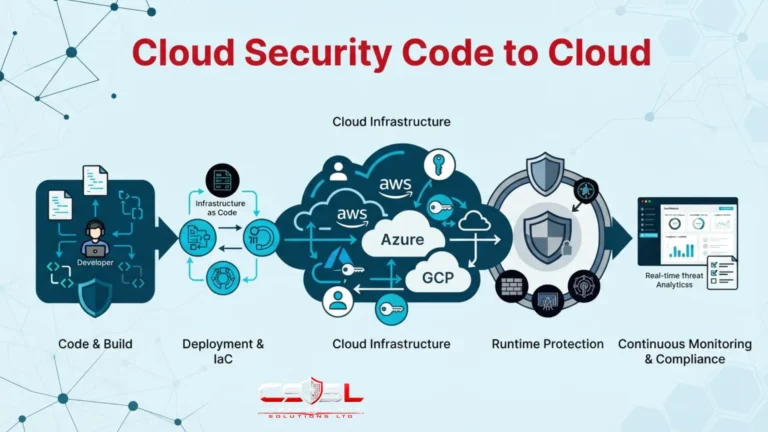
Multi-cloud security means protecting workloads distributed across more than one public cloud provider, distinct from hybrid cloud, which combines cloud with on-premises infrastructure. If you ended up running AWS, Azure and Google Cloud without ever deciding to, and nobody can say why, this guide starts with that exact diagnostic question.
What Is Multi-Cloud, and How Is It Different From Hybrid Cloud and Multi-Tenant Environments?
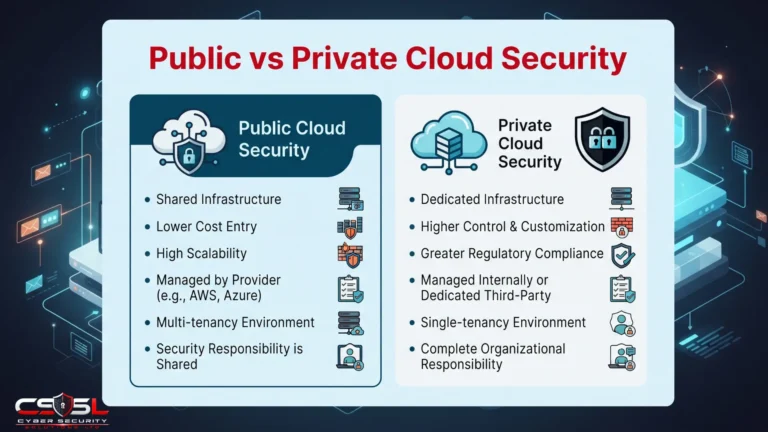
Multi-cloud means an organization runs workloads across more than one public cloud provider simultaneously, with no on-premises or edge component necessarily involved. Hybrid cloud means cloud combined with on-premises or edge infrastructure. Multi-tenant means one provider’s account structure holding many separate customer environments, an MSP’s own problem rather than an end-user organization’s.
Cloud security providers” in this title refers to the hyperscalers themselves, AWS, Azure and Google Cloud, not the managed security providers covered elsewhere in this series.
Multi-cloud has been named as an adjective, a challenge and a deferred reconciliation problem across roughly fifteen prior posts without its own synthesized treatment until now.
Why Do Organizations Actually End Up Running Multiple Cloud Providers?
Deliberate reasons include best-of-breed selection, genuine redundancy against concentration risk, and regulatory or geographic requirements only one provider satisfies.
| Driver | Deliberate or Accidental |
| Best-of-breed selection | Deliberate |
| Concentration risk mitigation | Deliberate |
| Regulatory/regional requirement | Deliberate |
| Shadow IT / organic team choice | Accidental |
| M&A bringing in an existing provider | Accidental |
Accidental reasons include infrastructure-level shadow IT, uncoordinated independent team choices, and M&A bringing an acquired company’s existing provider along. Whether your multi-cloud state is deliberate or accidental determines a fundamentally different remediation priority, not just an interesting backstory to tell.
Why Is Consistent Security Across Providers Genuinely Difficult, Not Just Inconvenient?
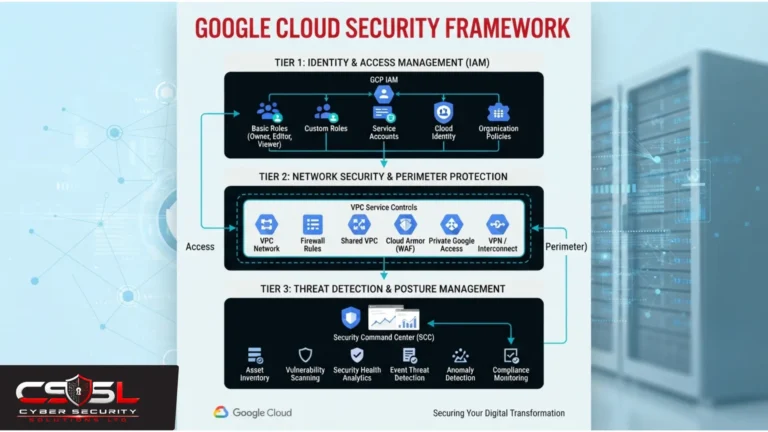
This series already proved it directly, not abstractly. AWS requires reconciling identity-based policies, resource-based policies, permission boundaries and Service Control Policies together. Azure’s model is hierarchical and inheritance-driven across Management Groups, Subscriptions and Resource Groups. Google Cloud’s three-level Organization/Folder/Project structure carries its own distinct Basic Roles pitfall.
Why does “just write one policy for all three” fail in practice? These are not three dialects of the same underlying language. They are three structurally different permission-evaluation systems, meaning a security team fluent in one provider’s model cannot simply transpose that fluency onto another without genuine, separate expertise.
The same pattern repeats at every layer already covered platform by platform in this series: network gateway terminology, native tool tiering, and DSPM-equivalent tooling, Macie, Purview and Sensitive Data Protection, three different products doing conceptually the same job with three different names. A team that has mastered AWS IAM is not automatically fluent in Azure’s inheritance model, any more than fluency in one language guarantees fluency in an unrelated one.
Workload Portability vs Practical Multi-Cloud: What Can You Move Between Providers?
True workload portability means an application can actually run on, and move between, more than one provider with reasonable effort. Practical multi-cloud, the far more common reality, means distinct, provider-pinned workloads running on each platform with no expectation any workload will ever move.
This distinction matters directly for concentration-risk mitigation. True redundancy against a provider-wide outage requires genuine workload portability, not merely holding accounts on two providers. Practical, provider-pinned multi-cloud gains best-of-breed flexibility but does not automatically gain the failover protection concentration-risk mitigation actually requires. Containerization, with externalized configuration, is the most common practical route toward genuine portability, though rarely portable without some rework.
How Do You Federate Identity Across Multiple Cloud Providers?
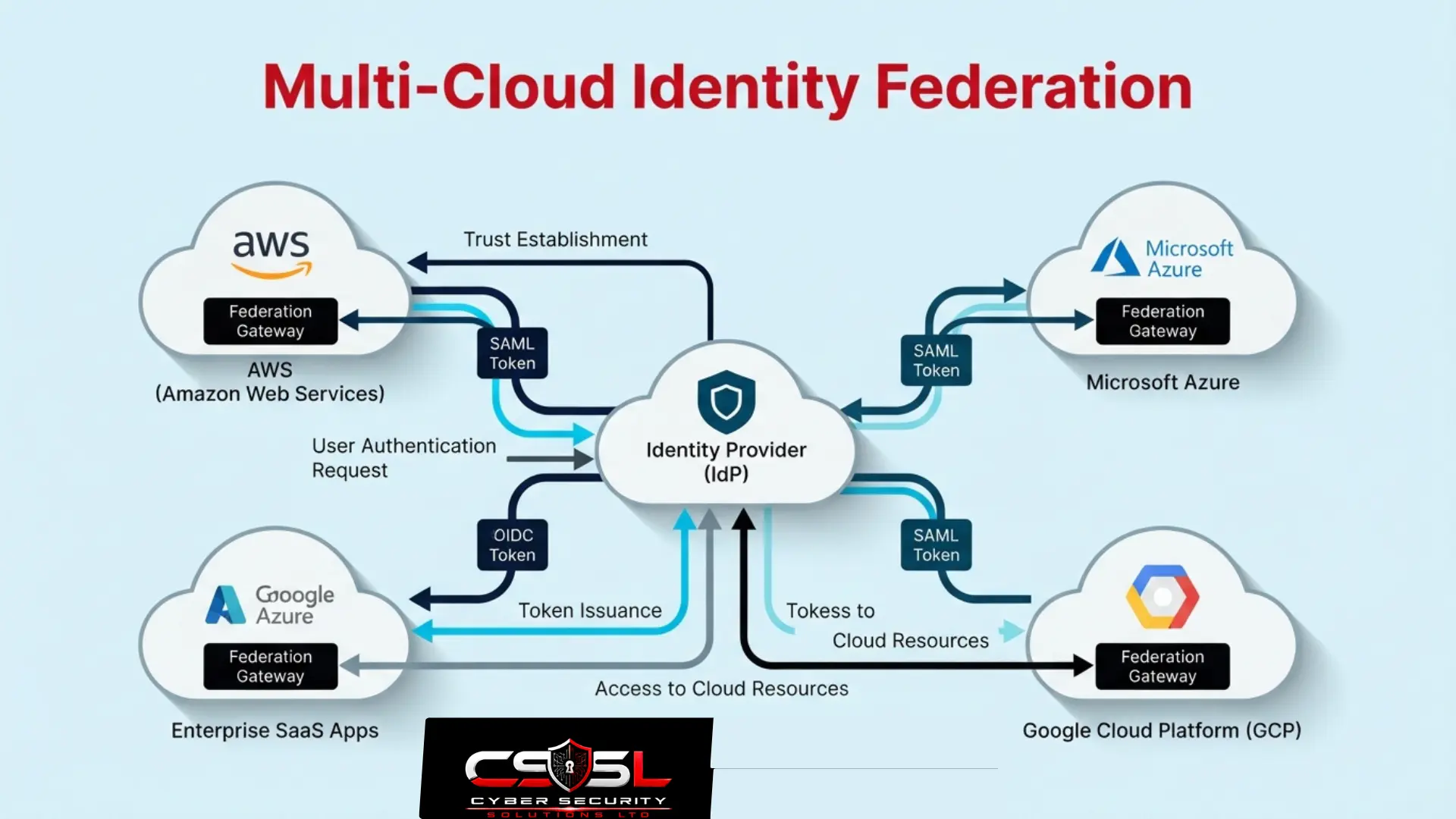
A dedicated, provider-neutral identity provider, Okta, Ping Identity or JumpCloud, sits above all connected clouds as the single source of truth, federating into AWS IAM, Microsoft Entra ID and Google Cloud IAM via SAML or OIDC. The alternative designates one hyperscaler’s own identity system, most commonly Entra ID, as the master.
The dedicated third-party option is often the more defensible long-term choice for multi-cloud specifically, since a hyperscaler-hosted identity system carries an inherent bias toward its own platform. This remains a continuous CIEM obligation, not a one-time integration, since federated identities carrying different effective permissions on each platform are exactly the cross-system correlation problem multi-cloud CIEM tooling exists to surface.
How Do You Achieve Consistent Posture, Policy and Visibility Across Providers?
CNAPP is precisely the technical answer to this consistency problem. A compound risk spanning a misconfigured AWS resource, an over-privileged federated identity, and sensitive data replicated into a Google Cloud storage bucket cannot be seen by any single provider’s native tooling, making cross-cloud correlation a genuine necessity, not a convenience.
Confirm a shortlisted platform’s multi-cloud coverage is genuinely equal-depth across every provider in use, not merely present on paper. Policy as Code, a single policy definition evaluated against AWS, Azure and Google Cloud resources alike, provides consistency at the rule layer even where the platforms remain structurally different.
How Do You Build Multi-Cloud Disaster Recovery and Resilience?
Active-active runs workloads simultaneously across two or more providers with live traffic distribution, requiring the workload portability established above and carrying real cost and complexity.
| Criteria | Active-Active | Active-Passive |
| Requires workload portability | Yes | No |
| Cost | High | Lower |
| Complexity | High | Moderate |
| Failover speed | Immediate | Requires activation |
| Testing requirement | Continuous | Scheduled drills |
Active-passive keeps a primary provider running normally while a secondary sits in reserve, periodically synchronized and activated only during a genuine primary-provider outage, considerably more common given its lower cost.
This introduces a genuinely new incident scenario. Prior incident response content in this series assumed a workload within a provider being compromised. Multi-cloud resilience planning must also account for the provider itself experiencing an outage, a scenario requiring failover mechanics never covered there. Testing the failover mechanism matters as much as having one: an active-passive arrangement never actually triggered in a drill carries real, undiscovered risk it will not function correctly during a genuine outage.
How Do You Reconcile Compliance Frameworks and Terminology Across Providers?
Maintain a short, plain-English internal glossary mapping each provider’s own specific terminology to one common internal vocabulary, so documentation does not silently drift between three vendor dialects.
Select one overarching, provider-neutral framework, NIST CSF, already established as this series’ own connective structure, as your internal master reference, mapping each provider’s own native framework onto it rather than attempting to satisfy three separately-structured provider frameworks in parallel. This delivers directly on two separate difficulties this series flagged and left open: reconciling each provider’s own architectural framework, and translating shared responsibility terminology across AWS’s “of/in the cloud” language, Azure’s sliding scale and Google’s shared fate framing.
The reconciliation burden does not disappear. Concentrating it into one internal glossary and one internal master framework converts three ongoing, separate translation efforts into a single, maintained artifact your whole team can actually reference consistently, rather than three parallel conversations that quietly drift apart over time.
What Does the Multi-Cloud Skills Gap Look Like in Practice?
An organization running three providers typically faces a choice between one generalist team with shallow depth across all three, or specialist sub-teams that may not coordinate well with each other.
Assessing whether identity federation, posture tooling and disaster recovery genuinely cover every provider with equal depth is exactly the multi-cloud assessment Cyber Security Solutions Ltd runs for organizations in this exact position. Organizations without realistic capacity to build genuine multi-provider depth in-house may reasonably concentrate that expertise in a managed provider relationship instead of hiring three separate specialist skill sets.
How Do You Build a Multi-Cloud Security Program Step by Step?
Building a multi-cloud program starts with diagnosing deliberate versus accidental adoption, then classifying workloads by portability before making any redundancy promises.
- Determine honestly whether your organization is multi-cloud by deliberate strategy or accidental accumulation.
- Establish which workloads are genuinely intended to be portable versus permanently pinned to their current provider.
- Choose an identity federation architecture and apply continuous CIEM review across every connected platform.
- Select a CNAPP platform with genuinely verified, equal-depth multi-cloud coverage.
- Decide between active-active and active-passive disaster recovery, then test the failover mechanism on a defined schedule.
- Build and maintain an internal terminology glossary translating each provider’s language into one vocabulary.
- Select one overarching framework as your internal master reference and map each provider’s guidance onto it.
- Resource your team deliberately, based on an honest assessment of realistic in-house capacity.
Conclusion
Multi-cloud security is not solved by simply holding accounts on more than one provider. Diagnose whether your multi-cloud state is deliberate or accidental, verify your tooling covers every provider with equal depth, and test your disaster recovery plan before you need it. To get a multi-cloud security assessment checking whether your identity federation, posture tooling and disaster recovery genuinely cover every provider in use, visit cybersecuritysolutionsltd.com for expert support from Cyber Security Solutions Ltd.
FAQs
What is the difference between multi-cloud and hybrid cloud?
Multi-cloud means running workloads across more than one public cloud provider with no on-premises component necessarily involved at all. Hybrid cloud means combining public cloud with on-premises or edge infrastructure directly. The two are frequently confused but describe genuinely different architectures entirely.
Does having two cloud providers protect us against an outage?
Only if your workloads are genuinely portable between them. Holding accounts on two providers without workload portability gains flexibility and negotiating power, but not automatic failover protection, since a workload pinned to one provider cannot simply run on another during an outage.
Why can’t we just write one IAM policy across AWS, Azure and Google Cloud?
Because they use structurally different permission systems, not dialects of one shared language. AWS combines identity-based and resource-based policies with permission boundaries and SCPs. Azure is hierarchical and inheritance-driven. Google Cloud uses a three-level structure with its own distinct pitfalls to learn.
What is the difference between active-active and active-passive disaster recovery?
Active-active runs workloads simultaneously across providers with live traffic distribution, requiring genuine workload portability and higher cost overall. Active-passive keeps one primary provider running while a secondary sits synchronized in reserve, activated only during an outage, and costs meaningfully less to maintain.
Should we use a third-party identity provider or one hyperscaler’s own identity system?
A dedicated, neutral provider like Okta or Ping Identity is often the more defensible long-term choice, since a hyperscaler-hosted identity system carries a structural bias toward its own platform. Either way, continuous entitlement review across every connected platform remains genuinely necessary.
How do you handle different shared responsibility terminology across cloud providers?
Maintain a short, plain-English internal glossary mapping each provider’s own specific terminology to one common vocabulary, and select one overarching framework, like NIST CSF, as your internal master reference rather than trying to satisfy three separate provider frameworks in parallel simultaneously.