Cloud Security for MSPs: Protecting Clients and Growing Your Practice
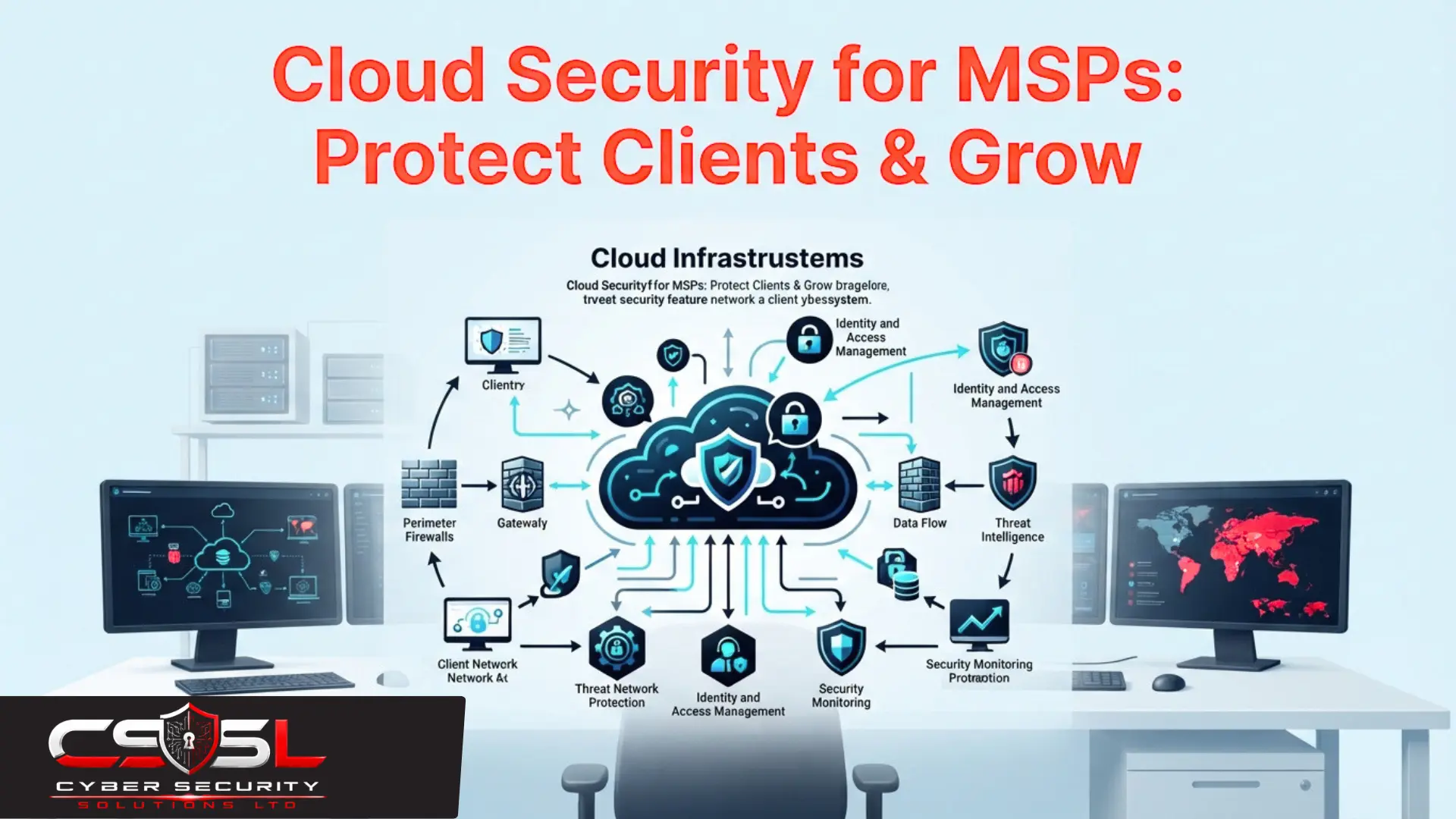
Cloud security for MSPs means delivering the same identity, posture, and entitlement disciplines already established for individual organizations, but across many distinct client environments simultaneously, using tooling and internal processes built for multi-tenant scale rather than a single organization’s own environment.
If a client once asked for your SOC 2 report and you did not have one, and lost the deal, or you are managing forty different client cloud environments and it does not scale to log into forty separate consoles, this guide covers what changes when an MSP, rather than an in-house team, is the one securing the cloud.
What Does Cloud Security for MSPs Mean, and How Is It Different from Delivering It In-House?
Every principle covered elsewhere in this cluster, shared responsibility, CSPM, CIEM, zero trust, applies fully to MSP-delivered cloud security. What changes is the operational model delivering it and the specific risks that model introduces. An in-house team secures one environment for one organisation. An MSP secures dozens or hundreds of distinct client environments simultaneously, often with a small technical team, meaning tooling choices, access architecture, and service scoping decisions carry weight that simply does not exist when only one environment is in play.
This post assumes the individual technical disciplines are already understood and focuses specifically on what changes when an MSP is the party applying them across many client tenants at once. See Managed Cloud Security Services: What They Are and Who Needs Them and Cloud Security for Small Business: Affordable Tools and Best Practices for the client-side perspective this post extends into the MSP’s own operational reality.
Why Are MSPs Specifically Targeted by Attackers, Not Just Incidentally Affected?
MSPs represent a multiplicative attack target: compromising a single MSP credential, RMM platform, or shared cloud management console can provide simultaneous access to every client that MSP serves, converting one successful attack into exposure across an entire client base at once. This structural incentive means MSPs face a materially different threat calculus than any single client organisation, since an attacker’s return on a single successful compromise scales with the MSP’s entire client roster rather than one organisation’s assets.
Most competitor content addressing MSP cloud security discusses the topic purely as a service delivered outward to clients, treating the MSP’s own risk exposure as an afterthought or ignoring it entirely, without naming the specific reason MSPs themselves have become documented, prime attacker targets in their own right, deserving the same weight already given to concentration risk in financial services coverage elsewhere in this cluster.
The underlying logic is straightforward and well documented across the wider security industry: an attacker choosing between compromising one organisation directly, gaining access to that organisation’s data and systems alone, or compromising the MSP serving fifty similar organisations, gaining simultaneous potential access to all fifty, will rationally prefer the second target whenever the MSP’s own defences are comparably weaker or equal to any individual client’s. This is precisely the supply chain attack pattern that has produced some of the most consequential real-world security incidents in recent years, where a single compromised RMM or PSA platform became the delivery mechanism for ransomware or data theft across dozens of downstream client organisations simultaneously, none of which were directly targeted individually.
This structural reality means an MSP’s own security posture is not simply a matter of professional diligence; it is a direct, multiplicative risk factor for every client relying on that MSP, whether or not any individual client has ever considered this. A client evaluating an MSP relationship, and an MSP evaluating its own internal security investment, should both treat the MSP’s own security maturity as carrying weight proportional to the number of clients it serves, not proportional to the MSP’s own size or asset value in isolation. An MSP with weak internal security controls serving two hundred clients represents a larger aggregate risk surface than any single one of those two hundred clients represents on its own, a fact that should directly shape both how seriously an MSP invests in its own security and how carefully a prospective client should scrutinise that MSP’s practices before signing.
How Do You Architect MSP Tooling to Prevent Tenant Isolation Failures Between Clients?
Tenant isolation on the MSP’s own side means ensuring that a technician’s access, and the MSP’s own management tooling, cannot provide a path from one client’s environment into another’s, even when that access is legitimately used to serve multiple clients from the same internal platform. Native multi-tenant management tools like Microsoft Azure Lighthouse and AWS’s cross-account delegation model are specifically designed to grant scoped, auditable access per client rather than one broad, undifferentiated credential spanning every tenant simultaneously.
This is a genuinely different architectural problem from anything covered elsewhere in this cluster, because every prior discussion of blast radius containment addressed how to prevent a compromise within a single cloud environment from spreading laterally within that same environment. This section addresses a structurally distinct question: how does an MSP prevent a compromise of its own internal tooling or staff credentials from spreading laterally between entirely separate client environments that would otherwise have no connection to each other at all.
Consider the realistic failure mode this creates when tenant isolation is not deliberately architected. An MSP technician holds one set of credentials granting access to the MSP’s own RMM platform, which in turn holds connections to every client environment the MSP manages, often through a single, broadly-scoped service account or API key configured once during initial platform setup and never revisited. If that technician’s own credential is phished, or if the RMM platform itself is compromised, the attacker does not gain access to one client’s environment; they potentially gain the same broad access the compromised technician or platform already held, spanning every client simultaneously, none of whom did anything wrong or had any direct relationship with each other beyond sharing the same MSP.
This is precisely the mechanism that converts an MSP compromise into a mass-casualty event rather than a contained, single-organisation incident. The architectural fix requires applying the same least-privilege and blast-radius-containment discipline already established for cloud environments generally, but pointed inward at the MSP’s own operational model specifically. Native tools like Azure Lighthouse are purpose-built for exactly this: granting an MSP delegated, auditable access scoped to a specific client tenant, with each client relationship visible and revocable independently, rather than relying on a single shared credential or platform-level connection spanning every client indiscriminately.
Technician access should similarly be scoped per client wherever the daily workflow allows, with broader, cross-client access reserved for a smaller number of senior staff and subject to its own dedicated review, exactly the same principle already established for privileged access generally, now applied specifically to the boundary between one client and the next rather than within a single environment.
What Does the Shared Responsibility Model Look Like with a Client, an MSP, and a Cloud Provider All Involved?
| Party | Responsible For |
| Cloud provider | Underlying infrastructure security, exactly as established generally |
| Client organisation | Ultimate accountability as tenant owner, regardless of MSP relationship |
| Contracted MSP | Whatever specific scope the SOW defines, and nothing beyond it |
| MSP’s own staff/tooling | A distinct risk surface requiring its own dedicated controls |
Managed cloud security services content already established that engaging a third-party provider redistributes responsibility across a three-party relationship rather than simply transferring it away from the customer. For MSP-delivered cloud security specifically, this model needs a further, genuine extension, since the reality on the ground involves not three parties but four, and collapsing the fourth into the third is precisely where client-MSP disputes and coverage gaps originate.
The cloud provider’s responsibility remains unchanged. The client organisation’s underlying accountability as the actual account owner remains unchanged; regulatory bodies and cyber insurers will hold the client accountable regardless of any MSP relationship, exactly as established for managed services generally. The genuinely distinct addition here is that the MSP’s contracted responsibility, defined by the Statement of Work, is not automatically identical to everything the MSP’s own staff and tooling can technically reach or affect. An MSP might be contracted specifically to monitor and alert on cloud misconfigurations, a narrower scope than actively remediating them, yet the MSP’s own technicians may hold access broad enough to make changes well beyond that contracted scope, creating a gap between what the SOW promises and what the MSP’s actual internal access permits, a gap that becomes visible and consequential only when something goes wrong and the client discovers the MSP’s contracted responsibility was narrower than assumed.
This is precisely why the client security education burden falls specifically on the MSP in this four-party model, extending the shared responsibility misconception already established for small businesses one further step. A client who does not fully understand where their cloud provider’s responsibility ends may now also not understand where their MSP’s contracted responsibility ends, reasonably assuming that engaging an MSP for cloud security means the MSP handles everything the provider does not, when the actual SOW may define a considerably narrower, specific scope, monitoring but not remediation, alerting but not incident response, that the client has never read as closely as the MSP itself has.
The practical discipline this requires: MSPs should document their specific SOW scope with the same explicit, named-responsibility rigour already established for internal governance elsewhere in this cluster, and should proactively communicate what falls outside that scope, not simply what falls within it, since the client’s dangerous assumption is almost never about what the MSP does cover, but about what the client wrongly believes is covered when it is not.
How Do You Manage CSPM, CIEM and Posture Visibility Across Many Client Tenants at Once?
Running standalone CSPM or CIEM tooling separately per client, logging into a distinct console for each, does not scale meaningfully beyond a handful of clients. Major CNAPP and posture management vendors increasingly offer MSP-specific, multi-tenant licensing tiers, aggregating findings across every managed client into one console while maintaining strict tenant-level separation of the underlying data and access.
The golden baseline versus per-client customisation tension deserves direct treatment as an extension of the guardrails-versus-gates governance choice already established for cloud architecture, since MSPs face this exact same trade-off applied across an entire client portfolio rather than within a single environment.
A single, standard security baseline deployed identically across every client, the same MFA enforcement, the same CSPM rule set, the same monitoring configuration, maximises the operational efficiency an MSP practice depends on to remain profitable at scale. Reviewing and remediating findings against one known, consistent configuration is dramatically faster than treating every client as a fully bespoke environment requiring individual reasoning from scratch. This efficiency, however, risks under-serving clients with genuinely distinct regulatory obligations: a healthcare client with HIPAA-specific requirements or a financial services client with concentration-risk and exit-strategy obligations covered elsewhere in this cluster needs configuration beyond what a generic baseline addresses, and forcing every client into an identical template regardless of sector risks missing exactly the sector-specific controls those clients most need.
The practical resolution mirrors the guardrails-and-gates principle directly: establish one golden baseline as the default, non-negotiable starting configuration for every client, the equivalent of a gate that every onboarding must pass through, then layer client-specific additions on top as explicitly documented exceptions where genuine regulatory or risk-tolerance differences warrant them, the equivalent of a guardrail allowing controlled deviation without abandoning the baseline’s efficiency for every other client. An MSP that treats every client as fully bespoke from day one sacrifices the standardisation that makes multi-client delivery viable at all; an MSP that forces every client into an identical configuration regardless of sector risks providing inadequate protection to the clients whose regulatory profile genuinely differs from the baseline. Multi-tenant tooling that supports this exact pattern, one enforced baseline with documented, visible per-client exceptions, is what actually lets an MSP scale securely across a diverse client portfolio.
Should You Pursue SOC 2 or Other Formal Attestation for Your Own MSP Practice?
Client-requested security attestations, most commonly SOC 2, are increasingly a genuine procurement prerequisite for MSPs specifically, since a client engaging an MSP for cloud security services is effectively extending trust to that MSP’s own internal controls, making the MSP’s own attestation directly relevant in a way it would not be for a vendor selling a self-contained product.
MSP-specific cyber insurance is a related, increasingly necessary consideration, given the MSP’s own elevated risk profile as a multiplicative attack target. Pursuing SOC 2 attestation represents a genuine, often multi-month investment in documentation and control maturity, but increasingly functions as table stakes for winning larger client relationships specifically, mirroring the same commercial-gateway function Cyber Essentials serves for UK small businesses covered elsewhere in this cluster, scaled to the enterprise-client context most MSPs are ultimately trying to win.
How Do You Use Cloud Security Maturity to Acquire and Retain Clients, Not Just Deliver a Service Line?
Cloud security maturity functions as a genuine competitive differentiator and growth lever, not merely a cost centre or service menu item, since clients increasingly face their own vendor security questionnaires, cyber insurance requirements, and downstream client pressure that a generalist MSP without demonstrable cloud security depth cannot adequately address. Tiered packaging, an initial assessment, a baseline configuration tier, and an ongoing managed tier, provides a natural, low-friction entry point converting into higher-value recurring revenue.
Most competitor MSP content treats cloud security as one item on a broader service menu without developing the commercial argument directly, missing that demonstrable security maturity has become a genuine reason clients choose one MSP over another, and a genuine reason they stay rather than switching.
A free or low-cost initial cloud security assessment functions specifically as a lead-generation tool, giving a prospective client concrete, specific findings about their own environment, exactly the kind of tangible, individualised value proposition that a generic sales pitch cannot replicate. This assessment naturally surfaces genuine gaps the client did not know existed, creating a direct, evidence-based path into a paid engagement rather than requiring the MSP to argue abstractly for why cloud security matters. A per-seat or per-account pricing model, scaling with the client’s actual cloud footprint rather than a flat fee, aligns the MSP’s revenue with the genuine scope of ongoing work required, avoiding the common mismatch where a growing client’s cloud footprint expands faster than a static, flat-fee arrangement was ever priced to cover.
The retention argument matters as much as acquisition. A client that has genuinely benefited from an MSP’s demonstrated cloud security maturity, faster incident response, cleaner compliance evidence when a client questionnaire or cyber insurance renewal arrives, has a concrete, specific reason to remain with that MSP beyond simple inertia or switching cost, precisely the kind of durable competitive advantage a generalist MSP competing purely on price cannot easily replicate. An MSP that treats cloud security purely as a cost of doing business, rather than as a demonstrable capability actively marketed and packaged into tiered offerings, is leaving a genuine growth lever unused.
When Should You Build Cloud Security Capability In-House, and When Should You Use a Specialist Partner?
Small business content elsewhere in this cluster established a specific, common gap: a general IT MSP’s own core expertise frequently centres on hardware, networking, and general troubleshooting, with cloud security receiving comparatively less specialist depth, sometimes subcontracted quietly to a separate MSSP the client is never explicitly told about. This same gap applies to the MSP itself when deciding whether to build genuine in-house cloud security expertise or partner with a specialist.
This is the direct, MSP-side mirror of a question already established from the client’s perspective elsewhere in this cluster, and recognising the symmetry matters because it gives an MSP a concrete, already-familiar framework for its own build-versus-partner decision, rather than treating this as an entirely new question requiring fresh reasoning.
An MSP that already runs its own general IT service line faces exactly the same specialist-scarcity reality already established as affecting the broader market: genuine cloud security depth, current CSPM, CIEM, and cloud-native threat detection expertise, requires a distinct specialism that general IT service delivery does not automatically develop. Building this depth entirely in-house requires either hiring genuinely scarce, specialised talent directly, or investing significant time developing existing staff, both genuine options but neither instant or guaranteed to reach full competence quickly. Partnering with a specialist cloud security provider, delivering services white-label or co-branded under the MSP’s own client relationship, lets the MSP offer genuine cloud security depth to clients immediately, without the multi-month or multi-year runway building that same depth internally would require.
Neither option is inherently superior; the right choice depends on the MSP’s own scale, existing client demand, and appetite for building a genuinely new specialism versus focusing on what the MSP already does well while partnering for the rest. Cyber Security Solutions Ltd works specifically with MSPs choosing the partnership route, providing the specialist cloud security depth an MSP’s own general IT practice may not yet have built in-house, delivered in a way that lets the MSP present a complete, credible cloud security offering to its own clients without the delay of building that capability from scratch.
How Do You Build a Cloud Security Practice for Your MSP Step by Step?
Step 1: Establish a golden baseline security configuration to deploy consistently across every new client onboarding.
Step 2: Architect tenant-scoped access for your own technicians and tooling, avoiding broad, shared credentials spanning every client.
Step 3: Document your specific SOW scope explicitly, communicating both what is covered and what falls outside it to every client.
Step 4: Select multi-tenant CSPM or CNAPP tooling with genuine per-client separation, not a single shared dashboard with no tenant isolation.
Step 5: Conduct a regular internal access review specifically of your own staff’s cross-client access, applying the same entitlement discipline you apply to client environments.
Step 6: Package cloud security as tiered offerings, an assessment, a baseline tier, and a fully managed tier, rather than a single undifferentiated line item.
Step 7: Pursue SOC 2 or equivalent attestation once client demand and deal size justify the investment.
Step 8: Decide deliberately whether to build cloud security depth in-house or partner with a specialist, based on your own scale and existing client demand.
Cyber Security Solutions Ltd partners with MSPs to deliver genuine cloud security depth to their clients, white-label or co-branded, without requiring the MSP to build that specialism entirely from scratch.
Conclusion
An MSP’s own security posture is not a private, internal matter; it is a multiplicative risk factor for every client relying on that relationship. Getting tenant isolation, SOW scope clarity, and baseline-versus-customization trade-offs right protects your entire client base at once, and packaged well, becomes the reason clients choose and stay with you.
FAQs
Compromising a single MSP credential or management platform can provide simultaneous access to every client that MSP serves, converting one successful attack into exposure across an entire client base at once. This multiplicative payoff makes MSPs a rationally preferred target over any single client organisation.
Architect tenant-scoped access using tools like Azure Lighthouse, granting delegated access per client rather than one broad, shared credential spanning every tenant. Reserve cross-client access for a small number of senior staff subject to its own dedicated, regular review.
Four parties, not three: the provider secures infrastructure, the client retains ultimate accountability, the MSP is responsible for whatever the SOW defines, and the MSP’s own staff and tooling represent a distinct fourth risk surface requiring its own dedicated controls beyond the contracted scope.
Use a golden baseline as the default for every client, then layer documented, explicit exceptions for genuine regulatory or risk-tolerance differences. Full customisation destroys the efficiency an MSP practice needs to scale; full uniformity under-serves clients with distinct compliance obligations.
Increasingly yes, particularly for winning larger client relationships. Clients engaging an MSP for cloud security are extending trust to that MSP’s own controls, making SOC 2 or equivalent attestation a genuine procurement prerequisite rather than an optional credential.
Use tiered packaging, a low-cost assessment as lead generation, a baseline tier, and a fully managed tier, converting demonstrated security maturity into both client acquisition and retention. Clients facing their own security questionnaires and insurance requirements increasingly choose MSPs who can prove genuine cloud security depth.