Cloud Security Framework: NIST, CSA and ISO 27017 Explained
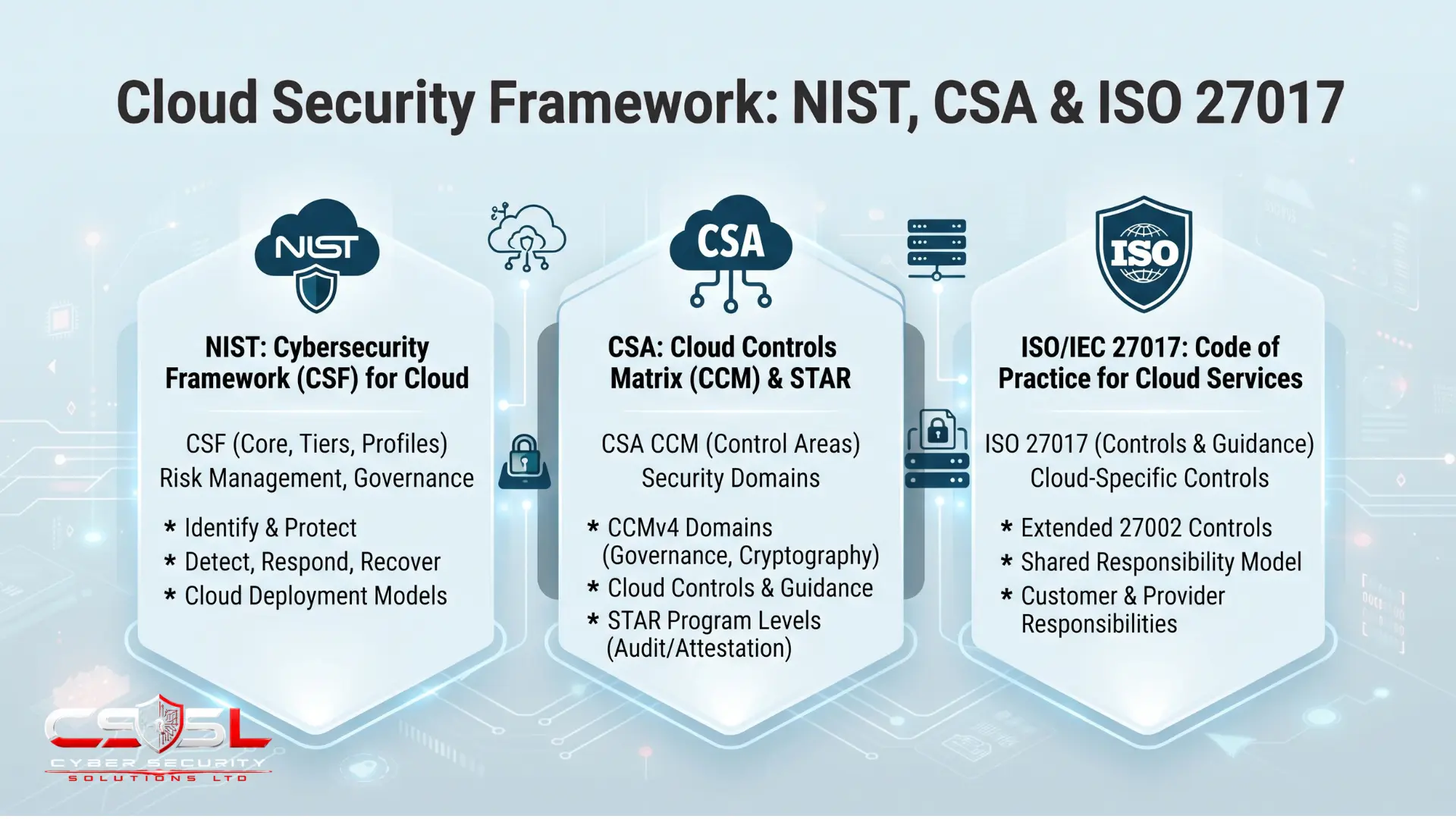
A cloud security framework is a structured body of governance, control and maturity guidance from an independent body like NIST, CSA, ISO or the UK NCSC, used to benchmark a programme rather than define its architecture. If NIST, CSA and ISO 27017 keep coming up with no clear sense of how they relate, this guide sorts that out.
What Is a Cloud Security Framework?
A cloud security framework is a structured body of governance, control and maturity guidance, typically produced by an independent standards body, government agency or industry consortium, used to organize, benchmark and demonstrate a security programme rather than to lay out physical or logical architecture.
This differs from a reference architecture, covered earlier in this series, which means a technical pattern for account structure, zoning and identity design. A framework benchmarks a programme. A reference architecture blueprints an environment.
Organizations use frameworks rather than building a programme from first principles because frameworks encode collective, tested experience across thousands of other organizations, giving a structured starting point and a common vocabulary for communicating maturity to boards, auditors, insurers and clients. This post covers four bodies: NIST, CSA, ISO 27017 and UK NCSC, the four most frequently encountered reference points across this series so far.
What Is the NIST Cybersecurity Framework, and How Does It Apply to Cloud Environments?
The NIST Cybersecurity Framework, developed by the US National Institute of Standards and Technology, is voluntary, non-regulatory guidance. It functions as the de facto reference structure many organizations, well beyond the US federal sector NIST originally served, use to organize a cybersecurity programme.
CSF 2.0 added a sixth function. Govern, covering organizational context, risk strategy and policy, joins Identify, Protect, Detect, Respond and Recover, each representing a distinct category of activity a mature programme needs to address.
NIST is not a single document but a family. The CSF provides the organizing structure. More granular Special Publications, SP 800-53 for control baselines, SP 800-144 for public cloud guidance, SP 800-207 for zero trust, SP 800-190 for containers, supply the specific technical detail beneath each function. NIST carries weight globally, not just in the US, because the guidance is vendor-neutral, publicly available at no cost and extensively peer reviewed.
What Is the Cloud Security Alliance, and What Does It Produce?
CSA is a not-for-profit industry body dedicated specifically to cloud security. Its Cloud Controls Matrix is a detailed, auditable, cloud-specific control framework. Its STAR registry lets vendors self assess or undergo independent audit against the CCM and publish results publicly.
CSA’s Top Threats to Cloud Computing research has already been cited repeatedly throughout this series as a statistical source. This is where that source finally gets explained as an organization and methodology rather than just a citation. CSA is worth stating plainly: a not-for-profit industry organization dedicated specifically to cloud security, distinguishing it from NIST and ISO’s much broader general security remit.
The Cloud Controls Matrix is CSA’s detailed, cloud-specific control framework, organized into domains with individual, auditable controls, considerably more granular and directly actionable than the narrative-style Security Guidance domains named earlier in this series.
STAR, Security, Trust, Assurance and Risk, is CSA’s registry and certification programme. It allows cloud providers and SaaS vendors to self assess or undergo independent third-party audit against the CCM and publish the results publicly, a genuinely practical resource for vendor risk conversations already touched on elsewhere in this series. A vendor’s published STAR entry provides independently structured evidence of their security posture, more substantive than a general marketing claim of being “secure.
What Is ISO 27017, and How Does It Relate to ISO 27001 and ISO 27018?
ISO 27017 is an international standard providing cloud-specific security controls and implementation guidance, published as a companion extension to ISO 27001 rather than a replacement or standalone alternative.
ISO 27017 genuinely appears in two post titles across this series, which is intentional, not an error. Here is the split stated directly. This post explains what ISO 27017 is as a standard, its structure and content. A separate post covers the practical business process of pursuing and demonstrating compliance against it alongside sector-specific regimes like HIPAA and government-specific regimes like FedRAMP.
The relationship to ISO 27001: 27001 provides the overarching management system. ISO 27017 adds cloud-specific controls addressing responsibilities and risks unique to cloud service provision and consumption. An organization typically pursues ISO 27001 certification with 27017 as an extension, not 27017 in isolation.
ISO 27018 is worth naming for completeness, since it gets mentioned alongside 27017 constantly. It is a related standard addressing protection of personally identifiable information in public cloud environments specifically, distinct in focus from 27017’s broader cloud security control scope. Structurally, ISO 27017 covers shared responsibility clarity, cloud-specific access control, virtualization security and the relationship between cloud service customer and provider, directly reinforcing the shared responsibility content covered fully elsewhere in this series.
What Are the UK NCSC’s 14 Cloud Security Principles?
Only Principle 1, understand your responsibilities, was detailed earlier in this series. This section names and groups the remaining principles for the first time.
Grouped thematically: data protection principles cover data in transit protection, asset protection and resilience, data at rest protection and secure data deletion. Governance and operational principles cover operational security, supply chain security and secure development. Identity and interface principles cover identity and authentication, external interface protection, secure user management and audit information provision.
Unlike NIST, US originated, or ISO 27017, globally generic, NCSC’s principles are produced specifically with UK regulatory and threat context in mind, making them a particularly relevant benchmark for UK based readers evaluating any cloud service. Organizations can use the 14 principles as a structured question set when evaluating a prospective provider, asking them to demonstrate how they address each one.
How Do These Frameworks Compare, and Which One Should You Use?
These are not mutually exclusive alternatives competing for the same role. NIST CSF provides overall programme structure. CSA CCM provides granular, auditable cloud-specific controls and vendor risk assessment tooling. ISO 27017 provides a formally certifiable extension to a recognized international management system. NCSC’s principles provide a UK-relevant, vendor-neutral evaluation checklist.
| Body | What It Produces | Formally Certifiable | Best Used For |
| NIST CSF | Six-function programme structure | No | General programme organization |
| CSA CCM/STAR | Granular control framework and vendor registry | Self-assessed or audited (STAR) | Vendor risk evaluation |
| ISO 27017 | Cloud-specific control extension | Yes | Formal, auditable certification |
| UK NCSC 14 Principles | Vendor-neutral evaluation checklist | No | UK-specific benchmarking |
Organizations without any existing structure benefit most from starting with NIST CSF’s six functions as an organizing skeleton. Organizations evaluating cloud and SaaS vendors specifically benefit most from CSA’s CCM and STAR registry. Organizations pursuing formal, auditable certification look to ISO 27001/27017. UK organizations wanting a vendor-neutral, government-backed benchmark reach for NCSC’s principles. Most mature programmes end up referencing several simultaneously, exactly as multi-cloud architecture reconciliation already established elsewhere in this series.
How Does the NIST CSF Map Onto Everything Else Covered in This Cluster?
Govern maps to the shared responsibility governance mapping and formal cloud security policy. Identify maps to asset and data discovery through CSPM and DSPM. Protect maps to cloud IAM, network segmentation and zones, encryption and zero trust.
| Function | What It Covers | Related Cluster Post |
| Govern | Shared responsibility mapping, written policy | Shared Responsibility Model, Cloud Security Policy |
| Identify | Asset and data discovery | CSPM Guide, DSPM Guide |
| Protect | IAM, zones, encryption, zero trust | Cloud IAM, Zero Trust Guide |
| Detect | Runtime and container monitoring | CWPP Guide, Container Security |
| Respond / Recover | Incident response, business continuity | Forthcoming Incident Response guide |
Detect maps to CWPP runtime protection, container and application runtime monitoring, and cloud security monitoring more broadly. Respond and Recover map to incident response and business continuity, covered in depth elsewhere in this series.
This section’s job is providing a second synthesis lens, complementing the 4 Cs model covered earlier, this time organized around governance function rather than architectural layer. Following this series in sequence has, without necessarily naming it until now, been building coverage of every NIST CSF function already. That gives you a recognized external structure to report your own progress against, whether to a board, an auditor or an insurer, without building that reporting structure from scratch.
How Is This Different From Pursuing Formal Compliance or a Personal Certification?
This post explains what these frameworks and standards are and how to use them as reference and benchmarking tools. The practical, step-by-step business process of pursuing formal compliance against specific regimes, including sector-specific ones like HIPAA and government-specific ones like FedRAMP, alongside ISO 27017 certification specifically, is covered fully elsewhere in this series.
The separate meaning of “certification” is worth flagging directly. A different post covers individual, professional credentials such as CCSP or CCSK that a person earns to demonstrate their own expertise, an entirely different concept from an organization achieving ISO 27017 certification or aligning with NIST CSF. Readers researching “cloud security certification” should be clear on which meaning actually applies to their need.
How Do You Apply a Cloud Security Framework Step by Step?
Applying a framework starts with identifying your primary driver, mapping existing controls against its structure to find genuine gaps, using CSA’s STAR registry for vendor evaluation, engaging formal certification separately where required, reporting progress using the NIST CSF mapping, and revisiting alignment periodically as guidance gets revised.
Mapping existing controls against a chosen framework’s structure to surface genuine gaps, rather than assuming coverage, is exactly what Cyber Security Solutions Ltd runs as a framework alignment review.
- Identify your primary driver: general programme structure, vendor risk evaluation, formal certification or a UK-specific benchmark, since this determines which framework to start with.
- Map your existing cloud security controls against your chosen framework’s structure to identify genuine gaps rather than assuming coverage.
- Use CSA’s STAR registry when evaluating any new cloud or SaaS vendor, requesting their published assessment rather than relying on marketing claims alone.
- Where formal certification is a genuine business requirement, engage that separate process rather than treating framework alignment alone as equivalent to certification.
- Use the NIST CSF function mapping above to report internal progress in a structure your board, auditors or insurers will recognize.
- Revisit your framework alignment periodically, since NIST CSF, ISO standards and NCSC guidance are each periodically revised.
Conclusion
A cloud security framework will not tell you exactly what to build. It tells you how to organize, benchmark and report on what you already have. Start with NIST CSF if you need general structure, CSA’s STAR registry if you are evaluating a vendor, and NCSC’s principles if you want a UK specific checklist, and expect to use more than one over time. To get a framework alignment review that maps your existing controls and surfaces genuine gaps, visit cybersecuritysolutionsltd.com for expert support from Cyber Security Solutions Ltd.
FAQs
A framework is governance, control and maturity guidance from an independent body, used to organize and benchmark a security programme. A reference architecture is a technical pattern for account structure, zoning and identity design. One benchmarks a programme; the other blueprints an actual environment to build.
Effectively both. ISO 27017 is a companion extension to ISO 27001, adding cloud-specific controls, and it is never pursued standalone. Organizations typically pursue ISO 27001 certification with 27017 as an extension, not 27017 in isolation without an underlying certified management system already in place.
STAR is CSA’s public registry where cloud and SaaS vendors self assess or undergo independent audit against the Cloud Controls Matrix and publish results. It gives buyers independently structured evidence of a vendor’s security posture, more substantive than a general marketing claim.
These are not competing alternatives. Start with NIST CSF for general programme structure, CSA’s CCM and STAR for vendor evaluation, ISO 27001/27017 for formal certification, and NCSC’s principles for a UK-relevant, vendor-neutral benchmark. Most mature programmes reference several at once.
No. ISO 27017 is an organizational certification an entire company achieves after a formal external audit. Personal credentials like CCSP or CCSK are individual, professional certifications a person earns to demonstrate their own expertise, an entirely different concept covered elsewhere in this series.
Periodically, not on a fixed annual cycle. CSF 2.0 added an entirely new function, Govern, to the original five functions NIST first published. Revisit your framework alignment whenever a major revision like this happens, rather than assuming your existing mapping stays accurate indefinitely without review.