Cloud Security Code to Cloud: Securing the Full Development Lifecycle
Cloud security code to cloud means applying checks at every stage your software passes through before it runs in production, not just scanning it once it is already live. If your team invested heavily in pipeline security and still got breached at runtime, this guide explains exactly what that investment was and was not supposed to cover.
What Does “Code to Cloud” Mean as a Security Lifecycle?
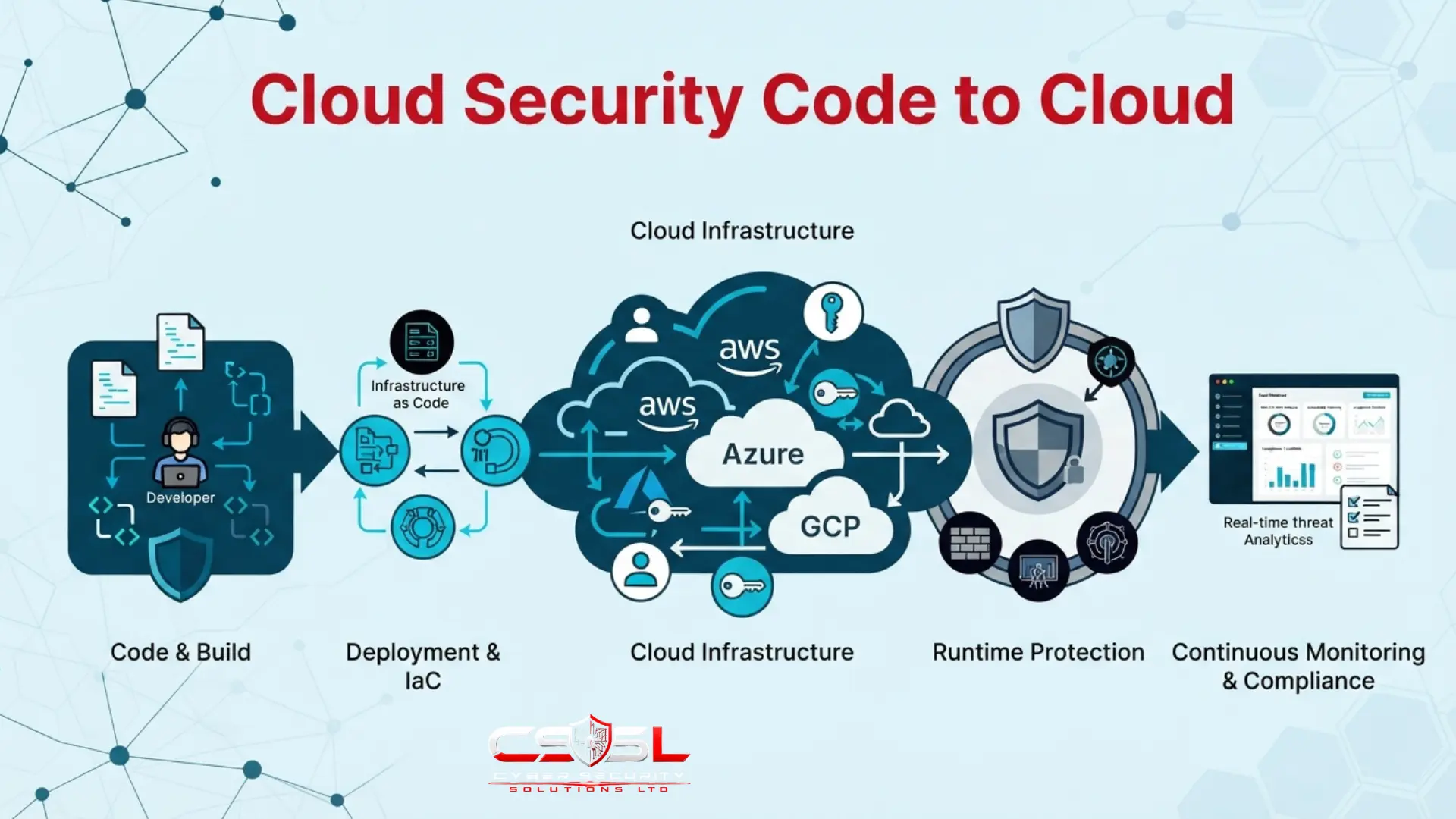
Code to cloud security means applying checks at every distinct stage software passes through on its way to running in production: source code, build, deployment and runtime, rather than treating security as a single check performed only after an application is already live.
| Stage | Check Type | Example Tool | What It Catches |
| Source code | SAST, secrets scanning, IaC scanning | Gitleaks, Checkov | Insecure patterns, leaked credentials, misconfigured templates |
| Build | SCA, image scanning, SBOM, signing | Sigstore, Cosign | Vulnerable dependencies, tampered artefacts |
| Policy enforcement | Policy as Code | OPA, HashiCorp Sentinel | Rule violations across every stage |
| Deploy | DAST, deploy-time gates, admission control | OPA Gatekeeper, Kyverno | Runtime behavior flaws, non-compliant deployments |
| Runtime | CSPM, CWPP, RASP | Covered elsewhere in this series | Live drift, active compromise |
CNAPP was described earlier in this series as the platform category covering this full span. This post is where that span gets walked through stage by stage, showing what specific check applies where and why.
The cost argument underlying this is simple. A vulnerability caught in source code costs a developer minutes to fix before it is ever committed. The same vulnerability discovered in a running production system can mean an incident, a compliance disclosure and a far more expensive remediation effort. This exact stage-by-stage map is what Cyber Security Solutions Ltd walks through first in a pipeline security review.
What Security Checks Happen at the Source Code Stage?
Source-stage checks include SAST, secrets scanning and IaC scanning.
SAST, Static Application Security Testing, scans code directly for insecure patterns like SQL injection risk, without executing the application. It typically runs as a pre-commit hook or automatically on every pull request.
Secrets scanning detects hardcoded API keys, passwords and credentials before they are committed to version control. Once a secret reaches Git history, it stays extractable even after later deletion. Tools like Gitleaks and TruffleHog address this.
IaC scanning checks Terraform, CloudFormation and similar templates for misconfiguration before any infrastructure is provisioned, directly closing the gap CSPM can only catch after deployment, using tools like Checkov, tfsec and Terrascan. A misconfigured storage bucket caught in a Terraform file costs nothing to fix. The same misconfiguration caught by CSPM after deployment means it was live and exploitable for however long it took the posture scan to notice.
What Security Checks Happen at the Build Stage?
Build-stage checks include SCA, container image scanning, SBOM generation and artefact signing.
Software Composition Analysis scans application dependencies and open source libraries for known vulnerabilities, extending the dependency scanning already covered elsewhere in this cluster to the point where a build is assembled.
Container image scanning belongs here too, before an image is pushed to a registry rather than only after. SBOM generation produces a structured Software Bill of Materials for every build, a standard artefact regardless of whether the application is containerized.
Build provenance and artefact signing cryptographically sign build outputs and record how and from what source they were produced, using tooling like Sigstore and Cosign, so anything consuming the artefact later can verify it has not been tampered with between build and deployment.
What Is Policy as Code, and How Does It Enforce Security Automatically?
Policy as Code means expressing security and compliance rules as version-controlled, machine-readable definitions rather than manual guidelines, letting the same rule get enforced automatically at every stage it applies to.
The same underlying policy engine, commonly Open Policy Agent or HashiCorp Sentinel, can evaluate an IaC template at the source stage, a Kubernetes manifest at deploy, and an admission request at runtime, using one consistent rule instead of three separate implementations.
OPA Gatekeeper and Kyverno, already covered as Kubernetes-specific enforcement points, are the deploy-stage expression of this same principle. This is what makes pipeline security genuinely automated rather than a checklist someone has to remember, though this pipeline-embedded automation is a different topic from the broader operational automation covered elsewhere in this series.
What Security Checks Happen at the Deploy Stage?
Deploy-stage checks include DAST, deploy-time policy gates, GitOps security and Kubernetes admission control.
| Testing Type | What It Analyses | When It Runs | Example Finding |
| SAST | Source code, unexecuted | Source stage | Hardcoded SQL injection pattern |
| SCA | Dependencies and libraries | Build stage | Known vulnerable package version |
| IaC scanning | Infrastructure templates | Source or build stage | Publicly exposed storage bucket setting |
| DAST | A running application | Deploy stage | Exploitable input validation flaw |
DAST, Dynamic Application Security Testing, tests a running application, typically in staging, by simulating attacks against it from the outside, catching runtime flaws static analysis structurally cannot see since it never executes the code.
Deploy-time policy gates are the practical enforcement point where a Policy as Code rule can genuinely block a deployment, rather than merely flagging it for later review.
GitOps and deployment credential security matter too, since a compromised CI/CD service account with broad permissions is exactly the over-privileged non-human identity risk already covered in our cloud IAM guide. Kubernetes admission control is where pod security standards actually reject a non-compliant deployment before it is scheduled onto a node.
Why Doesn’t Shift Left Mean You Can Ignore Runtime Protection?
No. Shift left reduces the volume and severity of what reaches production, but no combination of SAST, SCA, IaC scanning and deploy-time gates can catch a zero-day disclosed after deployment, a credential compromised after code was written, or anomalous behavior that only manifests once a workload runs under real traffic.
This is the genuinely common, costly misconception this section exists to correct. Organizations that adopt strong pipeline security often quietly deprioritize runtime protection, mistaking thorough early checks for complete coverage.
It is an easy mistake to make. Pipeline dashboards are green. Scans pass. It feels solved.
It is not, and it was never going to be solved that way. A mature architecture assumes that despite excellent pipeline security, something will eventually reach production that should not have. That is exactly why runtime protection, CSPM drift detection, CWPP monitoring, container runtime protection and RASP, remains necessary once pipeline security is strong, not less necessary.
Shift left reduces what reaches runtime. It does not remove the need to protect runtime once something does. Organizations that quietly deprioritize runtime protection after investing heavily in pipeline security are trading one real risk for a false sense of complete coverage.
What Is Software Supply Chain Security, and Why Does It Matter Now?
Software supply chain security addresses a dependency deliberately compromised by an attacker, a separate, harder problem than ordinary dependency scanning, since the malicious code may not match any known vulnerability signature at all.
SCA catches dependencies with known vulnerabilities, matched against a database of disclosed flaws. A dependency an attacker deliberately compromised at the source is a different problem entirely. A package can pass every scan cleanly and still be malicious, because the compromise happened before any scanner had a signature to check against.
This has become a pressing concern. High-profile incidents involving compromised, widely-trusted packages have shown that a clean scan result proves nothing about whether a dependency was tampered with upstream, only that no known flaw has been catalogued yet.
The SLSA framework, Supply-chain Levels for Software Artifacts, now under the Open Source Security Foundation, gives organizations a structured, checkable way to assess this instead of treating supply chain integrity as a vague aspiration, through graduated levels of assurance rather than a single pass or fail. The artefact signing covered at the build stage is the practical countermeasure, letting a pipeline verify what it deploys genuinely came from the expected build process.
How Do You Avoid Pipeline Security Becoming a Developer Bottleneck?
Security gates that block builds too aggressively or generate excessive false positives train developers to treat pipeline security as an obstacle to route around, not a genuine safeguard.
This is the genuine, underserved problem most pipeline security content skips. Everyone talks about which scanner to add. Almost nobody talks about what happens after, when developers start quietly working around a gate slowing them down for issues that do not actually matter.
Severity-based gating is the first fix. Configure pipelines to hard-block only genuinely critical findings, surfacing lower-severity issues as visible but non-blocking warnings instead. This prevents the all-or-nothing friction that pushes developers toward disabling checks entirely.
Fast feedback loops matter just as much as accuracy. A scan taking twenty minutes gets treated very differently than one returning feedback in under a minute. Scan performance is a genuine adoption factor, not a convenience concern.
Involving developers in policy definition closes the loop. Policies written entirely by a security team with no developer input are more likely to contain impractical rules that get bypassed than policies co-developed with the engineers who work within them daily.
How Does This Differ From DevSecOps as an Organizational Practice?
This post covers the technical, stage-by-stage pipeline mechanics: what scan runs where, what tool enforces what policy. DevSecOps, covered separately in this series, describes the broader organizational and cultural shift required to make security genuinely shared across development, security and operations, rather than solely the security team’s responsibility.
This post answers what scan runs at what stage. The other answers how teams need to work together, and what organizational maturity actually looks like. The tooling here delivers limited value without genuine cross-functional ownership, and the cultural shift lacks substance without the mechanisms walked through here.
How Do You Implement Code to Cloud Security Step by Step?
Implementing this starts with SAST and secrets scanning at source, IaC scanning before provisioning, SCA and image scanning at build, artefact signing, Policy as Code across stages, DAST and deploy-time gates, severity-based gating to avoid bypass, and permanent runtime protection regardless of pipeline maturity.
- Integrate SAST and secrets scanning at the source code stage, running on every pull request rather than as an occasional manual review.
- Add IaC scanning to catch infrastructure misconfiguration before anything is provisioned, reducing what CSPM would otherwise catch after the fact.
- Integrate SCA and container image scanning at the build stage, before artefacts are pushed to any registry.
- Implement artefact signing and provenance tracking to establish supply chain integrity for every build output.
- Define security and compliance rules as Policy as Code using one consistent engine across pipeline stages.
- Add DAST testing against staging and deploy-time policy gates that can genuinely block non-compliant deployments.
- Configure severity-based gating and fast feedback loops to avoid developer bypass behavior.
- Maintain full runtime protection regardless of pipeline maturity, as a permanent layer, not something pipeline security eventually replaces.
Conclusion
Cloud security code to cloud is not a single tool or a single scan. It is a sequence, source, build, deploy and runtime, each catching what the stage before it could not. Pipeline security earns its value by making runtime incidents rarer, not by making runtime protection optional. To see which stages of your development lifecycle currently have coverage and where the gaps sit, visit cybersecuritysolutionsltd.com for a free pipeline security review from Cyber Security Solutions Ltd.
FAQs
SAST scans source code directly for insecure patterns without executing it, run early at the source stage. DAST tests a running application by simulating actual attacks against it, run later at deploy. They catch different flaw types and are complementary, not interchangeable.
No. Shift left reduces what reaches production, but no pipeline check can catch a zero-day disclosed after deployment or a credential compromised after code was written. Runtime protection, covered across CSPM, CWPP and container security, stays a necessary, permanent layer regardless of pipeline maturity.
Ordinary dependency scanning catches known vulnerabilities matched against a database. A deliberately compromised dependency may contain malicious code matching no known signature at all, since the compromise happened at the source. This is what software supply chain security addresses, through provenance and artefact signing.
It means writing security rules as version-controlled, machine-readable definitions instead of manual guidelines, so the same rule gets enforced automatically and consistently at every pipeline stage it applies to, rather than depending on someone remembering to check it by hand.
Hard-block only genuinely critical findings while surfacing lower-severity issues as non-blocking warnings, keep scan feedback fast, and involve developers in defining the policies themselves. Gates that block too aggressively or return excessive false positives train developers to route around them.
No. Code to cloud security is the technical, stage-by-stage pipeline mechanics, what scan runs where. DevSecOps is the broader organizational and cultural shift making security a shared responsibility across teams. Both matter, and each tends to fail without the other.