What Is CWPP? Cloud Workload Protection Platform Guide
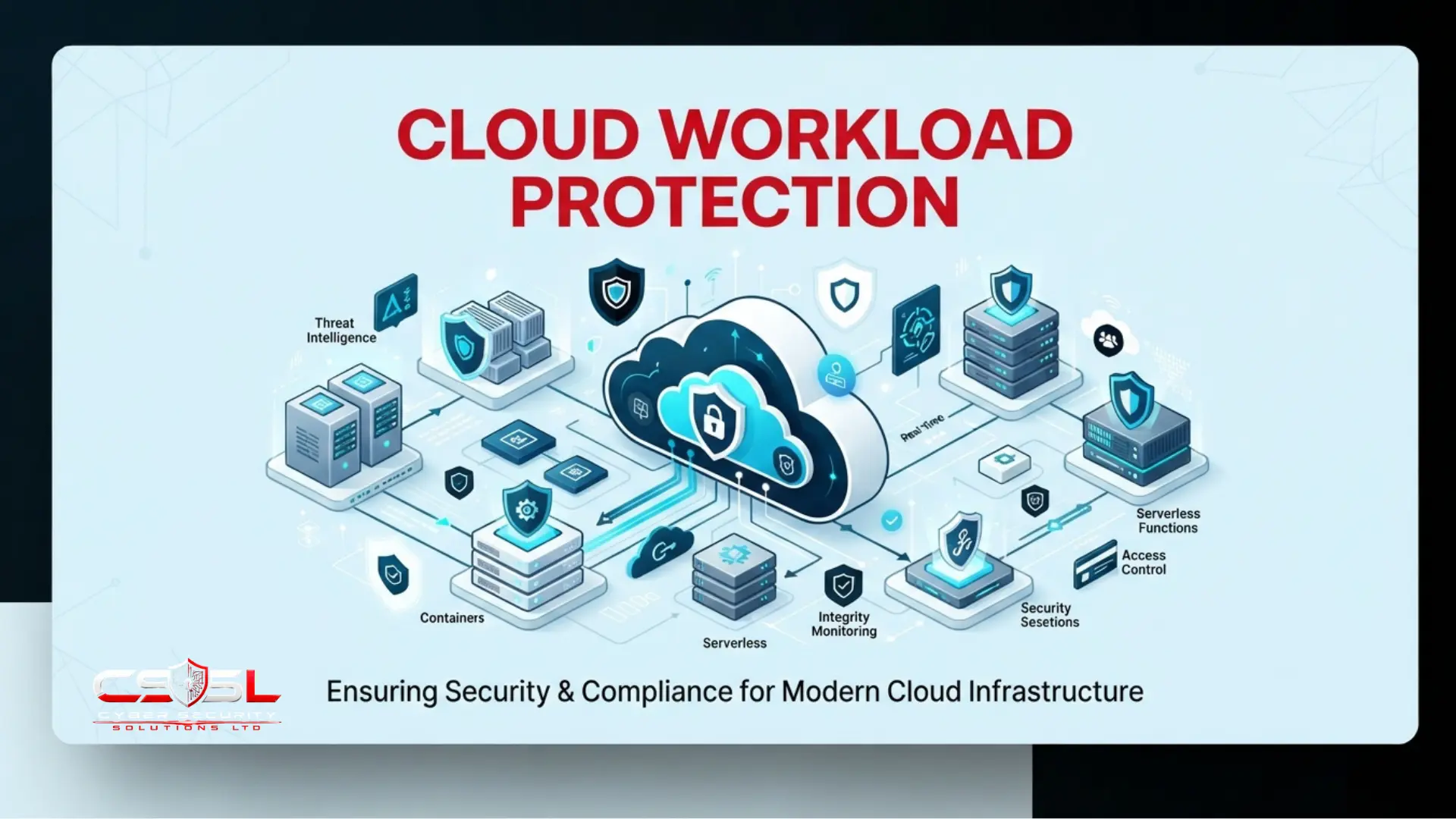
CWPP protects the workloads running inside your cloud environment, virtual machines, containers and serverless functions, by scanning them for vulnerabilities and watching them while they run. If a container image scan came back clean and something malicious still happened after it started running, this is exactly the gap CWPP closes.
What Is CWPP?
A Cloud Workload Protection Platform, CWPP, protects individual running workloads, virtual machines, containers and serverless functions, through vulnerability scanning and runtime threat detection, rather than assessing the configuration of the infrastructure those workloads sit inside.
Gartner defined CWPP as a standalone market years before CNAPP existed, back when workload-level protection was already recognized as a distinct discipline from infrastructure configuration scanning.
A workload can sit inside a perfectly configured cloud environment and still get actively compromised, through a vulnerable software package, a malicious process, or an exploited application flaw. None of that is visible to a configuration-focused tool. What is CWPP not, then? It does not check whether a storage bucket is public or an identity holds excessive permissions either. Those are CSPM’s and CIEM’s jobs.
How Does CWPP Relate to CNAPP and CSPM?
CWPP is not a rival to CNAPP, covered fully in our CNAPP guide, but one of its core components alongside CSPM.
| Criteria | CSPM | CWPP |
| What it assesses | Infrastructure and resource configuration | The workload itself, from inside |
| Timing | Periodic, point-in-time checks | Continuous, during execution |
| Agent use | Typically agentless | Often agent-based for depth |
| Primary output | Misconfiguration findings | Vulnerabilities and active threats |
| Related post | What Is CSPM? | This guide |
CSPM asks whether a resource is configured correctly, a question answerable from the outside without ever looking inside the workload. CWPP asks something different: is this workload itself currently safe to run, a question that requires looking inside, and for runtime detection specifically, watching it while it operates.
What Workload Types Does CWPP Protect?
CWPP protects three workload types, and each needs a genuinely different approach.
| Workload Type | Primary Protection Method | Agent Feasibility | Key Risk Addressed |
| Virtual machines | OS scanning, process monitoring | High, well established | Compromised processes, unpatched packages |
| Containers | Image scanning plus runtime monitoring | Moderate, host-level | Exploits after a clean image starts running |
| Serverless functions | Dependency scanning, IAM scoping | Low, largely impractical | Over-privileged roles, insecure dependencies |
Virtual machines get the most established coverage, closely resembling traditional endpoint detection applied to cloud-hosted VMs: OS-level scanning, file integrity monitoring, process behavior analysis. Containers need protection at two stages, scanning the image before deployment and monitoring the running container afterward, since a clean image can still be exploited once live. Serverless functions need an entirely different approach, covered below, since traditional persistent monitoring is largely impossible given execution windows measured in milliseconds. A vendor claiming uniform workload protection without specifying how it handles each model deserves direct questioning.
How Does CWPP Scan Workloads for Vulnerabilities?
CWPP scans through OS and package-level vulnerability scanning against the National Vulnerability Database for VMs, container image scanning at each layer before and after deployment, and software composition analysis for application dependencies, critical for serverless where code and dependencies are almost the entire attack surface.
Here is the part most vendor content glosses over. A raw vulnerability scan on any moderately complex environment routinely surfaces hundreds or thousands of individual CVEs. The overwhelming majority are not actually exploitable in the specific context found.
Mature CWPP tools prioritize findings differently. Instead of an undifferentiated severity-only list, they ask whether the vulnerable code path is genuinely reachable and whether the workload is actually exposed. A critical CVE on a package never called in your specific code path matters far less than a medium severity issue sitting on an internet-facing service.
This reachability-first approach is the first thing Cyber Security Solutions Ltd checks when a client’s vulnerability backlog looks unmanageable. Teams drowning in thousands of raw findings usually are not lacking a scanner. They are lacking prioritization. A tool that surfaces every CVE with equal urgency is not actually helping remediation focus anywhere. Triage quality matters as much as scan breadth.
What Does Runtime Protection Detect, and How?
Runtime protection detects through several layers: process behavior monitoring against a normal baseline, network connection monitoring for unusual destinations, file integrity monitoring for unauthorized changes, system call monitoring beneath both, and workload drift detection.
Process behavior monitoring watches which processes execute and flags patterns matching known malicious behavior or deviating from that workload’s established baseline. Network connection monitoring watches outbound and inbound connections, flagging communication with known malicious infrastructure or destinations inconsistent with the workload’s expected function.
File integrity monitoring detects unauthorized changes to critical system files, a classic indicator of compromise that predates cloud computing but remains directly relevant here. System call monitoring, for Linux-based container and VM workloads specifically, watches at a level beneath what file or network monitoring alone can see.
Workload drift detection deserves its own explanation, since it gets confused with something else entirely. This is not the configuration drift covered in our CSPM guide. Workload drift means a running container or VM’s actual content diverging from the image or template it was originally deployed from, a strong signal something got modified after deployment without authorization.
All of this depends on watching a workload while it actually executes, not periodically querying its configuration state. That is why runtime detection has historically needed closer, more direct access to the running system than agentless API polling alone can typically provide.
Do You Need an Agent for CWPP to Work?
For virtual machines and longer-lived containers, a lightweight agent gives real-time observation of process execution, network connections and system calls that agentless, snapshot-based scanning cannot fully replicate.
Most mature CWPP deployments use a hybrid approach: agentless vulnerability scanning applied broadly across the entire estate for complete coverage, combined with lightweight runtime agents deployed selectively to hosts that genuinely justify the overhead, typically internet-facing or otherwise high-value systems.
This logic works reasonably well for VMs and sufficiently long-lived containers. It breaks down entirely for one of the three workload types CWPP is meant to protect.
Why Does Serverless Break the Traditional Agent Model Completely?
A serverless function may execute for a few hundred milliseconds to a few seconds before its execution environment gets torn down entirely. There is often no meaningful window for a persistent agent to install, initialize and observe before the function has already finished and vanished.
This is a genuine architectural limit, not simply another trade-off. The agentless-versus-agent choice for VMs and containers is about weighing depth against overhead, and both options remain viable either way. Serverless removes persistent agent-based runtime monitoring as a practical option entirely, which has nothing to do with preference.
Protection shifts almost entirely to what can be assessed before and around execution rather than during it. Rigorous dependency and code scanning before deployment, the software composition analysis covered above, catches vulnerable packages before the function ever runs. Strict IAM permission scoping for the function’s execution role matters enormously, connecting directly back to the least-privilege discipline covered in our cloud IAM guide. Monitoring invocation logs and any external calls the function makes for anomalous patterns afterward replaces live in-process observation.
The OWASP Serverless Top 10 catalogues the risk categories most specific to this architecture, including over-privileged function permissions and insecure dependencies, both mapping directly to the approach above.
Here is the specific question worth asking any CWPP vendor claiming full runtime protection across all workload types. Ask directly how that claim applies to serverless. A credible answer describes pre-execution and permission-based controls. An answer implying live in-process monitoring identical to their VM or container capability is not describing serverless honestly.
What Are the Leading Cloud Workload Security Solutions in 2026?
Leading cloud workload security solutions in 2026 include Wiz, Palo Alto Networks through Prisma Cloud, CrowdStrike Falcon Cloud Security, Orca Security and Lacework, most delivered as a CNAPP module rather than a pure standalone product.
Providers with strong traditional EDR backgrounds have extended that same behavioral detection expertise into cloud-hosted VM and container workloads too, a natural extension of on-premise endpoint protection.
When evaluating a solution, demand explicit, workload-type-specific capability for VMs, containers and serverless individually, not one blended marketing claim. Check whether vulnerability prioritization addresses reachability and exploitability or just lists raw CVE counts, and how cleanly runtime findings correlate with CSPM and CIEM data as part of a CNAPP platform.
What Are the Benefits and Limitations of CWPP?
CWPP detects active compromise and exploitation that configuration-focused tools structurally cannot see. It prioritizes the vulnerability volume every complex environment accumulates down to what is genuinely reachable, and feeds the workload-level input that powers attack path correlation within a broader CNAPP platform.
Coverage inconsistency is the first real limitation. VM and container coverage can run considerably deeper than serverless coverage under the same product, making blanket full workload protection claims worth scrutinizing rather than accepting at face value.
Agent deployment overhead applies wherever CWPP relies on agents for its deepest capability, the same operational friction already covered for agent-based tools generally: installation coordination, potential performance impact, incomplete rollout.
Alert volume without prioritization is the third limitation. Raw findings across a large workload estate can be substantial, meaning a tool’s prioritization logic matters as much as its raw detection breadth.
How Do You Implement CWPP Step by Step?
Implementing CWPP starts with inventorying workloads by type, then selecting a tool verified per workload type, deploying agentless scanning broadly first, adding agents only to high-value systems, prioritizing dependency scanning and IAM scoping for serverless, configuring reachability-based triage, and verifying correlation with CSPM and CIEM if CNAPP-integrated.
- Inventory every workload by type, virtual machines, containers and serverless functions, since protection strategy differs by type.
- Select a CWPP tool or CNAPP module, verifying its specific, stated capability separately for each workload type you run.
- Deploy agentless vulnerability scanning broadly across the full estate first, establishing complete coverage before any agent-based deployment.
- Identify your genuinely high-value, high-risk workloads and deploy runtime agents selectively to those specific VMs and containers.
- For serverless functions specifically, prioritize dependency scanning and strict IAM permission scoping over any expectation of live monitoring.
- Configure vulnerability findings to prioritize by reachability and exploitability rather than raw severity score alone.
- Where deployed as part of a CNAPP platform, verify runtime and vulnerability findings genuinely correlate with CSPM and CIEM data.
Conclusion
So what is CWPP, at its core? Not one uniform capability applied evenly across every workload. Virtual machines, containers and serverless functions each need a genuinely different protection approach, and any vendor pitch that glosses over that difference deserves a harder look. The reachability-first triage and the serverless-specific controls covered here are what separate a usable CWPP deployment from an overwhelming pile of alerts.
FAQs
Not quite. CWPP includes runtime detection similar in spirit to traditional endpoint protection, but also covers vulnerability scanning, container image scanning and serverless-specific controls like IAM scoping. It protects three fundamentally different execution models, not just one endpoint type the way antivirus does.
Yes, they answer different questions. CSPM checks whether a resource is configured correctly from the outside. CWPP checks whether the workload itself is currently safe to run, detecting active compromise or exploited vulnerabilities that a perfectly configured environment can still contain undetected.
For VMs and longer-lived containers, agents provide real-time observation agentless scanning cannot fully replicate, though most mature deployments combine both approaches. For serverless functions specifically, persistent agents are not practically possible at all, for the architectural reasons covered in detail above.
Protection shifts to what can be checked before and around execution: dependency and code scanning before deployment, strict IAM permission scoping for the function’s role, and monitoring invocation logs for anomalous patterns afterward, rather than live monitoring during the brief execution window.
Raw scans routinely surface hundreds or thousands of CVEs, most not actually exploitable in your specific environment. Mature CWPP tools prioritize by whether the vulnerable code path is genuinely reachable and the workload actually exposed, rather than presenting an undifferentiated severity-only list.
Yes. A clean pre-deployment scan only confirms the image had no known vulnerabilities at that specific moment. A container can still be exploited once running, through a new disclosure or malicious behavior, which is exactly why runtime monitoring after deployment matters too.