12 Computer Virus Examples That Changed Cyber Security Forever
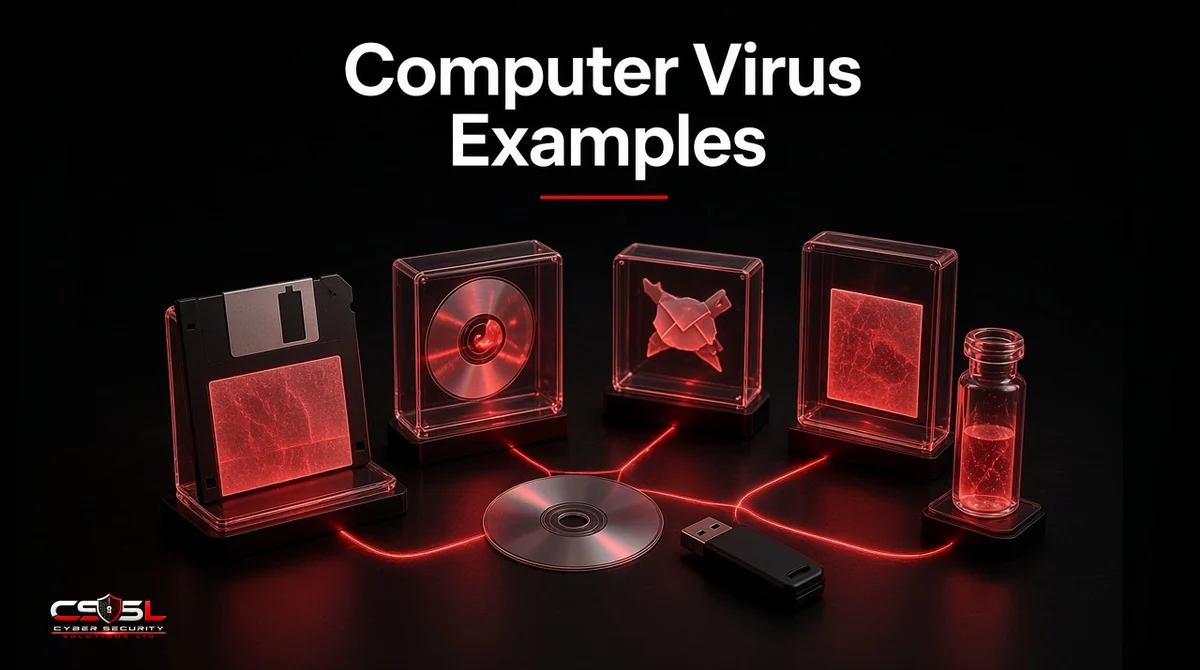
Famous computer virus examples include Elk Cloner (1982), Brain (1986), Melissa (1999), ILOVEYOU (2000), Mydoom (2004), Stuxnet (2010) and WannaCry (2017). Each forced a change in how we defend computers, from the first antivirus tools to email filtering, fast patching and offline backups. Many damage figures quoted online are guesses, so this list uses official numbers where they exist and labels the rest as estimates.
Virus, Worm or Ransomware?
Strictly, a virus attaches to a file or program and needs a person to run it, while a worm spreads on its own across networks. Several entries below, including Morris, Code Red, Slammer, Conficker and WannaCry, are worms. People search for them as “viruses”, so we keep them here and note the type.
12 Computer Virus Examples That Changed Cyber Security
The list runs in date order, so you can see how threats evolved.
1. Elk Cloner (1982): The First Virus Spread in the Wild
Written by 15-year-old Rich Skrenta, Elk Cloner infected Apple II floppy disks and displayed a short poem. It caused little harm, but it is widely cited as the first virus to spread outside a lab. Lesson: removable media can carry code between machines.
2. Brain (1986): The First IBM PC Virus
Created by brothers Basit and Amjad Farooq Alvi in Lahore, Pakistan, Brain infected the boot sector of floppy disks on MS-DOS PCs. It spread worldwide through shared disks and prompted some of the first antivirus products.
3. Morris Worm (1988): The Internet’s First Major Outbreak
On November 2, 1988, Robert Morris released a worm that, according to the FBI, hit about 6,000 of the roughly 60,000 computers then on the internet within 24 hours. It led to the first conviction under the US Computer Fraud and Abuse Act and the creation of the CERT Coordination Center at Carnegie Mellon.
4. Michelangelo (1992): The Virus Scare That Sold Antivirus
This boot-sector virus was set to wipe disks on March 6. Media predicted huge numbers of infections, but actual cases were far fewer. Its real legacy was public awareness and a surge in antivirus sales.
5. Melissa (1999): Macro Viruses Hit Email
Melissa hid in a Word document and mailed itself to the first 50 contacts in Outlook. The FBI and Department of Justice reported that it disrupted about one million email accounts, overloaded servers at more than 300 organizations, and caused an estimated $80 million in damage. Its author was sentenced in 2002.
6. ILOVEYOU (2000): Social Engineering at Global Scale
A “love letter” attachment from a known contact tricked millions into opening a script that overwrote files and resent itself. Industry estimates put damage in the billions of dollars, though no official figure exists. It showed that human curiosity beats technical defenses.
7. Code Red (2001): Web Servers Under Attack
Code Red exploited a flaw in Microsoft’s IIS web server. Researchers at CAIDA measured more than 359,000 infected hosts in under 14 hours on July 19, 2001. It also tried to flood the White House website.
8. SQL Slammer (2003): The Fastest Worm on Record
Slammer attacked Microsoft SQL Server using a flaw patched about six months earlier. CAIDA researchers found it infected roughly 90 percent of vulnerable hosts within ten minutes, disrupting ATMs and flight systems. Lesson: an available patch is worthless if nobody installs it.
9. Mydoom (2004): The Fastest-Spreading Email Worm
Mydoom spread through email attachments and opened backdoors on infected PCs, which were used for denial-of-service attacks against the SCO Group. Damage figures widely quoted for it are industry estimates rather than verified totals.
10. Conficker (2008): Millions of Unpatched PCs
Conficker exploited a Windows flaw Microsoft fixed in bulletin MS08-067, plus weak passwords and USB drives. Estimates of infections ran into the millions. Microsoft offered a $250,000 reward for information on its authors, and an industry working group formed to contain it.
11. Stuxnet (2010): Malware as a Weapon
Stuxnet spread through USB drives and targeted Siemens controllers at Iran’s Natanz uranium enrichment site. It is widely regarded as the first malware to cause physical damage. Figures for destroyed centrifuges are estimates from outside researchers, and no government has officially claimed it.
12. WannaCry (2017): Ransomware Worm Hits the NHS
On May 12, 2017, WannaCry used the EternalBlue exploit to spread across unpatched Windows systems, encrypting files and demanding ransom. Europol reported more than 200,000 victims in 150 countries. The UK National Audit Office found at least 81 NHS trusts were affected, and the Department of Health and Social Care later estimated the cost to the NHS at £92 million. The US and UK attributed it to North Korea in December 2017.
Honorable Mentions: CryptoLocker and NotPetya
CryptoLocker (2013) popularized modern ransomware and was disrupted in the 2014 Gameover ZeuS takedown led by the US Department of Justice. NotPetya (2017) posed as ransomware but destroyed data; in February 2018 the White House called it the most destructive and costly cyberattack in history.
Computer Virus Examples Compared
| Name | Year | Type | Spread method | Impact basis |
|---|---|---|---|---|
| Elk Cloner | 1982 | Boot-sector virus | Floppy disks | Qualitative |
| Brain | 1986 | Boot-sector virus | Floppy disks | Qualitative |
| Morris | 1988 | Worm | Network flaws | FBI figure |
| Michelangelo | 1992 | Boot-sector virus | Floppy disks | Qualitative |
| Melissa | 1999 | Macro virus | FBI/DOJ figure | |
| ILOVEYOU | 2000 | Script worm | Industry estimate | |
| Code Red | 2001 | Worm | IIS flaw | CAIDA measurement |
| SQL Slammer | 2003 | Worm | SQL Server flaw | CAIDA measurement |
| Mydoom | 2004 | Email worm | Industry estimate | |
| Conficker | 2008 | Worm | Windows flaw, USB | Estimates vary |
| Stuxnet | 2010 | Worm, ICS sabotage | USB, network | Research estimates |
| WannaCry | 2017 | Ransomware worm | SMB flaw | Europol, UK NAO |
What These Computer Viruses Taught Cyber Security
Read together, these cases point to four lessons that still hold.
Patch Fast
Code Red, Slammer, Conficker and WannaCry all used flaws with patches already available. In SMB reviews we still find internet-facing systems months behind. A sensible threshold: critical patches on internet-facing systems within days, and everywhere else within a month.
Filter Email and Disable Macros
Melissa, ILOVEYOU and Mydoom spread through attachments. Blocking macros from the internet and filtering executable attachments removes most of that risk.
Segment Networks and Protect OT
Stuxnet and NotPetya spread through flat networks into critical systems. Segmentation limits how far one infection travels.
Keep Offline Backups
CryptoLocker and WannaCry made backups a frontline control. Keep at least one copy offline or immutable, and test restoring it.
Picture an illustrative 30-person firm in 2017 with one unpatched file server and backups on a mapped drive. A WannaCry-style worm encrypts both. The same firm with patching and an offline copy loses a day, not the business. That difference is the whole history of these viruses in one scenario.
Are Computer Viruses Still a Threat Today?
Classic file-infecting viruses are rare now. The threat has shifted to ransomware, information stealers and worms that exploit unpatched services, but the delivery routes (email, removable media and unpatched systems) are the same ones these early examples used.
How to Protect Your Business From Computer Viruses
Use modern endpoint protection with detection and response, patch on a schedule, filter email, block macros, segment networks, remove local admin rights and keep tested offline backups. Train staff to report suspicious attachments quickly.
FAQs
Elk Cloner (1982) is widely cited as the first to spread in the wild. Earlier experiments, such as Creeper in the early 1970s, stayed in research networks.
The White House described NotPetya as the most destructive and costly cyberattack in history. Most other "most destructive" claims rely on industry estimates.
Brain, Michelangelo, Melissa, ILOVEYOU and Mydoom are well-known examples.
It is a ransomware worm. It spread on its own across networks using the EternalBlue exploit.
Classic viruses rarely do, but phones face malicious apps, spyware and phishing.
Not alone. Combine endpoint detection and response with patching, email filtering and backups.
Lessons That Outlived the Malware
Every one of these computer virus examples exploited a gap that basic hygiene closes: patching, email filtering, segmentation and backups. If you want to check how your business would stand up to the next outbreak, Cyber Security Solutions Ltd offers a free, no-obligation assessment through our contact page.