
What Is Identity Theft in Cyber Security? How to Protect Your Organisation
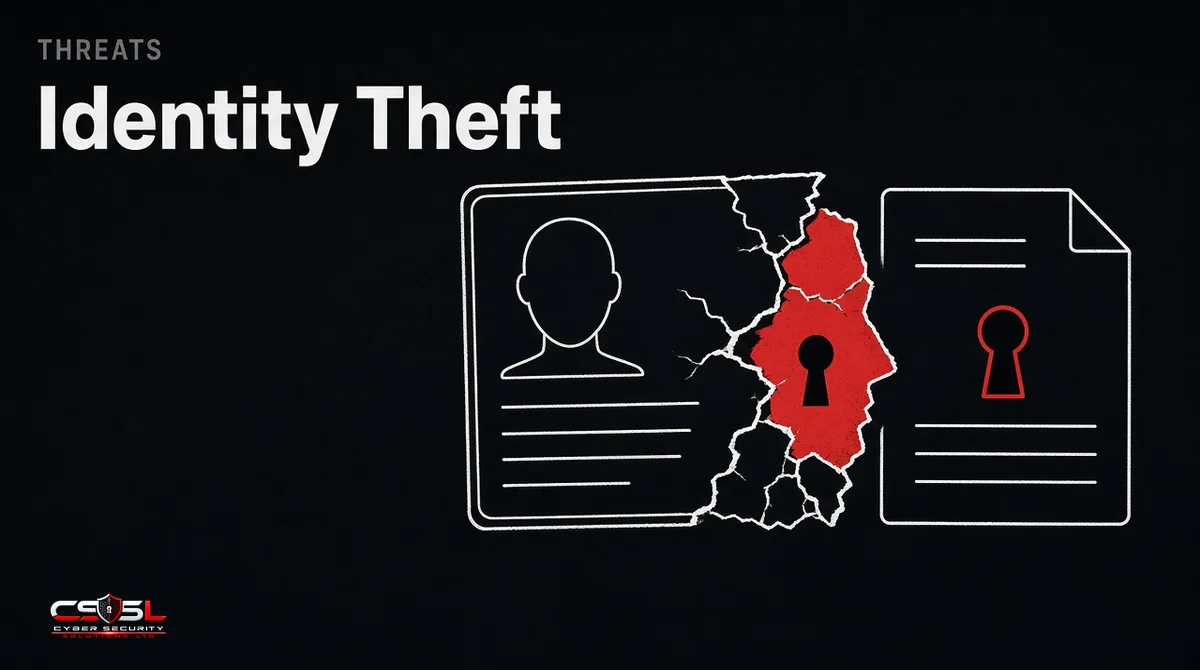
What is identity theft in cyber security? Picture someone using your existing credit card, and you’d be picturing the wrong crime. Ninety-one percent of credit card identity theft in 2025 involved criminals opening brand new accounts in someone else’s name, not stealing an existing one.
What is identity theft in cyber security?
Identity theft in cyber security is the unauthorized use of someone’s personal identifying information, name, Social Security number, financial details, or account credentials, to commit fraud, ranging from opening new accounts to hijacking existing ones or fabricating an identity entirely.
The scale here is genuinely enormous and still climbing: the FTC received over 1.1 million identity theft reports in 2024, up 9.5% year over year, with 2025 running well ahead of that pace. Total identity fraud and scam losses reached $47 billion in a recent year according to Javelin Strategy, while data breaches hit a record 3,322 compromises in 2025, a 79% jump over five years, feeding the raw material this entire fraud economy runs on.
Four distinct types: new account, takeover, synthetic, and first-party fraud
Identity theft splits into four genuinely distinct categories: new account fraud, opening credit in someone’s name; account takeover, hijacking an existing account; synthetic identity fraud, fabricating a composite identity from real and fake data; and first-party fraud, someone misusing their own genuine identity to defraud a lender.
| TypeMechanism2025 Loss Data | ||
|---|---|---|
| New account fraud | Opens credit in victim’s real name | $7 billion, 5.4M victims |
| Account takeover | Hijacks an existing, already-funded account | $15 billion+, 6M victims |
| Synthetic identity | Fabricated identity from real + fake data | $30-35 billion annually |
| First-party fraud | Own identity, no intent to repay | Distinct, self-inflicted category |
Account takeover is the costliest crime per victim specifically: roughly $2,500 lost per victim, nearly double the $1,296 average lost per new-account fraud victim, since a criminal inside an account you’ve already funded faces a ceiling set by your balance, not a lender’s credit decision. New account fraud remains far more common in raw volume, but account takeover extracts more value per successful attack.
Synthetic identity fraud: how a “Frankenstein identity” builds credit before it strikes
A “Frankenstein identity” combines a real, typically stolen Social Security number, often taken from a child, elderly person, or someone with limited credit history, with completely fabricated personal details, a made-up name, address, and date of birth, creating a composite identity that passes basic verification checks.
This is what makes synthetic fraud uniquely damaging compared to every other identity theft category: the fraudster builds credit patiently over months or years, paying bills on time specifically to raise available credit limits, before executing a “bust-out,” maxing every available credit line simultaneously and disappearing entirely. Victims of the underlying stolen SSN often don’t discover anything happened until years later, when the number surfaces unexpectedly on a credit report. Synthetic identity fraud now accounts for roughly 20% of all fraud losses, with US economic exposure estimated between $30 and $35 billion annually, and the average confirmed synthetic fraud case costs $15,000, a figure consistent across both consumer lending and auto financing.
What is phishing, and how does it feed identity theft directly?
What is phishing: fraudulent communication designed to trick recipients into revealing credentials or personal information, and it remains one of the most direct pipelines into identity theft, with the FTC receiving over 371,000 phishing-related reports in a recent year specifically tied to credit card information theft.
Phishing’s contact method genuinely changes the financial outcome: email-based fraud contact produces a median loss of $600 per victim, while phone-based contact, vishing specifically, produces median losses of $1,500, two and a half times higher. Vishing attacks surged 442% in a recent six-month period, driven heavily by AI voice cloning tools requiring just seconds of audio to convincingly impersonate a trusted contact, closing the gap between a suspicious email most people now recognize and a phone call that still carries inherent, often misplaced trust.
What is social engineering, and how does it target your organisation specifically?
What is social engineering in cyber security: the psychological manipulation of people into divulging confidential information or performing actions that compromise security, and it targets organizations specifically by exploiting trust in colleagues, vendors, and authority figures rather than technical vulnerabilities.
Business email compromise remains the clearest organizational-scale example, a fraudster impersonating an executive or vendor to trick an employee into an unauthorized transfer, and named enterprise breaches at MGM, Caesars, and Snowflake all began with exactly this kind of social manipulation aimed at a help desk rather than a technical exploit. Our guide comparing phishing versus vishing versus smishing breaks down the specific channel differences employees need to recognize, since social engineering increasingly moves across multiple channels within a single coordinated attack rather than staying confined to one.
Account takeover: how one compromised account becomes a platform for more fraud
Account takeover fraud losses exceeded $15 billion in 2025 alone, affecting 6 million victims, up 18% year over year, and the danger compounds specifically because a single compromised account rarely stays contained, it becomes a launching point for further fraud against connected accounts, contacts, and financial relationships.
Over 70% of identity theft victims report experiencing some form of digital account takeover, spanning online banking and social media accounts alike, showing how far this specific fraud type has spread beyond financial services into everyday digital identity generally. The compounding risk matters most for businesses specifically: a takeover of one employee’s email account frequently becomes the platform for business email compromise against that employee’s entire contact network, turning a single credential theft into an organization-wide exposure within hours.
What is a security breach, and how does it connect back to identity theft?
What is a security breach: an incident where unauthorized parties gain access to systems or data, and breaches function as the primary raw material supply feeding identity theft at scale, since the personal information exposed in one breach routinely resurfaces in credential stuffing and identity fraud attempts against entirely different organizations months or years later.
The connection isn’t hypothetical, it’s structural: 2025 set a record 3,322 data compromises, and that exposed information doesn’t stay contained to the breached organization, it circulates through criminal marketplaces and feeds directly into new account fraud, account takeover attempts, and synthetic identity construction elsewhere. This is precisely why breach notification matters beyond regulatory compliance, every unreported or delayed breach notification extends the window during which exposed data remains usable for fraud nobody’s watching for yet.
Why AI and deepfakes are industrialising identity fraud
AI is fundamentally industrializing identity fraud at scale: generative tools now let fraudsters create large numbers of synthetic identities simultaneously, automate enrollment across multiple financial platforms in parallel, and use deepfake images and video specifically to defeat biometric and liveness verification checks that were, until recently, considered a reliable defense.
Image-to-video generation technology has grown over 1,000% year over year, directly eroding the assumption that a live video check reliably proves a genuine human is present, and 64% of fraud industry respondents now cite AI and deepfakes as a top fraud threat specifically. This shift means identity verification methods that worked reliably even two years ago, a selfie check, a brief video call, can no longer be trusted as a standalone control, since the same technology producing convincing deepfake fraud, as seen in the $25 million Arup case, applies with equal effectiveness against consumer-facing identity verification systems.
Identity theft prevention: layered defenses, not a single control
Effective identity theft prevention requires layered defenses matched to each fraud type specifically: a credit freeze counters new account fraud, unique passwords with MFA counter account takeover, and freezing a child’s credit specifically counters the synthetic identity fraud pattern that targets exactly those thin-file, low-scrutiny profiles.
No single control addresses every fraud category, which is precisely why treating identity theft prevention as one unified checkbox consistently fails. Adaptive risk-based authentication adds a genuinely valuable additional layer here, dynamically requiring stronger verification when a login attempt shows unusual signals, an unfamiliar device, an impossible travel pattern, rather than applying identical friction to every access attempt regardless of risk, reducing both fraud losses and unnecessary friction for genuinely legitimate users simultaneously.
A realistic protection plan for a business without a dedicated fraud team
A realistic plan prioritizes three actions: enforce MFA and unique credentials specifically for any account with financial or administrative access, route high-value transaction verification through a separate channel from the request itself, and monitor for the specific account takeover patterns, unusual login geography, device changes, that precede most organizational fraud.
None of these require a dedicated fraud team or specialized tooling to start, they require applying the same layered logic individual consumers use against personal identity theft to your organization’s own most exposed accounts first. Cyber Security Solutions Ltd helps businesses build exactly this prioritized defense, since the organizations that succeed consistently protect their highest-value accounts first rather than attempting uniform protection everywhere simultaneously.
FAQs
Identity theft is the unauthorized use of someone's personal identifying information to commit fraud, ranging from opening new accounts to hijacking existing ones. The FTC received over 1.1 million reports in a recent year, with total fraud losses reaching tens of billions annually.
The four types are new account fraud, opening credit in someone's name; account takeover, hijacking an existing account; synthetic identity fraud, fabricating a composite identity; and first-party fraud, someone misusing their own identity with no intent to repay a lender.
Synthetic identity fraud combines a real, often stolen Social Security number with fabricated personal details to create a "Frankenstein identity." The fraudster builds credit slowly, then "busts out," maxing all available credit lines before disappearing entirely.
Phishing is fraudulent communication designed to trick recipients into revealing credentials or personal information. Phone-based phishing, vishing, produces median losses of $1,500 per victim, two and a half times higher than email-based phishing's $600 median loss.
Account takeover hijacks an existing, already-funded account and costs victims roughly $2,500 on average. New account fraud opens credit in someone's name and costs about $1,296 per victim, making account takeover the more financially damaging crime per incident.
AI lets fraudsters create synthetic identities at scale and generate deepfake images and video that defeat biometric verification checks. Image-to-video generation technology has grown over 1,000% year over year, undermining assumptions that live video checks reliably confirm a real person.
No single step covers every fraud type. A credit freeze stops new account fraud, unique passwords with MFA stop account takeover, and freezing a child's credit specifically counters synthetic identity fraud, since layered defenses matched to each fraud type outperform any single control.



One Comment