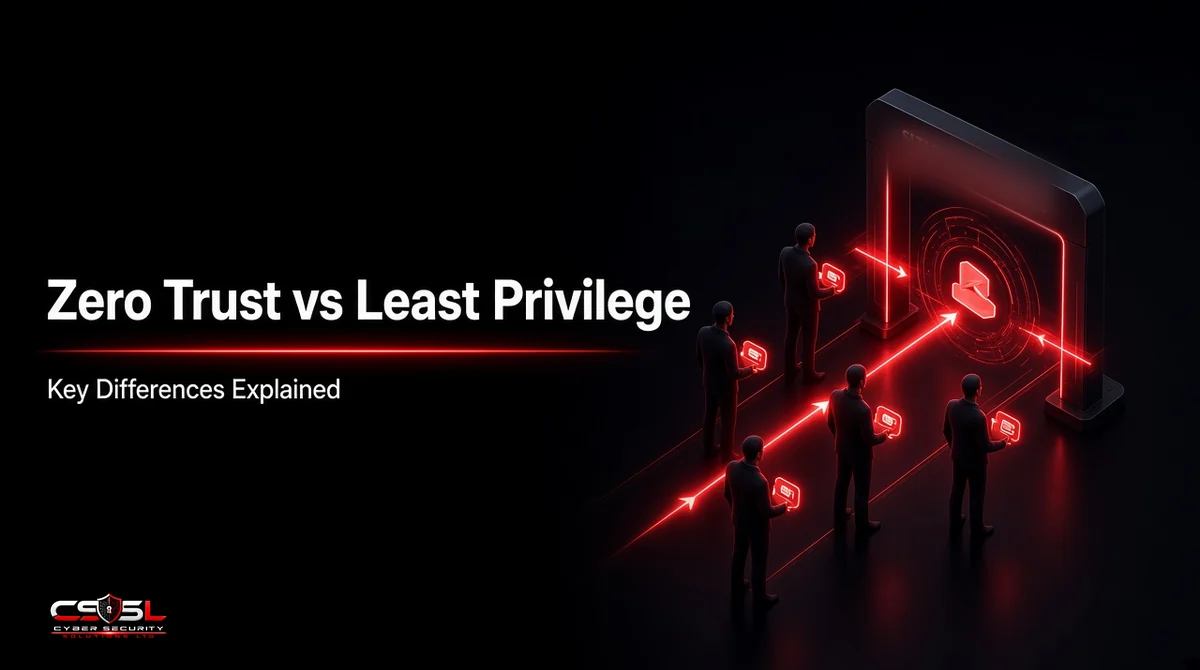
Zero Trust vs Least Privilege: Key Differences Explained
Think of an office building. Zero trust is the security desk that checks your badge at every door, every time. Least privilege decides which doors your badge opens in the first place. The zero trust vs least privilege question is not a choice between rivals: one is the model, the other is a rule inside it.
Zero Trust vs Least Privilege: What Is the Difference?
Zero trust is a security model that assumes no user, device or network is trusted by default and verifies every access request continuously. Least privilege is a principle that gives each identity only the minimum access needed for its task, for only as long as needed. Least privilege is one of the rules zero trust enforces.
What Is Zero Trust? (Quick Recap)
Zero trust replaces “trust anything inside the network” with “verify every request.” NIST SP 800-207 (2020) describes it as an approach where access decisions are made per request, based on identity, device health and context, and enforced as close to the resource as possible.
What Is the Principle of Least Privilege? (Quick Recap)
Least privilege means users, applications and services get only the permissions their job requires, and nothing more. A payroll clerk can open payroll records but not change firewall settings; a backup service can read files but not delete user accounts.
Zero Trust vs Least Privilege: Comparison Table
| Zero trust | Least privilege | |
|---|---|---|
| What it is | A security model and architecture | An access control principle |
| Main question | Should this request be allowed right now? | How much access should this identity have? |
| Scope | Users, devices, networks, apps and data | Permissions and entitlements |
| Decision timing | Every request, continuously | Mainly when access is granted or reviewed |
| Typical tools | Identity provider, MFA, ZTNA, device posture, microsegmentation, monitoring | Role design, access reviews, PAM, just-in-time access |
| Effort | Multi-year program | Can start immediately |
5 Key Differences Between Zero Trust and Least Privilege
1. Scope: Security Model vs Access Principle
Zero trust is an overall strategy that covers how users, devices and networks connect. Least privilege is narrower: it governs the size of each permission.
2. What Gets Verified: Every Request vs Permission Level
Zero trust checks who is asking, from what device, in what context, every time. Least privilege checks whether the permission itself is the smallest that works.
3. Static vs Continuous, Context-Aware Decisions
Least privilege on its own is often set at provisioning and reviewed periodically. Zero trust adds real-time context, so the same user may be allowed from a managed laptop but blocked from an unknown device.
4. Technologies Involved
Zero trust relies on identity providers, MFA, device posture checks, zero trust network access and segmentation. Least privilege relies on role design, access reviews, privileged access management and just-in-time elevation.
5. Implementation Effort and Timeline
Zero trust is usually a phased, multi-year program. Least privilege can start today by removing unused admin rights and stale accounts.
How Zero Trust and Least Privilege Work Together
Least Privilege as a Core Zero Trust Tenet (NIST SP 800-207)
NIST SP 800-207 lists among its tenets that access to resources is granted per session with the least privileges needed to complete the task. In other words, a zero trust architecture without least privilege still leaves verified users with too much reach.
Example: Securing an Admin Account With Both
An IT admin needs to manage servers. Least privilege gives the admin a standard account for daily work and a separate admin role only for the servers they manage, granted just in time for a set period. Zero trust then checks each admin session: phishing-resistant MFA, a compliant managed device and an approved location, with the session logged and revoked if risk changes. Either control alone leaves a gap; together, a stolen password achieves very little.
The same pattern applies to service accounts and third-party vendors. A support contractor gets access to one application, not the whole network, and only during an agreed support window. Each connection is still checked for identity and device health, and access ends automatically when the window closes. This mix of small permissions and continuous checks is what limits lateral movement after a breach.
Which Should You Implement First?
Start with least privilege, because it is cheaper and reduces risk immediately: remove local admin rights, separate admin accounts, clean up stale access and review groups. Then build zero trust around it: strong identity, device checks, ZTNA instead of VPN, and segmentation. CISA’s Zero Trust Maturity Model shows this as a gradual progression rather than a single project.
Common Misconceptions
- “Zero trust means trusting no one, ever.” It means verifying explicitly, not refusing access.
- “Least privilege is a one-time cleanup.” Permissions creep back without regular reviews.
- “Buying a zero trust product makes us zero trust.” It is an architecture across many controls.
- “They are the same thing.” One is the model; the other is a rule within it.
- “Least privilege slows people down.” Just-in-time elevation lets staff request extra rights when needed, so daily work stays smooth.
US and UK Guidance: NIST, CISA and NCSC
In the US, NIST SP 800-207 defines zero trust architecture, and CISA’s Zero Trust Maturity Model version 2.0 (2023) maps progress across identity, devices, networks, applications and data. In the UK, the NCSC’s zero trust architecture design principles stress knowing your users and devices and authenticating everywhere, while its guidance on privileged access emphasizes separate, tightly controlled admin accounts.
Zero Trust vs Least Privilege: Your Next Move
The zero trust vs least privilege debate ends in “both.” Here is the challenge: list every account with admin rights in your business today. If you cannot name why each one needs that access, start there, then add verification around it. For help building both into your environment, contact Cyber Security Solutions Ltd through our contact page.
FAQs
Yes. NIST SP 800-207 includes granting access per session with the least privileges needed as one of zero trust's core tenets. Zero trust decides whether each request should be allowed, while least privilege limits how much access is granted when it is. A zero trust program without least privilege is incomplete.
No. Zero trust is a broad security model that continuously verifies users, devices and context for every request. Least privilege is a specific principle that keeps each identity's permissions to the minimum required. They overlap because least privilege is built into zero trust, but zero trust also covers devices, networks and monitoring.
Organizations should use both rather than choose. Least privilege is the quicker starting point: removing excess admin rights and stale accounts cuts risk right away. Zero trust builds on it over time with strong authentication, device checks, ZTNA and segmentation, so that even correctly sized permissions are used only in trusted conditions.
The opposite is excessive or standing privilege: users and services holding more access than they need, often permanently. Examples include everyone being a local administrator, shared admin accounts, and broad "full access" groups. These make it far easier for attackers who steal one account to move across systems and reach sensitive data.
Common tools include an identity provider with MFA and conditional access, privileged access management for admin accounts and just-in-time elevation, zero trust network access to replace VPNs, device management for posture checks, and microsegmentation to limit network reach. Access review tools keep permissions small over time.
Most organizations treat zero trust as a phased program over several years, improving identity, devices, networks, applications and data step by step. Quick wins, such as MFA everywhere, removing local admin rights and replacing VPN access for key apps, can happen in months. CISA's maturity model helps plan the stages.