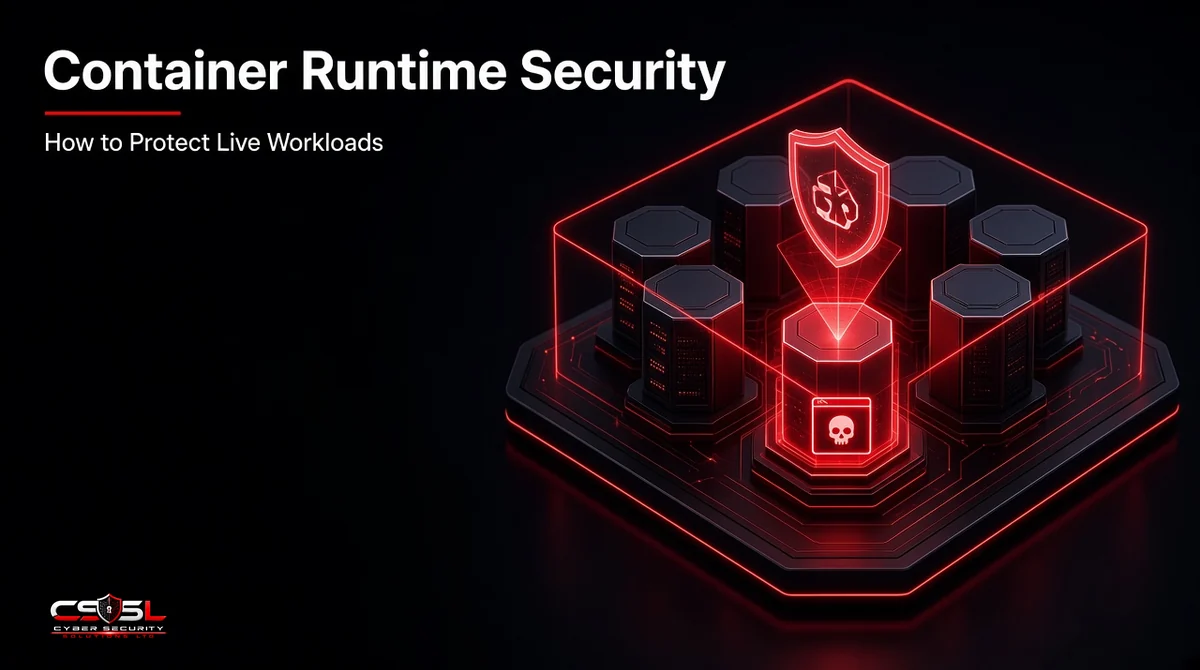
Container Runtime Security: How to Protect Live Workloads
A clean image scan feels like a finish line, but it is only the start. Container runtime security covers what happens after deployment, when a container is live and attackers can exploit a new flaw, steal credentials or start mining cryptocurrency. Scanning tells you what an image contains; runtime security tells you what it is doing.
What Is Container Runtime Security?
Container runtime security is the practice of monitoring and protecting containers while they run in production. It uses kernel-level sensors and detection rules to spot unexpected processes, file changes and network connections, then alerts, kills or isolates the compromised container before attackers can spread.
Runtime Security vs Build-Time and Deploy-Time Security
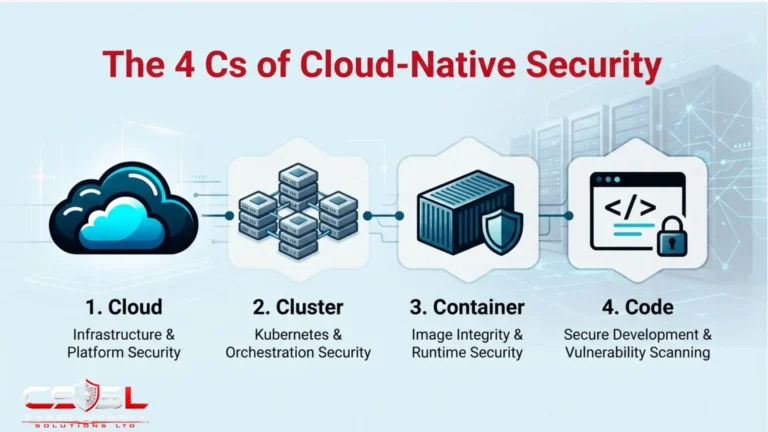
Build-time security checks images and code before release. Deploy-time security uses admission controls to block risky configurations from reaching the cluster. Runtime security watches live behavior. All three are needed; this guide covers only the runtime layer.
Why Image Scanning Alone Isn’t Enough
Scanners only know about vulnerabilities that were public when the scan ran. New flaws appear after deployment, attackers abuse legitimate tools already in the image, and stolen credentials need no vulnerability at all. Only runtime monitoring sees these.
Common Threats to Running Containers
Container Escapes and Privilege Escalation
Containers share the host kernel. A flaw in the kernel or container runtime, or a container running privileged, can let an attacker break out to the host. Real examples include runc vulnerabilities such as CVE-2019-5736 and the 2024 “Leaky Vessels” flaw CVE-2024-21626.
Cryptojacking and Malicious Processes
Attackers who reach an exposed container often launch cryptocurrency miners or download extra tools. Unexpected binaries and sustained CPU spikes are classic signs.
Reverse Shells and Lateral Movement
A web shell or exploited service opens an outbound connection to the attacker, who then explores the cluster, queries the Kubernetes API or steals service account tokens to move further.
Container Drift and Unauthorized Changes
Containers should run exactly what was built. New executables, changed configuration files or packages installed at runtime, known as drift, suggest tampering.
How Container Runtime Security Works
Behavioral Baselines and Anomaly Detection
Tools learn what each workload normally does, such as which processes run, which files change and which network destinations are contacted, and flag departures.
eBPF and Kernel-Level Monitoring
eBPF lets small, verified programs run safely inside the Linux kernel to observe system calls, process launches, file access and network activity with low overhead and without changing the containers.
Rules-Based Detection With Falco
Falco, a CNCF graduated open-source project, watches system calls and Kubernetes audit events against rules such as “a shell was started in a container” or “a sensitive file was read.” Teams can use community rules and write their own.
Automated Response: Kill, Pause or Isolate
When a detection fires, response options include alerting the security team, killing the offending process, pausing or stopping the container, or isolating its pod with a network policy. Start with alerts, then automate response for high-confidence detections.
How to Protect Live Container Workloads: 8 Best Practices
1. Run Containers as Non-Root With Least Privilege
Set containers to run as a non-root user, drop unneeded Linux capabilities and never run privileged containers unless essential.
2. Use Read-Only Filesystems and Block Drift
Mount the root filesystem read-only and write only to defined volumes. Alert on, or block, any new executable that was not in the original image.
3. Apply seccomp, AppArmor and SELinux Profiles
Use the RuntimeDefault seccomp profile at minimum to limit system calls, and apply AppArmor or SELinux profiles to restrict what processes can do.
4. Enforce Kubernetes Network Policies
Apply default-deny network policies per namespace and allow only required traffic, so a compromised pod cannot reach everything else.
5. Enforce Pod Security Standards at Admission
Kubernetes Pod Security Admission enforces the baseline or restricted Pod Security Standards, blocking privileged pods and risky settings before they run.
6. Monitor Kubernetes Audit Logs
Send API server audit logs to your monitoring platform and alert on actions such as exec into pods, new role bindings or secrets access.
7. Map Detections to MITRE ATT&CK
MITRE ATT&CK includes a containers matrix. Mapping runtime rules to it shows which attacker techniques you can see and where gaps remain.
8. Feed Runtime Findings Back Into Development
When runtime tools flag a vulnerable package in use or an overly broad permission, send it back to developers to fix in the image or manifest, so the issue does not return in the next release.
Runtime Security in Kubernetes vs Docker
On a single Docker host, runtime protection centers on the daemon, host hardening, container flags and a host-level sensor. Kubernetes adds layers: admission control, network policies, service account permissions and API audit logs. Managed services such as Amazon EKS, Azure AKS and Google GKE secure the control plane, but workloads and node configuration remain your responsibility.
Runtime Security Tools (Open-Source and Commercial)
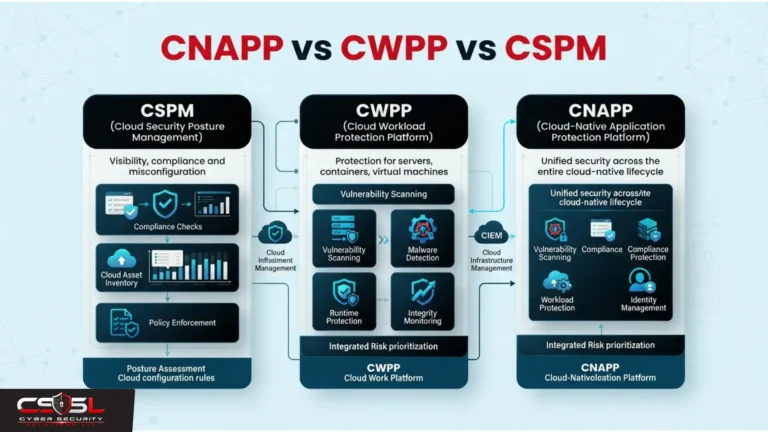
Open-source options include Falco for detection, Tetragon from the Cilium project for eBPF-based observability and enforcement, and Tracee and KubeArmor. Commercial cloud workload protection (CWPP) and CNAPP platforms add managed rules, response automation and cloud context. Small teams can often start with Falco and managed Kubernetes security features.
Runtime Security Guidance: NIST SP 800-190, CIS, NSA/CISA and NCSC
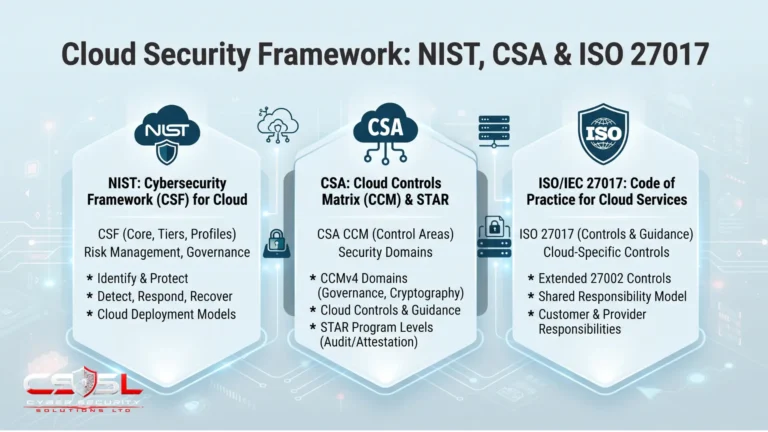
NIST SP 800-190 (2017), the Application Container Security Guide, recommends runtime monitoring of container behavior and limiting container privileges. The NSA and CISA Kubernetes Hardening Guidance (version 1.2, 2022) covers pod security, network separation, logging and threat detection. CIS Benchmarks for Docker and Kubernetes provide testable hardening settings, and the UK NCSC’s cloud security principles stress protecting workloads and monitoring for attacks.
Where Container Runtime Security Is Heading
Container runtime security is moving toward eBPF-based sensors that combine detection with in-kernel enforcement, and toward tighter links between runtime findings and code fixes. Expect more automated response and more focus on identities and Kubernetes API activity. Teams that harden workloads now and add runtime detection will be ready. For help assessing your container workloads, contact Cyber Security Solutions Ltd through our contact page.
FAQs
Run containers as non-root with minimal capabilities, use read-only filesystems, apply seccomp and AppArmor or SELinux profiles, and enforce Pod Security Standards and network policies in Kubernetes. Then add runtime detection, such as Falco or a CWPP, to monitor processes, files and network activity, with alerts and automated response for clear threats.
Many attacks only appear once containers run: exploitation of new vulnerabilities, stolen credentials, cryptominers, reverse shells and container escapes. Image scanning cannot see these. Runtime security detects them as they happen and can stop a compromised container before an attacker reaches the host, other workloads or cloud accounts.
Effective runtime security combines hardening, which limits what an attacker can do, with low-overhead monitoring that understands container and Kubernetes context. Detections should be mapped to known techniques, tuned to reduce noise and linked to clear response actions. Findings should also flow back to developers so issues are fixed at the source.
It needs system call and process activity, file access, network connections and Kubernetes API audit logs, enriched with context such as pod, namespace, image and service account. Cloud provider logs help detect attackers moving from containers into cloud accounts. Together these show both what happened and which workload was affected.
Not exactly. A cloud workload protection platform (CWPP) protects workloads such as virtual machines, containers and serverless functions, and usually includes runtime protection as one feature. Runtime security is the specific capability of monitoring and protecting running containers, which can also come from open-source tools.
Modern eBPF-based sensors are designed for low overhead because they observe events inside the kernel without modifying containers. Impact depends on the tool, rule set and workload, so test in a staging environment first. Hardening controls such as read-only filesystems and seccomp profiles add little or no performance cost.