Cloud Security Best Practices: The Checklist To Set Your Workflow
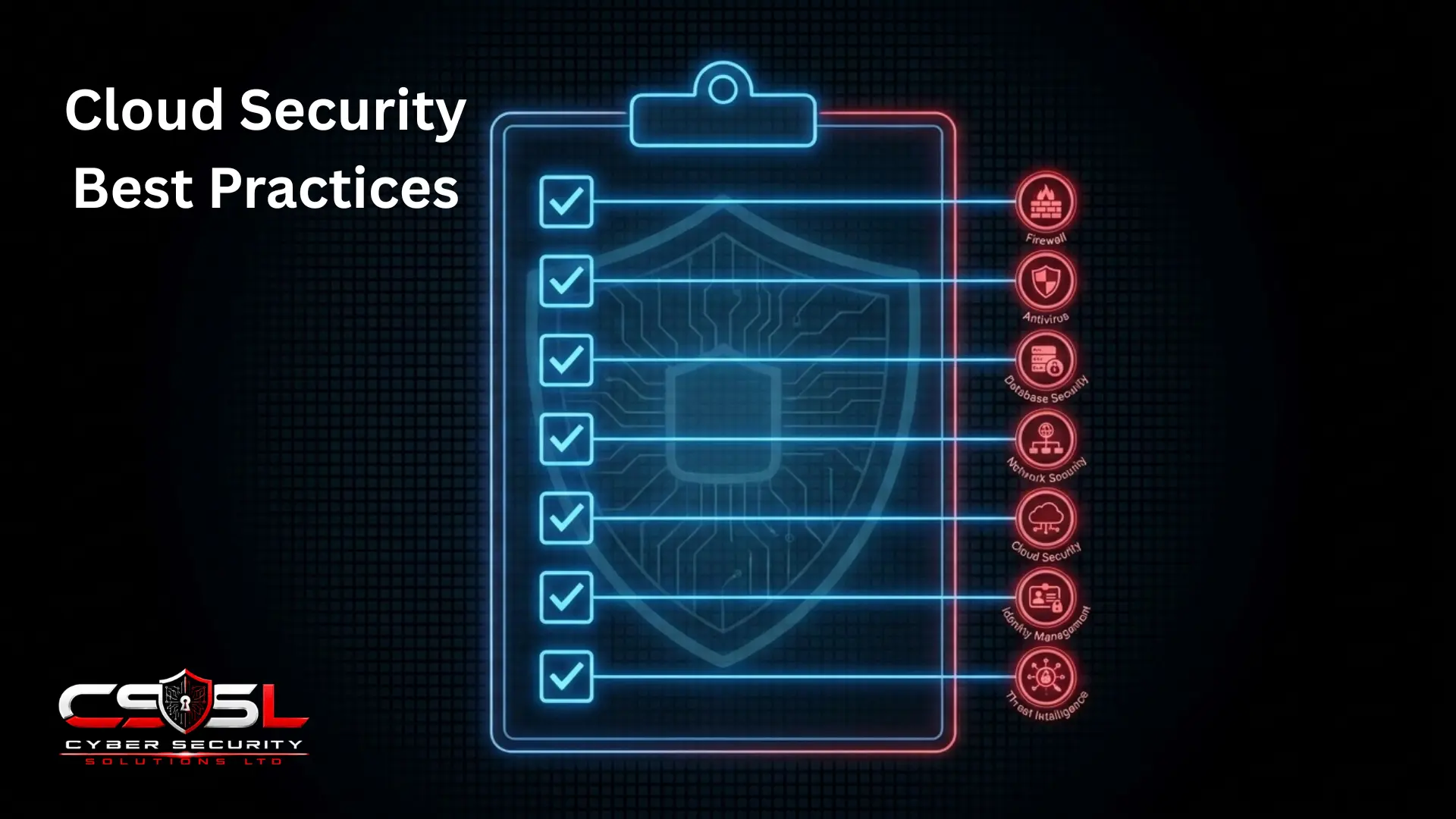
Cloud security best practices span identity and access, network segmentation, data protection, application security, continuous monitoring, and governance with named accountable owners. If you want a single checklist to actually audit your cloud environment against, instead of reading fifty separate articles across a dozen different topics, this is that checklist.
What Is Cloud Security Checklist, and How Is It Different From Your Written Cloud Security Policy?
This checklist is not your written cloud security policy. A prior post in this series delivered a formal, enforceable governance document with named accountable roles, structured around seven domains. This checklist reuses those same seven domains one final time, filled with concrete, checkable action items instead of declarative policy language. Policy says “access is granted on the basis of least privilege.” This checklist says “review and remove standing admin access nobody has used in 90 days.”
This is also not a project-bounded checklist. An earlier migration security checklist in this series was explicitly scoped to a single, bounded project with a start and end date, and stated directly it was distinct from this broader, ongoing checklist. A hybrid-architecture post made the identical distinction for its own best practices. This checklist applies indefinitely, to any cloud environment, regardless of whether a specific project is underway.
Here is the continuity worth stating directly. This is the fourth and final time this series uses the same seven domains as an organizing device: first as a descriptive definition, then as a scoring and sequencing tool, then as a formal policy’s section structure, now as this checklist’s own backbone. That is a deliberate choice for consistency, not a new structure invented at the very end. Use this as a bookmarkable, scannable reference to audit an existing environment or onboard a new one, not a document read once and filed away.
Identity and Access Management Checklist
The highest-priority identity items, each covered in full depth elsewhere in this series:
- MFA enforced on every account without exception, including root, Global Admin, and non-human identities capable of using it
- Legacy authentication protocols that bypass MFA disabled across every platform
- Least privilege applied through custom, narrowly scoped roles, not broad built-in roles
- Identity centrally federated across every connected cloud account and SaaS platform
- Just-in-time access and zero standing privileges applied to admin roles
- CIEM review on a regular, scheduled cadence, not a one-time deployment check
- Non-human identities governed with the same rigor as human accounts, including expiry and review
- Platform-specific pitfalls checked: no Basic Roles on Google Cloud, Conditional Access configured on Azure, identity-based and resource-based policies reconciled on AWS
Infrastructure and Network Security Checklist
- Documented reference architecture and landing zone template, with every new account provisioned against it
- Zones enforced through actual network controls, not just conceptual documentation
- Security groups and NACLs configured as complementary layers, not relied on individually
- Micro-segmentation applied to your highest-value workloads specifically
- Native DDoS protection enabled at a tier appropriate to your risk profile
- Cloud storage public access blocked by default at the account level
- Cross-account connectivity uses a hub-and-spoke model, not an unmanaged peering mesh
Data Security Checklist
- DSPM deployed to discover and classify sensitive data across every storage platform in use
- Encryption enabled by default at rest and in transit, key access governed separately
- Toxic combination correlation actively reviewed, not assessed as disconnected findings
- Data retention and lifecycle policy applied to forgotten, shadow copies and backups
A fuller, dedicated treatment of data security across your wider cloud estate lives in a separate post in this series; this section covers only the checklist-level essentials worth verifying right now.
Application and Workload Security Checklist
- WAF and API Gateway deployed in front of every externally facing application and API
- Object-level authorization (BOLA) specifically tested for per-user or per-record APIs
- SAST, secrets scanning, and IaC scanning integrated into every CI/CD pipeline
- CWPP deployed agentless-first, with selective agents only on high-value workloads
- Container images scanned before deployment, non-root users enforced, Kubernetes Network Policies configured
- Kubernetes RBAC reviewed as its own exercise, not assumed to inherit cloud IAM consistency
Threat Detection, Monitoring and Incident Response Checklist
- CSPM running continuously across every connected account, not a one-time audit
- Cloud-native or cloud-capable SIEM verified to genuinely parse your platforms’ log formats
- Signal-to-noise ratio and alert fatigue actively managed through tuning and tiered triage
- Automated remediation deployed for highest-confidence, lowest-blast-radius findings, tested in monitor-only mode first
- Documented, tested incident response plan covering cloud-specific containment and persistence hunting
- Forensic readiness confirmed: log retention extended, snapshot-based evidence preservation understood in advance
Compliance and Governance Checklist
- Shared responsibility explicitly mapped, service by service, onto named internal owners
- Formal, written cloud security policy exists, with named accountable roles and a review cycle
- Structured risk assessment conducted and refreshed on a regular cadence
- Cloud security audit or architecture review conducted periodically, distinct from continuous CSPM alone
- Every applicable compliance regime confirmed explicitly against actual cloud services in use
Culture and Team Checklist
- DevSecOps genuinely embedded: security champions in place, blameless review culture, honest maturity self-assessment
- Team certification and expertise matched to your actual cloud platform mix
- Governance structure clear regardless of size: named executive sponsor at minimum, full Cloud Center of Excellence at enterprise scale
If You Can Only Do Five Things This Year, Do These First
If you can only do five things: enforce MFA everywhere without exception, deploy continuous CSPM and DSPM as your baseline visibility layer, explicitly map shared responsibility onto named owners, write and formally acknowledge a cloud security policy, and build a tested incident response plan before you need one.
Why this specific five, not an arbitrary shortlist? Each one addresses either the single highest-frequency risk, misconfiguration or credential compromise, or the single most commonly-skipped governance step this series has flagged repeatedly, from its earliest risk research through its own domain-sequencing logic.
The Complete Checklist at a Glance
| Criteria | This Checklist | Cloud Security Policy | |||
| Format | Checkable action items | Declarative principles | |||
| Purpose | Audit and verify | Govern and hold accountable | |||
| Enforcement weight | Practical reference | Formal, disciplinary | |||
| Update frequency | Ongoing, as tools change | Scheduled review cycle | |||
Benchmarking your actual environment against this exact checklist and identifying your highest-priority gaps is exactly the assessment Cyber Security Solutions Ltd offers.
This checklist is the fourth complementary lens on this entire series, alongside three already-built synthesis devices: an architectural-layer lens, a governance-function lens, and a cybersecurity-discipline-hierarchy lens. Where those three gave conceptual ways to see this series as one coherent whole, this checklist gives the literal, checkable to-do-list version of the same whole. Every item above links back to a full, dedicated post covering its technical mechanics in depth. This post’s entire value sits in organization, prioritization, and linking, not in re-explaining anything already covered. A business owner who works through all eight sections above has effectively audited their environment against everything this series has built, domain by domain, without needing to reread fifty-plus individual articles to do it.
Conclusion
This checklist is not a document to read once. It is a recurring audit reference, and the five priorities above are your starting point if you do nothing else this year. Work through each domain honestly, checkbox by checkbox, and revisit it on a regular cadence as your environment changes. To get a full assessment benchmarking your actual environment against this exact checklist, visit cybersecuritysolutionsltd.com for expert support from Cyber Security Solutions Ltd.
FAQs
A policy states principles declaratively with named accountable roles, like “access is granted on least privilege.” A checklist gives concrete, checkable actions, like verifying and removing unused standing admin access. Both matter; a checklist without a policy behind it has no enforcement weight.
No. Those are project-bounded, scoped to a specific migration or architecture with a defined start and end date. This checklist applies indefinitely to any cloud environment, regardless of whether a specific project is currently underway, making it the ongoing reference those bounded checklists both point back to.
Enforce MFA everywhere without exception, deploy continuous CSPM and DSPM as baseline visibility, map shared responsibility onto named owners, write and formally acknowledge a cloud security policy, and build a tested incident response plan before you need one. Each addresses a high-frequency risk or a commonly-skipped governance step.
On a recurring, scheduled cadence, not as a one-time exercise. Most items on this checklist, CIEM review, risk assessments, and audits, are explicitly designed to be repeated regularly rather than checked once and considered permanently resolved for the life of your environment.
No, the same seven domains and checklist items apply across every provider you use, though a handful of platform-specific pitfalls, like Google Cloud Basic Roles or Azure Conditional Access, need checking explicitly within the identity section rather than assumed away.
Yes. It works equally well as an onboarding reference for a brand new environment and an audit reference for an existing one, since every item describes a state that should exist regardless of how long the environment has actually been running in production.