Cloud Security vs Cybersecurity: What Is the Difference?
Cloud security vs cybersecurity is not really a competition. Cloud security is a specific, cloud-hosted subset of the much broader cybersecurity discipline, not a rival branch fighting for the same territory. If someone asked whether these two terms mean the same thing and you were not sure how to answer precisely, this guide settles it.
What Is the Relationship Between Cloud Security and Cybersecurity?
Cloud security is not an alternative discipline competing for the same territory as cybersecurity. It is a specific, cloud-hosted subset of the much broader discipline, in the same way network security or endpoint security are subsets of it. Nobody seriously asks whether network security “wins” against cybersecurity, and the same logic applies here.
The “vs” framing persists in search behavior because searchers genuinely unfamiliar with how security disciplines are organized naturally reach for comparison language even when the honest answer is a hierarchy, not a choice. This same pattern already showed up for CNAPP versus CWPP elsewhere in this series, where the honest answer was containment, not competition, too.
Why does this post exist this late in a fifty-plus post series rather than at the very start? After that much depth covering cloud security’s own internal territory, this is the natural point to step back and show where all of it actually sits within the wider discipline, now that the internal detail is already established.
Where Does Cloud Security Sit in the Fuller Hierarchy: Information Security, Cybersecurity and Everything Below It?
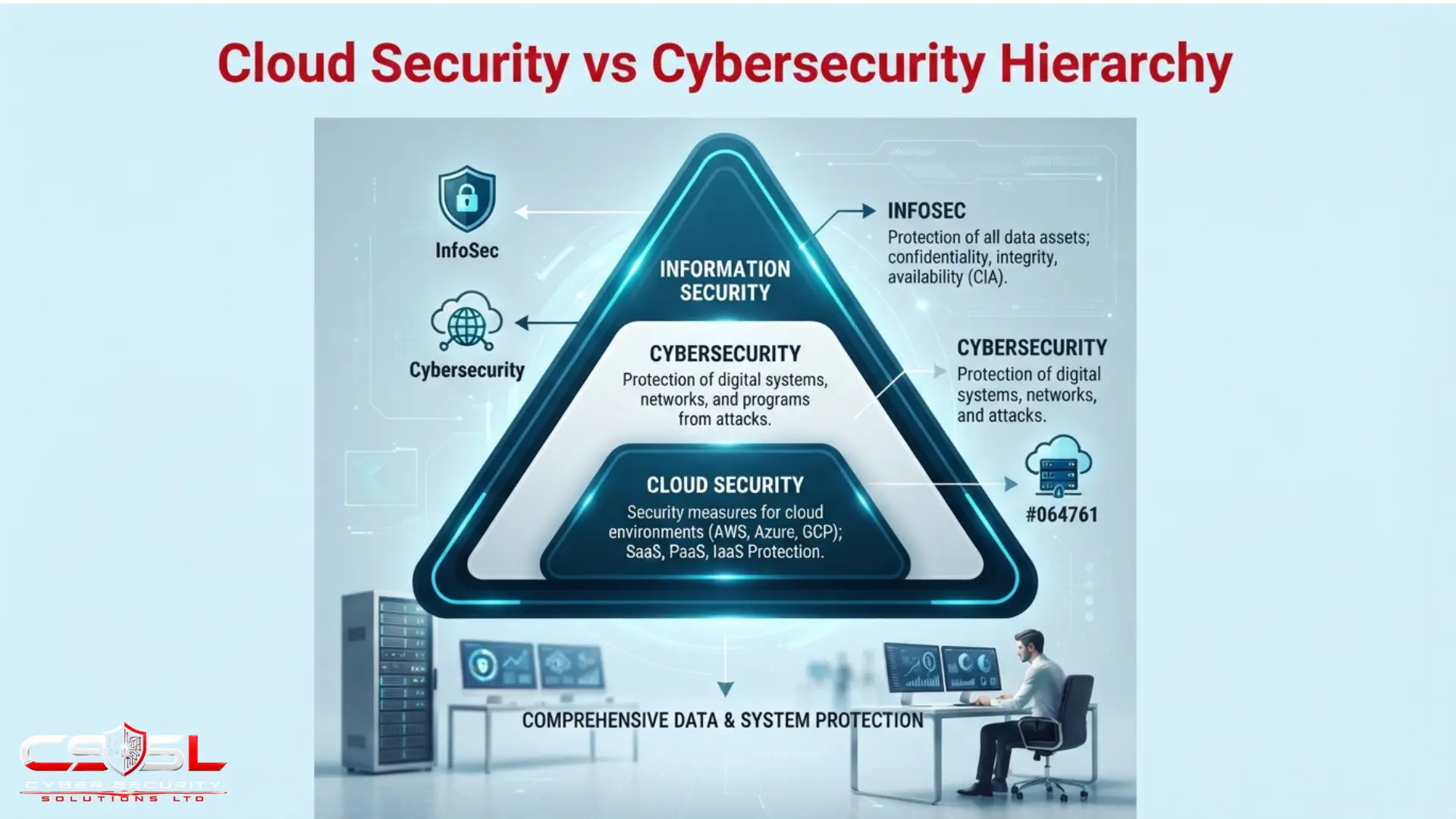
Information security is the broadest discipline, covering the confidentiality, integrity and availability of information regardless of medium, including paper records and spoken conversations, not only digital systems.
| Level | Scope | Example |
| Information security | All information, any medium | Paper records, spoken conversations, digital systems |
| Cybersecurity | Digital, networked systems specifically | On-premise servers, digital records, networked devices |
| Cloud security | Cloud-hosted systems specifically | Infrastructure, apps and data running in the cloud |
| Traditional discipline branches | Specific functional lanes | Network, endpoint, application, identity, data security |
Cybersecurity is information security’s digital, networked subset, concerned with protecting systems, networks and data that exist in electronic form. Cloud security is cybersecurity’s cloud-hosted subset specifically, applying the same CIA triad principles already established elsewhere in this series, now to infrastructure that happens to run in the cloud.
Treating any two of these three terms as interchangeable synonyms loses genuine, useful precision. This is the honest, defensible structure.
Cloud Security vs Network Security
Network security is one specific layer within cloud security’s broader scope, with identity, data and configuration controls increasingly taking precedence over pure network-layer controls once the traditional perimeter disappears, a full answer already delivered elsewhere in this series covering exactly what each domain protects and how they hand off to each other.
This section’s job is different. Rather than asking what each domain specifically covers, which that earlier answer already settled, this section places both within the fuller hierarchy just established. Network security and cloud security are best understood as two parallel branches beneath cybersecurity, except that cloud security’s own scope, as the next section develops, actually reaches into network security’s own territory as one of several disciplines it touches, rather than staying in its own separate lane the way network security largely does.
Why Cloud Security Cuts Across Other Cybersecurity Disciplines Rather Than Sitting Neatly Beside Them
Unlike network security or endpoint security, which each occupy a reasonably well-defined, separate lane beneath cybersecurity, cloud security is better understood as a lens applied specifically to the cloud-hosted expression of several other disciplines simultaneously.
Here is the concrete, structural evidence for this claim, not an abstract assertion. This fifty-plus post series itself had to cover cloud network security as its own dedicated topic. It had to cover cloud workload and container protection touching endpoint-security-adjacent territory.
It also had to cover cloud application security touching application-security territory, cloud identity and access management touching identity-security territory, and cloud data security touching data-security territory. Five separate disciplines, each needing dedicated coverage, is not a coincidence of content planning.
Why does this matter as a genuine insight, not just a structural observation? It explains precisely why cloud security can feel like it overlaps confusingly with several other named disciplines this brand also covers as separate content pillars, when in fact that overlap is the correct, expected shape of the discipline rather than a content organization accident.
Picture a mid-sized company that just hired a dedicated network security specialist, an application security specialist and a data security specialist, each confident they own their lane. None of them individually owns the cloud-specific version of their own discipline unless someone explicitly assigns it. That gap is exactly what this cross-cutting shape predicts, and exactly what shows up in practice.
What Does This Mean Practically for How You Organize a Security Team or Budget?
A security team structured purely around traditional, separate disciplines risks each team only partially covering its own cloud-specific responsibilities, with nobody holding the correlated, whole-environment view. A network specialist watches the network. An application specialist watches the application. Nobody watches how the two interact specifically in a cloud context.
A dedicated cloud security function or role often makes more sense than assuming existing, discipline-specific teams will each pick up their own cloud-specific slice coherently, echoing the same coordination argument already established elsewhere in this series for enterprise-scale cloud governance, just applied here to the general organizational question rather than a specific, multi-business-unit version of it.
Budget implications matter directly here too. A security budget organized strictly along traditional discipline lines can inadvertently under-fund the specifically cloud-hosted expression of each discipline, since no single traditional budget line naturally captures cross-cutting cloud spend. Ask directly, during your next budget cycle, which line item actually covers your cloud-specific network monitoring, and you may find the honest answer is nobody quite knows.
The Fifth Distinct “Cloud Security Challenge”: What Happens When Cloud Security Is Governed as Its Own Silo?
This is a governance challenge, distinct from four other named “cloud security challenges” elsewhere in this series covering technical, risk-process, workforce and infrastructure-paradigm territory.
Four prior, genuinely distinct uses of this exact phrase already exist across this series. One covered technical-discipline challenges like visibility gaps, skills shortage and alert fatigue. Another covered risk-assessment-process challenges.
Another covered workforce-distribution challenges. Another covered the challenge of running two infrastructure paradigms permanently side by side. This section introduces a fifth, distinct category that none of those four addressed.
Name the specific challenge directly. Organizations that treat cloud security as an entirely separate discipline from their broader cybersecurity program, with its own disconnected reporting line, its own separate risk register and its own separate incident response process, risk exactly the kind of coordination gap and blind spot this post’s own cross-cutting argument warns against.
Why is this a governance and organizational challenge specifically, distinct in character from the four prior ones? Those earlier challenges lived inside the discipline itself: a tool problem, a process problem, a staffing problem, an architecture problem. This one lives one level up, in how the discipline gets reported on and held accountable at all.
How Does This Entire Cluster Map onto the Broader Cybersecurity Discipline?
Network security discipline maps to cloud network security content. Identity security maps to cloud IAM, CIEM and CASB. Endpoint and workload security maps to CWPP and container security.
Application security maps to cloud application security and code to cloud. Data security maps to DSPM. Governance and compliance maps to the shared responsibility, framework, strategy and audit content collectively.
| Traditional Discipline | Cloud-Specific Expression | Related Content |
| Network security | Cloud network segmentation and gateways | Cloud Network Security guide |
| Identity security | Cloud IAM, entitlement and access broker coverage | Cloud IAM, CIEM, CASB guides |
| Endpoint and workload security | Workload and container protection | CWPP, Container Security guides |
| Application security | Cloud application and pipeline security | Cloud Application Security, Code to Cloud guides |
| Data security | Cloud data discovery and classification | DSPM guide |
| Governance and compliance | Responsibility, framework, strategy and audit | Shared Responsibility, Framework, Strategy, Audit guides |
This is a third synthesis device for this series, following an architectural-layer mapping and a governance-function mapping already delivered elsewhere in it. Organizing the same fifty-plus posts a third time, now by traditional cybersecurity discipline rather than architectural layer or governance function, gives readers yet another genuinely complementary way to see the same content as one coherent whole rather than a disconnected list.
So Is Cloud Security “Cybersecurity,” or Something Distinct? A Direct, Honest Answer
Cloud security is genuinely, fully cybersecurity. It is not a separate discipline sitting outside it, but it is also not simply a rebranded synonym for cybersecurity as a whole, since the broader discipline also covers on-premise, physical and non-cloud digital systems this series has not addressed and was never meant to.
The most useful way to think about cloud security is not as a box to check separately from a broader cybersecurity program, but as the specific lens that program needs applied everywhere infrastructure, applications, identity and data happen to be cloud-hosted, rather than a checklist item that sits apart from everything else your team already does.
Reviewing whether a team’s current structure and budget genuinely capture cloud security’s cross-cutting reach, or whether gaps exist between traditionally organized disciplines, is exactly the assessment Cyber Security Solutions Ltd runs for organizations asking this question.
This brand covers cloud security in depth here, alongside six other content pillars: Email Security, Network Security, Endpoint Security and EDR, Cyber Security Threats and Attacks, Data Security, and Cyber Security Strategy and Governance.
Conclusion
Cloud security vs cybersecurity was never a real competition to begin with. It is a hierarchy, not a choice, and cloud security’s job is applying cybersecurity’s principles everywhere your infrastructure happens to be cloud-hosted. Stop treating it as a separate box to check, and start treating it as the lens your existing program needs applied consistently. To get a review of whether your team structure and budget actually capture that cross-cutting reach, visit cybersecuritysolutionsltd.com for expert support from Cyber Security Solutions Ltd.
FAQs
No, but it is genuinely part of it. Cloud security is a cloud-hosted subset of the much broader cybersecurity discipline, not a separate or rival field. Cybersecurity also covers on-premise and non-cloud digital systems that cloud security specifically does not address.
Information security is the broadest term, covering all information regardless of medium. Cybersecurity is its digital, networked subset. Cloud security is cybersecurity’s cloud-hosted subset specifically. Each term narrows the scope of the one before it, rather than being interchangeable synonyms.
Because cloud security is a cross-cutting lens, not a separate lane. It touches the cloud-hosted expression of network security, identity security, application security and data security simultaneously, which is why genuine cloud security coverage necessarily overlaps with each of those disciplines.
A dedicated function often works better. Teams structured purely around traditional disciplines risk each one only partially covering its own cloud-specific responsibilities, with nobody holding the correlated, whole-environment view a dedicated cloud security role or team is actually positioned to hold consistently.
You risk a coordination gap. A disconnected reporting line, a separate risk register and a separate incident process can each miss the cross-cutting reach cloud security actually has, creating exactly the kind of blind spot treating disciplines as neatly separate tends to produce.
Not necessarily, and this is worth checking directly. A budget organized strictly along traditional discipline lines can under-fund the specifically cloud-hosted expression of each discipline, since no single traditional budget line naturally captures cross-cutting cloud spend unless it is deliberately accounted for.