What It Is Cloud Security Audit and How to Conduct One
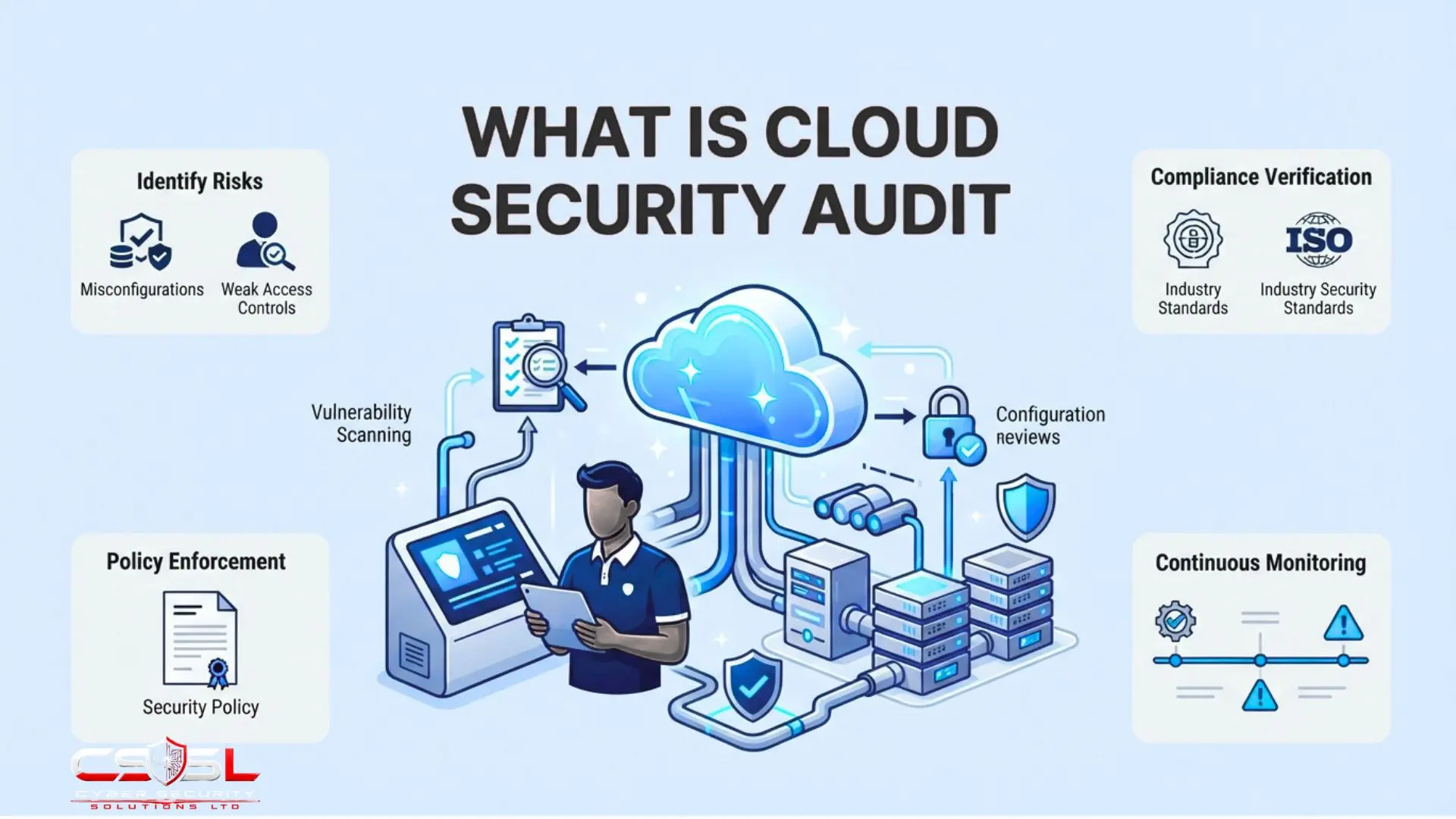
A cloud security audit is a structured, evidence-based process verifying whether your cloud environment conforms to a defined standard, a policy, framework or compliance regime. If you run CSPM continuously and assumed that meant you were already being audited, this guide explains exactly why that assumption falls short.
What Is a Cloud Security Audit?
This is a structured, evidence-based process of verifying whether an organization’s cloud environment conforms to a defined standard, most commonly an internal policy, an external framework or a binding compliance regime, producing a documented, reportable finding of conformance or gaps.
Assessment and audit get used almost interchangeably in casual search and industry language, and that is acceptable here. Unlike several other terminology pairs this cluster disambiguates, cloud security assessment and cloud security audit genuinely overlap substantially in real world usage. This post treats them as effectively synonymous throughout, except for one distinction that matters most, covered next.
Twenty six prior posts covered what good looks like: tools, architecture, policy. This post covers the structured process of actually verifying whether an environment lives up to what was designed and documented.
How Is a Cloud Security Audit Different From a Cloud Security Risk Assessment?
An audit checks conformance against a defined standard, a clean pass is possible. A risk assessment identifies and prioritizes threats by likelihood and impact, with no fixed standard being checked against at all.
| Criteria | Audit | Risk Assessment |
| Primary question | Are we meeting the standard? | What could go wrong, and how badly? |
| Method | Conformance verification | Likelihood and impact scoring |
| Checked against a fixed standard | Yes | No |
| Typical output | Pass or gap-based finding | Prioritized threat list |
| Related post | This guide | Risk Assessment Guide |
Here is the one distinction this post insists on getting right. An audit answers are we doing what we said we would do, or what the standard requires. A risk assessment answers what could go wrong, how likely is it, and how bad would it be, with no fixed standard being checked against.
Picture the same environment run through both exercises. An audit against your own written policy might find that MFA is correctly enforced everywhere the policy requires it, a clean pass. A risk assessment on that same environment might still flag that a specific, MFA protected system represents high residual risk, simply because of what it holds and who could target it, independent of whether any policy requirement was violated.
Organizations need both, not one instead of the other. An audit alone can confirm compliance while missing genuinely significant risk that no existing policy addresses. A risk assessment alone can identify and prioritize threats without confirming whether documented controls are actually implemented. The full risk assessment methodology gets its own dedicated treatment elsewhere in this series.
Different Types of Cloud Security Audits
First-party audits are conducted by the organization’s own internal team, typically the most frequent type, suited to routine, ongoing verification against internal policy.
| Audit Type | Who Conducts It | Typical Trigger | Output |
| First-party (internal) | Internal security team | Routine, scheduled review | Internal findings report |
| Second-party | Customer or business partner | Vendor risk assessment | Assurance for the relationship |
| Third-party (independent) | Accredited external body | Formal certification | Certifiable audit report |
| Continuous/automated | Ongoing tooling, periodic review | Continuous evidence collection | Evidence base feeding periodic audits |
Second-party audits are conducted by a customer or business partner auditing a vendor directly, common when a client requires direct assurance before or during a commercial relationship rather than relying solely on published certifications. Third-party audits are conducted by an accredited, external body with no direct stake in the outcome, the type underlying the ISO 27017 and FedRAMP processes covered elsewhere in this series. Most formal audits remain periodic, point-in-time exercises even when they draw on continuously updated CSPM data as evidence.
What Triggers a Cloud Security Audit, and How Often Should You Conduct One?
Scheduled, periodic audits tie directly to your governance review cadence, commonly annual for a full audit with lighter touch interim reviews more frequently.
Pre-certification audits happen ahead of a formal external audit, to identify and close gaps before the accredited external auditor arrives, reducing the risk of a failed or delayed certification.
Event-driven audits get triggered by a security incident, a significant architecture change, a merger or acquisition bringing new cloud environments into scope, or the loss of a staff member who held undocumented knowledge about a system’s configuration. Customer or partner-requested audits are increasingly common too, as procurement processes require evidence of a recent audit before a contract is signed. Cyber insurance-driven audits round this out, with insurers increasingly requesting evidence of a recent audit during underwriting.
What Does a Cloud Infrastructure Security Assessment Examine?
A cloud infrastructure security assessment refers to an audit scoped specifically to the infrastructure and platform layer, compute, storage, networking, identity configuration, distinct from a broader security programme assessment that would also examine people, process and governance maturity.
This narrower scope typically covers identity and access configuration, network zoning and segmentation, encryption and data protection settings, workload configuration, and posture findings already surfaced by CSPM.
Organizations often start here because infrastructure layer findings are typically the fastest to gather evidence for, since much of the relevant data already exists in CSPM, CIEM and DSPM tooling output rather than requiring extensive interviews or documentation review.
Is CSPM the Same as an Audit? Why Continuous Scanning Is Not Enough on Its Own
No. CSPM provides continuous, automated configuration scanning against a fixed rule library, a valuable evidence source. It cannot provide a defined audit scope, interview-based evidence, sampling and manual testing, or a formal, reportable conclusion.
Treating “we run CSPM continuously” as equivalent to “we get audited” is a genuine, common misunderstanding this post corrects directly.
What CSPM structurally cannot provide is worth naming specifically: a defined audit scope tied to a specific standard or policy version, verification that documented policy actually matches operational reality beyond configuration settings, interview-based evidence from control owners, sampling of processes CSPM has no visibility into, and a formal, reportable conclusion suitable for a board, client or regulator.
The practical relationship is straightforward once stated plainly. CSPM output should feed directly into an audit as a major evidence source, dramatically reducing the manual evidence gathering burden. It replaces evidence collection, not the audit process itself. An organization with excellent CSPM coverage still has not been audited until someone defines a scope, tests controls beyond configuration, and produces a reportable conclusion.
How Do You Conduct a Cloud Security Audit Step by Step?
Conducting an audit starts with defining scope and the standard being checked, assembling the right team, gathering evidence starting with existing CSPM, CIEM and DSPM findings, testing controls through sampling, documenting every gap, rating severity, producing a report for governance stakeholders, and tracking remediation to closure with fresh verification.
- Define scope and objectives: which environments, accounts and services are in scope, and which standard is being audited against.
- Assemble the audit team: internal staff for a first-party audit, or an accredited third party where independence is required.
- Gather evidence: pull current CSPM, CIEM and DSPM findings as a starting base, request documentation, and interview named control owners.
- Test controls: verify documented policy matches configured reality, using sampling across a representative subset rather than full manual coverage.
- Identify and document findings: record every gap between what the standard requires and what evidence shows, including partial implementation.
- Rate findings by severity: apply a lightweight, audit-specific rating distinct from the fuller risk assessment methodology.
- Produce and present the audit report: findings, evidence, severity and recommended remediation, to the governance structure.
- Track remediation to closure: assign accountable owners, set realistic deadlines, and verify closure with fresh evidence.
What Cloud Security Audit Tools Are Available in 2026?
Provider-native tools include AWS Audit Manager, which continuously collects and organizes evidence mapped against frameworks including CIS Benchmarks and PCI DSS, Microsoft Purview Compliance Manager, providing compliance scoring across the Microsoft cloud estate, and Google Cloud Security Command Center, which includes compliance reporting for Google Cloud environments specifically.
Dedicated GRC platforms, Vanta, Drata, Secureframe and OneTrust, have become widely adopted to automate continuous evidence collection and control monitoring across multiple frameworks simultaneously, reducing the manual burden of audit preparation compared to assembling evidence from scratch each cycle.
Provider-native tools are scoped to that single provider’s environment. GRC platforms are typically multi-cloud and multi-framework, aggregating evidence across an organization’s full estate. Tool selection should follow scope, not the reverse.
How Do You Report Findings and Track Remediation to Closure?
A useful audit report includes clear scope and standard referenced, a summary suitable for non-technical governance stakeholders, detailed findings with supporting evidence, severity ratings and named, accountable owners for remediation drawn directly from your responsibility mapping.
Remediation tracking is where many audits lose practical value. An audit that produces a report nobody actively tracks to closure delivers documentation without delivering genuine risk reduction, the same pattern already established for CSPM, DSPM and CIEM findings throughout this series.
Set realistic, risk-weighted remediation deadlines. Critical findings warrant immediate, tightly bounded deadlines. Lower-severity findings can reasonably follow a longer, scheduled path without undermining the audit’s overall credibility. Verify closure with fresh evidence, ideally updated CSPM or CIEM data, rather than accepting a remediation claim on trust alone.
Findings left untracked is the single most common gap Cyber Security Solutions Ltd finds when reviewing a client’s previous audit history.
How Does This Connect to the Formal Compliance Audits?
The FedRAMP 3PAO assessment and the ISO 27017 Stage 1 and Stage 2 external audit are concrete, worked examples of this post’s general third-party audit methodology, applied to two specific, named compliance regimes.
This is not separate territory. It is the exact eight-step methodology just covered, applied with the sequencing and accreditation requirements each regime demands.
Reading both posts together gives you the fullest picture available. This post provides the general discipline any audit follows: defining scope, assembling a team, gathering evidence, testing controls, documenting findings, rating severity, reporting and tracking remediation. The compliance guide shows exactly how that same discipline plays out for two specific, high-stakes external certification processes.
Once you understand this methodology, you are not learning a new process for every compliance regime you encounter. You are applying one process, repeatedly, to different standards, which is what makes audit competence something an organization builds once rather than relearning for every regime that becomes relevant.
Conclusion
A cloud security audit is not something your CSPM dashboard produces automatically, no matter how good your posture scores look. It requires defined scope, tested controls, documented findings and remediation tracked to actual closure. Do that consistently and an audit becomes routine evidence of genuine governance, not a stressful annual scramble. To get an independent audit that verifies your actual configuration against your own policy or a chosen standard, visit Cyber Security Solutions Ltd.
FAQs
No. An audit checks conformance against a defined standard, a policy, framework or compliance regime, producing a pass or gap-based finding. A risk assessment identifies and prioritizes threats by likelihood and impact, with no fixed standard checked against. Organizations typically need both, not one instead of the other.
No. CSPM provides continuous, automated configuration scanning, a valuable evidence source, but it cannot provide a defined scope, interview-based evidence, sampling, manual control testing, or a formal reportable conclusion. CSPM output should feed an audit; it does not replace the audit process itself.
Commonly annual for a full audit, with lighter interim reviews more frequently, tied to your governance review cadence. Additional audits get triggered by a significant incident, an architecture change, a merger, a customer request, or a cyber insurer requesting evidence during underwriting.
An architecture review checks whether the design itself follows sound patterns, zones, layering, landing zone consistency. A cloud security audit is broader, verifying actual configuration state, evidence and control testing against a defined standard, not just whether the design looks sound on paper.
Provider-native tools like AWS Audit Manager and Microsoft Purview Compliance Manager work within one specific cloud. GRC platforms like Vanta, Drata, Secureframe and OneTrust automate evidence collection across multiple frameworks and multiple clouds simultaneously, reducing manual audit preparation significantly for larger, multi-cloud organizations.
Because tracking remediation to closure gets treated as optional once the report is delivered. An audit report nobody actively tracks provides documentation without genuine risk reduction. Assign named accountable owners, set realistic deadlines by severity, and verify closure with fresh evidence, not a claim on trust.