What Is Zero Trust Cloud Security and How Do You Implement It?
Zero trust cloud security means verifying every user, device and workload for every single access request, never trusting anything just because it sits inside your network. If your team already runs separate tools for identity, posture and access but nobody can explain how they fit together, this guide connects them into one architecture.
What Is Zero Trust Cloud Security?
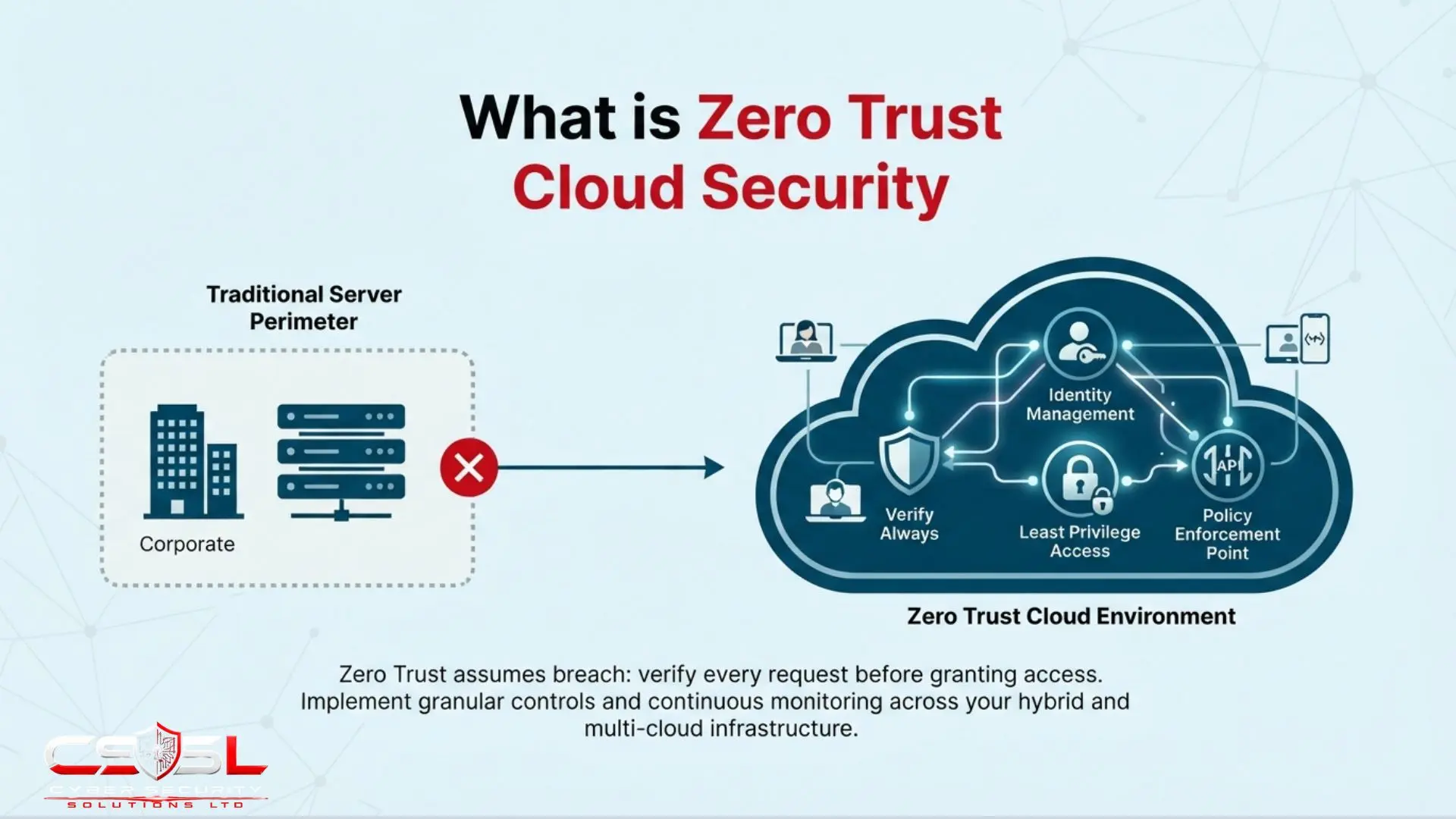
This architecture rests on one rule: never trust, always verify. Every user, device and workload gets continuously authenticated and authorized for every access request, inside or outside your network.
Cloud Security Fundamentals introduced zero trust as one of five general principles, a single bullet among several. This post treats it as a complete architecture, with its own tenets, pillars and implementation model.
Perimeter security asks whether a request came from inside the trusted network. Zero trust asks something different: is this specific request, right now, verified and authorized, regardless of where it came from.
Where Did Zero Trust Come From, and Why Does It Matter More in the Cloud?
Former Forrester analyst John Kindervag coined the term Zero Trust around 2010, arguing internal traffic deserved no more automatic trust than traffic coming from outside.
NIST SP 800-207 later formalized the concept, giving organizations an authoritative, vendor-neutral reference for what a genuine zero trust architecture actually requires.
Zero trust was built for on premise networks. Cloud changes the calculation. Once the traditional perimeter disappears, as our comparison of cloud versus traditional security covers, there is no implicit network trust left to fall back on. Zero trust stops being optional and becomes close to the only coherent model once workloads sit fully in the cloud.
What Are the Core Principles of a Zero Trust Architecture?
Six principles define a zero trust architecture.
- Verify explicitly: every decision draws on identity, device health, location and workload sensitivity, not a single static credential check
- Least privilege access: scoped as narrowly as possible per session, building on the discipline our cloud IAM guide covers
- Assume breach: architecture assumes compromise will happen, limiting blast radius through segmentation and monitoring rather than prevention alone
- Per-session, per-resource authorization: access to one resource never automatically extends trust to another
- Dynamic policy evaluation: decisions use real-time signals like device compliance, not fixed static rules
- Continuous monitoring and validation: every asset’s posture gets assessed continuously, not validated once and trusted for the session
What Are the Pillars of a Zero Trust Cloud Model?
The pillars framework organises zero trust implementation around five interconnected areas: identity, devices, network, applications and workloads, and data, plus cross cutting visibility, analytics, automation and governance supporting all five.
| Pillar | What It Governs | Related Post |
| Identity | Continuous validation of human and non-human identities | Cloud IAM Solutions |
| Devices | Security posture of the device making each request | CASB reverse proxy mode |
| Network | Micro-segmentation limiting lateral movement | Cloud Network Security |
| Applications and workloads | Securing workloads against exploitation | CNAPP / CWPP |
| Data | Classifying and protecting data by actual sensitivity | DSPM |
The identity pillar continuously validates human and non-human identities, covered fully in our cloud IAM guide. Devices means assessing posture at each request, an area CASB’s reverse proxy mode partially addresses. Network means micro-segmenting so lateral movement stays restricted after initial access. Data means classifying and protecting by actual sensitivity, the domain our DSPM guide covers.
Mapping the pillars this way matters. It shows zero trust is not a single product to buy. It is an architectural outcome that the tool categories already covered in this cluster each contribute toward from a different angle.
How Do CSPM, IAM, CIEM and CASB Work Together as Building Blocks of Zero Trust?
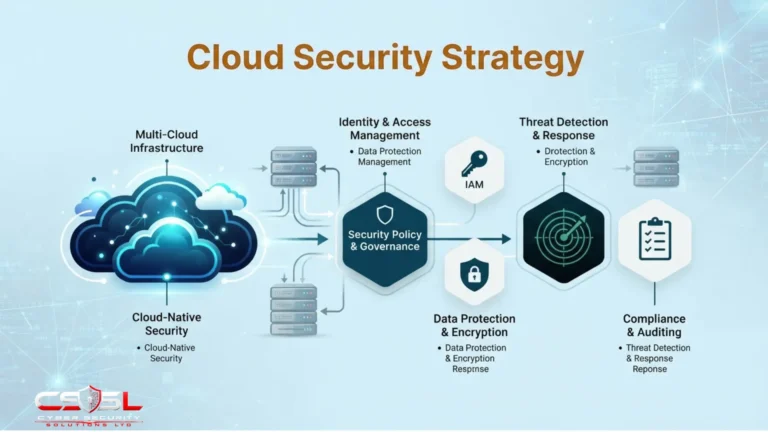
CSPM answers whether infrastructure is configured correctly. DSPM answers where sensitive data lives and how exposed it is. CIEM answers what each identity can actually reach.
CASB answers what is happening to data in transit right now, even on unmanaged devices. Cloud IAM answers who an identity is. Together, continuously, they form zero trust.
Here is the connection most competitor content skips. Zero trust content usually explains its principles in isolation, or lists NIST’s tenets, without connecting them to a tool category you could actually go evaluate and buy. That leaves readers with a compelling philosophy and no practical next step.
Each tool answers one specific, continuous question zero trust depends on. CSPM confirms infrastructure is configured correctly, feeding dynamic policy evaluation real data. DSPM answers where sensitive data actually lives, feeding the data pillar’s classification requirement.
CIEM continuously answers what each identity can actually reach, validating that least privilege is genuinely maintained, not assumed true because a policy document says so. CASB answers a real-time question: what is happening to data in transit right now, including on devices you do not manage. Cloud IAM answers the most foundational question: who is this identity.
Here is the point worth sitting with. None of these five tools individually constitutes zero trust. A company can buy all five and still lack a zero trust architecture if they run as disconnected dashboards nobody cross references. Zero trust is not a product on this list. It is the commitment to running these tools together, continuously, so every access decision draws on current, verified information instead of a static judgment made months ago.
What Is ZTNA, and How Does It Fit Into Zero Trust?
ZTNA implements zero trust at the network access layer, granting access to individual applications based on verified identity and device posture, rather than placing users on a broad network segment.
The practical difference from a VPN: a VPN typically grants broad network level access once connected. ZTNA grants access only to the specific application explicitly authorized, reflecting the per-session, per-resource principle above.
Full ZTNA mechanics belong to network security architecture. This post covers it only far enough to show how it operationalizes the principles already established here.
How Does Zero Trust Connect to the SASE Architecture Trend?
Secure Access Service Edge, or SASE, bundles ZTNA, CASB, secure web gateway and SD-WAN into a single, cloud delivered platform, an evolution already flagged in our CASB guide.
SASE represents the practical, commercial packaging of zero trust principles. Organizations asking how do we actually buy zero trust increasingly get answered through a SASE vendor conversation rather than separate point tool purchases.
As with ZTNA, full SASE treatment belongs to network security. This post’s job is connecting the dots so you understand why SASE and zero trust keep coming up together.
What Are the Benefits of Implementing Zero Trust in Cloud Environments?
Zero trust closes the internal trust gap perimeter thinking leaves open. Compromised internal accounts and lateral movement get the same scrutiny as external access attempts.
It limits blast radius when a breach happens, since per-session, least-privilege access means one compromised credential cannot reach every resource. Verizon’s 2026 DBIR found that in 16 percent of organizations, an attacker with low-level access had an 80 percent or better chance of reaching a key administrative account. Zero trust exists to close that path.
It provides continuous, evidence-based compliance posture instead of point-in-time snapshots, since continuous monitoring generates an audit trail as a byproduct of normal operation.
It supports remote and hybrid work natively, since access never depended on network location, removing the need for a separate remote-access model bolted onto an office-centric design.
What Are the Common Challenges and Mistakes in Zero Trust Implementation?
Common mistakes include treating zero trust as a single product, attempting a full cutover instead of a phased rollout, underestimating the discovery work policy depends on, neglecting non-human identities, and letting verification friction drive shadow IT.
The non-human identity gap deserves its own callout, since almost no zero trust content mentions it. Zero trust conversations focus almost entirely on verifying human users: identity, device, location. Service accounts and API keys quietly get left out.
This recreates the exact gap already flagged in our cloud IAM guide, just at architecture scale. One loosely governed service account, with standing permissions nobody reviews, can bypass every layer of human verification you just built. It authenticates once and keeps working, never asked to prove itself again.
Treating zero trust as a single purchase is the second recurring mistake. A vendor sells one product labelled zero trust, and leadership assumes the architecture is complete. Zero trust spans identity, data, device, network and application layers at once. One product covers one pillar at most.
Attempting a full rollout on day one is the third. Strict verification everywhere immediately triggers enough friction that employees find workarounds, undermining the visibility zero trust depends on. A phased rollout, starting with the highest risk identities, avoids that trap.
How Do You Implement Zero Trust Cloud Security Step by Step?
Implementing this starts with a full inventory, then federated identity, data classification through DSPM, a CSPM configuration baseline, continuous entitlement review through CIEM, CASB or ZTNA enforcement, risk based policy, a phased rollout by risk, and continuous ongoing monitoring rather than a one time project.
| Criteria | Perimeter-Based Security | Zero Trust Security |
| Trust basis | Network location | Continuous verification |
| Internal traffic treatment | Implicitly trusted | Scrutinized like external traffic |
| Access grant duration | Standing, persistent | Per-session, per-resource |
| Blast radius if compromised | Broad, often lateral | Contained by segmentation |
| Remote work fit | Requires bolted-on VPN model | Native, location-independent |
- Inventory all identities, devices, applications, data and network flows. Visibility is the prerequisite every later step depends on.
- Establish strong, centrally federated identity management, using the guidance already in our cloud IAM guide.
- Classify data by sensitivity using DSPM, so protection applies proportionally rather than uniformly.
- Deploy posture management through CSPM to establish a verified configuration baseline.
- Implement continuous entitlement review through CIEM, so least privilege stays maintained rather than assumed.
- Layer CASB or ZTNA to enforce real time, context aware access control at the point of connection.
- Define dynamic, risk based access policies evaluating device posture, location and behavioral signals.
- Roll out in phases, starting with your highest risk identities and most sensitive resources.
- Establish continuous monitoring and review cycles. Zero trust is ongoing, not a state you reach once.
Step one mirrors the same inventory-first approach Cyber Security Solutions Ltd runs in a zero trust readiness assessment, before recommending any specific tooling.
Conclusion
Zero trust cloud security is not a product sitting on a shelf waiting to be purchased. It is the architectural commitment to verifying every request, continuously, using tools your organization likely already owns. The pillars framework and tool synthesis in this guide give you the map. To see how your existing identity, posture and access tools line up against this architecture, visit cybersecuritysolutionsltd.com for a free zero trust readiness assessment from Cyber Security Solutions Ltd.
FAQs
It is an architecture, not a single product. No individual tool, CSPM, IAM, CIEM or CASB, constitutes zero trust alone. It is the commitment to using several tool categories together, continuously, so every access decision draws on current, verified information rather than static, one-time trust.
Zero trust is the broader principle: never trust, always verify. ZTNA is one specific technology implementing that principle at the network layer, granting access to individual applications based on identity and device posture, rather than broad network access like a VPN.
Perimeter security asks whether a request came from inside the trusted network. Zero trust asks whether this specific request, right now, from this specific identity and device, is verified and authorized, regardless of network location. Cloud removes the perimeter, making the second question the only reliable one.
Not necessarily. If you already run CSPM, DSPM, CIEM, CASB or cloud IAM, you likely have several building blocks in place already. Zero trust often means connecting and operating existing tools as one coherent architecture rather than starting from a blank slate.
Access decisions in a zero trust model never depended on network location in the first place, so remote and office based requests get evaluated by exactly the same standard. This removes the need for a separate remote access model bolted onto an office centric design.
Start with inventory, not policy. You need accurate, current visibility into identities, devices, applications, data and network flows before any access rule can make real sense. From there, prioritize your highest risk identities and most sensitive resources first, expanding coverage in phases.