Cloud Security vs Traditional Security: What Is the Difference?
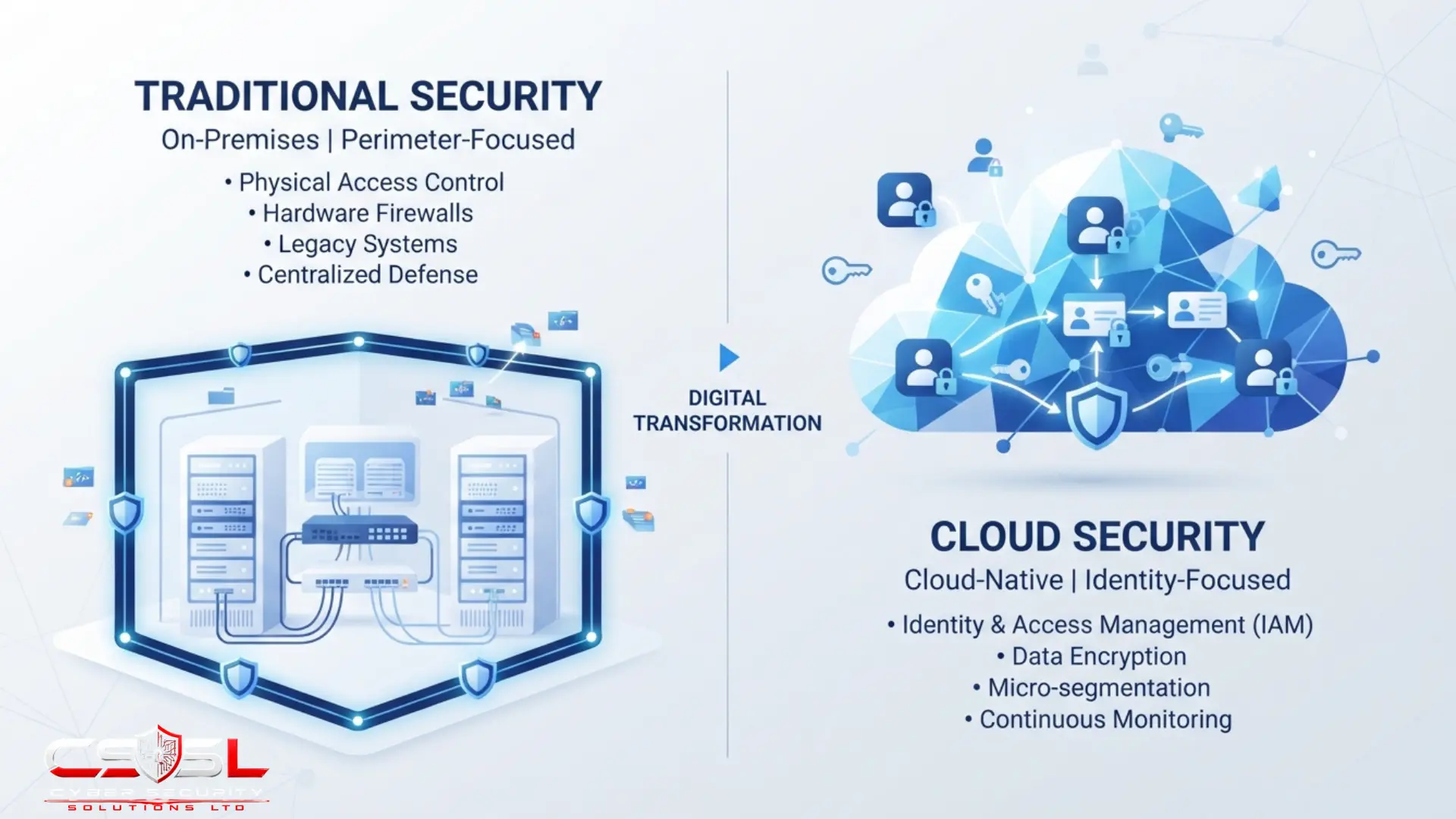
The fundamental difference between cloud security vs traditional security is the replacement of the network perimeter model with an identity-centric model, the shift of some infrastructure responsibility to the cloud provider under the shared responsibility model, and the addition of configuration risk as a primary threat vector absent from traditional on-premise environments.
If you have managed on-premise security for years and want to understand exactly what changes before migrating, or your team keeps applying traditional firewall thinking to cloud environments and encountering unexpected gaps, this guide explains precisely what transfers and what must be replaced.
What Is the Fundamental Difference Between Cloud Security and Traditional Security?
Traditional security was built around a network perimeter, a defined boundary inside which assets were relatively trusted and outside which threats were assumed. Cloud security eliminates that perimeter entirely and replaces it with identity as the primary security boundary. The ownership model shifts from controlling all hardware and software to securing assets running on infrastructure owned by someone else.
| Dimension | Traditional On-Premise Security | Cloud Security |
| Security perimeter | Network boundary, firewall at the edge | Identity-centric, no meaningful network perimeter |
| Identity model | Active Directory, network location as trust signal | Granular IAM, continuous verification regardless of origin |
| Infrastructure responsibility | Organization owns every layer | Divided by service model under shared responsibility |
| Primary threat vector | Known software vulnerabilities (CVEs) | Configuration errors alongside known CVEs |
| Monitoring approach | Network traffic, IDS/IPS, SIEM from static assets | Cloud-native audit logs, API events, dynamic coverage |
| Change speed | Weeks or months per infrastructure change | Minutes, continuous provisioning and decommissioning |
| Asset inventory | Known, relatively stable list of systems | Dynamic, requires automated discovery |
Experienced on-premise security professionals must actively unlearn specific perimeter-based intuitions when transitioning to cloud, because these intuitions were accurate in their original context and become misleading when applied uncritically to cloud environments.
Three specific intuitions cause the most real-world problems. The first is trusting network location as a signal of legitimacy: in on-premise environments, internal network traffic carries genuine contextual trust, since reaching that internal position required physical access or VPN authentication. In cloud, every service is internet-accessible by design, and being inside the cloud environment provides no meaningful security context whatsoever. The second is assuming a known, stable asset inventory: cloud environments provision and decommission resources continuously, invalidating any static list within hours of creation. The third is treating all patching as self-managed: in cloud, the patching boundary shifts dramatically by service model, and misunderstanding where that boundary falls creates either duplicated effort on provider-managed layers or real exposure on customer-managed layers someone assumed were covered.
Understanding specifically which intuitions transfer and which must be replaced is more practically useful than any abstract feature comparison, and almost no competitor content addresses this practitioner-level transition directly.
How Does the Security Perimeter Differ Between Cloud and On-Premise?
Traditional perimeter security placed firewalls at the network boundary, treating everything inside the corporate network as relatively trusted and focusing defences on the edge between inside and outside. Cloud removes this meaningful perimeter entirely. An employee accessing Microsoft 365 from a coffee shop, a home office, or a corporate laptop all appear identical from the cloud service’s perspective. There is no meaningful inside left to protect.
Zero trust architecture replaces perimeter-based trust with continuous, context-aware verification of every access request regardless of origin. Network segmentation survives in cloud environments through security groups and virtual private clouds that limit lateral movement within the cloud, but shifts from being the primary defence to one layer among many. See Zero Trust Cloud Security for the full architectural framework this transition requires.
How Does Cloud vs On-Premise Security Differ for Identity and Access?
On-premise identity typically centred on Active Directory governing access to on-premise resources, with network location providing implicit contextual trust that simplified access decisions. Cloud requires explicit, granular IAM governing every resource independently, since identity is the only reliable trust basis without a network perimeter. Cloud environments significantly expand identity scope through service accounts, API keys, and federated identities requiring deliberate permission management beyond what traditional on-premise IAM needed to address.
The asset inventory assumption is the specific on-premise intuition that breaks most immediately in cloud identity management. Traditional security professionals are accustomed to managing a known identity list as the foundation of access control: you know your users, their roles, and you apply permissions to people whose existence HR processes have made visible. Cloud environments introduce a non-human identity layer that invalidates this assumption structurally.
A typical cloud environment contains significantly more service accounts, API keys, and automated roles than human user accounts, and these machine identities are created without the onboarding processes that bring human identities under management. A developer provisions a microservice, and the service account it requires appears alongside it carrying permissions that made sense at creation and may not be reviewed again. An infrastructure automation tool accumulates cross-service permissions that no manual audit can easily track, and these credentials sit outside any HR-driven lifecycle process that would trigger a review when the business context changes.
The on-premise intuition that permission management means managing access for the people in the organization fails entirely in this context. Cloud identity management requires explicit tooling and processes specifically designed to discover, inventory, and review non-human identities as first-class security objects rather than implementation details that someone else’s team handles.
How Does Cloud vs Data Center Security Differ for Infrastructure Protection?
In a traditional data centre, the organization handles physical infrastructure security entirely or relies on colocation provider assurances. In public cloud, physical infrastructure security is the provider’s responsibility, removing both the operational burden and direct control simultaneously.
Vulnerability management narrows progressively from IaaS, where the customer patches everything above the hypervisor covering operating systems, middleware, and applications, through PaaS, to SaaS where patching scope reduces almost entirely to data and access configuration. Understanding exactly where this line falls for each cloud service is essential to ensuring nothing falls through the responsibility gap between provider and customer.
Network segmentation shifts from physical or VLAN-based topology to software-defined networking configured through APIs and management consoles. Security groups and virtual private cloud rules provide equivalent logical separation, but the primary risk shifts from physical network topology errors to software configuration mistakes, making misconfiguration the dominant concern rather than physical layout.
How Does Responsibility for Security Differ Between Cloud and On-Premise?
On-premise security places full responsibility for every layer of infrastructure with the organization. There is no provider to share the burden, and every vulnerability in every layer is the organization’s problem to address directly.
| Element | Traditional Security | Cloud Security |
| Primary security boundary | Network perimeter | Identity and access controls |
| Vulnerability scope | Every layer from firmware upward | Varies by service model |
| Network segmentation | Physical or VLAN topology | Software-defined groups and VPCs |
| Monitoring telemetry | Network traffic, endpoint logs | API calls, configuration events, identity actions |
| Compliance obligations | Full organizational responsibility | Same obligations, different technical controls |
| Human risk factor | Phishing, social engineering | Identical, unchanged by technology layer |
Cloud divides responsibility under the shared responsibility model. IaaS leaves substantial infrastructure responsibility with the customer. PaaS narrows scope significantly. SaaS reduces customer responsibility primarily to data and access configuration. The division creates risk where customers assume providers cover more than they contractually do. IT professionals transitioning from on-premise must explicitly map each workload’s responsibility boundary rather than applying uniform assumptions. See Cloud Security Shared Responsibility Model for the complete breakdown.
How Does Threat Detection and Monitoring Differ in Cloud vs Traditional Environments?
Traditional monitoring used SIEM tools fed by firewall logs, IDS/IPS alerts, and endpoint telemetry from known static assets in known network locations. Cloud monitoring must cover cloud-native audit logs capturing API calls, configuration changes, identity actions, and data access events in addition to network traffic. Dynamic environments require automated asset discovery to maintain monitoring coverage as resources appear and disappear faster than any manual inventory can track.
The SIEM integration gap is a specific and frequently underestimated challenge when extending traditional monitoring to cloud environments, and most organizations discover it only after assuming coverage they do not actually have.
Traditional SIEM platforms were architected for network traffic logs, firewall alerts, IDS events, and endpoint logs from systems with known, stable IP addresses. AWS CloudTrail records API calls made to AWS services, capturing who called which API with what parameters. Azure Monitor generates management plane activity events for resource operations. Google Cloud Audit Logs capture administrative activity and data access at the cloud platform level. None of these resemble a firewall log or an endpoint agent event.
Organizations that deploy cloud workloads and assume existing SIEM coverage extends to those workloads without explicit cloud connector configuration have a monitoring gap they may not discover until investigating an active incident. The cloud API calls documenting an attacker’s reconnaissance, privilege escalation, and data exfiltration may be generating events that land in a cloud audit log no monitoring tool currently reads. AWS VPC Flow Logs and Azure Network Watcher provide network-layer visibility, but these supplement rather than replace the management plane coverage that cloud audit logs provide. Closing this gap requires explicit cloud connector configuration, cloud-specific detection rules, and often specialist cloud SIEM capability deployed alongside the existing on-premise platform.
How Does Cloud Security vs Network Security Relate to Each Other?
Network security remains important in cloud environments but shifts from the central, primary defence to one layer within a broader control set where identity, configuration, and data security often take precedence. Virtual private clouds, security groups, and cloud-native firewall services provide logical network separation configured through APIs rather than physical equipment.
Cloud security encompasses identity management, posture management, SaaS configuration security, and data security that fall entirely outside network security’s traditional scope. Treating cloud security as equivalent to network security in a different location addresses only a fraction of the controls cloud environments require to function safely.
What Stays the Same Between Cloud and Traditional Security?
Core security objectives remain identical across both environments. Confidentiality, integrity, and availability of data and systems are the goals whether workloads run on-premise or in cloud, with controls and mechanisms differing but the underlying objective unchanged.
Human behavior remains the primary risk factor. Social engineering, phishing, and weak password practices remain as significant in cloud environments as in traditional ones. Security governance fundamentals including documented policies, regular risk assessments, audit logging, incident response planning, and access reviews apply equally in both environments, with specific content adapting to cloud-specific controls.
Compliance obligations under GDPR, HIPAA, and PCI DSS apply equally to cloud-hosted data. Regulatory requirements do not diminish with the technology change even as the specific technical controls used to satisfy them adapt to cloud architecture.
How Do You Manage Security Across a Hybrid On-Premise and Cloud Environment?
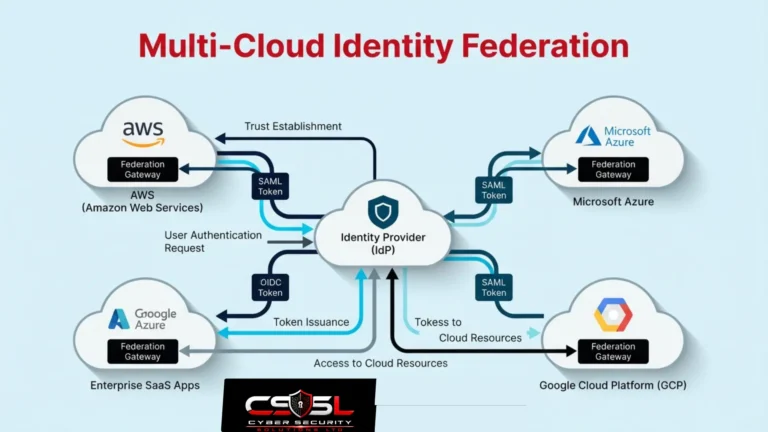
Hybrid environments require unified identity management through a federated identity provider like Microsoft Entra ID or Okta extending governance across both on-premise and cloud resources. Inconsistent identity management at the cloud-on-premise boundary is the most common critical hybrid security gap.
The hybrid environment is not simply a transitional state en route to full cloud migration. For many organizations it is the permanent operational reality for the foreseeable future, and it is the specific state most organizations occupy when cloud security incidents occur. Most cloud security guidance assumes either a purely cloud or purely on-premise context, leaving the hybrid practitioner without a clear framework for the specific risks the boundary itself creates.
The boundary between cloud and on-premise is not a security control; it is a gap. Attackers who gain a foothold in an on-premise environment actively look for cloud credentials and service access from that position, since cloud services often contain higher-value data than the on-premise systems through which initial access was gained. Conversely, attackers with cloud access probe for hybrid connections, VPN credentials, and synchronized identity stores providing a path into on-premise systems. Neither the on-premise security team monitoring internal network traffic nor the cloud security team monitoring API events has visibility into cross-boundary movements unless monitoring is explicitly unified.
Federated identity is both the solution and a critical attack target. A unified identity provider governing both on-premise Active Directory and cloud services provides the consistent governance hybrid environments need, but its synchronisation mechanisms require protection appropriate to a system with simultaneous access to both environments. Attacks against hybrid identity synchronization infrastructure are specifically documented in incident data because controlling synchronization provides access to both sides from a single position.
A SIEM or XDR platform receiving telemetry from both environments is essential for detecting cross-boundary attack patterns. Cyber Security Solutions Ltd helps organizations design security programmes that span cloud and on-premise environments consistently, specifically addressing the identity and monitoring gaps most commonly arising at the hybrid boundary. See Hybrid Cloud Security: Challenges, Solutions and Best Practices for the full implementation guidance.
Conclusion
Cloud security vs traditional security is not simply a technology upgrade; it is a structural model change requiring specific intuitions to be updated alongside specific tools. The perimeter is gone, responsibility is shared, and configuration risk joins vulnerability management as an equal priority. Visit cybersecuritysolutionsltd.com for a cloud security assessment identifying where your current programme needs to adapt for the cloud environment you are already running or preparing to build.
FAQs
The main difference is the replacement of network perimeter-based trust with identity-centric security, combined with the shared responsibility model dividing infrastructure security between provider and customer. Configuration risk becomes a primary cloud threat vector with no direct equivalent in traditional on-premise security, where vulnerability management centred on patching known CVEs in self-managed systems.
On-premise identity centred on Active Directory with network location providing implicit trust. Cloud requires explicit, granular IAM governing every resource independently. Cloud environments significantly expand identity scope through service accounts, API keys, and automated roles that require deliberate management, often outnumbering human accounts while receiving far less consistent security review than human credentials receive.
No. Cloud environments still use security groups, virtual private clouds, and cloud-native firewalls for network segmentation. However, network security shifts from primary defence to one layer within a broader control set where identity, configuration management, and data security often take precedence. Cloud security cannot be fully addressed by network security tooling alone.
Security awareness training, MFA, incident response processes, risk assessment methodologies, and audit logging requirements transfer directly. Traditional SIEM platforms, network-based IDS/IPS, and Active Directory-based access controls require cloud-specific extension or replacement rather than direct transfer, since cloud environments generate different telemetry types requiring different processing and detection rules.
Inconsistent identity management and monitoring coverage across the cloud-on-premise boundary is the most common critical gap. Attackers specifically exploit this seam, pivoting between environments. Unified identity federation and a SIEM or XDR platform covering both environments are the foundational controls required to detect and contain cross-boundary attack patterns effectively.
No. GDPR, HIPAA, PCI DSS, and equivalent frameworks apply equally to cloud-hosted data. The specific technical controls adapt to cloud architecture, but regulatory obligations do not diminish because a cloud provider hosts the data. The organization remains fully responsible for the security and compliance of its data regardless of where it resides.