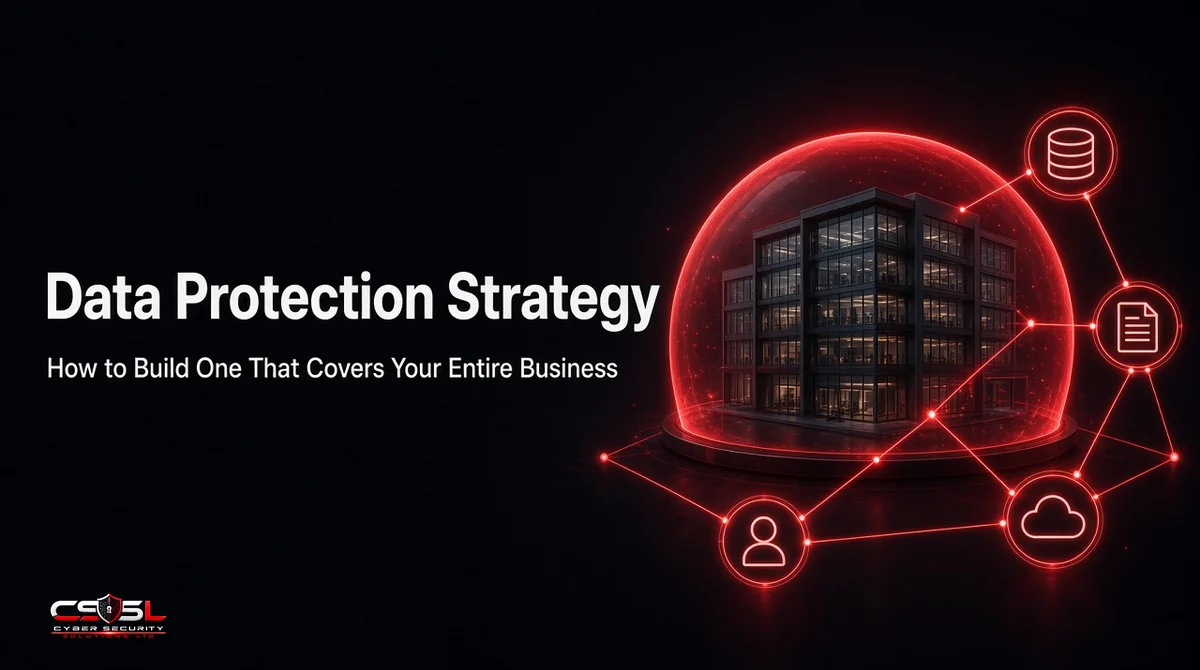
Data Protection Strategy: How to Build One That Covers Your Entire Business
A data protection strategy is the documented framework covering how your business discovers, classifies, secures and governs data across every system, not a single tool you install once and forget. If you have treated data protection as whatever your antivirus or backup software happens to cover, that gap is exactly what leaves most businesses exposed.
What Is a Data Protection Strategy, and How Is It Different From a Single Security Tool?
A data protection strategy is a documented, organization-wide framework governing how data gets discovered, classified, secured, retained and eventually deleted across every system your business uses. A single security tool, encryption software, a backup solution, addresses one specific piece of that broader picture.
The distinction matters directly because businesses commonly assume a strong tool stack alone equals a genuine strategy. It doesn’t. A tool without documented policy, clear ownership and ongoing monitoring behind it protects only the specific gap it was built for, leaving everything else genuinely uncovered.
The Four Pillars of Data Governance
Data governance rests on four pillars working together. Ownership assigns clear, named responsibility for specific data categories, so accountability never sits with everyone and therefore no one. Quality ensures data remains accurate, consistent and genuinely fit for its intended purpose across every system storing it.
Security protects data from unauthorized access or loss through the specific technical controls, encryption, access management, monitoring, this guide develops further below. Compliance ensures data handling genuinely meets applicable legal and regulatory obligations, not just internal policy preference. Removing any one pillar weakens the other three, since ownership without quality standards produces inconsistent data, and security without compliance still exposes real legal risk.
A Practical Roadmap: Inventory, Policy, Leadership, Training, Monitoring
Start with a genuine data inventory, identifying what data exists, where it lives, and how sensitive it actually is, since you cannot protect data you do not know exists. Build documented policy directly from that inventory, defining retention periods, access rules and handling requirements for each specific data category identified.
Secure named leadership sponsorship before rolling out policy broadly, since a framework without genuine executive backing typically loses priority the moment a competing business need arises. Train staff specifically on the policy that applies to their own role, rather than generic, one-size-fits-all awareness content covering everything and retaining little. Establish continuous monitoring confirming the policy remains followed in practice, not simply documented and forgotten once the initial rollout finishes.
Connecting the Pieces: Where DSPM, DLP, Encryption and Compliance Monitoring Fit
These specific tools each answer a genuinely different question within the broader strategy. DSPM discovers and classifies where sensitive data actually lives across your environment, directly supporting the inventory step covered above. DLP enforces policy on data movement, blocking unauthorized transfer once your governance framework has defined what counts as authorized in the first place.
Encryption protects data confidentiality specifically, both at rest and in transit, addressing the security pillar directly. Compliance monitoring verifies these controls remain genuinely effective on an ongoing basis, rather than assuming a point-in-time implementation stays correct indefinitely. None of these tools substitutes for the broader strategy; each one implements a specific piece the governance framework already defined.
Why Most Governance Frameworks Fail
Here is a genuinely important point most guidance misses entirely: governance frameworks rarely fail because the technology was wrong. They fail because ownership was never genuinely clear, and enforcement never followed documentation.
A policy document sitting in a shared drive, with no named individual responsible for confirming it gets followed, is not a working framework, it is a written intention. Staff quietly work around policies that create friction without anyone genuinely checking, precisely because nobody was ever assigned the specific job of checking. Technology purchased to support a governance framework then gets blamed for the resulting gap, when the real failure sat entirely upstream, in unclear ownership and missing enforcement, long before any tool was ever deployed. Fixing this requires assigning specific, named accountability for each governance element, and building genuine, recurring verification into the process, not simply documenting policy once and assuming it holds.
Start Small: A Realistic First 90 Days
In the first 30 days, complete a genuine data inventory covering your highest-risk systems specifically, rather than attempting exhaustive coverage across everything simultaneously. In the next 30 days, draft policy directly from that inventory and secure leadership sign-off before rolling anything out broadly.
In the final 30 days, train staff on the specific policy affecting their own role and establish a basic, recurring monitoring check, even a simple quarterly review. Cyber Security Solutions Ltd builds exactly this phased 90-day approach for businesses starting from nothing, since attempting a complete, enterprise-scale framework immediately typically stalls before any single piece genuinely gets implemented.
What AI Project Failure Rates Mean for Your Data Strategy
Gartner’s own research, published in February 2025, predicts that 60% of AI projects will be abandoned through 2026 specifically due to a lack of AI-ready data, with only 12% of organizations currently having data of sufficient quality to support AI applications at all.
This connects directly to your own data protection strategy, not just AI initiatives specifically. Data that is inconsistent, poorly classified or scattered across ungoverned systems fails AI projects for precisely the same underlying reason it fails genuine security and compliance efforts too: nobody can trust or effectively act on data nobody has properly governed. Businesses building AI capability on top of a genuinely governed data foundation, clear ownership, consistent quality standards, documented classification, avoid exactly the failure pattern Gartner’s own research identifies, since the same governance discipline this guide has developed throughout directly determines whether any AI initiative built on that data has a real chance of succeeding.
What UK GDPR Specifically Requires: Accountability and Your Data Protection Officer
UK GDPR’s Accountability principle, set out in Article 5(2), requires organizations to be responsible for, and genuinely able to demonstrate compliance with, the core data protection principles, not simply comply with them quietly. This means documented evidence, records of processing activities, training logs, policy documentation, matters as much as the underlying compliance itself.
A formal Data Protection Officer is specifically required for public authorities, organizations conducting large-scale systematic monitoring, or organizations processing special category data at scale. Smaller businesses outside these categories are not legally required to appoint one, though someone within the organization should still hold clear, named responsibility for data protection oversight, directly reflecting the ownership pillar covered earlier in this guide.
Conclusion
A data protection strategy only genuinely works when ownership, policy and monitoring reinforce each other, since technology alone, however capable, cannot substitute for governance nobody is accountable for maintaining. Start with a focused inventory of your highest-risk systems this month, not a complete framework attempted all at once. To build a phased data protection strategy for your business, visit cybersecuritysolutionsltd.com for expert support from Cyber Security Solutions Ltd.
FAQs
A documented, organization-wide framework covering how data gets discovered, classified, secured, retained and eventually deleted across every system a business uses, distinct from any single security tool that addresses only one specific piece of that broader picture.
Ownership, assigning clear responsibility for data categories. Quality, ensuring data stays accurate and consistent. Security, protecting data from unauthorized access or loss. Compliance, ensuring handling genuinely meets legal obligations. All four work together, and weakening one weakens the rest.
Rarely due to wrong technology. Most fail because ownership was never genuinely clear and enforcement never followed documentation. A policy with no named individual confirming it gets followed is a written intention, not a working framework.
Gartner predicts 60% of AI projects will be abandoned through 2026 due to lack of AI-ready data, with only 12% of organizations having sufficiently governed data quality. Poorly governed data undermines AI initiatives for the same reasons it undermines security and compliance.
Only if you are a public authority, conduct large-scale systematic monitoring, or process special category data at scale. Smaller businesses outside these categories are not legally required to appoint one, though someone should still hold clear data protection responsibility.
Begin with a genuine data inventory of your highest-risk systems, draft policy directly from what you find, secure leadership sign-off, then train staff and establish recurring monitoring, following a phased 90-day approach rather than attempting everything simultaneously.