EDR Gartner Magic Quadrant: Who Leads the Market?
There is no separate “EDR Gartner Magic Quadrant.” Gartner evaluates this space under its Magic Quadrant for Endpoint Protection, currently naming Sophos, CrowdStrike, Microsoft and Palo Alto Networks as Leaders. If you have been searching specifically for an EDR-only report, that search itself explains a genuine, common misunderstanding worth clearing up directly.
EDR Magic Quadrant: Here’s What Gartner Actually Evaluates
Gartner’s flagship report in this space was previously titled “Magic Quadrant for Endpoint Protection Platforms.” For its 2026 edition, published May 26, 2026, Gartner dropped “Platforms” entirely, renaming it simply the “Magic Quadrant for Endpoint Protection.” This is not a cosmetic change.
The rename reflects Gartner’s own current position that endpoint protection is no longer meaningfully separable into distinct prevention and detection categories. Gartner’s own framing states this directly: endpoint protection is “no longer simply about stopping attacks on a device,” but about detecting, understanding and responding to threats moving across users, identities, endpoints, networks, cloud environments, email and browsers together. In other words, Gartner evaluates unified endpoint protection, prevention and EDR capability combined, as one single category, precisely because the analyst firm concluded evaluating them separately no longer reflects how these platforms genuinely function or how organizations should actually be comparing them. If you have been searching for an “EDR Magic Quadrant” specifically, distinct from broader endpoint protection, that search reflects exactly the outdated separation Gartner’s own rename was designed to correct.
Who Are the Current 2026 Leaders, and How Long Have They Held That Position?
| Vendor | Consecutive Years as Leader |
| Sophos | 17 |
| CrowdStrike | 7 |
| Microsoft | 7 |
| Palo Alto Networks | 4 |
The 2026 Magic Quadrant for Endpoint Protection names four vendors as Leaders. Sophos holds this position for the 17th consecutive report, the longest sustained tenure among current Leaders. CrowdStrike and Microsoft each hold Leader status for the seventh consecutive time, with CrowdStrike specifically positioned furthest for Completeness of Vision and highest for Ability to Execute among all evaluated vendors this cycle. Palo Alto Networks earned Leader status for the fourth consecutive year, with recent positioning emphasizing its approach to emerging agentic AI security challenges.
This tenure data matters beyond simple bragging rights. Sustained, multi-year Leader status across changing evaluation criteria genuinely demonstrates consistency, a vendor repeatedly meeting Gartner’s evolving standards year after year, rather than a single strong showing in one specific evaluation cycle.
What Does Leader Mean? Ability to Execute vs Completeness of Vision, Explained
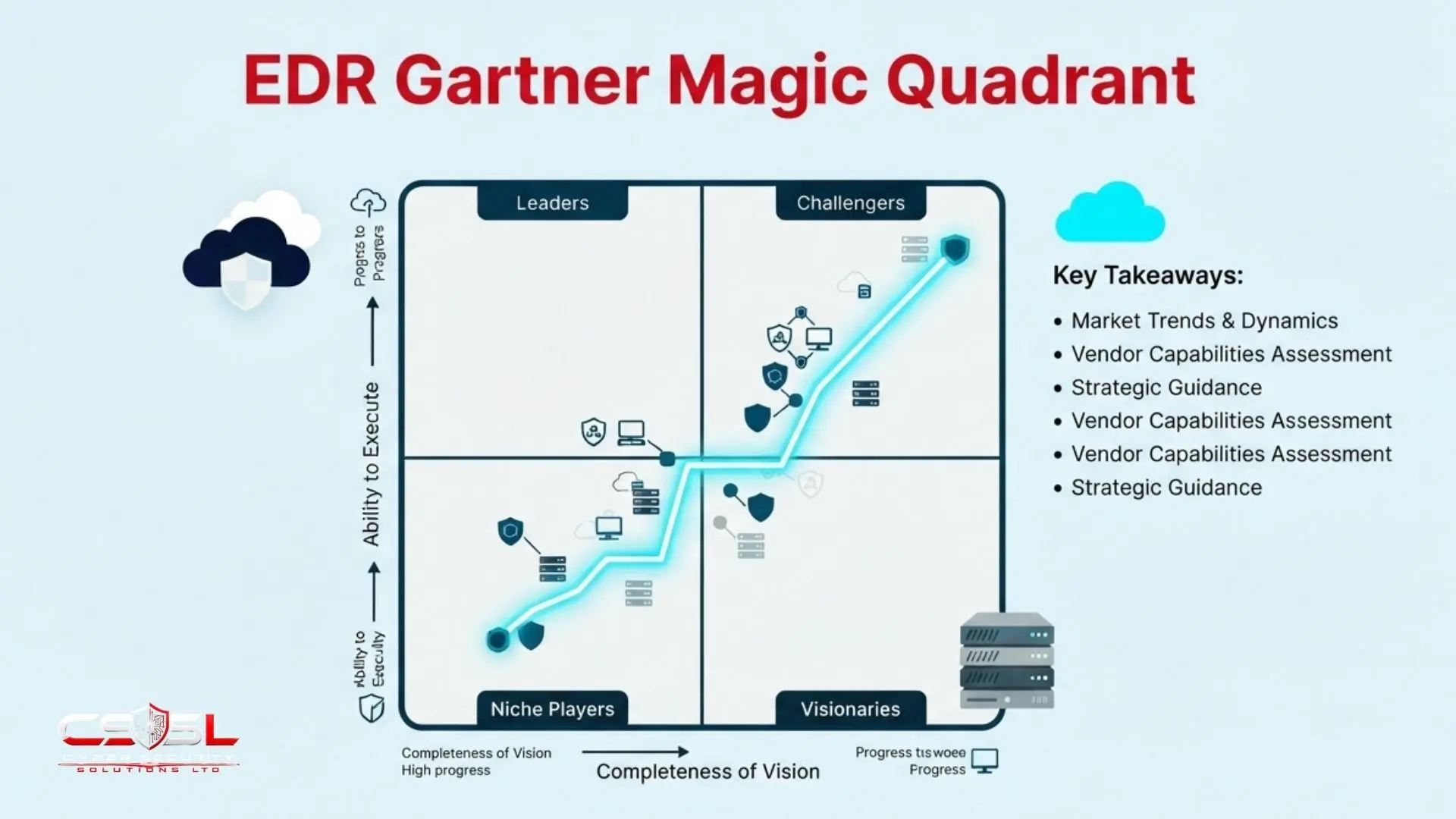
Gartner’s Magic Quadrant plots vendors across two independent axes. Ability to Execute evaluates current performance directly: product capability, financial viability, sales effectiveness, customer support quality and operational execution today. Completeness of Vision evaluates strategic direction instead: market understanding, product roadmap, innovation plans and how well a vendor anticipates where the market is genuinely heading next.
A vendor lands in the Leaders quadrant specifically by scoring highly on both axes simultaneously, strong current execution combined with a genuinely forward-looking strategic direction. This distinguishes Leaders from Visionaries, strong on vision but weaker on current execution, and Challengers, strong current execution without the same forward-looking strategic depth. Understanding this two-axis structure matters directly for interpreting what “Leader” actually signals: not simply “biggest” or “most popular,” but a specific combination of proven current capability and credible future direction, evaluated independently rather than as a single blended score.
Why the Magic Quadrant Is a Starting Point, Not a Conclusion
The Magic Quadrant evaluates vendors against Gartner’s own general market criteria, reflecting broad, aggregate priorities across the entire endpoint protection market rather than your own organization’s genuinely specific requirements. A vendor’s overall Leader position tells you they perform strongly on average across Gartner’s chosen criteria, not that they are automatically the correct choice for your specific environment, industry, or team’s operational capacity.
An organization with extensive Linux infrastructure, unusual compliance obligations, or a genuinely small internal team without dedicated security staff may find a vendor positioned lower on the overall quadrant, or not evaluated in the quadrant at all, actually fits their specific situation better than the vendor Gartner ranks highest in aggregate. The Magic Quadrant is precisely designed as a starting reference point for building your own shortlist, not a final purchasing decision made on its own. Treating quadrant position as the entire decision skips the genuinely important step of mapping that general market position against your own specific, concrete requirements.
The Report Most Buyers Never Check: Gartner’s Critical Capabilities
Here is a genuinely underused companion report most buyers never consult, despite it often mattering more for a specific purchasing decision than quadrant position alone. Gartner publishes a separate “Critical Capabilities” report alongside the Magic Quadrant, using a fundamentally different methodology: rather than one aggregate score across general market criteria, Critical Capabilities scores vendors against specific, named use cases, weighted differently depending on which use case you actually care about.
This matters enormously in practice. A vendor scoring strongly overall in the Magic Quadrant might score considerably lower for a specific use case genuinely relevant to your organization, small business deployment, heavy Linux environments, cloud-native workload protection, than a different vendor positioned lower in the overall quadrant but scoring specifically higher for that exact use case. The Magic Quadrant answers “who performs well broadly.” Critical Capabilities answers “who performs well specifically for the situation I actually have.” Buyers who stop at the Magic Quadrant alone are making a decision based on general market positioning, while buyers who also check Critical Capabilities against their own specific use case are making a decision based on genuine fit. This single additional step, checking a report most buying guides never mention, is precisely the difference between choosing the vendor Gartner ranks highest overall and choosing the vendor genuinely best suited to your own specific requirements.
What License Price Doesn’t Tell You: The Real 3-5x TCO Multiplier
License price is only the starting point of what an EDR platform genuinely costs, and the real multiplier deserves honest, specific attention rather than a vague warning. Independent total cost of ownership analysis across multiple EDR-specific sources consistently points to a realistic multiplier of two to three times the quoted annual license cost for a complete, accurate picture, with more complex or poorly tuned deployments pushing toward the higher end of a broader two-to-five-times range.
This multiplier comes from several genuine, specific cost categories rarely reflected in a vendor’s headline quote. Deployment and initial tuning commonly requires meaningful upfront time investment before a platform runs cleanly. Out-of-the-box configurations generate significant false positive rates, often 20 to 40 percent of alerts in the first 90 days before proper tuning, each one requiring analyst time to investigate and dismiss. Server endpoints frequently carry a two-to-three-times pricing premium over standard workstation endpoints, meaning an environment with a meaningful server count can see licensing costs considerably higher than a simple per-endpoint estimate suggests. Data retention beyond a basic default window, incident response retainer fees when a genuine incident occurs, and annual price escalation clauses commonly running five to fifteen percent round out the categories that consistently push real total cost well beyond the quoted license price alone. Budgeting using the license quote alone, without applying this realistic multiplier, is the single most common way organizations end up with a genuine budget shortfall discovered only after deployment is already underway.
How Does This Map Onto UK Cyber Essentials? A Separate Question Entirely
NCSC’s Cyber Essentials scheme requires malware protection as one of five core technical controls, satisfied through any one of three approved approaches: anti-malware software, application allow-listing, or sandboxing. Baseline, properly configured antivirus is explicitly confirmed as sufficient to meet this specific requirement, including for Cyber Essentials Plus in many environments where an assessor actively attempts to deliver malware during testing.
This means Gartner Leader status and Cyber Essentials compliance are genuinely separate questions, worth keeping distinct rather than conflating. Every vendor covered throughout this guide, whether positioned as a Leader or elsewhere on the quadrant, exceeds what Cyber Essentials itself mandates as a baseline requirement. Achieving Cyber Essentials certification tells you nothing about where a specific vendor sits on Gartner’s own evaluation, and conversely, choosing a Gartner Leader tells you nothing directly about your Cyber Essentials compliance status, since basic antivirus alone already satisfies that specific requirement. Cyber Security Solutions Ltd routinely helps UK organizations keep these two genuinely distinct evaluations separate, since conflating “which vendor Gartner ranks highest” with “what our compliance scheme actually requires” leads to decisions answering the wrong question for whichever goal matters most in a given moment.
How Should You Use This Ranking When Buying?
Use Magic Quadrant position to build an initial shortlist of credible, well-established vendors, not as the final decision itself. Check the companion Critical Capabilities report specifically against your own genuine use case, small business deployment, heavy Linux infrastructure, cloud-native workloads, rather than relying on overall quadrant position alone.
Apply the realistic two-to-five-times TCO multiplier to any license quote before comparing vendors financially, since comparing raw license prices alone routinely produces a misleading picture once deployment, tuning and ongoing operational costs get included honestly. Separately confirm your own specific compliance obligations, Cyber Essentials or otherwise, since meeting those requirements is a genuinely distinct question from where a vendor sits on Gartner’s own ranking. Treat this ranking as the credible starting point it genuinely is, then do the specific, honest homework, use case fit, realistic total cost, your own compliance requirements, that turns a general market position into an actual, informed purchasing decision for your own organization.
Conclusion
The Gartner Magic Quadrant for Endpoint Protection is a genuinely credible starting point for building a vendor shortlist, but Leader status alone answers a broader question than the one your own organization actually needs answered. Check the Critical Capabilities report against your specific use case, and apply a realistic total cost multiplier before comparing vendors on price alone.
FAQs
No. Gartner’s report was renamed from “Magic Quadrant for Endpoint Protection Platforms” to simply “Magic Quadrant for Endpoint Protection” for its 2026 edition, evaluating unified prevention and detection capability together as one category, not EDR as a separately evaluated market segment.
Sophos, recognized for the 17th consecutive report; CrowdStrike and Microsoft, each recognized for the seventh consecutive time; and Palo Alto Networks, recognized for the fourth consecutive year, are the current 2026 Leaders in Gartner’s Magic Quadrant for Endpoint Protection.
Ability to Execute evaluates current performance: product capability, financial viability, and operational execution today. Completeness of Vision evaluates strategic direction: market understanding, product roadmap, and how well a vendor anticipates future market needs. Leaders score highly on both axes.
It’s a companion report scoring vendors against specific, named use cases with different weightings, rather than one aggregate score. A vendor ranking highly overall might score lower for your specific use case than a different vendor positioned lower in the general Magic Quadrant.
Realistically, two to three times the quoted annual license cost, sometimes up to five times for complex or poorly tuned deployments. This includes deployment and tuning time, false positive investigation, server endpoint premiums, data retention, and incident response retainer fees.
These are separate questions. Cyber Essentials’ malware protection control is satisfied by baseline anti-malware software, which every vendor in this guide exceeds regardless of quadrant position. Gartner ranking reflects market positioning, not compliance status, and neither implies the other.