What Is Network Perimeter Security and Is It Still Relevant in 2026?
Network perimeter security is not dead, but it can no longer stand alone. It refers to the practice of placing defensive controls at the boundary between your trusted internal network and the open internet. In 2026, it remains useful for specific systems, just not as your only line of defense.
What Is Network Perimeter Security?
Network perimeter security means concentrating your strongest defenses at the edge of your network, the point where your internal systems meet the outside internet. This is the same logic behind network zones, the DMZ pattern, and layered defense strategies many businesses already use. If you’re new to those concepts, it helps to understand how zones and layered defense work before reading further, since this article builds directly on top of that foundation rather than repeating it.
Why Did the Traditional Perimeter Model Make Sense for So Long?
For most of network security’s history, this model made sense because business assets sat inside a handful of locations a company fully controlled.
Think about a typical office in the 1990s or 2000s. Employees worked from desks inside the building. Servers sat in a back room or a nearby data center. Almost everything that mattered lived within four walls the business owned or leased.
Under those conditions, trusting anything “inside” the network was not naive. It was a reasonable, efficient design choice given the reality businesses faced. This is where the castle and moat comparison comes from. You build strong walls around a space you can clearly define, and you defend the gate hard because you know exactly where the gate is.
That approach worked well for decades. The problem is not that it was ever wrong. The problem is that the world it was built for has changed.
What Has Changed by 2026, and Why Does the Perimeter Struggle With It?
The perimeter struggles today because a large share of legitimate business traffic no longer comes from inside any definable boundary at all.
Four shifts explain why:
- Cloud adoption: Business data and applications increasingly run on infrastructure the organization doesn’t own or physically control. This overlaps with cloud security topics that deserve their own separate treatment, but the short version is simple: if your data lives outside your walls, your wall can’t protect it.
- Remote and hybrid work: This is no longer a temporary exception. It is the normal way many teams operate. A meaningful share of legitimate traffic now starts from home networks, coffee shops, and shared workspaces the business has zero control over.
- BYOD and mobile devices: Personal phones, tablets, and laptops connect to business systems constantly, and they blur the very edge the perimeter model depends on being clearly defined.
- SaaS and third-party tools: Payroll software, customer databases, project management tools. Many of these now live entirely on someone else’s servers, outside any boundary your business controls.
Put these four together and you get the real technical problem. The perimeter model assumes “inside” can be trusted and “outside” cannot. Once a large portion of legitimate traffic has no stable inside to begin with, that assumption stops holding up.
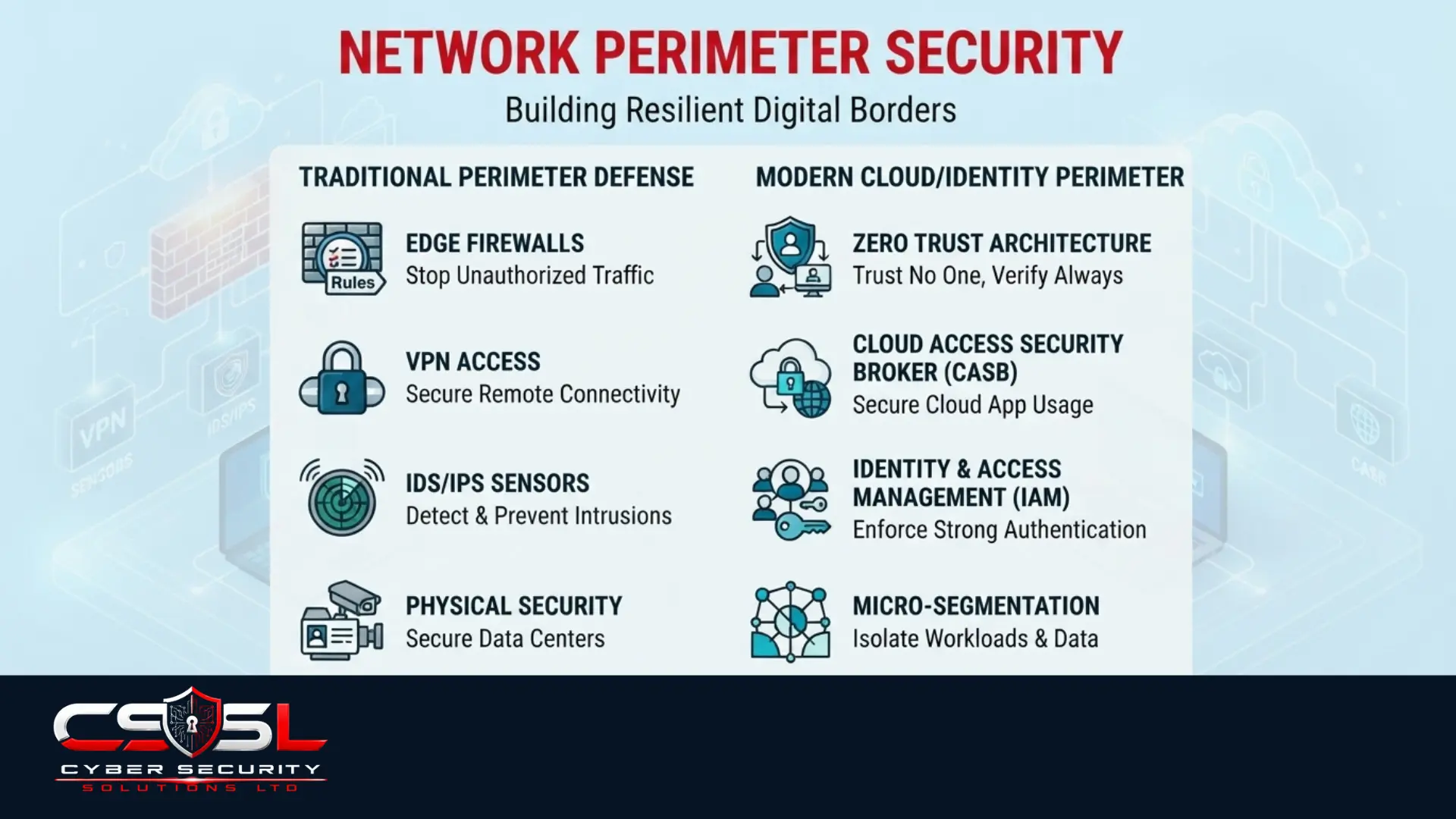
Where Perimeter Thinking Still Fits vs Where It Has Broken Down
| Scenario | Still Relevant | No Longer Sufficient Alone | Why |
| On-premise infrastructure | Yes | — | The organization still controls a defined physical boundary |
| Industrial and OT environments | Yes | — | Strict boundary control remains standard, appropriate practice |
| DMZ-hosted, internet-facing systems | Yes | — | Sound approach for any system that must face the internet |
| Cloud applications | Partial | Yes | The application lives outside any boundary the business controls |
| Remote workforce access | Partial | Yes | Traffic originates from networks the business doesn’t control |
Is the Perimeter Dead, or Is That Framing Itself the Problem?
Neither extreme is honest. The perimeter is not dead, and it is also not still fully sufficient on its own.
Most articles on this topic pick a side. One camp declares the perimeter dead and moves on. The other insists nothing has really changed and boundary defense is still enough. Both positions are lazy, and both cause real damage.
Here’s what actually happens when a business takes the “dead” framing literally. A security team reads enough headlines calling the perimeter obsolete, so they quietly deprioritize firewall upgrades, stop patching edge devices as urgently, and shift every dollar toward newer buzzword tools. Then a ransomware group walks in through an unpatched, internet-facing server that a firewall rule could have blocked in the first place. That’s not a hypothetical. It’s one of the most common breach patterns tracked in incident reports year after year, and it happens specifically because someone believed boundary defense no longer mattered.
The honest position sits in the middle, and it’s more useful than either extreme. Perimeter security is not obsolete. It’s one necessary layer inside a broader defense strategy, but it can no longer serve as your primary or only line of defense the way it reasonably could decades ago. Treating it as dead leads to underinvestment in controls you still genuinely need. Treating it as sufficient leaves your cloud apps, remote workers, and SaaS tools completely unprotected.
Where Does Perimeter Security Still Genuinely Matter Today?
Perimeter defense still matters directly for three specific situations, not as a blanket rule for your entire network.
On-premise infrastructure and data centers. If you still run physical servers in a location you control, boundary defense around that infrastructure remains a smart, necessary investment. Plenty of businesses, especially in manufacturing, healthcare, and finance, still operate this way.
Industrial and operational technology environments. Factories, utilities, and industrial control systems rely on strict boundary control and air-gapping as standard, appropriate practice. These systems often can’t be patched or updated the way office laptops can, so keeping them isolated behind a hard boundary is one of the few reliable defenses available.
Internet-facing systems using a DMZ. Any system that must be reachable from the public internet, like a web server or an email gateway, still benefits from being placed in an isolated zone separated from your core network. This pattern hasn’t lost any relevance just because other parts of your architecture moved to the cloud.
The point here is simple. Perimeter thinking hasn’t disappeared. It has narrowed to where it genuinely still fits, instead of trying to serve as the organizing principle for your entire modern network.
What Does a Modern, Perimeter Strategy Look Like?
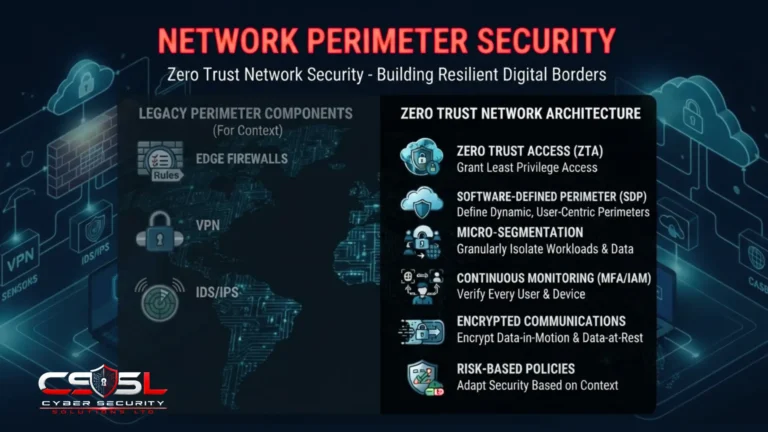
A modern perimeter strategy treats boundary controls as one layer among several, then extends that same scrutiny to every resource, not just your traditional network edge.
Here’s the shift most businesses miss. It’s tempting to think of “the perimeter” as one single line you defend once. In reality, every cloud application your team uses is its own small perimeter. Every remote employee’s laptop is its own small perimeter. Every third-party integration pulling data from your systems is its own small perimeter too.
This isn’t a small semantic point. It changes how you allocate your security budget. Instead of pouring most of your resources into one firewall at the network edge, you distribute boundary-style controls across every meaningful access point: identity verification for cloud logins, device checks for remote workers, and access limits for third-party integrations. Perimeter thinking hasn’t gone away. It has multiplied into dozens of smaller boundaries that each need their own attention.
This is exactly the kind of layered approach the team at Cyber Security Solutions Ltd builds for clients who are trying to modernize an older, edge-focused network without throwing away the parts that still work. You don’t need to rip out your firewall. You need to stop expecting it to do a job it was never built to do alone.
Where Does This Leave You, and Why Does Zero Trust Come Next?
This is exactly the gap zero trust was built to close. Instead of trusting anything based on where it connects from, zero trust verifies every single access request individually, whether it comes from inside your office or from a laptop in another country.
That’s a full topic on its own, and it deserves proper treatment rather than a rushed explanation here. What matters for now is understanding why it exists: it’s the industry’s direct response to the exact problem this article just walked through.
Conclusion
Perimeter security earned its reputation for a reason, and it hasn’t lost its usefulness completely. What’s changed is the size of the job it’s expected to do. Treat it as one strong layer among several, not your entire strategy, and you’ll avoid the two most common mistakes businesses make with it today.
FAQs
No. It’s no longer sufficient on its own, but it remains a necessary layer, particularly for on-premise infrastructure, industrial systems, and internet-facing servers placed in a DMZ.
No. Firewalls still protect real, definable infrastructure. The shift is toward treating them as one layer of defense rather than your entire security strategy.
Not pointless, just limited. Cloud applications mostly live outside any boundary you control, so perimeter defense needs to be paired with controls that follow your data and your users.
Yes. The DMZ pattern remains sound for any system that must face the public internet, regardless of how much of your other infrastructure has moved to the cloud.
Remote work means a large share of your traffic starts outside your network entirely. That’s exactly why boundary-style checks need to extend to devices and user identity, not just physical location.
Yes. Zero trust doesn’t remove the need for boundary controls where a physical edge still exists. It extends that same verification mindset to everything that doesn’t have one.