Cloud Security for Financial Services: Compliance and Protection Guide
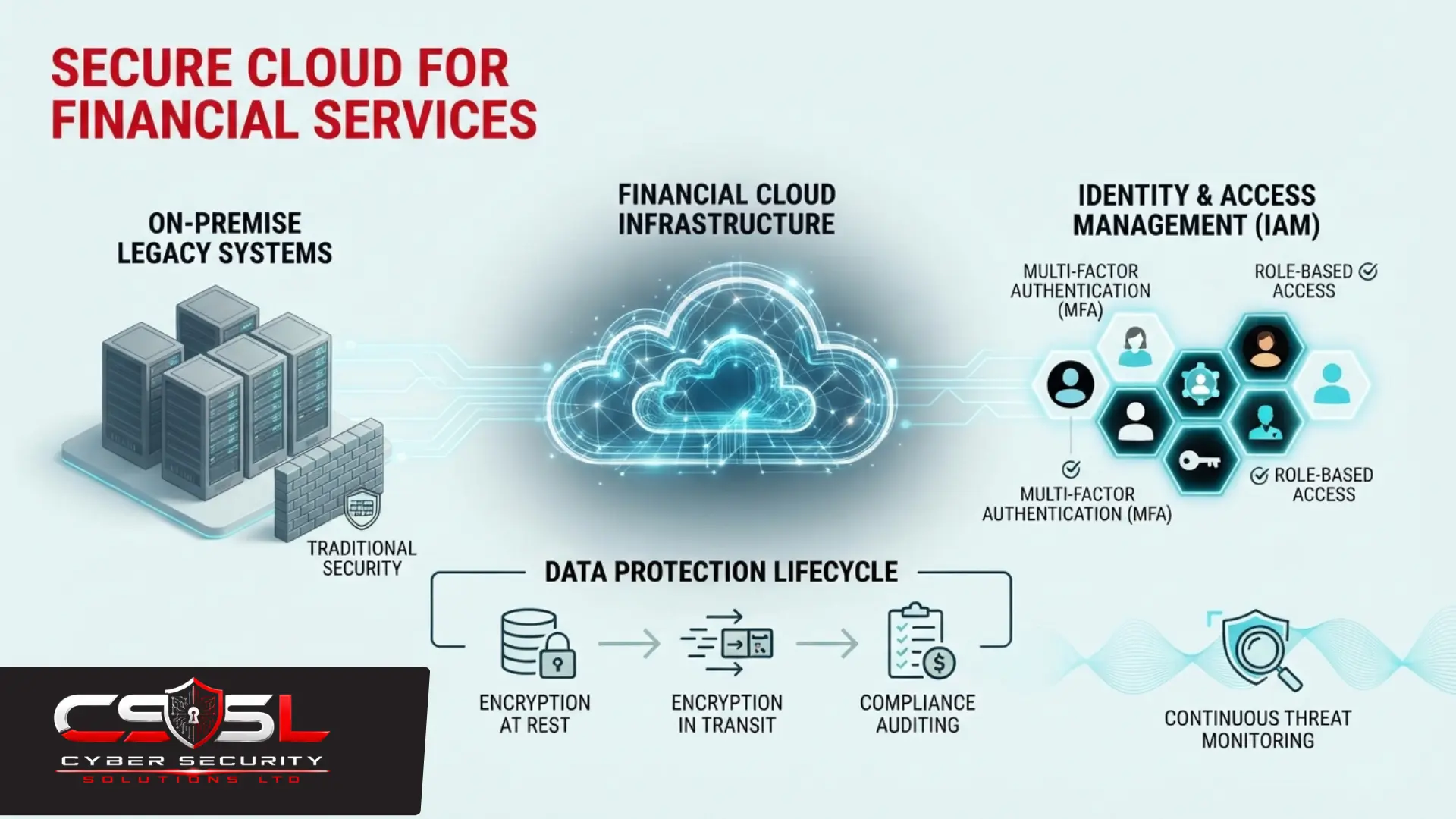
Financial services cloud security extends general compliance obligations into sector-specific regimes including PCI DSS, DORA, and SWIFT CSP, while introducing distinctive architectural pressures like cloud concentration risk and personal regulatory accountability that general cloud compliance guidance does not address.
If your board asked what your exit strategy is when your cloud provider has a major outage and you do not have a real answer beyond a contract clause, or a named senior manager is now personally accountable for your cloud risk under SM&CR and you have never mapped that responsibility properly, this guide gives you the sector-specific depth general compliance content stops short of.
What Does Financial-Sector-Specific Cloud Security Add Beyond the General Compliance Mechanics Already Covered in This Cluster?
Financial services cloud security applies the same discipline general compliance methodology establishes to a distinct set of regimes shaping this sector specifically, PCI DSS, DORA, SWIFT CSP, FFIEC, and SEC disclosure rules, while introducing genuinely sector-specific architectural pressures none of those regimes address in isolation.
Financial services follows healthcare as the second industry vertical because both sectors combine heavy regulatory obligation with distinctive systems, but financial services introduces a genuinely different category of pressure: systemic, sector-wide regulatory concern about the cloud market itself. This post assumes shared responsibility, general compliance methodology, CIEM’s entitlement analysis, and the general framework landscape are already understood.
Why Is Financial Services Distinctly Exposed, and What Makes Cloud Risk Different in This Sector?
Unlike most sectors where a breach primarily threatens data confidentiality, financial services cloud infrastructure frequently sits directly upstream of the ability to move money, meaning a compromised identity or misconfigured permission can translate into immediate financial loss rather than a data exposure requiring further exploitation. IBM’s Cost of a Data Breach Report consistently ranks financial services among the most expensive sectors for breach costs, reflecting both regulatory penalty exposure and transaction volume scale.
Complex organizational structures from mergers, acquisitions, and multi-entity group structures create cross-account trust relationships and legacy access grants at a scale most other sectors do not encounter. This post does not repeat business email compromise and wire fraud content, which is covered in full depth within the Email Security content pillar; this post addresses the underlying cloud infrastructure and regulatory architecture surrounding financial services specifically.
How Does PCI DSS Apply to Cloud Environments Handling Payment Card Data?
PCI DSS applies to any entity that stores, processes, or transmits cardholder data, regardless of hosting environment, with the Cardholder Data Environment representing the specific, defined boundary of systems actually handling card data subject to PCI DSS requirements in full. Segmentation properly isolating the CDE from broader cloud infrastructure can significantly reduce the number of systems subject to full assessment, making segmentation as much a compliance-cost decision as a security one.
Cloud providers frequently hold their own PCI DSS Attestation of Compliance for underlying infrastructure, but this never automatically extends to the customer’s own CDE-specific configuration, access control, and encryption implementation. Many organizations choose to outsource raw card data handling entirely to a compliant third-party payment processor, dramatically shrinking their own CDE and compliance burden. PCI DSS v4.0 emphasizes stronger authentication and continuous, rather than point-in-time, compliance monitoring.
PCI DSS deserves reframing explicitly as a targeted application of controls already established elsewhere in a mature cloud security programme, rather than an entirely separate compliance discipline requiring its own parallel control set, and this reframing is precisely what most competitor content misses by treating PCI DSS as its own isolated silo.
Vulnerability management, one of the twelve PCI DSS requirement categories, maps directly onto continuous configuration and posture monitoring practices any organization running a mature CSPM programme already has in place. Strong access control requirements map onto cloud IAM discipline already established for least-privilege access and multi-factor authentication generally. Continuous monitoring requirements map onto the same audit logging and threat detection coverage a broader cloud security programme already maintains for reasons entirely unrelated to PCI DSS specifically.
This means an organization that has already built mature CSPM, IAM, and monitoring practices for its own general risk management purposes is, in practice, already substantially compliant with a meaningful proportion of PCI DSS’s technical requirements before ever specifically targeting PCI DSS as a compliance goal. The remaining work is scoping, precisely defining and segmenting the CDE, and demonstrating that existing controls apply correctly and consistently within that specific boundary, rather than building an entirely new, parallel security programme from scratch specifically for card data. Organizations that treat PCI DSS as a wholly separate discipline requiring dedicated new tooling and processes are frequently duplicating effort their existing cloud security programme already covers, while organizations that correctly recognize PCI DSS as a targeted, scoped application of existing controls can achieve compliance considerably more efficiently.
What Is Cloud Concentration Risk, and Why Are Regulators Treating It as a Systemic Concern?
Cloud concentration risk is the systemic exposure created when a large proportion of the financial sector relies on a small number of the same cloud providers, meaning a major outage or failure at one hyperscaler could simultaneously disrupt many institutions and potentially threaten broader financial stability, not just one organization’s own operations. The UK’s Critical Third Parties regime, established jointly by the Bank of England, PRA, and FCA, brings certain cloud and technology providers under direct regulatory oversight for the first time, independent of any single financial institution’s own relationship with them. US regulatory attention, while less formalized, is present through OCC and Federal Reserve third-party risk guidance increasingly naming cloud concentration as a specific supervisory focus.
Cloud concentration risk deserves treatment as the standout, current, sector-defining concern reshaping cloud architecture decisions across financial services right now, and this is precisely the depth most competitor content on this topic entirely lacks, defaulting instead to generic phishing or SOC 2 advice with no engagement of the actual regulatory pressure reshaping the sector this year.
This matters at the individual institution level, not just systemically. Your own risk assessment should explicitly treat concentration risk as its own named category, distinct from generic cloud outage risk, asking specifically what happens to your institution during an extended outage at your primary provider and whether your existing incident response plan genuinely addresses that scenario, rather than assuming standard business continuity planning already covers it adequately.
Multi-cloud represents a genuine mitigation, but the trade-off deserves stating honestly rather than presenting it as a costless best practice organizations should simply adopt. True, workload-portable multi-cloud meaningfully reduces concentration risk by eliminating single-provider dependency, but it reintroduces multi-cloud complexity costs, inconsistent tooling, fragmented visibility, and duplicated configuration effort across genuinely different platform architectures. This is a genuine trade-off decision requiring honest weighing against your institution’s specific risk profile and operational capacity, not a default recommendation every financial institution should pursue regardless of size or resourcing. A smaller institution forcing itself into premature multi-cloud complexity specifically to address concentration risk may introduce more operational risk through inconsistent security posture across two poorly-managed environments than it removes through provider diversification, meaning this decision genuinely requires case-by-case judgement rather than blanket industry advice treating multi-cloud as an unambiguous improvement regardless of context.
What Does DORA and UK Operational Resilience Regulation Actually Require of Your Cloud Architecture?
DORA requires maintaining a register of all ICT third-party arrangements including every cloud service in use, conducting regular risk assessments of those arrangements, ensuring contracts contain specific required provisions including audit rights and exit terms, and testing digital operational resilience regularly, including threat-led penetration testing for the most significant entities. UK operational resilience rules require firms to identify their own important business services, set defined impact tolerances for disruption to each one, and map the technology, including cloud infrastructure, supporting those services, with mandatory board-level sign-off and regulatory reporting attached.
A defined impact tolerance for a critical service effectively mandates specific redundancy, failover, and potentially multi-region or multi-cloud architecture decisions that general architecture guidance would otherwise treat as optional based on risk appetite alone. DORA’s ICT risk management requirements substantially mirror the NIST CSF functions already established across general framework guidance, Govern, Identify, Protect, Detect, Respond, Recover, giving financial services readers a natural, already-familiar structure to organize this binding regulatory requirement around.
How Do You Build a Genuine Cloud Exit Strategy, Not Just a Paper One?
DORA and UK operational resilience rules now make a documented exit strategy a formal, often mandatory regulatory requirement specifically for financial institutions, not merely prudent risk management as it remains for most other sectors. A genuine exit strategy requires periodically testing the actual exit process rather than only holding exit rights on paper, understanding realistic data extraction timeframes and formats in practice, and having a genuinely viable alternative provider or in-house fallback identified in advance.
The distinction between holding contractual exit rights and having a genuinely tested, operational exit strategy deserves direct emphasis, because most competitor content treats an exit clause as sufficient evidence of readiness, when regulatory expectation under DORA and UK operational resilience rules is now considerably more demanding than that.
A contractual right to extract your data and terminate a cloud relationship is necessary but insufficient. The genuine test of an exit strategy is whether the organization has actually attempted, even in a limited, controlled way, to extract a representative sample of data and configuration from its primary provider and confirmed the realistic timeframe, format, and completeness of that extraction in practice, rather than relying on the contract’s stated terms as a proxy for what would actually happen during a real, time-pressured exit. Contracts frequently state generous, reasonable-sounding extraction timeframes and formats, but an organization that has never actually tested this process has no genuine evidence that the stated terms reflect operational reality, particularly under the time pressure a genuine, forced exit scenario would create.
There is also a genuine, honest tension worth naming directly that most competitor content avoids entirely: the deep, connected data model that makes a comprehensive, well-integrated cloud security platform analytically powerful, correlating findings across posture, entitlement, and threat detection into one coherent picture, is precisely the kind of vendor-specific investment that makes a later exit materially harder. The richer and more deeply integrated your security tooling becomes with a specific provider’s native services, the more genuine effort a future exit requires to replicate that same correlation capability elsewhere. Financial institutions specifically need to weigh this trade-off with more regulatory rigour than most other sectors, since the regulatory requirement for genuine exit viability is not merely good practice here; it is a binding compliance obligation that a deeply platform-locked security architecture can directly undermine. This does not mean avoiding deep platform integration entirely, but it does mean consciously documenting, and periodically testing, what a genuine exit from that integration would actually require, rather than discovering the true difficulty only when a regulator or an actual operational crisis forces the question.
How Does Personal Regulatory Accountability Change Cloud Security Governance in Financial Services?
The UK’s Senior Managers and Certification Regime assigns named individual senior managers formal, personal regulatory responsibility for specific areas of a regulated firm’s operations, with firms increasingly mapping cloud and technology risk explicitly to a named Senior Manager Function. While the US has no direct SM&CR equivalent, OCC and Federal Reserve expectations for board and senior management oversight of technology risk, alongside SEC disclosure rule requirements, create comparable pressure toward the same practical outcome without the same individually-named formality.
SM&CR represents a genuinely higher order of stakes than any prior cloud security governance content addresses, and naming this escalation directly is essential rather than treating SM&CR as simply another item on a compliance checklist.
Internal governance structures elsewhere in cloud security practice identify which team owns a technical control, or establish a steering group and executive sponsor overseeing strategic decisions. These are genuinely valuable governance mechanisms, but they operate at an organizational level: if a control fails, the organization faces consequences, and internal accountability structures determine who within the organization is expected to answer for that failure. SM&CR operates at a fundamentally different level entirely. It identifies which specific, named individual is personally accountable to the regulator if that control fails, converting what was previously an internal accountability exercise into direct personal and career exposure for a specific named person, independent of the organization’s own internal structures.
This distinction matters enormously in practice. A named Senior Manager under SM&CR faces personal regulatory consequence, potentially including formal regulatory action against them individually, if cloud and technology risk within their designated area of responsibility is found to have been inadequately managed, regardless of what internal team or steering group nominally owned the relevant technical decision. This creates a direct, practical implication for policy documentation that most competitor content never connects explicitly: documentation establishing which internal role owns a specific cloud security control takes on direct regulatory significance here, since that same documentation may be the concrete evidence a named senior manager relies on to demonstrate reasonable steps were taken, should their personal accountability under a control failure ever be scrutinized by the regulator. Financial institutions operating under SM&CR or comparable US expectations need to approach policy and control-ownership documentation with a level of rigour general cloud governance guidance does not require.
How Do Segregation of Duties and CIEM Work Together in Regulated Financial Environments?
Segregation of duties is a foundational financial controls concept, most closely associated with SOX Section 404 internal controls requirements for US public companies but a standard financial services control expectation well beyond SOX alone, requiring that no single individual holds the combined ability to both execute and approve a sensitive financial action. CIEM’s effective-permission calculation is precisely the mechanism that can detect when a single identity’s combined entitlements inadvertently violate a defined SoD rule, a violation invisible from reviewing either the cloud IAM policy or the financial application’s own permission model in isolation.
This represents a genuinely more complex correlation problem than typical entitlement analysis already covers elsewhere, since SoD violations require correlating permissions across two logically separate systems, cloud infrastructure identity and a financial application’s own internal role model, rather than tracing a single permission chain within one system alone.
Consider a realistic scenario illustrating why this matters. A financial application’s own internal role model may correctly enforce that no single user can both initiate and approve a payment within that specific application, a properly configured SoD control at the application layer. However, if that same individual also holds cloud infrastructure permissions allowing direct database access to the underlying payment records, perhaps granted for a legitimate, unrelated operational reason such as troubleshooting database performance, that individual may be able to directly modify payment approval status at the database level, entirely bypassing the application’s own carefully configured SoD control without triggering any alert within the application itself, since the application’s own logging only observes actions taken through its own interface, not direct database-level modifications made through a separate cloud access path.
Neither the financial application’s own permission review, which correctly shows the SoD rule is properly configured within the application, nor a standalone cloud IAM review, which might show the database access permission as reasonable in isolation for its stated operational purpose, would surface this combined risk on its own. Only correlating both systems together, the financial application’s role assignments and the cloud infrastructure’s effective permissions for the same identity, reveals that this specific combination creates a genuine SoD bypass path. Practical implementation requires mapping defined SoD rules into CIEM’s own policy engine or a complementary GRC platform, treating any identity found to combine prohibited permission pairs across these two systems as a distinct, high-priority CIEM finding category, rather than folding it into a generic excessive-permission alert.
What Other Sector-Specific Frameworks Exist — SWIFT CSP, FFIEC Guidance and SEC Cyber Disclosure Rules?
The SWIFT Customer Security Programme is a mandatory security controls framework for institutions connected to the SWIFT payment messaging network, including specific requirements for securing local SWIFT infrastructure and connectivity, directly relevant wherever SWIFT-connected systems run within cloud environments. FFIEC guidance is the Federal Financial Institutions Examination Council’s cloud computing guidance for US financial institutions, functioning as a sector-specific US regulatory overlay on top of general NIST guidance. SEC cyber disclosure rules require public companies to disclose material cybersecurity incidents within a defined, short timeframe, directly shaping the incident response timeline and materiality-assessment process financial services incident response plans must explicitly accommodate.
Each of these deserves specialist attention proportionate to an institution’s specific exposure; this section ensures readers know each exists and where it sits relative to general frameworks already established.
How Do You Secure Cloud-Hosted Trading, Payment and Market Data Systems?
Algorithmic trading systems under MiFID II carry specific regulatory requirements around resilience, testing, and business continuity, directly relevant wherever such systems run on cloud infrastructure. Market data feed and latency considerations are primarily a performance rather than pure security concern, but nonetheless shape architecture decisions, since proximity and colocation trade-offs interact directly with cloud placement decisions.
Payment processing systems represent the clearest overlap between transaction-processing architecture and CDE scoping already covered. The same broken object level authorization and authentication risks affecting general APIs apply directly to APIs handling trade instructions or payment initiation, arguably with even higher stakes given direct financial transaction capability.
How Do You Build a Financial Services Cloud Security Programme Step by Step?
Step 1: Scope your Cardholder Data Environment precisely and apply segmentation principles to isolate it from broader cloud infrastructure.
Step 2: Conduct a risk assessment that explicitly includes cloud concentration risk as its own named category.
Step 3: Map your ICT third-party register and cloud exit strategy against DORA or UK operational resilience requirements as applicable to your institution.
Step 4: Assign named, accountable individuals for cloud security risk consistent with SM&CR or equivalent governance expectations.
Step 5: Implement segregation-of-duties rule detection within your CIEM tooling, treating violations as a distinct, high-priority finding category.
Step 6: Confirm coverage against every sector-specific framework applicable to your institution, PCI DSS, SWIFT CSP, and FFIEC guidance, alongside general frameworks already established.
Step 7: Build your incident response plan to explicitly accommodate SEC disclosure and other regulatory notification deadlines.
Step 8: Test your cloud exit strategy periodically as an operational exercise, not a static contractual document reviewed only when renewed.
Cyber Security Solutions Ltd helps financial institutions map cloud concentration risk, build genuine exit strategies, and implement cross-system segregation-of-duties detection tailored to their specific regulatory obligations.
Conclusion
Financial services cloud security genuinely differs from general compliance guidance because the stakes extend beyond data confidentiality into direct financial transaction capability, systemic sector risk, and named personal regulatory accountability. Getting concentration risk, exit strategy testing, and cross-system SoD detection right protects both your institution and the individuals now personally accountable for it. Visit cybersecuritysolutionsltd.com for a financial services cloud security assessment covering concentration risk, exit strategy readiness, and segregation-of-duties detection tailored to your regulatory obligations.
FAQs
Financial services cloud security extends general compliance into sector-specific regimes, PCI DSS, DORA, SWIFT CSP, while introducing distinctive pressures general guidance does not address: cloud concentration risk, personal regulatory accountability under SM&CR, and cross-system segregation-of-duties correlation between cloud infrastructure and financial application permissions.
Yes. PCI DSS applies regardless of hosting environment to any entity storing, processing, or transmitting cardholder data. Your cloud provider’s own compliance certification covers their infrastructure only; you remain responsible for configuring and segmenting your specific Cardholder Data Environment correctly.
Cloud concentration risk is the systemic exposure from much of the financial sector relying on the same few cloud providers, where one major outage could disrupt many institutions simultaneously. The UK’s Critical Third Parties regime and the EU’s DORA both directly address this systemic concern.
DORA requires an ICT third-party register covering every cloud service, regular risk assessments, contracts with specific audit and exit provisions, and regular resilience testing including threat-led penetration testing for significant entities. Defined impact tolerances effectively mandate specific redundancy and failover architecture decisions.
SM&CR assigns a named individual senior manager personal, direct regulatory accountability for cloud and technology risk within their area, converting internal accountability into personal career exposure. This makes policy documentation establishing control ownership genuinely higher-stakes evidence than general governance frameworks require.
Map defined SoD rules into your CIEM policy engine or a complementary GRC platform, correlating cloud infrastructure permissions with financial application role assignments for the same identity. Neither system reviewed in isolation reveals combined permission paths that bypass application-level SoD controls entirely.