Cloud Security for Healthcare: Protecting Patient Data in the Cloud
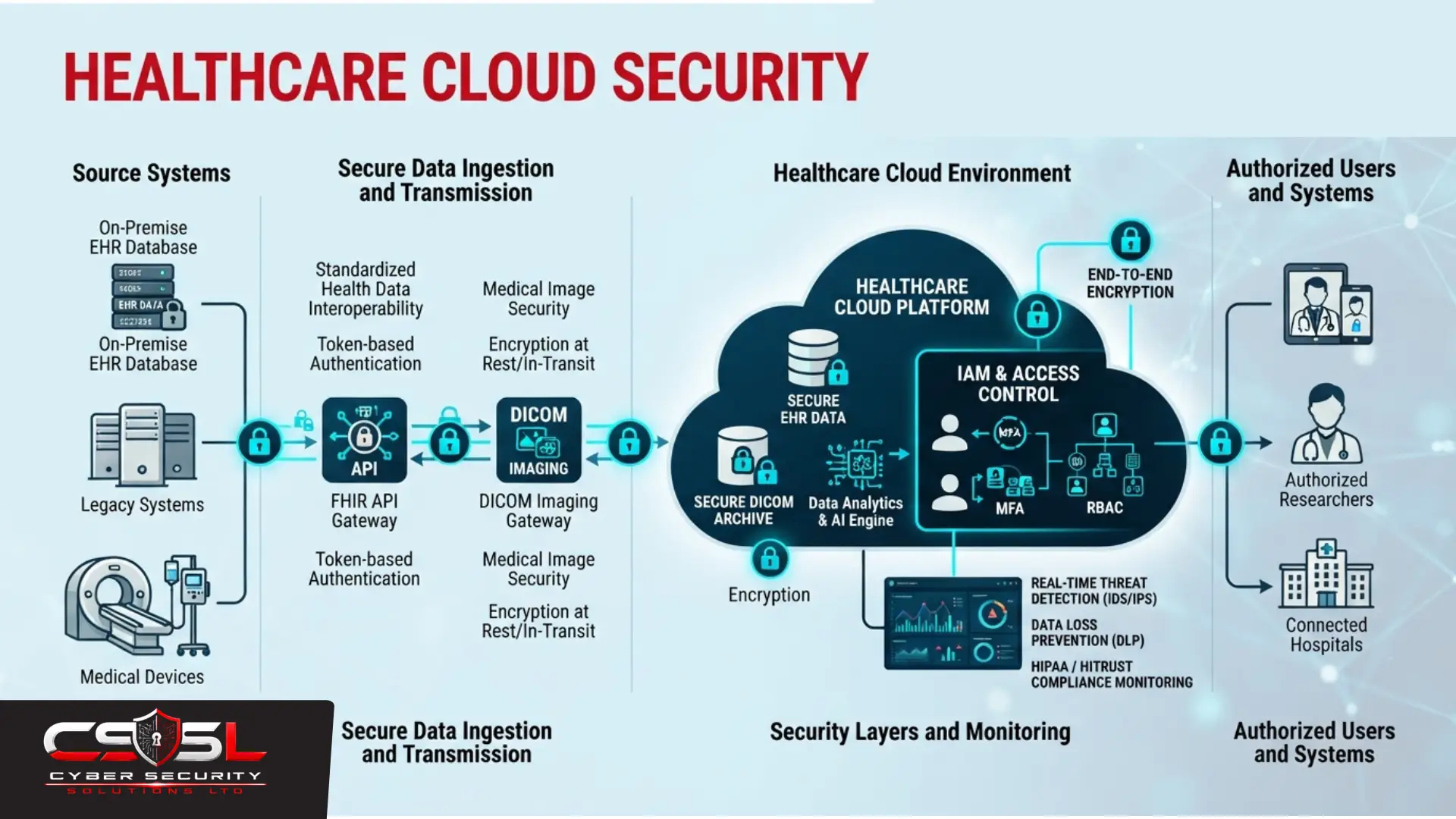
Healthcare cloud security extends general HIPAA cloud compliance into sector-specific systems including EHR platforms, medical imaging, clinical interoperability APIs, and connected medical devices, each introducing distinct risks that general cloud compliance guidance alone does not address.
If you migrated your EHR to a cloud-hosted platform and are not sure your BAA actually covers every module you use, or your emergency department needs override access to patient records and you do not know how to allow that safely, this guide covers the sector-specific systems general compliance content never reaches.
What Does Healthcare-Specific Cloud Security Add Beyond the General Compliance Mechanics Already Covered in This Cluster?
General HIPAA cloud guidance already establishes what the law requires of any cloud service: BAA scope, technical safeguards, and HHS’s own cloud computing guidance. This post covers what happens once those requirements meet healthcare’s actual systems, electronic health records, medical imaging, clinical data exchange, and connected devices, none of which general compliance treatment addresses.
Healthcare represents the most heavily regulated and most architecturally distinctive vertical any cloud security guide covers, making it the natural starting point for understanding how general principles translate into sector-specific practice. This post assumes shared responsibility, HIPAA’s cloud-specific requirements, and general IAM and data security principles are already understood.
| System Type | Provider Responsibility | Customer Responsibility |
| EHR/clinical SaaS platform | Application hosting, infrastructure security | Configuration, role-based access, BAA scope verification |
| PACS/imaging storage | Storage infrastructure | Access control, encryption, retention, format-aware classification |
| FHIR/interoperability API | Platform runtime | Object-level authorization logic, OAuth2 scoping |
| Medical device data ingestion | Ingestion endpoint infrastructure | Device identity, network segmentation |
Why Is Patient Data Uniquely Valuable, and Healthcare Cloud Infrastructure Uniquely Exposed?
Patient records combine identity, financial, and clinical information in one record, commanding materially higher value on illicit markets than financial data alone, since a single compromised record enables multiple, simultaneous forms of fraud. IBM’s Cost of a Data Breach Report has consistently identified healthcare as the single most expensive sector for data breaches of any industry, reflecting both regulatory penalty exposure and the operational complexity of responding to an incident touching clinical systems.
An incident affecting a cloud-hosted EHR or imaging system is not purely a data confidentiality event. It can directly disrupt clinical care delivery, a consequence with no equivalent severity in most other sectors. Healthcare organizations frequently carry older, sometimes still on-premise clinical systems now being connected to or migrated into cloud environments, a pattern that compounds cloud-specific risk with existing legacy technical debt.
How Do You Secure Cloud-Hosted EHR and Clinical SaaS Platforms?
Major EHR platforms including Epic, Oracle Health, and Meditech are increasingly delivered as cloud-hosted or SaaS offerings, meaning standard SaaS posture management discipline applies directly, even though these are specialized clinical systems rather than general productivity SaaS. External sharing settings, integration permissions, and third-party application access within an EHR platform represent exactly the same configuration drift risk seen elsewhere, now applied to systems holding the organization’s most sensitive clinical data by definition.
BAA scope verification must be applied concretely: confirm the specific EHR platform and every connected module or integration is explicitly covered under the vendor’s BAA, rather than assuming a general vendor relationship extends automatically. Role-based configuration within the EHR itself matters as much as platform-level access control, since clinical, billing, and administrative staff typically require meaningfully different views and permissions within the same platform, requiring granular, role-specific configuration beyond a single organization-wide access policy.
How Do You Secure Medical Imaging and PACS Data in Cloud Storage?
PACS and DICOM files represent a genuinely distinct data type from the structured PII covered by general data security guidance, large binary imaging files carrying embedded metadata that itself frequently contains patient identifiers. Apply the same cloud storage hardening principles used across every major cloud platform, bucket-level access control and encryption at rest, specifically to imaging repositories, which are frequently large enough that misconfiguration goes unnoticed longer than in smaller, more actively reviewed data stores. Medical imaging often carries long, sometimes decades-long retention requirements, meaning retention and lifecycle policy discipline applies with particular force here.
DICOM metadata requiring genuinely format-specific parsing, rather than being addressed through generic structured-text classification, deserves direct explanation, because most healthcare cloud security content treats medical imaging simply as another large file type needing standard storage hardening, without engaging the specific technical challenge embedded patient data within these files actually presents.
A DICOM file is fundamentally a binary image format, but embedded within its header structure sits metadata fields that frequently contain patient name, date of birth, medical record number, and other direct identifiers, information every bit as sensitive as anything found in a structured database record. Generic data classification tooling built around scanning structured or semi-structured text content has no native ability to parse this embedded metadata structure correctly, since the file as a whole registers as binary image data rather than text a pattern-matching classifier can meaningfully scan.
This creates a specific and genuine gap. An organization running a mature data classification programme across its structured data stores can have a comprehensive, accurate picture of where sensitive data resides in databases and document repositories while remaining entirely blind to the patient identifiers embedded throughout its imaging archive, simply because the classification tooling in place was never built to parse DICOM’s specific metadata structure. Closing this gap requires format-aware scanning capability specifically designed to parse DICOM headers, not a generic content classifier applied uniformly across every storage type regardless of underlying format. Organizations should confirm explicitly whether their chosen classification approach includes this DICOM-specific parsing capability, rather than assuming a data security tool’s general sensitivity-detection claims automatically extend to correctly reading embedded metadata within binary medical imaging files.
What Is Break-Glass Access, and Why Does Healthcare Need a Different Identity Model?
Break-glass access is a deliberate, audited emergency access procedure allowing a clinician to override standing access restrictions to view a specific patient’s record when normal, pre-approved access does not exist, such as an unconscious emergency department patient with no prior relationship to the treating clinician. A specific, clearly logged role or workflow trigger grants temporary, elevated access, with mandatory justification captured at the point of use and reviewed as a matter of course afterward, not as an exception-only audit trigger.
Break-glass access genuinely departs from the least-privilege principle that governs most cloud security thinking, but this departure does not represent a security failure or a gap in access control discipline. It represents a deliberate, differently structured, equally rigorous model that most generic content either ignores entirely or, worse, wrongly frames as an inherent weakness that should be minimized rather than properly understood and implemented.
The core insight most generic security content misses is that break-glass access does not abandon rigour. It relocates it. Standard least-privilege access grants permission based on pre-approval: an identity receives access to specific resources because someone reviewed and approved that specific grant in advance, before any access occurs. Break-glass access inverts this sequence deliberately, and for good reason. Access is granted first, immediately, without waiting for any approval process, and justification is required and reviewed immediately after the fact. This inversion exists because the alternative, requiring pre-approval before granting emergency access to an unconscious patient’s complete medical history, would introduce a delay that could genuinely cost that patient’s life in the specific moment access is needed. Patient safety in that moment outweighs the delay strict pre-approval would introduce, and this is not a security compromise. It is a considered design decision recognizing that different situations warrant different access models, both equally rigorous in their own way.
The technical implementation matters as much as the philosophy. A specific, clearly logged role or workflow trigger must grant this temporary, elevated access, with mandatory justification captured at the point of use, not left as an optional field the accessing clinician might skip. HIPAA’s own audit control requirement directly mandates this logging and review capability, making break-glass access one of the clearest places compliance obligation and access design meet in one concrete mechanism.
Reviewing exactly who invoked break-glass access, for which patient records, and whether the stated justification holds up on review is a concrete healthcare application of entitlement-usage review. This connects to a more sophisticated opportunity most organizations have not yet exploited: applying behavioral baselining to break-glass usage specifically. Anomalous break-glass patterns, unusually frequent use by a specific individual, access with no plausible clinical relationship to the patient in question, access at times or in combinations that deviate from that individual’s established pattern, are precisely the kind of learned-baseline deviation that behavioral entitlement monitoring is designed to surface. This transforms break-glass review from purely manual, retrospective spot-checking into an actively monitored process capable of flagging genuinely suspicious emergency access patterns as they emerge, rather than only during periodic manual audits.
How Do You Secure FHIR and HL7 Healthcare Interoperability APIs?
HL7 is the longstanding healthcare data exchange standard, and FHIR is its modern, RESTful, API-based evolution, increasingly mandated by US interoperability and patient-access regulation rather than remaining a purely optional integration choice. SMART on FHIR is the OAuth2-based authorization framework built specifically for healthcare API access, representing the sector-specific implementation of general API authentication principles.
A FHIR endpoint such as a patient resource accessed by identifier is a textbook, high-stakes instantiation of Broken Object Level Authorization, the single most common and severe API vulnerability category, and naming this connection explicitly is what separates genuinely useful healthcare API security guidance from generic advice repeating “secure your APIs” without engaging the specific failure mode that actually matters here.
BOLA occurs when an API correctly verifies that a requester is authenticated, confirming they are a legitimate, logged-in user or application, but fails to verify that this specific authenticated identity is actually authorized to access the specific resource being requested. In a FHIR context, this failure mode carries uniquely severe, immediately tangible consequences. A FHIR patient resource is typically accessed by a specific patient identifier embedded in the API request itself. If the endpoint correctly checks that the requesting application holds valid authentication credentials but fails to verify that those credentials are genuinely authorized to view the specific patient ID being requested, the vulnerability becomes trivially exploitable. An authenticated user legitimately authorized to view one patient’s record can potentially view any other patient’s complete record simply by changing the patient identifier in the request, since nothing in the endpoint’s logic ever checks whether that specific identifier falls within what this specific requester should be permitted to see.
This is not a hypothetical risk category described in the abstract. It is the single most direct, concrete illustration available anywhere of exactly why object-level authorization checks matter, because the consequence of failure here is one patient’s complete clinical history becoming accessible to anyone capable of incrementing or guessing a patient identifier value. This attack surface is also expanding as a direct side effect of regulation rather than organizational choice. US patient-access and information-blocking rules increasingly require healthcare organizations to expose these interoperability APIs, converting what was once an optional integration decision into a compliance-driven necessity that simultaneously increases attack surface regardless of an organization’s own risk appetite. The security question facing most healthcare organizations is no longer whether to expose a FHIR API at all, but specifically how to ensure every such endpoint correctly implements object-level authorization checks for every patient-specific request.
What Cloud Security Considerations Do Connected Medical Devices Introduce?
This section scopes narrowly and honestly to the cloud-connectivity boundary, where device-generated data reaches cloud storage and analytics platforms, since comprehensive medical device security is its own discipline sitting more naturally within network and endpoint security specifically. Device identity and authentication to cloud ingestion endpoints extends non-human identity governance to a device population frequently harder to inventory, patch, and de-provision than standard service accounts.
Network segmentation applied to medical device traffic directly extends zone-based segmentation principles, isolating device traffic from broader clinical and administrative systems so a compromised device cannot move laterally toward higher-value targets. The FDA’s own cybersecurity guidance for medical devices provides the relevant regulatory reference point for the device side of this boundary, complementing rather than replacing cloud-side guidance.
How Does NHS DSPT and UK Healthcare Cloud Guidance Compare with US HIPAA Requirements?
| Framework | Geography | Scope | Mandatory or Voluntary |
| HIPAA | United States | Any covered entity or business associate | Mandatory |
| HITRUST CSF | International | Organizational certification | Voluntary, often client-required |
| NHS DSPT | United Kingdom | Organizations connecting to NHS systems | Mandatory for NHS connection |
| UK GDPR | United Kingdom | Any organization processing UK personal data | Mandatory |
The NHS Data Security and Protection Toolkit is a genuinely sector-specific UK framework, mandatory for organizations connecting to NHS systems and data, requiring an annual self-assessment against defined data security standards, broadly parallel in function to a compliance regime rather than a purely voluntary framework. This sits alongside UK GDPR obligations applying to any UK organization processing patient data regardless of NHS connection. HITRUST CSF is a distinct, sector-specific organizational certification separate from general frameworks.
A UK healthcare technology provider serving US clients may need to satisfy HIPAA, NHS DSPT, and UK GDPR simultaneously, each addressing overlapping but not identical requirements. Confirm coverage against each applicable regime explicitly rather than assuming any single regime’s compliance substitutes for another.
What Do AWS, Azure and Google Cloud Each Offer Specifically for Healthcare Workloads?
AWS HealthLake is a HIPAA-eligible, FHIR-native data store. Microsoft Azure Health Data Services is a named product family explicitly including a FHIR service, a DICOM service, and a MedTech service for device data. Google Cloud Healthcare API explicitly supports FHIR, HL7v2, and DICOM within a single managed service.
All three hyperscalers have independently converged on the same three-part healthcare data architecture, a dedicated FHIR service, a dedicated DICOM imaging service, and a dedicated device or health-data ingestion service, and this convergence deserves explicit naming as genuine structural evidence, not a coincidental overlap most competitor content never notices.
Most competitor content profiles each hyperscaler’s healthcare offering separately, describing AWS HealthLake, Azure Health Data Services, and Google Cloud Healthcare API as three independent product choices without ever stepping back to observe the pattern connecting them. When three competing cloud providers, each making independent product design decisions without coordinating with each other, arrive at an identical structural answer to how healthcare data should be organised in the cloud, this convergence represents meaningful, external validation that this three-part structure genuinely reflects how healthcare data actually needs to be organized, rather than being an arbitrary categorization.
This matters practically because it confirms the pattern is not an artificial organizing device, but a direct reflection of how the underlying technology and healthcare data types actually demand to be structured. An organization evaluating any of the three major cloud providers for healthcare workloads should expect, and specifically look for, this same three-part pattern regardless of which specific provider it ultimately selects. Choosing the right native service, rather than defaulting to generic storage or compute offerings, matters more here than in most general workload decisions, since these purpose-built services inherit standards support, FHIR resource validation, DICOM metadata handling, HL7v2 parsing, that would otherwise require substantial custom security and compliance engineering to replicate using generic infrastructure alone.
How Do You Migrate Legacy Healthcare Systems to the Cloud Without Compromising Patient Safety?
A legacy, on-premise EHR or PACS system is a common, concrete candidate for the rehost-versus-refactor migration decision, with the same security-implication logic applying: a rehosted legacy system carries its existing vulnerabilities directly into the cloud regardless of how secure the surrounding infrastructure is. Rollback conditions defined before migration begins should explicitly include continuity-of-care thresholds for clinical systems specifically, not purely technical or security metrics.
Data classification before migration takes on particular weight here, since PHI and imaging data require the specific handling already established before they are ever moved. Incident response readiness during the migration window itself must incorporate patient-safety-first prioritization as a distinguishing feature of clinical incident response generally.
How Do You Build a Healthcare Cloud Security Programme Step by Step?
Step 1: Confirm BAA coverage explicitly extends to every specific cloud service in use, including EHR modules, imaging storage, and any FHIR or device-data services, not just a general platform-level agreement.
Step 2: Apply data classification specifically to DICOM and imaging metadata, not just structured PHI, using format-aware scanning where the platform supports it.
Step 3: Design and implement a break-glass access workflow with mandatory logging and scheduled, not exception-only, post-hoc review.
Step 4: Review FHIR and other clinical API authorization logic specifically for object-level access flaws.
Step 5: Segment medical device network traffic from broader clinical and administrative systems.
Step 6: Determine which UK and US compliance regimes genuinely apply and confirm coverage against each rather than assuming one regime substitutes for another.
Step 7: Select and configure the relevant hyperscaler’s purpose-built healthcare data services rather than defaulting to generic storage and compute.
Step 8: Build migration and incident response plans that explicitly incorporate patient-safety-first prioritization.
Cyber Security Solutions Ltd helps healthcare organizations assess BAA coverage, break-glass workflow design, and FHIR API authorization against their specific cloud environment and applicable compliance regimes.
Conclusion
Healthcare cloud security succeeds when general compliance mechanics meet the sector’s actual systems: EHR platforms configured with role-specific granularity, imaging archives scanned with format-aware tools, FHIR APIs checked for object-level authorization, and break-glass access properly logged rather than avoided. Visit cybersecuritysolutionsltd.com for a healthcare cloud security assessment covering BAA coverage, break-glass design, and FHIR API authorization across your specific environment.
FAQs
Healthcare cloud security extends general HIPAA compliance into sector-specific systems, EHR platforms, medical imaging, clinical interoperability APIs, and connected medical devices, each introducing distinct risks. General cloud compliance guidance establishes legal requirements; healthcare cloud security addresses what happens once those requirements meet the sector’s actual clinical systems.
Break-glass access is a deliberate, audited emergency procedure letting clinicians override standing access restrictions for urgent patient care. It relocates rigour from pre-approval to mandatory, logged post-hoc justification and review, since patient safety in an emergency outweighs the delay strict pre-approval would introduce.
FHIR is the modern, API-based healthcare interoperability standard. Its patient resources are typically accessed by identifier, meaning an endpoint that authenticates a user but fails to verify authorization for that specific patient ID exposes one patient’s entire record to anyone who changes the identifier.
DICOM imaging files are binary formats carrying embedded metadata with patient identifiers. Generic data classification tools built for structured text cannot reliably parse this metadata, requiring format-aware scanning capability specifically designed to read DICOM headers rather than standard content classification approaches.
Not automatically. NHS DSPT is mandatory for organizations connecting to NHS systems regardless of HIPAA status, and UK GDPR applies separately to any UK organization processing patient data. Organizations serving both US and UK markets typically need to confirm coverage against each regime independently.
All three offer purpose-built FHIR, DICOM, and device-data services rather than generic storage, inheriting standards support that reduces custom compliance engineering. The right choice depends on your existing cloud provider relationship and which service’s specific integration and pricing structure fits your environment.